Article
Aug 21, 2026
How to Build an AI-Powered Sales Operations System Without a RevOps Team
Build an AI-powered sales operations system without a RevOps team. Learn the layers, the workflow, and which tool to run it on.

Most small revenue teams are now expected to run the kind of sales operations that used to sit inside a dedicated RevOps function. Someone still has to keep the CRM clean, route leads, watch the pipeline, prepare forecasts, and give reps useful feedback after calls. When there is no RevOps team to own that work, it usually lands on a founder, a head of sales, or one operations person who is already stretched thin. Hiring a full RevOps team solves this on paper, but it is slow and expensive, and most companies below a certain size cannot justify it.
AI changes the math here. A lean team can now run most of the operational backbone that RevOps used to own, as long as the system underneath is built well. This guide covers what a sales operations system actually does, the layers you need, how to build it step by step, and which tool to run it on.
What a Sales Operations System Actually Does
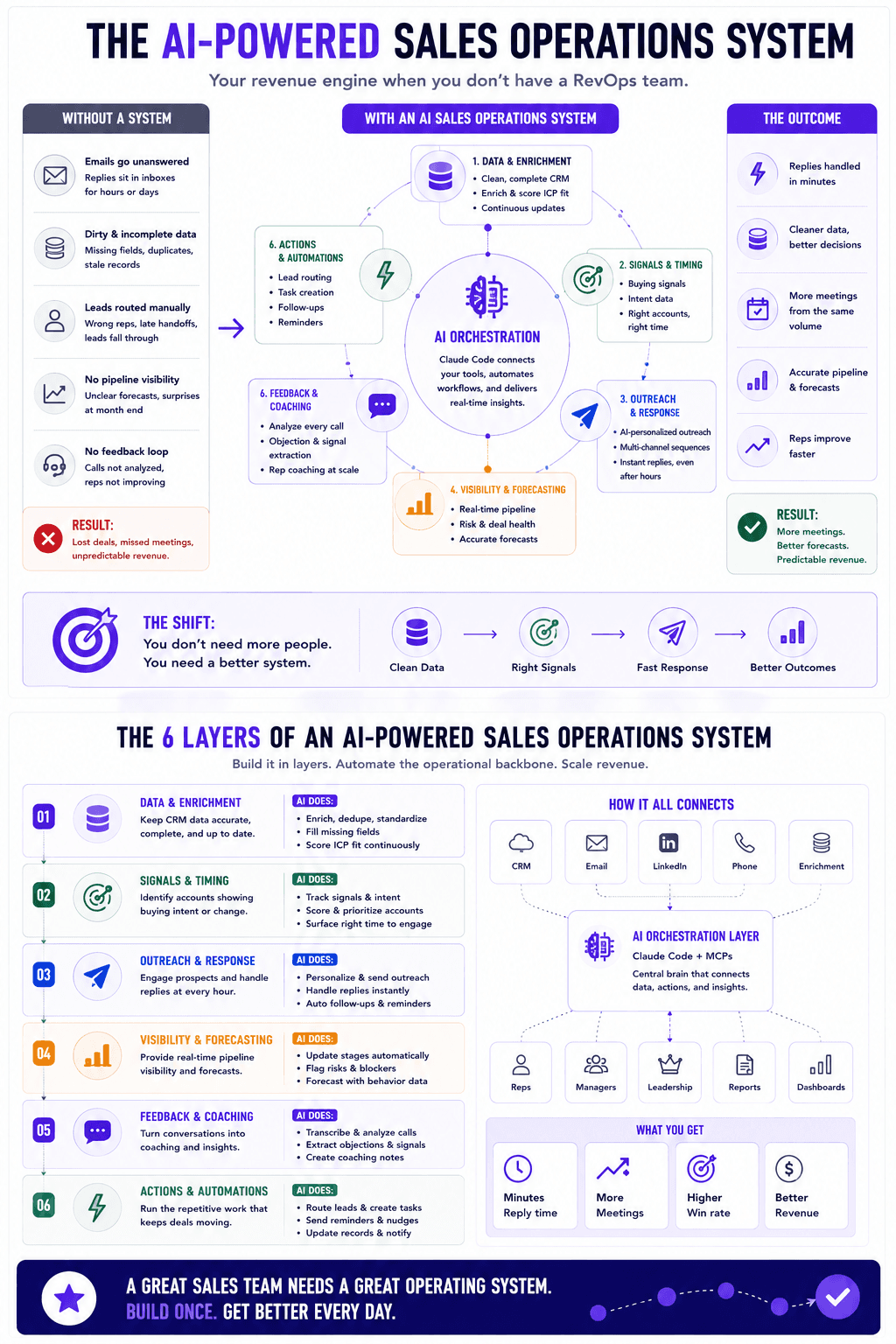
A sales operations system is the connective work that keeps revenue moving predictably. It covers data hygiene in the CRM, lead routing and handoffs between marketing and sales, pipeline visibility, forecasting, reporting, and the feedback loop that helps reps improve. In larger companies this work is owned by a RevOps team or a GTM engineer, whose whole job is to build and maintain the systems behind the sales motion. The work is mostly coordination and data management rather than selling, which is exactly why it is a good fit for automation.
This matters because pipeline problems are usually system problems. When reps miss quota, the cause is often broken routing, stale data, or slow follow-up rather than effort, a pattern we see across SDR teams that struggle to generate pipeline. A sales operations system exists to remove that friction so the selling that does happen actually converts. Revenue intelligence sits inside this, giving you a clear read on deal health and forecast gaps from the data you already have.

Why You Can Build This Without a RevOps Team Now
The operational work behind sales has always been repetitive and predictable, which is why it consumed so much headcount. AI now handles a large share of that repetition, from cleaning and enriching records to drafting follow-ups and summarizing calls. That shifts the question from how many people you need to how well your system is designed. A useful way to think about this is as an AI operating system for your business, where each part of the sales process runs as a defined layer rather than a set of manual tasks scattered across people and tools.
AI does not replace judgment. It replaces the manual coordination work that used to require several people, so one person who understands the workflow can oversee a system that would have needed multiple hires two years ago.
The Layers of an AI-Powered Sales Operations System
It helps to build in layers, because each one does a specific job and can be improved on its own.
Data and Enrichment
Everything downstream depends on clean, complete records. This layer keeps contact and account data accurate, fills in missing fields, and scores fit against your ideal customer profile. AI can run enrichment continuously instead of in batches, and you can enrich your lead list using Claude Code so records stay current without manual research.
Signals and Timing
Knowing who to contact matters less than knowing when. This layer tracks buying signals and intent data so the system surfaces accounts that are showing activity worth acting on, instead of treating every contact the same. It is also where a lot of quiet efficiency comes from, since your team spends its time on accounts that are actually in a buying window.
Outreach and Response
This is where personalization and follow-up live. AI SDRs are replacing manual prospecting for the repetitive parts of outreach, and the response side matters just as much. When a prospect replies, the speed of the next touch has a direct effect on how many replies turn into meetings, which is the case for building speed-to-lead into your outbound. A good system covers replies that come in after hours, so warm interest does not go cold overnight.
Visibility and Forecasting
Leaders need an accurate read on the pipeline without asking reps to update spreadsheets by hand. This layer rolls up deal data, flags risk, and keeps the forecast grounded in behavior rather than optimism. One team we worked with improved its sales efficiency substantially after this layer began surfacing the right timing and account context, which let them engage leads at better moments with data behind each decision.
Feedback and Coaching
The last layer closes the loop. AI can analyze sales calls to pull out objections, buying signals, and coaching notes from every conversation, so feedback becomes consistent instead of depending on a manager listening to a handful of recordings. Over time this data also feeds back into the signals layer, since the language of your best replies tells you which accounts to prioritize next.
How to Build It Step by Step
Start with the workflow before you touch any software. Map how a lead moves from first contact to closed deal today, and mark the points where work stalls or gets dropped. Those stall points are where the system pays for itself, so they are the right place to begin.
Next, choose an orchestration layer that connects your existing tools rather than replacing them. You already have a CRM, a sequencer, and enrichment sources, and the goal is to wire them together so data and actions flow between them. Claude Code works well here because you can set it up for your GTM team and connect it to your stack through MCPs for lead generation, which let it read from and write to the tools you already use.
Then add the layers one at a time. Get data and enrichment stable first, because everything else depends on it. Add signals, then outreach and response, then visibility, then feedback. Keep a person in the loop at the points where judgment matters, such as approving messaging or reviewing a forecast, so the system stays accountable as it grows.
What Is an AI-Powered Sales Operations System?
It is the set of connected workflows that keep your revenue running, with AI handling the repetitive data and coordination work underneath. It manages CRM data, routing, signals, outreach, forecasting, and call feedback as defined layers rather than manual tasks, which is what lets a small team run operations that used to need a larger function. The point is not to add more software. It is to give the work you already do a reliable system to run on.
Do You Need a RevOps Team to Run Sales Operations?
Not at the size most companies are asking the question. A RevOps team makes sense once complexity and headcount grow past what one system owner can reasonably oversee. Below that point, a well built AI system managed by one person covers most of the same ground, and it lets you get more sales meetings without increasing headcount. When you do reach the size where a RevOps hire is justified, the system you built gives that person a working foundation instead of a blank page.
Which Tool Should You Use to Build It?
For most teams building this without RevOps, use Claude Code as the orchestration layer and connect it to your existing CRM, sequencer, and enrichment tools through MCPs. It gives you one place to run the whole workflow, from data to outreach to reporting, without forcing you into a rigid platform that only does part of the job.
Point solutions still have a place. If you want a single system to run one specific outbound motion from end to end, a dedicated AI sales agent can handle that slice cleanly, though it will not give you the flexibility to build across every layer. The setup that holds up over time is a flexible orchestration layer for the system as a whole, with specialized tools plugged in wherever they clearly outperform. That way you own the workflow, and the individual tools become parts you can swap without rebuilding everything around them.
Final Takeaway
Building an AI-powered sales operations system without a RevOps team comes down to three decisions. Design the workflow first, build in layers so each part does one job well, and choose an orchestration layer that connects your existing tools instead of replacing them. Done this way, a lean team can run the operational backbone that used to require several hires, with cleaner data and faster follow-up than most manual setups produce.
If you want help designing this for your own sales motion, book a call and we will map the layers and the build with you.