Article
Jun 17, 2026
What Are Buying Signals? (And How GTM Teams Use Them to Book More Meetings)
Buying signals show which accounts are actually ready to buy. Learn the signals worth tracking and how GTM teams use them to book more meetings.

Most outbound goes to people who have no reason to care yet. A rep pulls a list that fits the ICP on paper, writes a decent email, sends it, and hears nothing back, because the company on the other end is not thinking about the problem this week. The list was right about who they are and wrong about when to reach them. That timing gap is where most pipeline quietly dies, and it is the reason teams keep adding volume to fix a problem that volume created. We see this pattern constantly, and it usually starts long before the copy gets blamed. A lot of cold outreach fails before the first email is even sent because the targeting was based on fit alone.
Buying signals are the fix that actually addresses the timing problem. This guide covers what a buying signal really is, which ones are worth tracking in 2026, and how GTM teams turn a single signal into a booked meeting without sounding like everyone else hitting the same trigger.
What a buying signal actually is
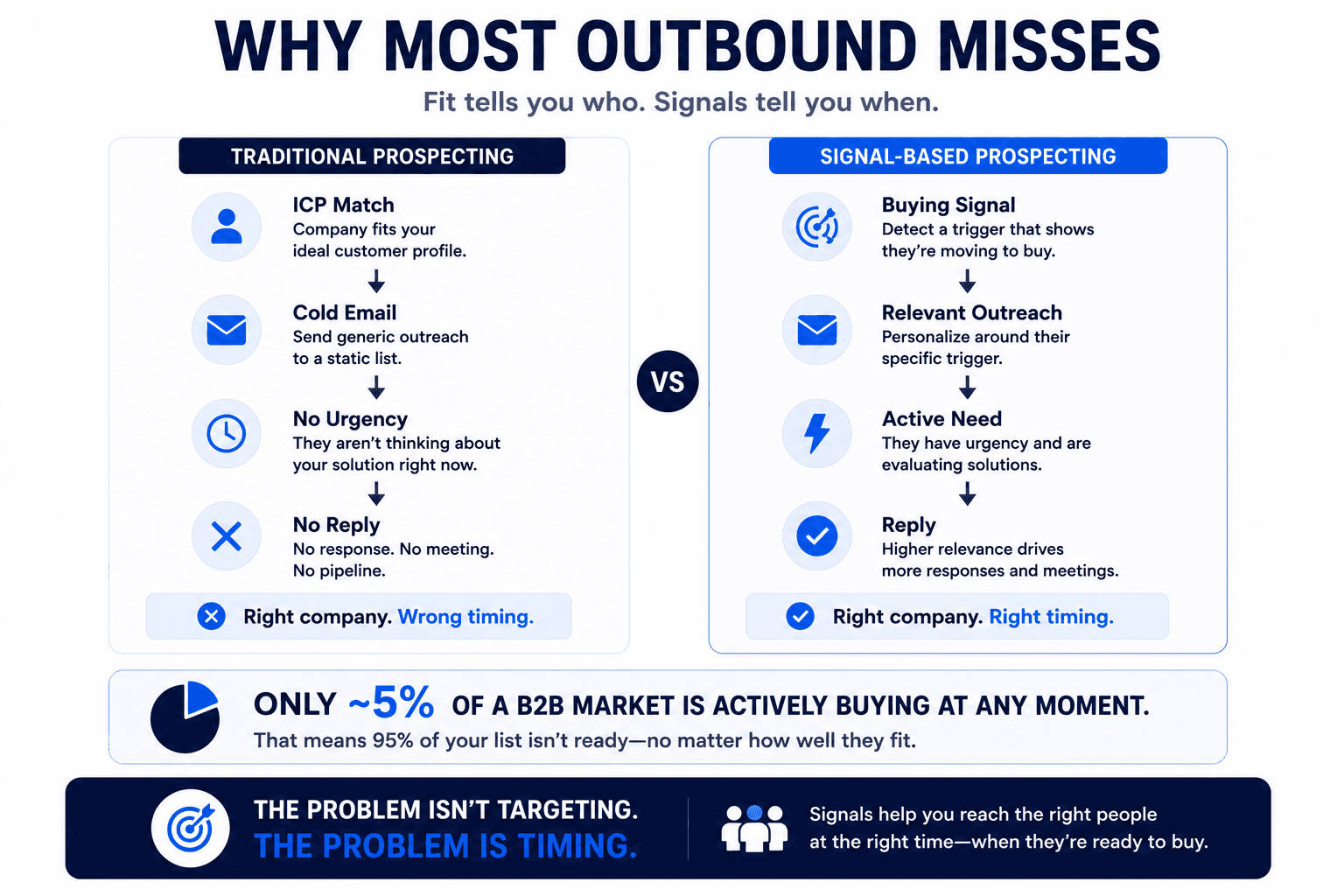
A buying signal is an observable event or behavior that shows an account is moving toward a purchase. A visit to your pricing page, a funding announcement, a new VP of Sales, a competitor's tool showing up in their stack: each one says something about timing that a static list cannot.
The part most teams miss is that a signal is only useful when you know why it fired and where it came from. Anyone can label the top 20% of a list as "high intent" and call it signal data. The harder and more valuable question is what specifically that account did to earn the label, because the source changes how you reach out. A company that downloaded your guide needs a different opening than a company that just closed a funding round, even if both look equally warm on a dashboard.
Timing is the whole reason this matters. At any given moment only about 5% of a B2B market is actively in-market, which means the large majority of any list you send to is not ready regardless of how well they fit. Buying signals exist to help you find that 5% before you spend a sequence on the other 95%. This is also why most cold email campaigns are struggling in 2026: they treat every account on the list as equally ready, and the math does not support that.
First-party and industry signals, and why you combine them
Signals fall into two broad groups, and the teams getting results use both together.
First-party signals are the data you own. Trial signups and product usage, content downloads, website behavior, past customers, and your own network all sit here. This data is valuable precisely because nobody else has it. A free signup from someone at an ICP account is a signal even when that person is an individual contributor, because it gives you a reason to reach their manager. Website de-anonymization tools now let you see which companies visited even when they never filled out a form, which surfaces accounts that are problem-aware but still anonymous.
Industry signals are open data that anyone can access if they know where to look. Funding rounds, job changes, hiring patterns, tech-stack installs, news mentions, and compliance deadlines all live in public. On their own these are noisy. The work is combining them with your own data and your knowledge of the market to produce something closer to real intent. That is why the strongest signal setups tend to be specific to one company. What counts as intent for you may be meaningless for a competitor, because you assembled sources and context they do not have. Teams running this well usually pull industry data through enrichment platforms, and our comparison of Apollo and Clay covers how the common ones differ on data and personalization.
The reason to combine both groups is coverage. Gartner research cited by Launch Leads found that B2B buyers spend only about 17% of their purchase journey actually talking to suppliers, so most of what an account is doing happens where you cannot see it. First-party data shows you the small slice of activity on your own properties, and industry data fills in some of the rest. Stacking them gives you a fuller read than either provides alone. For GTM teams building this into a repeatable workflow, we walk through the setup in how GTM teams use Claude Code for prospecting.
The buying signals worth tracking in 2026
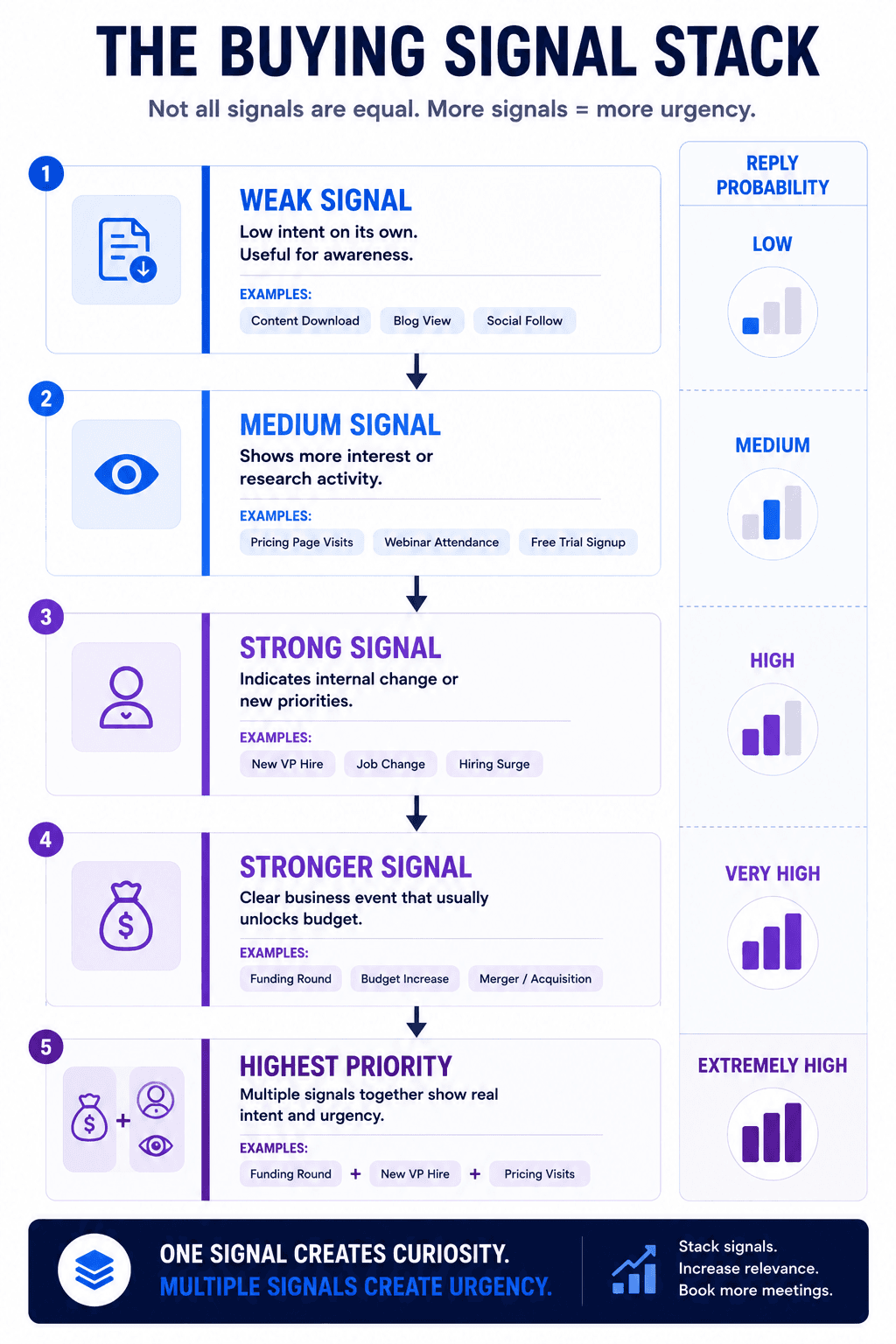
Not every signal carries the same weight, and treating them as equal is a common mistake. Analysis of B2B software purchases summarized by Reachly found that AI tool adoption correlated most strongly with buying behavior, followed by headcount growth of 10% or more in 90 days, and recent purchases. New executive hires and recent funding also ranked high. Job postings on their own correlated weakly, which is worth remembering since many teams lean on them as a primary trigger.
A practical list to start with:
Funding and financial events. A round signals budget and pressure to deploy it. Investors expect growth, and growth often means buying.
Leadership changes. A new VP or C-level hire opens a 30 to 90 day window where existing vendors get re-evaluated.
Headcount and hiring patterns. Fast growth in a relevant department implies new problems to solve.
Tech-stack installs and renewals. Scrapers like BuiltWith can show not only what a company uses but when it was first detected, which lets you estimate a renewal date and reach out near it.
Website behavior. De-anonymized visitors and repeat pricing-page visits show active research.
Content downloads. A download is a reason to ask whether the topic is a current priority, not a reason to assume they want to buy.
Job changes in your network. A former champion moving to a new company is one of the highest-quality signals you have, because the relationship already exists.
The bigger point is that single signals are weak. Stacking two or three indicators on the same account inside a short window is where the difference shows up, and Salesmotion reports stacked signals converting at five to ten times the rate of cold outreach. A funding round plus a new VP hire is far stronger than either alone. This is the same prioritization gap behind why most SDR teams struggle to generate pipeline: they spread effort evenly instead of concentrating it on accounts showing more than one reason to act. Once you have a scoring model that weights and stacks signals, AI SDR workflows can act on them at scale without adding headcount, and the enrichment underneath is something you can build into your lead list with Claude Code.
How GTM teams turn a signal into a booked meeting
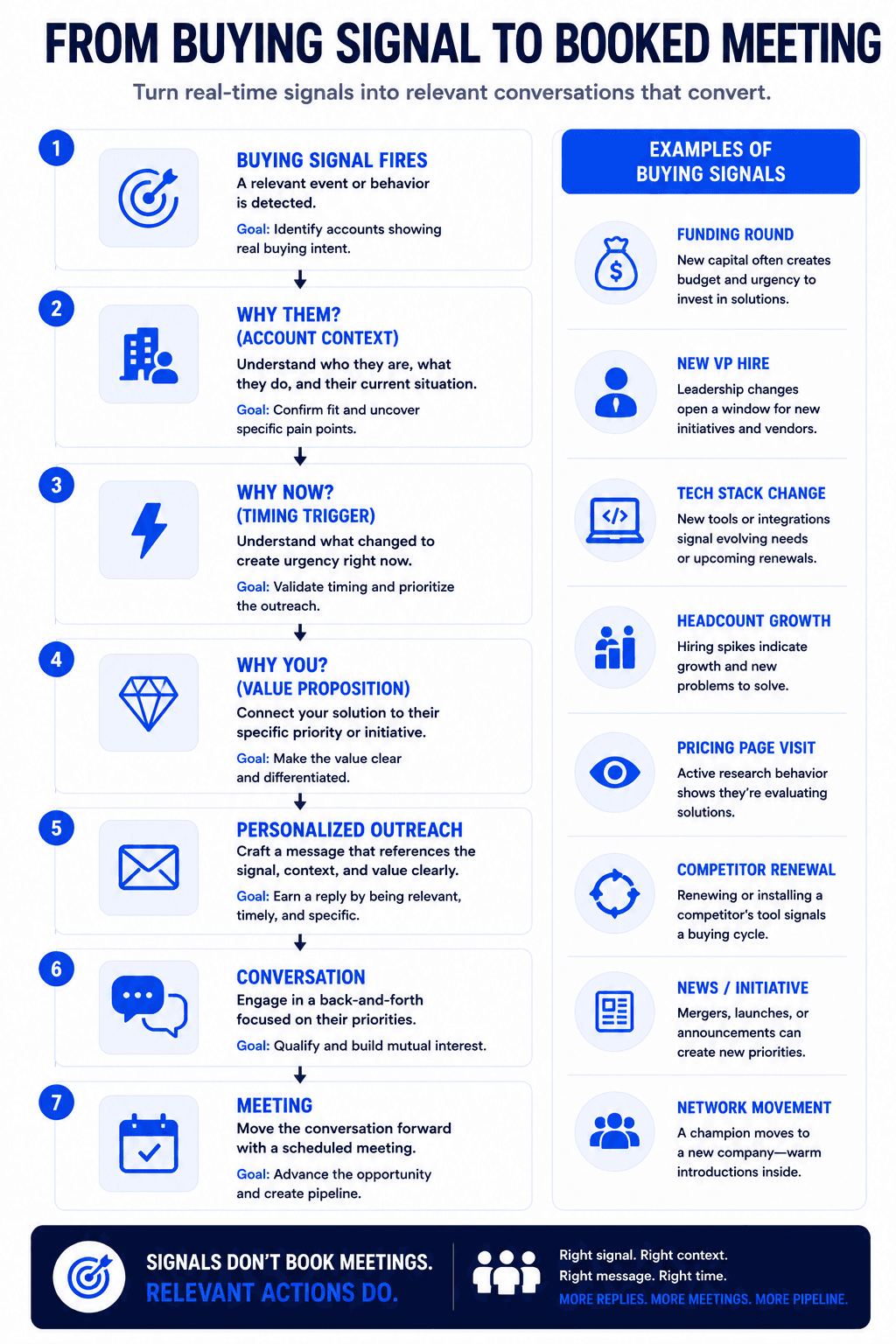
Finding a signal is the easy half. The meeting comes from what you do with it, and the structure that works is built on three questions: why them, why now, and why you. The signal usually answers why now. Your read of their situation answers why them. Your offer answers why you. Skipping any of the three turns a good signal into the same generic note everyone else is sending off the same trigger.
A few examples that teams run today:
A marketing agency selling to restaurants monitors news for new openings, pulls the owner and contact details, and reaches out while the opening is fresh and the budget to grow is available. The signal is public, but it works because the timing is tied to a real moment in the buyer's world.
After closing a deal, a team finds four or five lookalike companies in the same space and leads with the exact problem the closed account had before they started. Social proof from a recognizable peer does the heavy lifting. For a small local business, proximity often beats a famous logo, so the same play runs on nearby companies instead of direct competitors.
A team selling a CRM alternative scrapes which companies run a competitor's tool, estimates the renewal date from when that tool was first detected, and reaches out as the contract nears its end. The renewal timing is the why now.
A download or MQL becomes an opening to ask rather than a reason to pitch. Instead of assuming the person wants to buy, the rep asks whether the topic is a current focus, and the conversation starts from a yes. This worked in the transcript we reviewed, where a download led to a question, the question led to a yes, and the yes led to a closed deal.
Messaging is where most of these go wrong. Leading with "I saw you're using HubSpot" tends to feel intrusive, the same way "my tool found you on my website" would. Softening the claim with a label like "it looks like you might be using HubSpot" keeps you safe when the data is wrong, which it sometimes is. The framing matters as much as the signal, and getting it right is the difference between a reply and a block. Our breakdown of cold email frameworks high-performing teams use covers how to translate a signal into a sequence, and writing personalized first lines is where the why-them usually lives. It also helps to know the cold email mistakes that quietly kill reply rates before you scale any of this.
When the personalization is tied to a real signal, the numbers move. Instantly's 2026 benchmark data found that signal-specific personalization reached roughly 18% reply rates against a 3.4% generic average, which is more than five times the baseline. The lift comes from relevance and timing, not cleverer subject lines.
How is a buying signal different from intent data?
People use the terms together, but they are not the same thing. Intent data is a broad category that includes early research behavior, like a company reading articles about a problem you solve. A buying signal is narrower and points to a specific account moving toward a purchase in your category now. Intent data tells you a company is curious. A buying signal tells you a company is closer to a decision.
In practice you use both. Intent data widens the top of the funnel by surfacing accounts that are starting to research. Buying signals sharpen prioritization by telling you which of those accounts to call first. Treating them as one thing usually leads to acting too early on soft research behavior, which is why the why and the source of each data point matter so much.
How many buying signals should we track to start?
Start with about five signals you can actually act on this quarter, then add more only when you can route them, score them, and measure them. The temptation is to track everything available, which produces a dashboard full of activity nobody follows up on.
Pick signals that map to your motion. A team selling to fast-growing companies might start with funding, headcount growth, and new leadership hires. A team selling software might add tech-stack installs and renewal timing. The constraint is operational rather than technical. A signal you cannot route to a rep with a clear next step is noise that looks like progress. Building this into a real system is the work behind what a GTM engineer actually does, and it is worth assigning ownership early.
When is the best time to reach out on a signal?
Speed matters more than polish. The same Reachly analysis makes the case that the best moment is often two to four weeks before an account realizes it is in-market, which is when the internal conversation starts and the shortlist gets built. A funding round, a new exec, or a competitor renewal are all early triggers that put you in the room before the buyer has finished forming preferences.
Real-time signals decay fast, so a same-day response on a fresh trigger beats a perfect email sent next week. The practical rule is to route high-tier signals to a rep the day they fire and keep slower-moving ones in a weekly review. Signals also surface in your own conversations, and you can pull buying signals straight out of recorded sales calls to catch intent your reps mentioned but never logged.
The takeaway
Buying signals work because they replace guessing with timing. The teams booking more meetings are not sending more email, they are sending it to fewer accounts that have a real reason to respond this week. Three things carry most of the value: combine first-party and industry signals so you see more than one slice of activity, stack two or three signals on an account before you act, and tie the message to the signal with a clear why them, why now, and why you.

If you want a system that surfaces these signals and turns them into booked calls instead of another list to work through, book a call with our team and we will map it to your motion.