Article
Jul 22, 2026
How to Get More Sales Meetings in 2026 (Without Increasing Headcount)
Get more sales meetings in 2026 without hiring. The levers that lift booked and held meetings: targeting, timing, deliverability, and systems.

Most sales leaders walk into 2026 with the same instruction from two directions. The board wants more pipeline, and finance wants the headcount line to stay flat. The usual reaction is to ask for another SDR, run the hiring process, and wait a quarter for the number to move. That path is slower and more expensive than it looks, and it rarely fixes the reason meetings were low in the first place.
The better question is how much more each person on the team can produce with the system you already have. When teams want to get more sales meetings, the gains almost always come from targeting, timing, deliverability, and the way work is divided, not from adding bodies. This guide walks through the specific levers that move booked and held meetings in 2026, using current benchmark data so you can size the opportunity against your own funnel rather than against a vendor's marketing copy.
Why hiring more SDRs is the slow, expensive answer
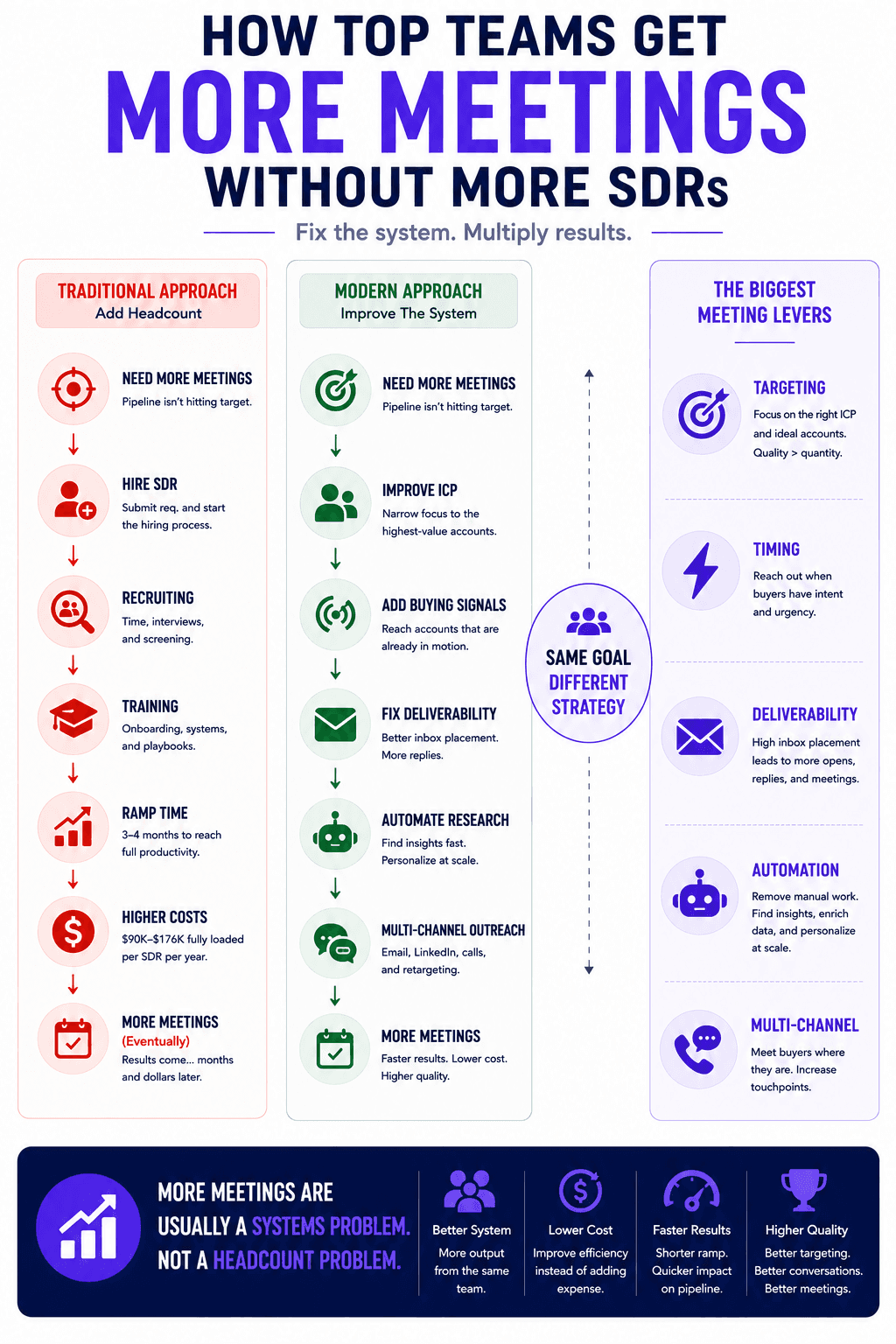
The sticker cost of an SDR is misleading. Once you include benefits, payroll taxes, tooling, management time, recruiting, and the ramp period, a fully loaded rep runs somewhere between $90,000 and $176,000 a year depending on market and seniority, according to independent 2026 outbound benchmarks and cost breakdowns from Instantly. A new hire also takes three to four months to reach full productivity, which means you pay a full salary against a fraction of the output during the window when you needed pipeline most.
Turnover makes the math worse. SDR attrition runs between 35 and 40 percent industry wide, so many teams are replacing and re-ramping reps every year, and every replacement restarts the recruiting cost and the ramp cost together. Hiring first and diagnosing later is how companies spend $50,000 to $80,000 finding out that the problem was never the size of the team.
In most cases the constraint sits in the system around the rep. When SDR teams struggle to generate pipeline, the cause is usually broken targeting, poor data, or a deliverability issue that quietly caps every number downstream. Fixing those raises output per person, which is the same result you were trying to buy with a new hire, at a far lower cost.
Fix targeting before you touch volume
More sending only helps when it lands on the right accounts. The fastest way to get more sales meetings from the same effort is to sharpen who receives the outreach in the first place.
Narrow the ICP so every meeting carries weight
Teams selling into finite markets learn this early, but it applies everywhere. A tighter ideal customer profile raises reply quality, improves show rates, and reduces the number of meetings that go nowhere. Offer specificity does the same work on the copy side. A generic pitch gives the reader nothing concrete to evaluate, while a specific claim about a deliverable and an outcome gives them a reason to respond, which High Ticket AI Systems found can move positive reply rates by 5 to 10 percentage points on its own.
Reach accounts that are already in motion
The biggest reply-rate gap in 2026 is between cold outreach sent on a schedule and outreach timed to something the account just did. Cold sequences to a broad list average around a 3.4 percent reply rate, while messages tied to a trigger event reach 15 to 25 percent, based on GrowthSpree's 2026 cadence benchmarks. That difference exists because you are reaching people when the problem is live rather than hoping it becomes live after you email them.
This is where buying signals and intent data earn their place in the stack. A funding round, a new executive hire, a job posting for a role you serve, or research activity on a relevant topic tells you which accounts are worth reaching this week instead of next quarter. Pointing the same team at accounts already showing movement produces more meetings without a single new sender.
The math of more meetings
Understanding where the funnel leaks tells you which lever is worth pulling. The chain from email to held meeting is short, and each step has a known 2026 range you can measure against.
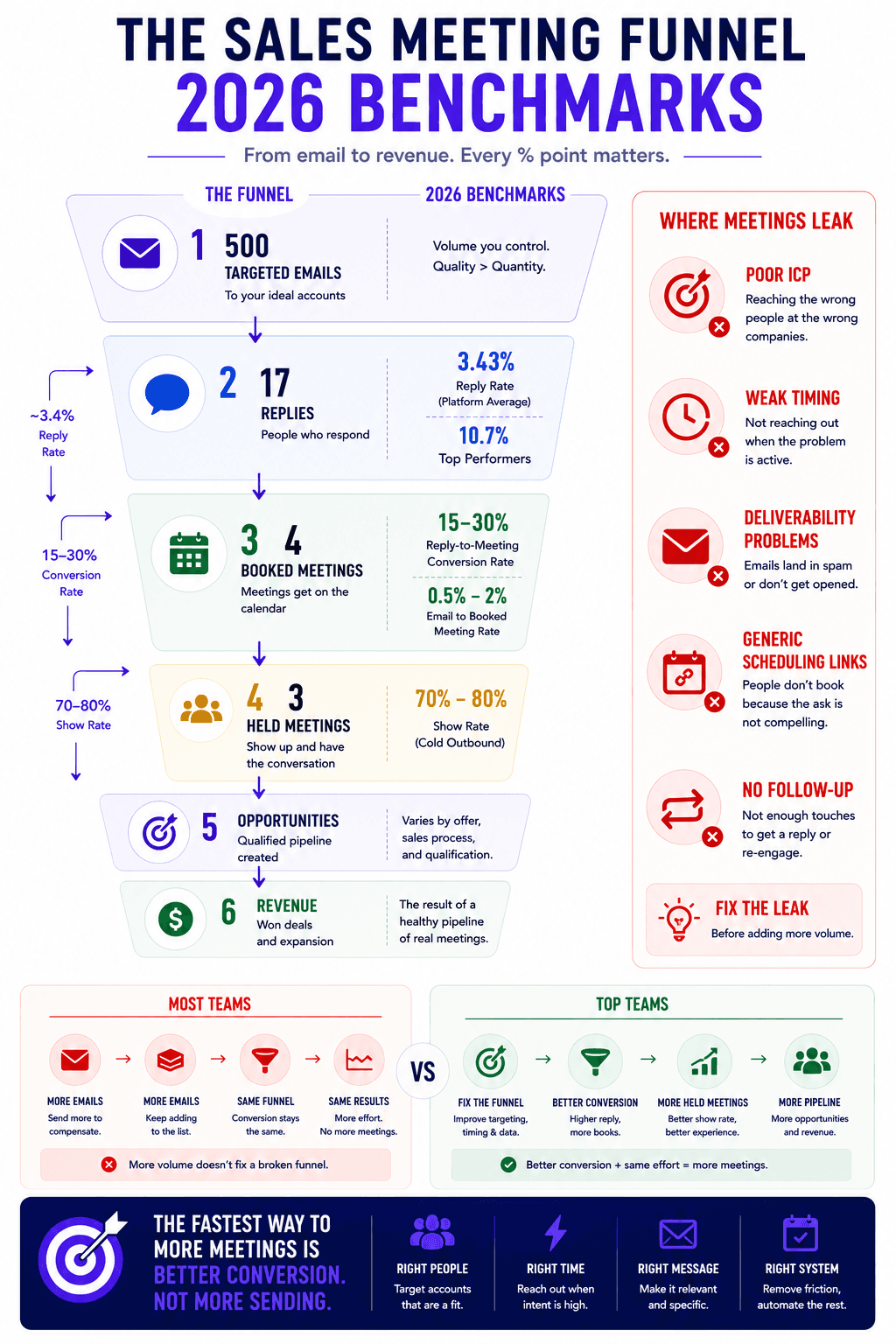
At the top, the platform-wide reply rate sits at 3.43 percent, with top performers clearing 10.7 percent, according to LeadHaste's 2026 outbound benchmarks. Between 15 and 30 percent of replies convert to a booked meeting, which puts the email to booked meeting rate at 0.5 to 2 percent for most teams. To make it concrete, 500 well targeted emails at a 3.43 percent reply rate produce roughly 17 replies, which at a 25 percent conversion becomes about 4 booked meetings.
Booked meetings and held meetings are different numbers
The gap between those two is where most reporting goes wrong. Show rates on cold outbound run 70 to 80 percent in 2026, so a team reporting 4 booked meetings is really holding 3. Held meetings are the number that produces opportunities and revenue, so that is the figure worth tracking and forecasting against. An agency or a rep who counts booked meetings can inflate the total with reschedules and no-shows, which is why the honest scoreboard uses held meetings.
The booking surface is a common leak
A large share of pipeline disappears in the space between a positive reply and a confirmed calendar slot. A bare scheduling link sent to a stranger carries the lowest show rate, often 55 to 65 percent, because the prospect feels no commitment to it. Teams that hit the top of the range send something that pre-sells the call, a short relevant asset or a specific agenda, before attaching the calendar. Tightening this one step raises held meetings without touching the top of the funnel at all.
Deliverability is a meeting problem, not a tooling problem
None of the targeting work matters if the email never reaches the inbox. Roughly 17 percent of cold emails never arrive under typical sending conditions, and SalesHive's 2026 analysis notes that bounce rates and sender reputation quietly drag down reply rate, meeting count, and every downstream number before a rep writes a word.
The fixes are unglamorous and they compound. Keep hard bounces under 2 percent, verify lists before they enter a sequence, authenticate your domains with SPF, DKIM, and DMARC, and distribute volume across enough inboxes that no single one sends past a safe daily limit. Teams that treat this as ongoing hygiene rather than a one time setup protect their meeting volume month over month. Our guide to the best cold email infrastructure setup for B2B companies covers the domain, DNS, and warmup layer in detail.
It is also worth knowing why campaigns fail, because most of the reasons are fixable. Many of the issues behind cold email mistakes that kill reply rates sit upstream of the copy, and the shift in inbox rules is a large part of why most cold email campaigns are dying in 2026. Reading those before you scale volume saves you from amplifying a problem.
Get more meetings from the same team using systems
The clearest path to more sales meetings without new headcount is to change what your existing people spend their hours on. Research shows that manual prospecting, list building, and enrichment consume 60 to 70 percent of a typical SDR's working time, which leaves only a fraction for actual conversations.
Let software handle volume and let people handle conversations
The model that works in 2026 gives the repetitive work to automation and keeps the judgment work with humans. Software can source accounts against your ICP, enrich records, draft personalized sequences, and run first-pass reply triage, while your reps spend their time on discovery calls and objection handling. This is not a headcount cut. It increases the pipeline one person can cover, which is exactly the outcome you wanted from a new hire. The approach behind AI SDRs replacing manual prospecting is built on this division of labor, and it is the same logic founders are using to scale cold outreach without building a large team.
Teams that want to run this in a single workspace rather than stitching tools together often build a cold email system using Claude, which handles lead scoring, enrichment, copy, and campaign work in one place. The same pattern extends to prospecting, and our walkthrough of how GTM teams use Claude Code for prospecting shows the workflow end to end.
Add channels before you add people
Email alone leaves meetings on the table. Sequences that combine email with LinkedIn and phone lift meeting acceptance by 40 to 60 percent over email only for account-based motions, according to GrowthSpree's 2026 data. Running the same list across a few coordinated channels reaches prospects who ignore one of them, and it does this with the team you already have.
Frequently asked questions
How many sales meetings should one rep book per month in 2026?
The 2026 benchmark for a ramped SDR is 8 to 15 booked meetings per month, with a median near 11, based on data compiled by GrowthSpree. Outbound-heavy reps land lower, around 6 to 10, while inbound-heavy reps reach 14 to 18 because those leads convert faster. Remember to judge the team on held meetings rather than booked, since show rates of 70 to 80 percent mean the booked figure overstates real pipeline input by 20 to 30 percent.
Can I get more meetings without hiring an SDR?
Yes, and for most teams it is the higher-return move. The two fastest levers are timing and reallocation. Pointing outreach at accounts showing buying signals raises reply rates several times over compared to untimed cold sends, and moving manual research off your reps' plates lets the same people cover more pipeline. Both increase output per person, which is what a new hire was supposed to deliver, without the ramp time or the fixed cost.
What is the single biggest lever for more booked meetings?
There is no universal answer, because it depends on where your funnel leaks, which is why the funnel math above is worth running against your own numbers. If your open and delivery rates are weak, deliverability is the constraint and nothing downstream matters until it is fixed. If delivery is fine but replies are low, the problem is targeting and offer specificity. If replies are strong but held meetings are low, the leak is in the booking surface or the show rate. Diagnose the specific layer before you spend money on any of them.
The takeaway
Getting more sales meetings in 2026 is a system problem more than a staffing problem. Sharpen the ICP and time your outreach to buying signals so replies come from accounts already in motion, protect deliverability so your messages actually arrive, and reallocate the manual work to software so your people spend their hours in conversations. Each of these raises output per person, which is why teams that apply them book more meetings without expanding the team or the budget.
If you want a second set of eyes on where your outbound is leaking and what a system like this would produce for your market and offer, book a call with our team. We will walk through your current numbers and scope what more meetings would realistically look like without adding headcount.