Article
Jun 15, 2026
What Does a GTM Engineer Actually Do?
A GTM engineer builds the automated revenue systems behind modern sales. Here's what the role actually does, day to day, and when to hire one.

The title shows up on more and more job boards, and almost nobody agrees on what it means. Search any sales or RevOps forum and you will find people calling it pre-sales, a fancy rebrand of RevOps, an SDR with automation skills, or sometimes Google Tag Manager. The confusion is fair. The role is new enough that companies are still defining it as they hire for it.
That confusion matters because the work behind the title is real and it is growing fast. According to a review of more than a thousand GTM engineering listings, job postings grew 205 percent year over year, the median salary sits around $127,500, and the top payers are companies like Vercel and OpenAI offering well past $250,000. Salaries like that signal a builder role, not an administrative one.
This guide breaks down what a GTM engineer does, how the role differs from RevOps, why it is emerging now, and how to think about hiring one. The goal is a definition built from actual work rather than buzzwords.
So what is a GTM engineer, really?
A GTM engineer builds automated revenue systems across sales, marketing, and customer success. They take a go to market strategy and turn it into running infrastructure, which means clean data pipelines, scoring models, enrichment workflows, and AI integrations that produce useful output instead of noise.
The clearest way to describe the person is a hybrid. They are part commercial thinker and part builder, comfortable enough with tools and code to ship something, and close enough to revenue to know whether it matters. One common shorthand in the field is a marketer who can build, or an engineer who cares more about pipeline than perfect code.
What makes this confusing is that the work is older than the title. Enrichment, routing, lead scoring, and signal activation used to live scattered across three or four operations roles. Consolidating that work into one technical function is what created the role, and the team at Clay coined the term in 2023. Since then it has appeared on org charts at companies like Anthropic, Notion, Intercom, and Ramp. The skill set existed for years. What changed is that one person can now own the whole chain.
It helps to be specific about what a GTM engineer is not. They are not software developers, since they rarely write production code. They are not data engineers, since they consume clean data rather than build the warehouse. And they are not marketing operations managers, since their scope covers the full revenue motion rather than demand generation alone. If you want a fuller picture of how this fits into a modern outbound team, our breakdown of why most SDR teams struggle to generate pipeline covers the systems gap a GTM engineer is hired to close.
What does a GTM engineer actually do, day to day?
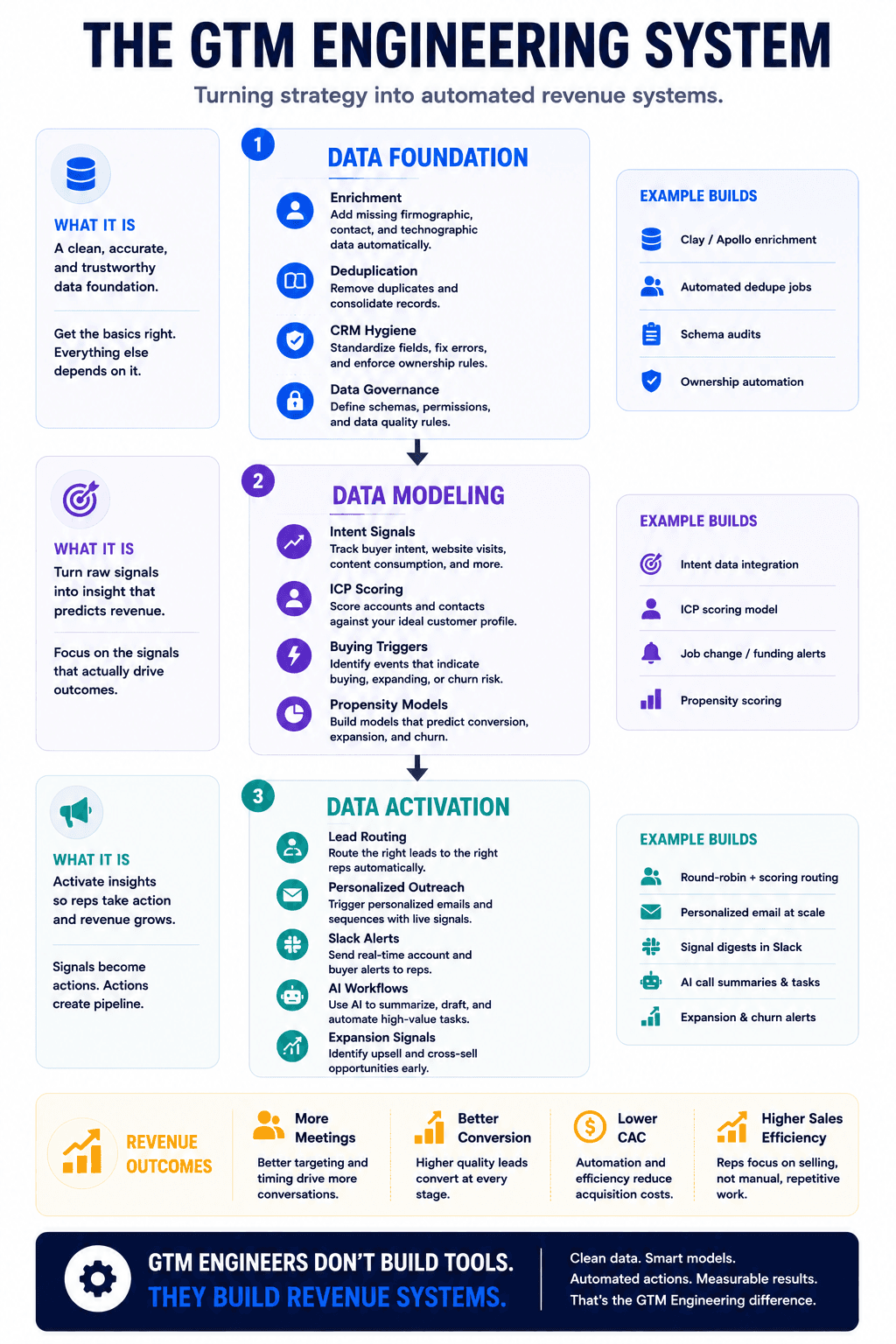
The work progresses through three layers that depend on each other. Getting the order right is most of the job.
The first layer is the data foundation. This means keeping contact and account records clean, deduplicated, and trustworthy through automated enrichment, schema audits, and ownership rules. Most teams stumble here. They either run ambitious campaigns on incomplete data or burn the majority of their hours on manual hygiene and leave very little for actual experimentation. A GTM engineer automates the hygiene work so the team can spend its time testing and refining who to target. If you are setting up the data side of an outbound motion, our guide on how to enrich your lead list using Claude Code walks through this layer in practice.
The second layer is data modeling. This is where the engineer collects the specific signals that predict whether an account will buy, expand, or churn, then turns them into propensity scores and ICP attributes. The signals that drive most pipeline tend to be intent data, job changes, funding events, hiring spikes, and product usage patterns. The skill is not collecting more signals. It is picking the few that actually correlate with revenue for your business.
The third layer is data activation, where those signals turn into rep actions and campaigns. This is the part people picture when they hear the title.
Real workflows that make the role concrete
The clearest definition of the role comes from looking at what gets built. Drawing on documented examples from teams running this work, a typical week might include:
Intelligent inbound routing that scores new signups for deal potential, assigns the best leads to the right rep, and drafts follow up notes that reference similar customer use cases.
CRM enrichment from call transcripts, where a script listens to recorded calls, extracts firmographic details, and backfills the CRM so reps stop losing time on data entry.
Signal digests piped into Slack so sellers get account awareness and call prep without digging through tools.
Churn and expansion alerts that scan support threads for enterprise feature requests or risk patterns and flag the account owner before a renewal.
Personalized outbound triggered by a live signal, such as a reverse IP visit or a funding announcement, while interest is still fresh.
These builds are the same kind of work our GTM engineer's guide to Claude Code gets into, and if you want the folder structure and setup behind them, how to set up Claude Code for your GTM team covers the foundation. For the prospecting side specifically, we documented how GTM teams use Claude Code for prospecting end to end.
How a GTM engineer measures success
The honest test of the role is whether the number moved. Good GTM engineers measure their work in outcomes such as meetings booked, hours saved, trial conversion lifted, and reduced cost of acquisition. They treat a workflow as a hypothesis, ship a version, measure it, and either scale it or kill it. One enterprise team we worked with doubled its sales efficiency this way, engaging leads at the right moments using data backed scoring rather than rep guesswork.
The before and after for an SDR makes the value obvious. Before, a rep manually researches fifteen accounts, writes the emails by hand, and spends half the day on data entry. After, the system surfaces fifty prioritized accounts with researched context, the rep reviews the top ten and approves the messaging, and the rest go out automatically. The rep spends the morning on calls instead of building lists. This is the same shift we cover in how AI SDRs are replacing manual prospecting.
How is a GTM engineer different from RevOps?
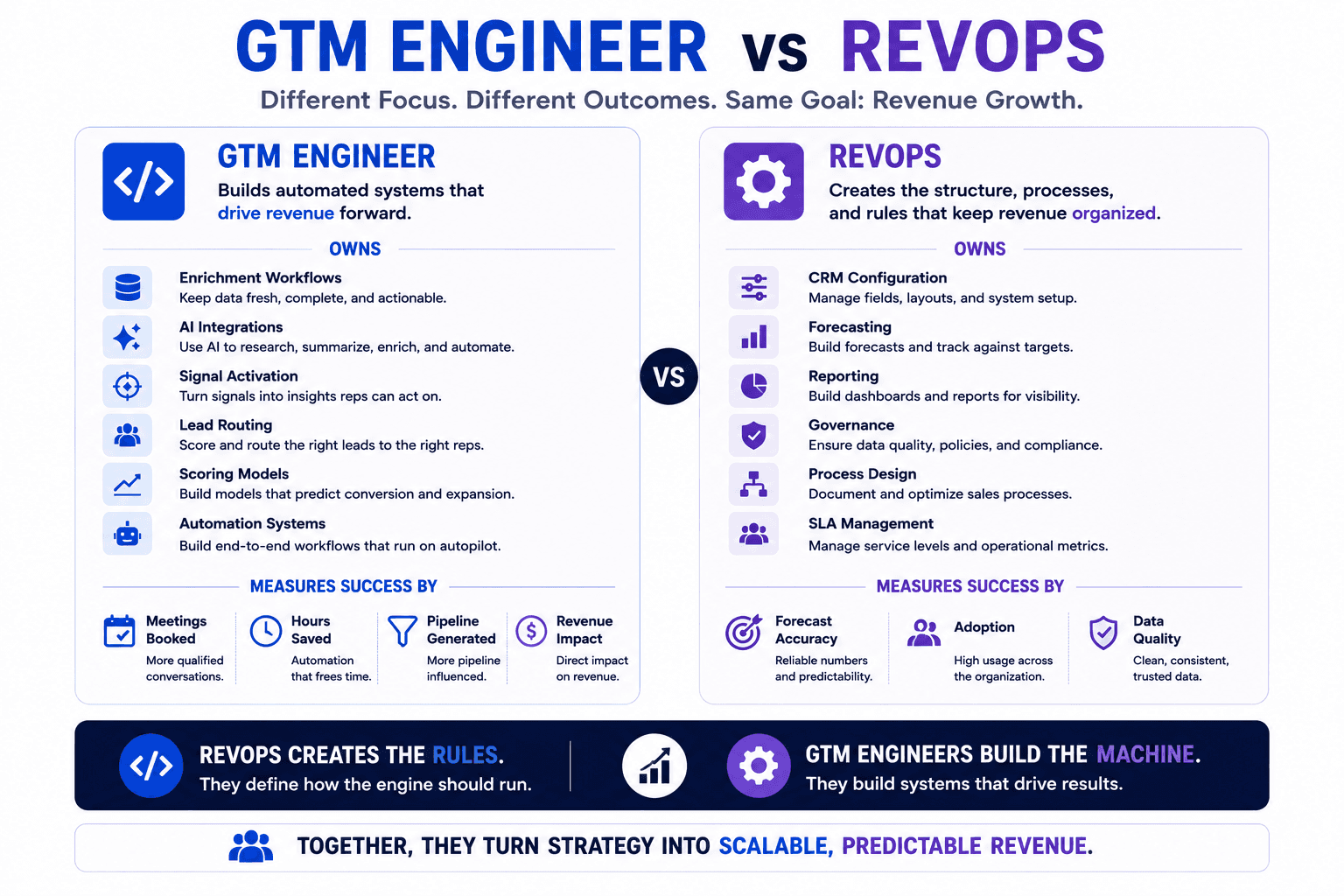
This is the question that comes up most, because the two roles overlap and the boundary keeps moving. The cleanest distinction is the primary deliverable. RevOps designs the strategy, process, and governance. The GTM engineer builds the systems that execute it. RevOps sets the rules, and the GTM engineer builds the machine that follows them.
In practice that splits along a few lines. RevOps owns CRM configuration, forecasting, SLA enforcement, and reporting, and measures itself on forecast accuracy and process adoption. A GTM engineer owns enrichment workflows, scoring models, routing logic, and AI integrations, and measures itself on meetings booked and hours saved. RevOps tends to run on a quarterly and monthly cadence, while a GTM engineer works in daily system operations and monthly signal tuning.
The line is blurring at companies that are scaling quickly, where senior RevOps people are increasingly expected to build rather than only manage, and GTM engineers take on more strategic ownership. If the output is a process or a policy, that is RevOps. If the output is a working system, that is GTM engineering.
Why the role is showing up now
Three shifts arrived at roughly the same time and made this role necessary.
The first is that go to market tactics became commoditized. The generic cold email gets ignored, spam filters bury the same tired subject lines, and volume alone stopped working. Winning teams now compete on unique data and differentiated plays, which takes real infrastructure to run at scale. We wrote about this directly in why most cold email campaigns are dying in 2026, and getting the sending foundation right starts with the best cold email infrastructure setup for B2B companies.
The second is tool sprawl. A typical B2B revenue team now runs dozens of specialized tools, and most companies use over a hundred SaaS applications across the business. Without tight integration those tools create silos that drag everything down, and someone has to own how they connect. This is also where the difference between buying more tools and building real systems becomes clear, a distinction we unpack in AI agents vs AI tools.
The third is the AI gap. Tool adoption has exploded, but most of that spend produces very little. A widely cited MIT analysis of enterprise AI deployments found that the large majority of organizations are seeing no measurable profit impact from their generative AI pilots, and the reason is almost always the same. Teams automate chaos instead of fixing the data underneath it. A GTM engineer exists to wire AI into a foundation worth automating in the first place. This is the same failure pattern behind why 70 percent of AI transformations fail, and avoiding it is mostly about sequencing the work correctly.
The demand reflects all of this. Beyond the salary figures, Gartner has projected that 95 percent of seller research will begin with AI by 2027, up from under a fifth in 2024. Someone has to implement and govern that shift, and that someone is increasingly a GTM engineer.
What to look for when you hire one
Great GTM engineers come from varied backgrounds. Many came up through sales operations, RevOps, or growth marketing, and some were SDRs or AEs who automated their own workflows to hit quota and never stopped. There is no formal credential path, so most built their skills by solving real problems with real consequences attached.
The skills that matter fall into two halves. On the technical side, fluency with tools like Clay, n8n, Zapier, SQL, and Python helps, and the engineers building net new capability tend to be the ones who can write code. On the commercial side, the strongest candidates ask whether a workflow actually helps someone close a deal before they build anything, which takes judgment that no tool provides. If you are weighing the platforms these people work in, our comparison of Apollo vs Clay lays out the tradeoffs.
Coding is worth addressing directly, because it is the most common question. It is not strictly required, and people without it can do real work. They tend to cap out at the workflows existing tools already support, while the ones writing custom integrations and enrichment scripts build the net new capability and earn the engineering level pay. SQL and Python each appear in roughly 38 percent of postings, and the real number is likely higher.
How to actually assess a candidate
A useful interview has three parts. Start with a fuzzy business problem, such as a trial to paid rate that will not move, and watch whether the candidate asks about your ICP, your most successful customer calls, and which signals predict a purchase. Then ask them to sketch how they would turn those insights into a working flow, picking good data points, keeping them clean, and plugging them into a workflow. Finish with a small take home build, where a strong submission explains its assumptions and fallback logic, mentions suppression and multichannel sequencing rather than blasting everyone, and shows how success gets measured. The red flag is tunnel vision, like proposing a single channel or ignoring deliverability and targeting fatigue.
The biggest failure mode
The most common way the role fails is what one team calls the Frankenstack trap. An engineer strings together a dozen tools in an automation, calls it seamless, and mistakes complexity for sophistication. Every added tool is another login, another contract, and another data sync that can break the night before a campaign launch. The best practitioners are revenue strategists rather than tool collectors, and they favor one good play on existing infrastructure over an elaborate workflow nobody trusts.
The related mistake is over engineering before validating a signal. Spending a sprint hardening a workflow for a signal that does not predict pipeline is wasted work. A good habit is to validate the signal manually for a week first. If it cannot work as a simple spreadsheet and a short daily review, automation will not save it. The other recurring failures are familiar once you have seen them: automating on top of broken data, scoring on static form fields instead of real behavior, building plays reps never adopt, and treating data hygiene as a one time project rather than a continuous discipline.
Where should a GTM engineer sit, and do you need one?
Most companies start their GTM engineer inside RevOps, because that team already owns the data pipelines and CRM hygiene the role builds on. From there the function often federates outward into growth or customer success once the foundation is solid. Intercom, Notion, Anthropic, and Ramp all use variations of this pattern, splitting over time into people who prototype close to sales and people who harden the winning ideas for production.
As a rough capacity guide, one GTM engineer can usually support a full revenue org up to somewhere around $50 to $100 million in ARR, provided the data foundation is solid. Past that point the function tends to split between prototypers and implementers.
Whether you need one depends less on the title and more on the bottleneck. If your reps spend more time researching and list building than talking to buyers, if your AI spend is producing activity but not pipeline, or if a new targeting priority takes weeks to ripple through the team, the constraint is a systems problem. You may already have someone doing pieces of this work without the title, in which case the move is to formalize and expand it. For a wider framework on building that capability deliberately, our guide on how to build an AI operating system for your business and our workflow first guide to implementing AI both start from the same principle: fix the workflow before you automate it.
The short version
A GTM engineer builds the automated revenue systems that turn strategy into execution, working across a clean data foundation, predictive signal models, and the workflows that activate them. The role differs from RevOps because the deliverable is a running system rather than a process, and it is emerging now because commoditized tactics, tool sprawl, and a wide AI execution gap all reward teams that can build and validate plays faster than the market. When you hire one, look for the hybrid of commercial judgment and building ability, and watch for the engineer who chases outcomes rather than tool count.
The underlying lesson is simple enough to state plainly. Most revenue problems are systems problems, not people problems, and adding ten more reps for every small lift in pipeline stopped being the answer a while ago.

If you want help figuring out where the systems gap is in your own revenue motion, book a call with our team and we will walk through it with you.