Article
Mar 18, 2026
How to Build an AI Operating System for Your Business
Learn how to build an AI operating system for your business in five layers. A practical methodology for founders to automate operations and scale.
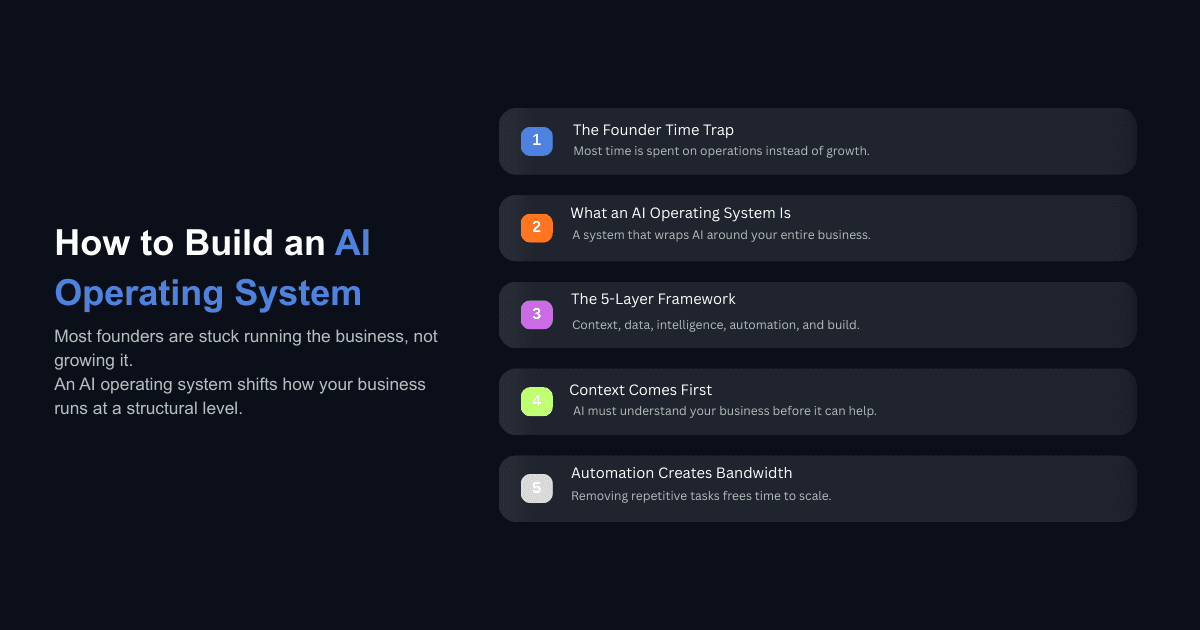
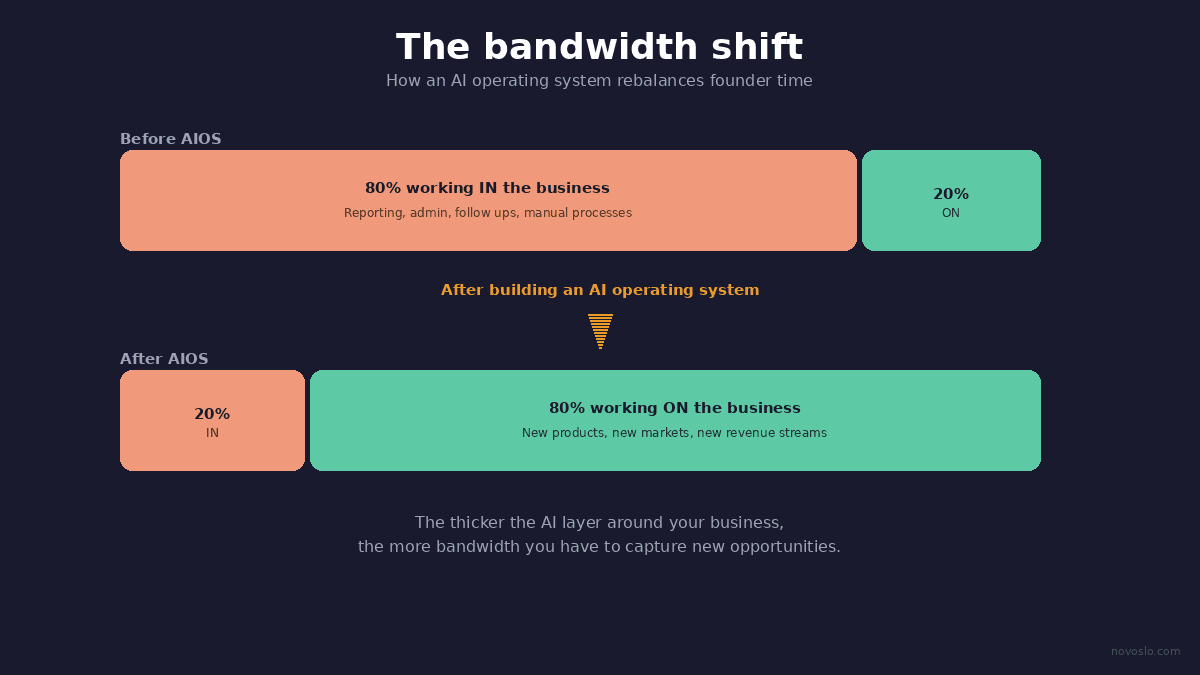
Most founders spend roughly 80% of their time keeping the business running and about 20% actually growing it. New products, new channels, new markets — they all sit on the backburner because there is no bandwidth left after the daily grind of reporting, meetings, follow ups, and manual processes.
An AI operating system is a methodology that reverses that ratio. It wraps an intelligent layer around your existing business model so that the AI understands your context, connects to your data, synthesizes what is happening across teams, and automates the tasks that currently eat your schedule. The result is not a marginal productivity gain. It is a structural shift in how you operate as a founder or operations leader, and the businesses that adopt it early are already pulling ahead by a significant margin.
This post walks through how to build one, layer by layer, without needing a technical background to get started.
What Is an AI Operating System (and What It Isn't)
It's a Methodology, Not a Product
An AI operating system is not a single piece of software you purchase and install. It is an approach to running your business where AI acts as a persistent, informed layer around your operations. Think of your business model as the core — the thing that creates value for your customers. The AI operating system is everything wrapped around that core: the context it holds, the data it accesses, the intelligence it delivers, and the tasks it handles on your behalf.
This means it works regardless of whether you run an ecommerce brand, a services firm, a SaaS company, or a consulting practice. The business model stays the same. The way you operate it changes entirely.
The key principle is building in layers, not leaps. You start with a thin wrapper of context around the business and add capability over time. Each layer takes something off your plate or makes an existing workflow meaningfully faster. After a few weeks of deliberate building, that thin wrapper becomes a thick, capable system that lets you run significant parts of your operation from your phone if you choose to.
Why This Is Nothing Like Using ChatGPT
If you have been using ChatGPT or Claude through a browser tab, you already know the frustration. Every conversation starts from zero. You paste your business context, explain your strategy, remind it who your team members are, and then finally get to the actual question you needed help with.
An AI operating system eliminates that entirely. The AI already knows your business the way a seasoned co-founder would. It knows your products, your team structure, your revenue model, your current priorities, and your strategy for the quarter. Every interaction starts fully informed, which means you skip the setup and go straight to the work.
This distinction matters because it is the difference between using AI as a search tool and using AI as an operational layer. One gives you answers. The other gives you capacity. And capacity is what founders are actually short on.
The Five Layers of an AI Operating System
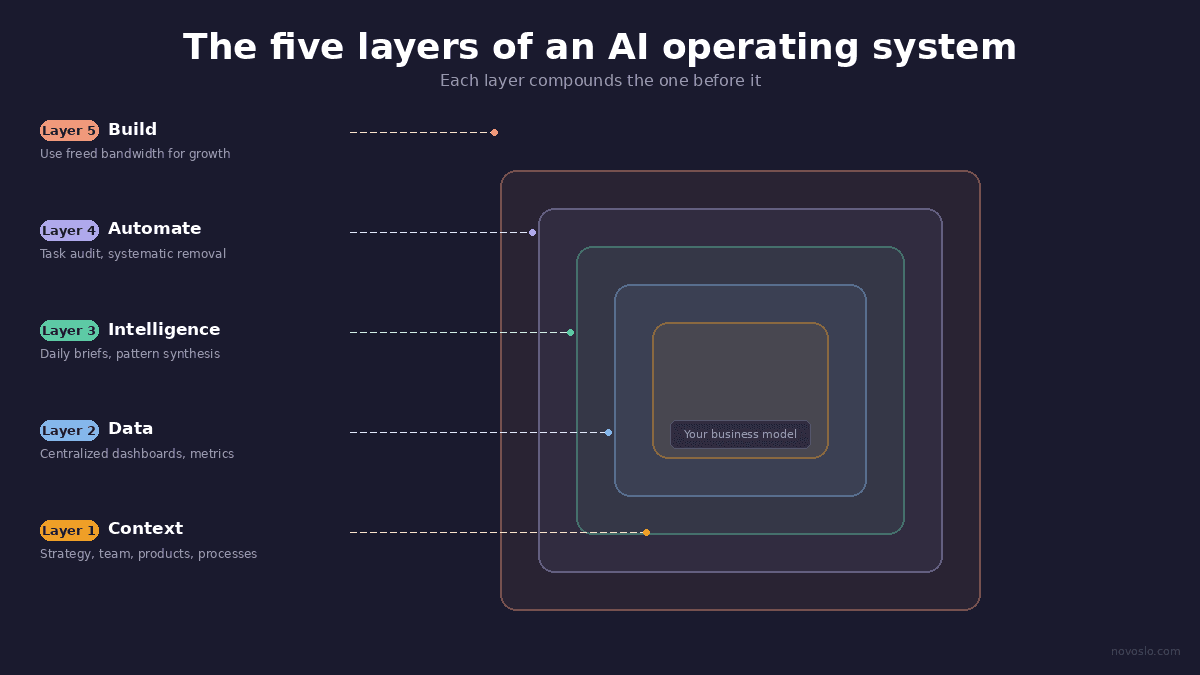
Building an AI operating system follows a specific sequence. Each layer builds on the one before it and becomes more powerful when combined with the others. Here is the full stack.
Layer 1: Context (Teach the AI Your Business)
The foundation of everything is context. Before the AI can do useful work, it needs to understand your business deeply. That means loading in your company information, your products and services, your team members and their roles, your current strategy, your processes, and any institutional knowledge that would take a new hire months to absorb.
This is not a one-time data dump. Context is something you build and refine as you work with the system. The more it knows, the more useful every subsequent interaction becomes. Most founders who are implementing AI in their business for the first time underestimate how much value this single layer provides on its own.
Once your context layer is solid, you stop explaining yourself. You just work.
Layer 2: Data (Centralize What's Scattered)
How many dashboards do you log into every morning to understand what is happening in your business? Your CRM, your analytics platform, your revenue tool, your marketing dashboard, your project management software. For most operations leaders, it is somewhere between five and ten platforms just to get a read on the current state of things.
The data layer pulls all of that into one place. Revenue numbers, pipeline status, content performance, website traffic, community growth, sales activity — all of it accessible in a single view or through a conversational query. Instead of toggling between tabs, you ask the system a question and it pulls the answer from across your entire data stack.
KPMG's recent analysis of AI adoption in finance describes this as the shift from fragmented legacy tools to a unified intelligent interface. That framing applies well beyond finance. Any business with data spread across multiple platforms benefits from centralizing it into a layer the AI can access and reason over.
When context and data combine, the AI does not just know what your business does. It knows where your business stands right now relative to your goals.
Layer 3: Intelligence (The Daily Brief That Changes Everything)
This is where the system starts delivering real operational value without you asking for it. When context, data, and an intelligence layer come together, the AI can generate a daily briefing that tells you everything important that happened across your business in the past 24 hours.
Revenue changes. Team updates. Meeting summaries from calls you did not attend. Content performance. Pipeline movement. Anomalies worth investigating. Opportunities to act on. All synthesized into a concise summary delivered before you start your day.
The power of this layer is that it connects dots across departments and data sources that a human brain would struggle to hold simultaneously. It is not just reporting numbers. It is synthesizing patterns across your entire operation and surfacing what actually matters.
For founders running multiple business lines or managing teams across different functions, this layer alone removes hours of daily admin. You become the most informed person in your organization before your first meeting of the day, without sitting through a single status update to get there.
Layer 4: Automate (The Task Audit)
This is the layer that starts giving you tangible time back. The process begins with a task audit: write down every recurring task you handle across your business. Reporting, data entry, content planning, follow up emails, proposal creation, meeting prep, check-ins, scheduling, and everything in between.
Once you have that list, you categorize each task. Can AI fully handle this? Can it partially assist? Or does it still require a human? Then you start building automations into the system, crossing tasks off permanently.
McKinsey's 2025 assessment found that 57% of work hours are now automatable, nearly double what they estimated just two years prior. That number will keep climbing. The founders who run this exercise now and start systematically removing tasks from their plate will compound those gains week over week.
One enterprise client we worked with doubled their sales efficiency by applying AI across their operations workflow, specifically around lead engagement timing and data analysis. The gains were not theoretical. They showed up in the pipeline within weeks.
Each task you automate is bandwidth you permanently reclaim. And unlike hiring, the cost does not scale linearly. The hundredth automation costs roughly the same as the first.
Layer 5: Build (Use the Bandwidth You Freed Up)
When the first four layers are in place, something happens that most founders have not experienced since the early days of their business. You have bandwidth again. Real bandwidth. Not a squeezed-out extra hour, but meaningful mental space and time to think, strategize, and build.
This is where the AI operating system pays off in a way that is hard to overstate. You now have a fully contextualized workspace connected to your data, your intelligence layer, and your automations. When you decide to launch a new product, enter a new market, or run a campaign, you are doing it with an AI co-pilot that understands your entire operation and can help you execute at a pace that would normally require a full team.
The choice at this point is yours. You can pour that bandwidth into growth by launching things you have been putting off for months. Or you can step back and actually enjoy the freedom you originally wanted when you started the business. Both are valid. The point is that you finally have the option.
How Do You Actually Start Building an AI Operating System?
Start With Context, Not Tools
The most common mistake is starting with tools. Founders hear about AI and immediately go looking for software to buy. But without a context layer, every tool operates in isolation and requires constant re-explanation.
Start by documenting your business. Your strategy, your team, your products, your processes, your goals. Feed that into your AI workspace so that every interaction from that point forward is grounded in a real understanding of what you are building and why.
This is the same reason most AI transformations fail. The technology is not the bottleneck. The missing context is. When the AI does not understand the business underneath, it produces generic output that creates more work instead of less.
Run a Task Audit Before Automating Anything
Do not try to automate everything at once. List your tasks, prioritize the ones that consume the most time relative to their value, and start there. The goal is not to automate 100% of what you do. It is to systematically remove the tasks that block your bandwidth from being used on higher value work.
A good starting target is 40 to 60% of your recurring tasks within the first 30 to 60 days. That is achievable for most businesses once the context and data layers are in place.
Build in Layers, Not Leaps
Each layer of the AI operating system compounds the one before it. Context makes data useful. Data makes intelligence possible. Intelligence makes automation targeted. Automation creates the bandwidth to build.
If you try to skip ahead to automation without the foundational layers, you end up with brittle workflows that break whenever the business changes. The layered approach is slower to start but dramatically more resilient and powerful over time.
This is the fundamental difference between choosing AI agents and standalone tools. Tools solve isolated problems. A system solves how your business operates.
What Should You Measure to Know It's Working?
Without clear metrics, you are just adding technology and hoping it helps. Three KPIs tell you whether your AI operating system is actually delivering value. If you want a deeper framework, we have written separately about measuring AI transformation success.
Task Automation Percentage
Track how many of your recurring tasks have been fully or partially automated compared to your starting baseline. If you began with 80 tasks and 35 are now handled by the system, that is roughly 44%. Set a target and track progress weekly. This is the most direct measure of bandwidth reclaimed.
Revenue per Employee
This is becoming one of the most important metrics in the AI era. It measures how efficiently your team is operating relative to the revenue the business generates. As you automate more of the operational workload, this number should increase, either through revenue growing while headcount stays flat, or through the same revenue being generated with fewer manual hours.
MIT Sloan Review recently noted that companies without internal AI infrastructure force their teams to replicate foundational work on every project, making it both more expensive and slower to build AI at scale. Revenue per employee captures whether you are solving that problem or just adding tools on top of it.
Away from Desk Autonomy
This one is less conventional but extremely telling. Can you step away from your desk for a full day and have the business continue operating normally? Can you travel for a week without things falling apart?
The AI operating system should progressively increase your ability to operate remotely and asynchronously. If you still need to be physically at your computer for 10 hours a day to keep things moving, the system is not doing its job yet. Test this regularly and note what breaks when you are away. Those gaps are your next automation targets.
Why Most AI Implementations Fail (and How an AI Operating System Avoids It)
The Problem With Disconnected AI Tools
Most businesses approach AI by buying individual tools. A chatbot for customer support. An AI writing assistant. A data analysis plugin. Each tool works in isolation, requires its own setup, its own context, and its own maintenance.
The result is a scattered collection of AI capabilities that do not talk to each other, do not share context, and do not compound over time. This is why so many companies invest in AI and feel like they are not getting real returns. The tools themselves might be good. The absence of a unifying system is what holds them back.
An AI operating system solves this by design. Every layer shares the same context, accesses the same data, and feeds into the same intelligence layer. When you add a new automation, it immediately benefits from everything the system already knows. That compounding effect is what separates businesses that get real value from AI and businesses that are just experimenting.
What Compounds vs What Doesn't
Individual prompts do not compound. A clever workflow hack does not compound. A one-off automation that runs in isolation does not compound.
What compounds is a system where every new piece of context, every new data connection, and every new automation makes the entire system smarter and more capable. The AI operating system is built specifically to create that compounding effect across your entire business.
This is what an AI transformation partner helps you design. Not a collection of tools, but a system architecture where each component reinforces the others and the value accelerates over time rather than plateauing after the initial setup.
Where to Go From Here
An AI operating system is not something you build in a weekend. It is a methodology you adopt and build over weeks and months, one layer at a time. Context first, then data, then intelligence, then automation, then whatever you want to build with the bandwidth you have freed up.
The businesses that will operate most efficiently over the next few years are the ones building this infrastructure now, while most of their competitors are still using AI as a glorified search bar.
If you want help designing and building an AI operating system for your business, book a call with our team. We work with founders and operations leaders to map out the layers, identify the highest value automations, and build a system that actually compounds over time instead of collecting dust after the initial excitement wears off.