Article
Jul 6, 2026
Best AI Sales Agents for B2B Companies in 2026
Compare the best AI sales agents for B2B companies in 2026: Artisan, 11x, AiSDR, Regie.ai, and Lindy, plus how to pick the right one.

The AI sales agent category got crowded fast. A year ago most B2B teams had heard of two or three names. Now every founder we talk to has sat through at least one demo where an agent promised to book meetings while the team slept, and most of them walked away unsure whether the tool actually fit their business or just performed well in a controlled walkthrough.
That confusion is the real problem. The best AI sales agents for B2B companies are not the ones with the biggest funding rounds or the cleanest interface. They are the ones that match how your team already sells, feed on good data, and produce meetings your closers can actually work. This guide breaks down the agents worth evaluating in 2026, what each one costs in practice, and where each tends to break. At the end there is a simple framework for choosing, because the right answer depends more on your motion than on any single feature list.
What an AI Sales Agent Actually Does (And Where It Stops)
An AI sales agent handles the repetitive top of the funnel. That means researching accounts, building and enriching lists, writing outreach, running multi-step sequences, replying to interested prospects, and booking calls. A good one compresses work that used to take an SDR most of their week into something that runs in the background.
The part vendors rarely emphasize is where the agent stops. Discovery calls, handling real objections, reading a room, and closing a deal still depend on human judgment. Most teams that get value from these tools use them to fill the calendar so human reps can spend their time on conversations that move revenue. If you want a fuller picture of how this shift is playing out, we covered it in how AI SDRs are replacing manual prospecting.
It also helps to know that the tools on this list come in three shapes, because the label "AI sales agent" gets applied to all of them.
The first is the autonomous agent, which is designed to run outbound end to end with minimal input once you set the ideal customer profile. The second is the assistant, which sits alongside your existing reps and speeds up specific parts of their workflow rather than replacing the role. The third is the no-code builder, which gives you the parts to assemble your own agent around your own logic. Each shape fits a different kind of team, and picking the wrong shape is the most common reason these purchases disappoint. We wrote more on that distinction in AI agents vs AI tools.
The Best AI Sales Agents for B2B Companies in 2026
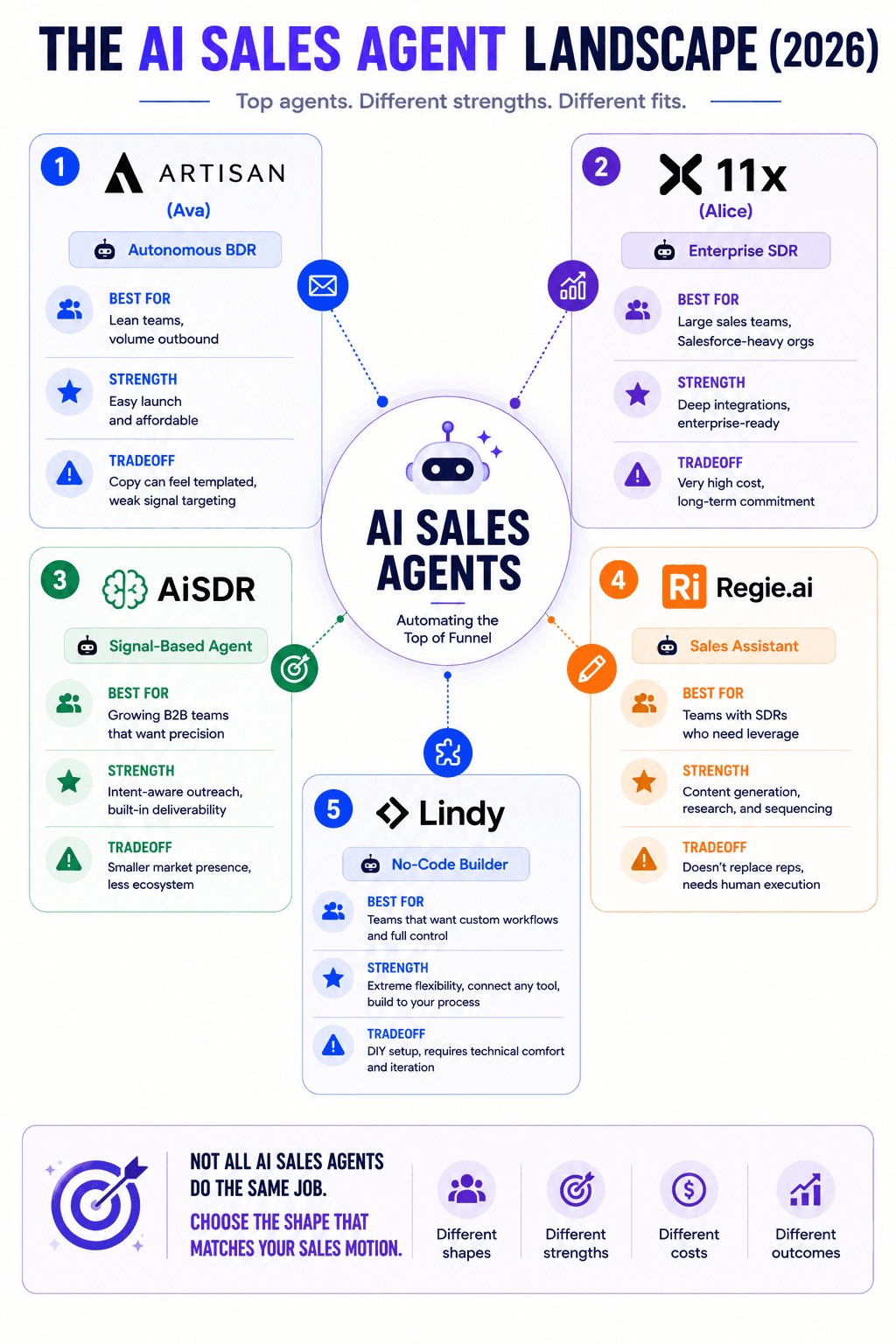
Here are the agents worth putting on your shortlist, with what each does well, who it fits, what it costs, and the tradeoff you should walk in expecting.
Artisan (Ava)
Artisan built one of the most talked about products in the category. Its agent, Ava, is an autonomous BDR that pulls leads from a database of more than 300 million contacts, writes personalized email sequences, runs follow-ups, and books meetings with limited hand-holding. The positioning is straightforward: give Ava your ideal customer profile and email setup, and she handles roughly 80 percent of the outbound.
Pricing is more accessible than most enterprise options. Public plans start around $280 per month for a starter tier and $660 per month for a heavier one, with a free tier for testing and custom enterprise pricing above that. That makes Artisan a reasonable entry point for lean teams and solo founders who want to test outbound without hiring.
The catch shows up in quality and control. Because Ava is built for volume, several operators report that the copy can feel templated and that leads are not always well qualified. One independent Artisan review noted that the agent tends to pull static lists without deep signal-based prioritization, which means you can send a large number of emails to prospects who are not in-market right now. Artisan works best when your targeting is broad and your main goal is reach rather than precision.
11x (Alice)
11x sits at the enterprise end of the market. Its agent, Alice, runs autonomous prospecting, personalized email, LinkedIn outreach, reply handling, and meeting booking, and the company added a phone agent called Julian for inbound qualification. The standout strength is depth of integration. In hands-on tests, Alice pulled opportunity stage, deal history, and territory rules directly from Salesforce, which is why it fits large orgs with complex sales operations.
That depth comes at a price. 11x does not publish rates, but third-party pricing analysis places entry deployments around $5,000 per month and enterprise multichannel setups well above that, with annual contracts as the standard commitment. The buyer profile is narrow: large teams, clean CRM data, high contract values, and a RevOps function to keep the data tidy.
The tradeoff is cost, lock-in, and outcome risk. Industry reporting through 2025 and 2026 flagged churn and questions about whether results matched the marketing, and several buyers said they were asked to commit to a full year before proving fit. Alice can perform well for the right enterprise, but the math only works when the deals it books are large enough to cover the spend.
AiSDR
AiSDR takes a more predictable approach to pricing and a more targeted approach to outreach. It runs on a flat quarterly plan starting around $900 per month with unlimited seats, personas, and campaigns, plus a smaller solo plan near $250 per month. According to AiSDR's own comparison material, the agent carries your context forward between sessions, so it remembers your ideal customer profile and what has worked rather than starting cold each time.
Where it separates from volume-first tools is prioritization. AiSDR connects to HubSpot and Salesforce, scores accounts, watches lists for trigger events, and pushes leads that heat up back into campaigns, including re-engaging deals that went quiet. That signal awareness tends to produce fewer, sharper touches aimed at prospects more likely to reply.
The tradeoff is track record and brand. AiSDR is a strong fit for growing B2B teams that want signal-based outreach with a flat, understandable bill, but it does not carry the enterprise footprint or the recognition of the larger names, so buyers running formal procurement may need to make the case internally.
Regie.ai
Regie.ai is best understood as an assistant rather than a replacement. It helps existing reps write and manage outbound content at scale, generating email sequences, call scripts, LinkedIn messages, and summaries built around your personas. For mid-market and enterprise teams running high-volume outbound where personalization still matters, it fills the gap when reps are juggling too many cadences or stuck on writing.
Pricing starts around $35,000 per year based on seats and feature access, which places it firmly in the team-tool bracket rather than the solo-founder bracket.
The tradeoff is that Regie.ai improves a sales motion you already have. It supports human-led outbound and speeds up the content layer, but it still expects SDRs, QA, and ongoing management on your side. If your goal is to shift the outbound motion to something more autonomous, this is not the tool for that job. If your goal is to make an existing team faster and more consistent, it fits well.
Lindy
Lindy is the no-code builder on this list. Instead of a single fixed agent, it gives you a platform to assemble your own using natural language, connecting your inbox, CRM, and tools to run logic-based workflows for prospecting, qualification, follow-up, and CRM updates. The flexibility is real, and reviewers consistently praise how approachable it is for non-technical operators.
Pricing starts near $49.99 per month for the entry tier and scales through higher self-serve plans, but the number that matters is credits. Lindy runs on a credit model where each action draws down a monthly balance, and detailed pricing breakdowns show that heavier actions like voice calls burn credits quickly, which makes the effective cost harder to predict than the sticker price suggests. Voice calling is billed separately on top.
The tradeoff is setup and cost predictability. Lindy suits teams that want to build custom sales workflows and are comfortable owning the logic, but the credit burn can surprise you as usage scales, and you are assembling the system rather than buying a finished one.
Others Worth Knowing
Two more names come up often enough to mention. Salesforge's Agent Frank is a fully autonomous SDR positioned around multichannel outreach and deliverability control, which appeals to teams that want autonomy without giving up sending flexibility. Reply.io's Jason AI is more component-oriented and sits inside a broader sales engagement platform, which fits teams that already run Reply.io and want an agent layered on top. Neither reinvents the category, but both are reasonable additions to a shortlist depending on the stack you already run.
Comparison Table
Agent | Type | Best for | Entry pricing | Main tradeoff |
Artisan (Ava) | Autonomous BDR | Lean teams testing volume outbound | ~$280–$660/mo | Templated copy, weak signal targeting |
11x (Alice) | Autonomous SDR | Enterprise with clean CRM data | ~$5,000+/mo, annual | High cost, lock-in, churn reports |
AiSDR | Autonomous, signal-aware | Growing teams wanting flat pricing | ~$900/mo quarterly | Smaller brand and track record |
Regie.ai | Assistant for existing reps | Mid-market teams with SDRs | ~$35,000/yr | Augments, does not replace, a team |
Lindy | No-code agent builder | Teams building custom workflows | ~$49.99/mo + credits | Unpredictable credit burn, DIY setup |
Why Most AI Sales Agents Underdeliver for B2B
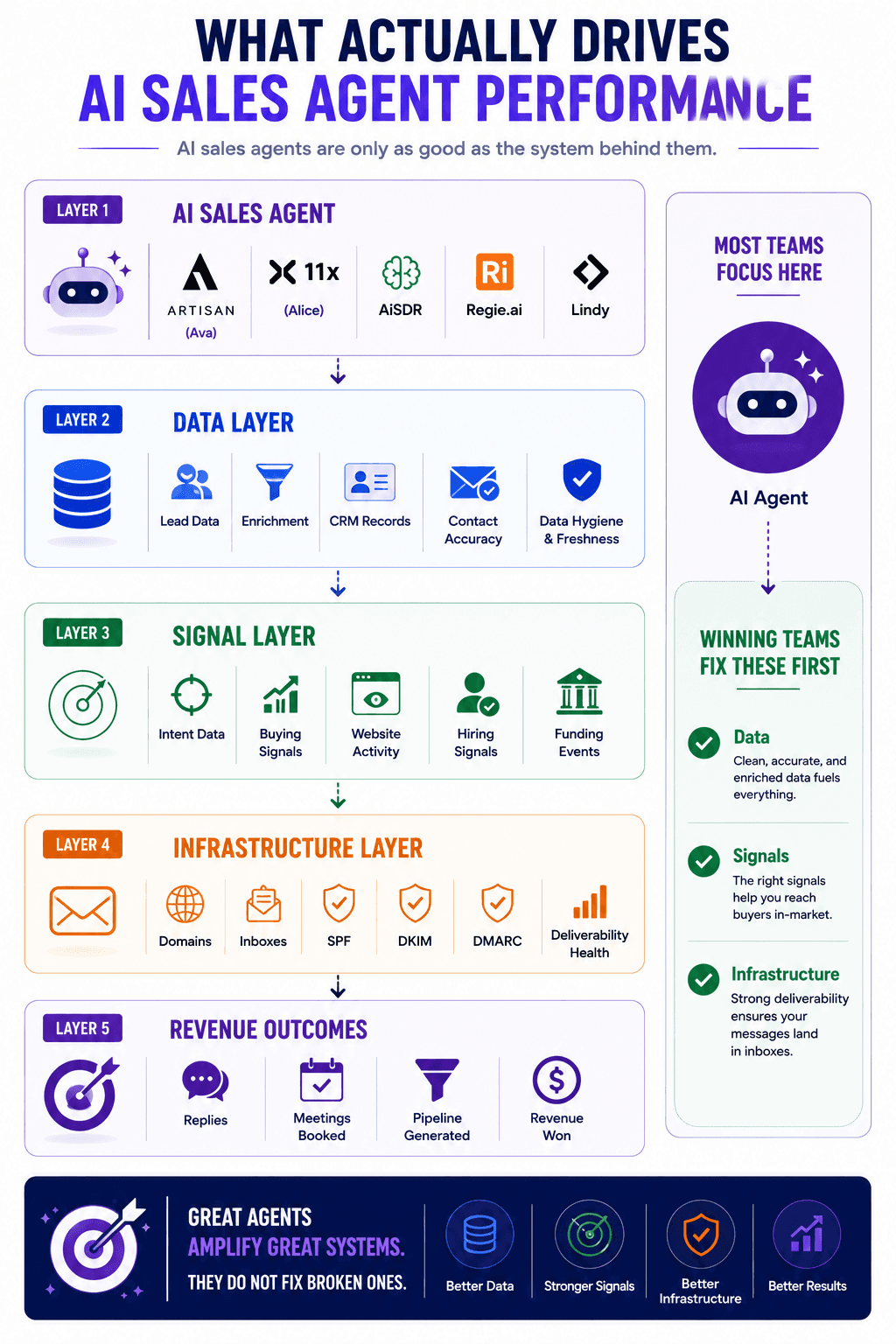
The pattern behind disappointed buyers is consistent, and it has little to do with the agent itself. Most of these tools automate sending without automating thinking. They can produce and deliver a large volume of email, but they do not reliably decide who is worth contacting right now, and that decision is where results are won or lost.
The two inputs that determine outcomes are data quality and timing. An agent working from a stale or poorly matched list will send polished emails to the wrong people, and no amount of personalization fixes a bad target. This is why buying signals and intent data matter more than the copy engine. A relevant message sent to an account that just raised funding or started hiring in your category beats a beautifully written message sent to someone with no reason to care.
Deliverability sits underneath all of it. If your domains are not set up correctly and your inboxes are not healthy, even a strong agent will land in spam, and the whole system quietly fails. Reply rates across cold email fell sharply in 2026, which we covered in why most cold email campaigns are dying, and much of that decline traces back to infrastructure and targeting rather than the tools. If you are evaluating any agent, look at the cold email infrastructure setup it runs on and the cold email mistakes it is prone to before you judge the AI.
None of this means the technology fails to deliver. When the data and timing are right, the results are measurable. One enterprise sales team we worked with roughly doubled its sales efficiency by pairing AI-driven insights with better timing, engaging leads at the moment they were most likely to respond rather than blasting a static list. The agent was part of that, but the win came from feeding it good signals. The teams that struggle are usually the ones expecting the tool to compensate for a broken system underneath it, a problem we see across SDR teams that cannot generate pipeline.
How to Choose the Right AI Sales Agent
Start with your motion, not the feature list. If you run a high-volume SMB motion and want reach at a low entry cost, an autonomous tool like Artisan or AiSDR fits the shape of your work. If you sell high-value enterprise deals with a real RevOps function and clean Salesforce data, 11x earns its cost by working inside that complexity. If you already have SDRs and want to make them faster, an assistant like Regie.ai fits better than a replacement. If you want to own the logic and build something specific, Lindy gives you the parts.
The second question is data. Before you evaluate any agent's automation, look at where its leads and signals come from. An agent with weak data will underperform regardless of how good its copy engine is, so treat the data and enrichment layer as the first thing to test, not the last. Pair that with a look at the cold email stack the agent depends on, since the tool is only one layer of a working system.
The third question is build versus buy versus done-for-you. Buying an agent means you still own the strategy, the data, the deliverability, and the ongoing management, which is closer to a build than most vendors admit. Building your own with a tool like Lindy gives you control but adds work that increasingly resembles hiring a GTM engineer. The done-for-you path removes that overhead entirely.
This is where our own model differs from buying software. Novoslo runs the full outbound system for B2B service companies, from infrastructure and lists to copy and booked calls, and we price it around performance rather than a flat software fee. You pay a monthly tech fee plus a fee per qualified booked call, which means the incentive is aligned with the meetings you actually get rather than the seats you license. If you want to see what that would look like against your current numbers, the AI ROI calculator is a quick way to model it.
Frequently Asked Questions
What is an AI sales agent?
An AI sales agent is software that automates the repetitive parts of outbound sales. It researches accounts, builds and enriches prospect lists, writes and sends outreach, runs follow-up sequences, handles interested replies, and books meetings. The more autonomous versions run this workflow end to end once you set the ideal customer profile, while lighter versions assist a human rep with specific tasks. The common goal is to fill the top of the funnel so your team can focus on conversations that close.
Do AI sales agents replace human SDRs?
Not entirely. AI sales agents handle prospecting, research, and initial outreach well, and for lean teams they can cover work that would otherwise require a hire. What they do not replace is the judgment involved in discovery, objection handling, and closing. Most B2B teams get the best results from a hybrid model where the agent generates and qualifies pipeline and human reps run the conversations that require nuance. Treating the agent as a full SDR replacement is where many buyers end up disappointed.
How much do AI sales agents cost in 2026?
Pricing spans a wide range. Entry-level autonomous tools like Artisan start around $280 per month, and flat-rate options like AiSDR run near $900 per month on quarterly terms. No-code builders like Lindy start under $50 per month but add variable credit costs that climb with usage. Enterprise agents like 11x typically run $5,000 per month or more on annual contracts, and content-focused assistants like Regie.ai start around $35,000 per year. The sticker price is rarely the full cost once data, deliverability, and management are included.
Which AI sales agent is best for a small B2B team?
For a small team, the best fit is usually an agent with a low entry cost and predictable pricing that does not require a RevOps function to operate. AiSDR works well for teams that want signal-based outreach on a flat quarterly plan, and Artisan suits teams that want to test volume outbound cheaply. Lindy fits teams comfortable building their own workflows. The larger enterprise agents rarely make sense at small scale, since the cost assumes headcount consolidation that a small team does not have.
The Takeaway
The best AI sales agents for B2B companies in 2026 are the ones that match your sales motion, run on good data, and produce meetings your team can actually close. Artisan and AiSDR fit lean and growing teams, 11x fits enterprise operations with the budget and data to support it, Regie.ai speeds up teams that already have reps, and Lindy suits builders who want control. Across all of them, the outcome depends more on targeting, timing, and deliverability than on the agent itself.
If you would rather skip the evaluation and have the entire outbound system run for you, with pricing tied to booked calls instead of software seats, book a call with our team and we will map it to your numbers.