Article
Aug 20, 2026
Speed-to-Lead for Outbound: How AI Turns Positive Replies Into More Meetings
Speed-to-lead decides how many positive outbound replies turn into meetings. See how AI covers after-hours replies and which tool to pick.

The hardest part of outbound used to be getting a campaign out the door. That is no longer true. A single person can now build a list, write personalized copy, and launch a sequence in an afternoon, which means the way outbound works has shifted away from sending and toward what happens after someone replies. When a prospect writes back with interest, a short window opens where they are thinking about their problem and expecting a response. Most teams miss that window because their reply handling runs on a person checking an inbox between other tasks, often hours later and rarely on weekends.
This is where speed-to-lead for outbound matters. It is the discipline of getting a qualified human interaction in front of a positive reply while the interest is still warm, and it is the difference between a busy campaign and a full calendar. In this guide we cover why the bottleneck moved, what speed-to-lead means when replies arrive across channels and time zones, how AI can carry the load without burning good conversations, and which tool we would actually use to run it.
Why the bottleneck moved from sending to responding
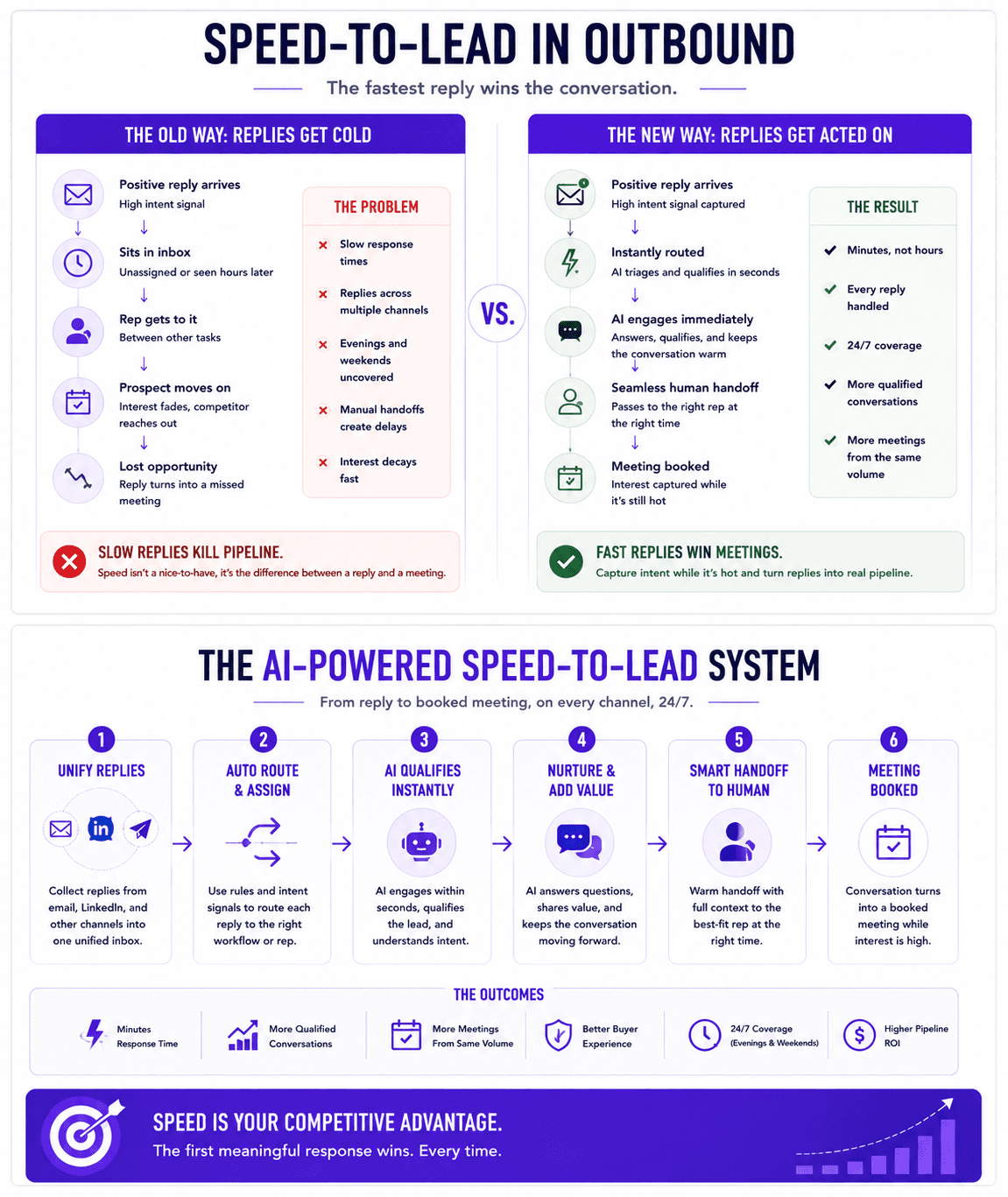
Outbound is a systems problem now, not a volume problem. The tools to source contacts, enrich them, and write relevant copy at scale are widely available, so the number of campaigns hitting any given inbox has climbed. The constraint that remains is the part that never automated cleanly: turning a reply into a booked meeting. Teams that struggle here usually assume they have a rep problem, when the real issue is broken systems rather than weak reps. The reply comes in, sits unassigned, and by the time someone acts on it the prospect has moved on to their next priority.
A positive reply is the strongest buying signal you get in outbound. Someone read a cold message, understood the offer, and chose to respond, which is a level of intent no scraped list or intent feed can match. The value of that signal decays quickly. A reply that gets worked within minutes carries far more weight than the same reply worked the next morning, because interest fades and competitors are often reaching out to the same account. Treating replies as a queue to clear when convenient wastes the most valuable input the whole system produces.
Getting more of these replies in the first place is its own discipline, and most campaigns lose them to fixable cold email mistakes long before speed becomes the issue. But once the replies start arriving, the math changes. Every reply you fail to work quickly is a meeting you paid to generate and then let cool. That is the leak worth fixing.
What speed-to-lead means for outbound, not just inbound
Speed-to-lead has been studied in inbound sales for over a decade, and the findings are consistent. Response time is one of the strongest predictors of whether a lead converts, and the first company to respond usually wins the conversation. Teams that reply within a few minutes qualify prospects at materially higher rates than teams that wait a day, and most companies fall well short of that window. The pattern holds because a buyer who reaches out is momentarily focused on their problem, and that focus does not last.
Outbound replies are harder to serve at that speed than inbound form fills, for two reasons. First, they arrive across channels. A modern outbound motion often runs email and LinkedIn together, so replies land in a sequencer inbox, a LinkedIn message thread, and sometimes a direct email reply, none of which talk to each other by default. Second, they arrive on the prospect's schedule, which includes evenings and weekends. A reply that comes in Saturday morning is exactly the kind of high-intent moment you want to catch, and it is also the moment your team is least likely to be watching. Revenue teams that consistently generate pipeline treat these windows as something to act before the window closes on, not something to batch.
The after-hours problem
A meaningful share of positive replies arrive outside working hours, and those replies are often the ones that never get a fast response. Adding a second shift of reps rarely makes financial sense at typical outbound volumes, so most teams accept the gap and let those conversations wait until morning. That delay is where a lot of would-be meetings quietly disappear. Closing it is one of the clearest ways to book more sales meetings from the volume you already generate, without touching your targeting or your copy.
How AI turns positive replies into booked meetings
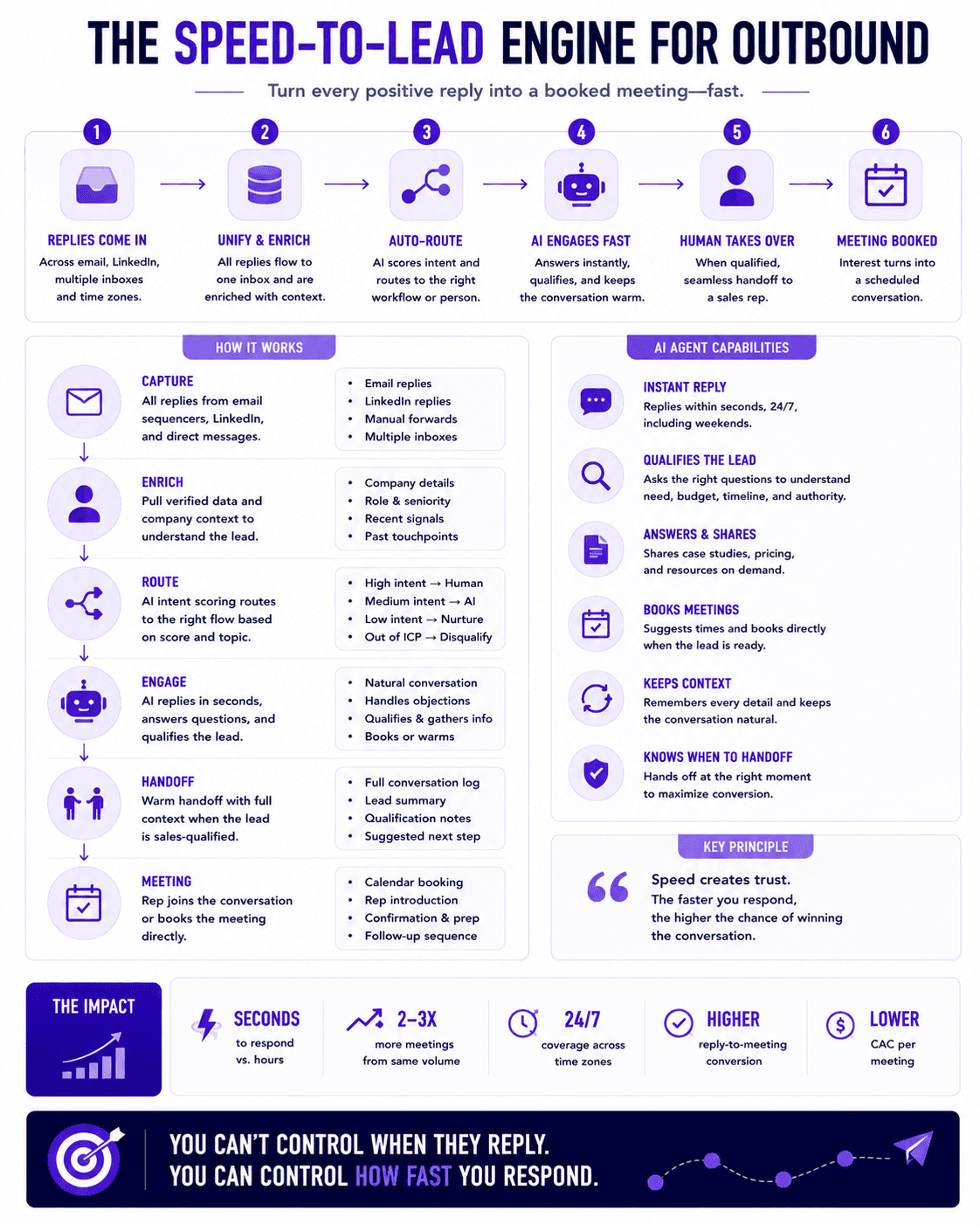
The workflow that solves this has three parts: unify the replies, route them automatically, and cover the moments your team cannot with AI that hands off to a human at the right point.
Unify replies into one place
The first step is giving every reply a single destination. A unified inbox layer pulls replies from your email sequencer and your LinkedIn tool into one view, and a webhook pushes each incoming and outgoing message into your CRM as it happens. This matters because you cannot act fast on something you have not seen. When replies are scattered across three tools, the delay is not the rep being slow, it is the reply being invisible until someone goes looking. Storing every reply in the CRM also builds an asset over time, which connects directly to revenue intelligence: the record of who responded with interest becomes a scoring input for future campaigns, since prospects who engaged once tend to engage again.
Enrich and route automatically
Once a positive reply hits the CRM, an automated workflow decides what happens next before a human is involved. The reply triggers an enrichment step that looks for a phone number. If a number is found and it is business hours, the lead routes to an available rep for an immediate call. If a number is found and it is after hours, it routes to an AI voice agent. If no number is found, it routes to the inbox for a fast written reply. This branching happens in seconds, which is the entire point. The prospect gets a relevant response while the interest is live rather than waiting in a queue. Where your sequencer sits in this matters too, because your sequencing platform needs to pass reply data cleanly into whatever layer sits above it. Offering a booking link early in that response also helps, since letting prospects book a time immediately removes a step that otherwise stalls warm conversations.
Use AI agents for coverage, with a human on qualification
This is where AI SDRs and AI voice agents earn their place. The AI voice agents in current CRMs sound close enough to human that they can call an after-hours reply, confirm interest, run a light qualification, and book the prospect onto a rep's calendar. On the written side, an AI inbox agent can respond to a reply in seconds and keep follow-ups queued based on what the prospect does next. Used this way, AI is not replacing your reps, it is holding the conversation open until a rep is available.
There is a boundary worth respecting. Fully automated reply handling can still burn good conversations, because qualification and objection handling still benefit from human judgment. The strongest setup keeps a person in the loop on qualification and uses AI for coverage and speed, not for the whole conversation. The teams getting the most out of this treat it as one component of a broader signal-driven process rather than a hands-off machine. That balance is also what lets the system feed feedback loops that compound, since every logged reply and outcome improves lead scoring and campaign targeting over time. One enterprise sales team we worked with found that acting on data-backed timing for lead engagement roughly doubled their sales efficiency, which is the kind of result that comes from tightening the response process rather than adding headcount.
Which tool should you actually use?
There are many AI sales tools that claim to handle replies, so the useful question is not which one has the longest feature list, but which one fits the speed-to-lead workflow above. Three things matter when you evaluate options. The tool should have native AI agents for voice and inbox handling, so you are not stitching a voice product to a CRM with brittle automations. It should integrate tightly with your sequencers and reflect reply outcomes back into the CRM, so routing decisions run on live data. And it should let you own your reply data, because that record is what makes your future targeting smarter.
Against those criteria, a CRM with built-in AI agents is a stronger foundation than a standalone tool bolted onto a legacy CRM. Our practical recommendation for teams that want after-hours coverage without a fragile automation stack is Close, paired with its AI voice agent for calling replies and booking meetings when a rep is offline. It integrates reply data cleanly, the voice agent is convincing enough to qualify and book, and it keeps the whole flow inside one system of record. If you want to compare the broader field before committing, our roundup of AI sales agents covers the alternatives by use case. Whichever you choose, hold to the human-in-the-loop principle: let the AI carry speed and coverage, and let a person own qualification.
Frequently asked questions
What is a good speed-to-lead time for outbound replies?
As fast as you can manage, ideally within a few minutes of the reply landing. The research on response time shows the sharpest drop in qualification odds happens in the first hour, so the goal is to respond while the prospect is still thinking about the message they just sent. For outbound specifically, the realistic target is a relevant response within minutes during business hours and automated coverage for replies that arrive after hours, so no high-intent reply waits until the next morning.
Can AI book meetings without a human?
AI can book meetings, and the voice and inbox agents in current tools are good enough to call a reply, confirm interest, and place a booking on a rep's calendar. The better approach keeps a human involved in qualification and objection handling, because those parts of the conversation still benefit from judgment that automation does not reliably provide. Use AI to guarantee a fast, relevant first response and to cover hours your team cannot, then hand qualified conversations to a rep.
Does this work for LinkedIn and cold email together?
Yes, and running them together is one of the reasons a unified reply layer matters. When a prospect might respond on LinkedIn or by email, you need both channels feeding one inbox and one CRM so replies are visible and routable regardless of where they arrive. This connects to a larger shift where one-to-one advertising and personalized outbound blur the line between channels, and the teams that win treat every reply the same way no matter which channel produced it.
The takeaway
Speed-to-lead is the single most effective change you can make to an outbound motion that is already generating replies, because it costs you nothing in targeting or copy and recovers meetings you are otherwise letting cool. The three moves that matter are unifying replies into one place, routing them automatically based on phone availability and time of day, and using AI voice and inbox agents to cover the hours your team cannot while a human still owns qualification. The tool you pick should make that workflow simple rather than adding another layer to manage, which is why a CRM with native AI agents is the cleaner foundation.
If you want help building this into your outbound so positive replies stop slipping through, book a call with our team and we will map it to your stack.