Article
May 8, 2026
How AI SDRs Are Replacing Manual Prospecting
Learn how AI SDRs automate prospecting, cut costs, and scale outbound without adding headcount. A tactical guide for operations leaders.
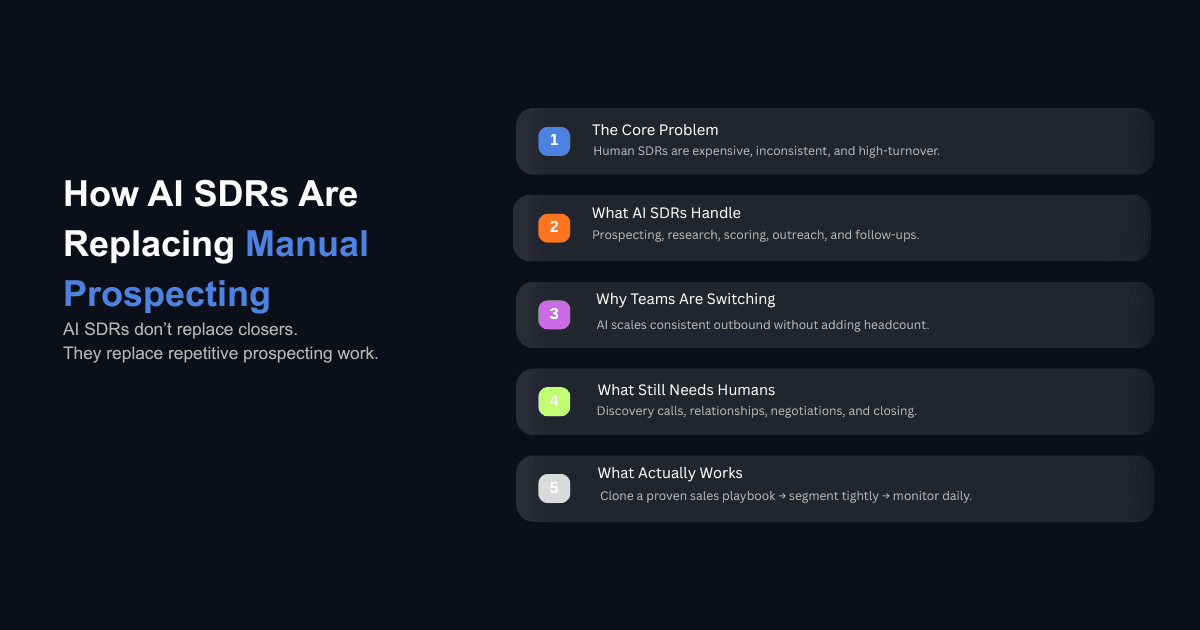
The traditional SDR model has an economics problem that most sales leaders already feel but rarely quantify. A single in-house sales development rep costs $110,000 to $160,000 per year when you add up salary, commissions, benefits, tools, management overhead, and ramp time. SDR turnover sits at roughly 45% annually, which means you are frequently paying to rebuild capacity you already paid for once. The average SDR takes about three months to ramp, stays roughly 14 to 16 months, and gives you about a year of actual productivity before the cycle restarts.
Meanwhile, the AI SDR market grew from $4.39 billion in 2025 to $5.81 billion in 2026, and 36% of B2B companies reduced their SDR headcount in the past year. This is not a coincidence. Companies are finding that AI can handle the repetitive, high-volume prospecting work that burns out human reps, and they are redirecting those savings toward closers and relationship builders.
This article breaks down how AI SDRs actually work in practice, where they perform well, where they still fall short, and how to deploy one without wasting your first quarter on a failed pilot.
What Is an AI SDR and How Does It Actually Work?
An AI SDR is software that automates the early stages of your sales pipeline. It is not a chatbot bolted onto your website. A properly deployed AI SDR handles prospecting, lead research, scoring, message creation, and initial engagement across email, LinkedIn, and sometimes phone.
The five stages AI SDRs cover
The prospecting pipeline, whether run by humans or AI, follows a consistent sequence. First, the system identifies companies and contacts that match your ideal customer profile using databases, intent signals, and firmographic filters. Second, it researches each prospect by scanning their website, LinkedIn profile, recent news, and hiring activity to understand what they care about. Third, it scores and segments those prospects so that different campaigns can carry different messaging. Fourth, it creates personalized outreach, including email copy, follow-up sequences, and sometimes call scripts, tailored to each segment. Fifth, it handles the actual engagement by sending messages, responding to replies, handling basic objections, and booking meetings into your calendar.
What makes this different from the sequencing tools of five years ago is that AI SDRs operate with context. They can pull information from a prospect's website and reference it in the email. They can adjust follow-up timing based on engagement signals. They process the research and writing steps that used to consume 70% of a human SDR's day and compress them into minutes.
Where AI SDRs fit vs. where humans still close
This distinction matters because it changes how you staff and budget. AI SDRs are strong at driving awareness and qualification, which covers the top of the funnel. They are not replacing your account executives, sales directors, or anyone who handles complex deal cycles, contract negotiations, or relationship management. The companies getting results are using AI to generate more qualified conversations for their human closers, not to eliminate the humans who close.
One enterprise client doubled their sales efficiency by using AI-driven insights to engage leads at the right time with data-backed decisions. The AI handled the research and timing, and the humans handled the conversations that converted.
Why Manual Prospecting Is Losing Ground
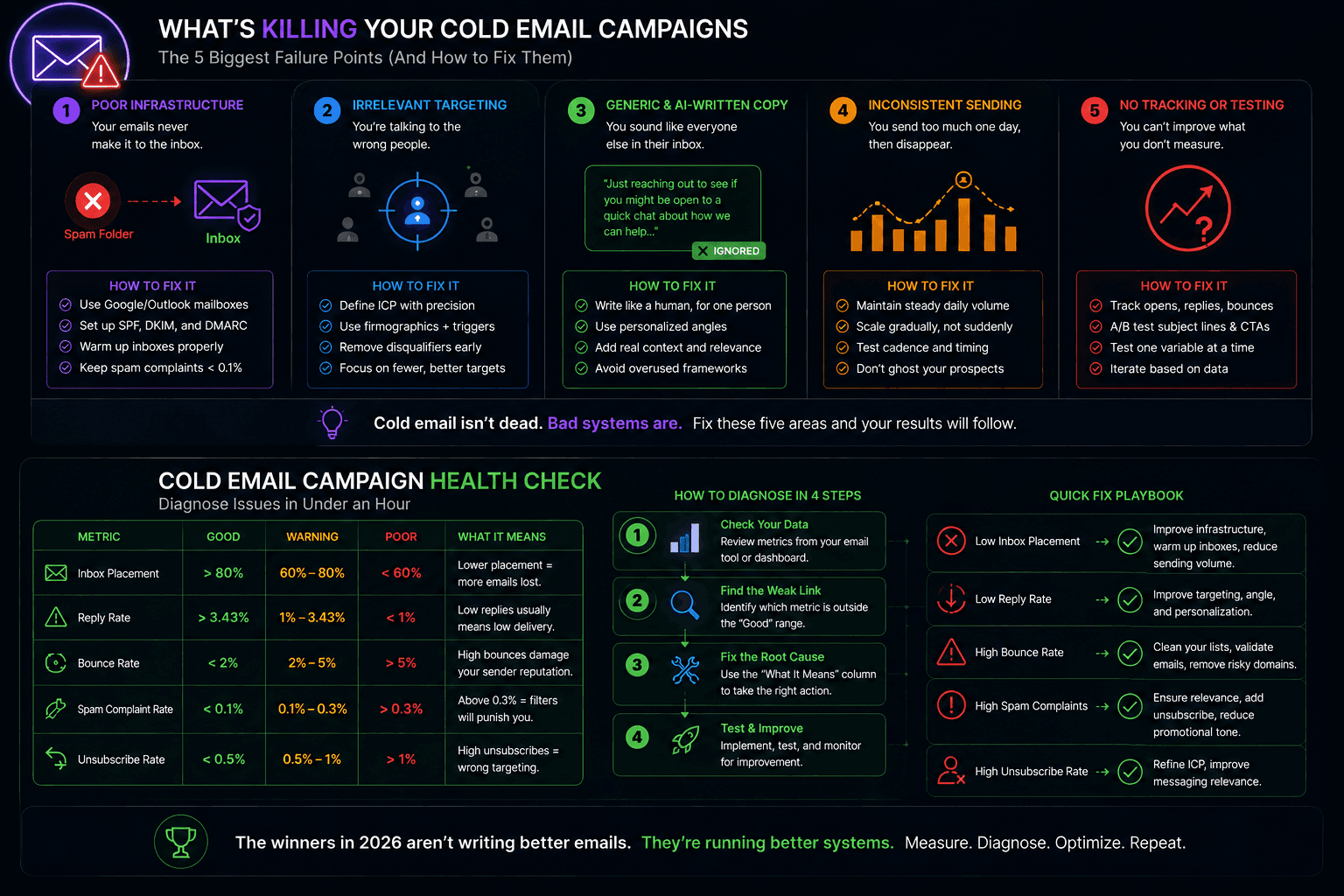
The pressure on manual prospecting comes from two directions simultaneously: the cost of doing it with people keeps rising, and the quality bar for outbound keeps getting higher.
The real cost of a human SDR
When you budget for an SDR, the salary line is the smallest part of the problem. The fully loaded cost includes recruiting fees, onboarding time, tool licenses ($2,000 to $8,000 per rep per year just for sales tech and data), management bandwidth, and the lost pipeline that evaporates every time someone leaves. With SDR tenure averaging 14 to 16 months and ramp consuming the first three, you get roughly a year of full productivity before you are hiring again.
The math gets worse at scale. A 10-person SDR team at $130,000 fully loaded per rep is $1.3 million per year. If you lose 4 or 5 of those reps annually, as the turnover data suggests you will, the cost of rebuilding that capacity adds another layer that rarely shows up in the original headcount plan. This is the operational reality that makes AI agents a fundamentally different investment than traditional sales tools.
The consistency problem that humans cannot solve at scale
Beyond cost, there is a performance consistency issue that even great SDR managers struggle with. Human reps have good weeks and bad weeks. They skip follow-ups. They ignore leads that look unappealing. They interpret training and messaging guidelines differently from each other.
AI SDRs do not have off days. When you give them context and messaging that works, they execute it the same way every time, across every segment, at whatever volume you need. As one SaaS operations leader put it after running AI SDRs for 10 months: the emails do not need to be the best on the planet. They need to be consistently good at scale, and that consistency compounds into results that inconsistent human effort cannot match.
The trade-off is real. The output from an AI SDR will probably not match what your single best human rep could write in a focused hour. But your best human rep does not write in focused hours all day, every day, for months without variation. The AI does.
What Does a Successful AI SDR Deployment Look Like?
Most AI SDR failures are not technology failures. They are deployment failures. Companies buy the tool, skip the preparation, and wonder why the results are mediocre. The pattern is consistent across startups and enterprises alike.
Start with a proven human playbook before handing it to AI
This is the most common mistake, and it shows up at every company size. Early-stage startups that have never closed an outbound deal expect the AI to magically generate customers. Large enterprises with billions in revenue just want to turn on a tool without training it on what has already worked with their human reps.
The AI SDR is not going to invent a sales motion for you. It is going to replicate and scale the one that already works. If you have not proven through founder-led sales or a small SDR team that your messaging, your ICP definition, and your offer actually generate meetings and close deals, an AI SDR will only scale that failure faster.
The goal in the first 30 days is to reproduce the human playbook that works inside the AI system. Take the subject lines that get opens, the email copy that gets replies, the follow-up cadence that books meetings, and feed all of that as context to the AI. You are cloning the best person on your team. If it is just you, clone yourself.
Segment ruthlessly so context stays tight
Generic campaigns produce generic results regardless of whether a human or AI is sending them. The teams seeing strong response rates from AI SDRs are segmenting their outbound to the point where each campaign carries messaging specific to that audience.
This means separating your prospects not just by title and company size, but by scenario. A former customer looking at your pricing page needs different context than a brand-new prospect who has never heard of you. A VP of Sales at a fintech company needs different messaging than a VP of Sales at a SaaS company, even though the title is the same.
The AI SDR will use whatever context you provide, word for word. If that context is broad and generic, the output will be broad and generic. If the context is tight and specific to a segment, the output will reflect that. One operations team running four different AI SDR tools found that hyper-segmented campaigns with tailored context consistently outperformed single-brain campaigns, even when the underlying AI model was the same.
If you are thinking about implementing AI in your business, segmentation quality is one of the first things to get right because it determines the ceiling for everything that follows.
Budget at least two weeks of real ramp time
Nothing about deploying an AI SDR is instant, regardless of what the vendor demo suggests. The email infrastructure alone, including buying domains, setting up dedicated sending addresses, and warming those up, takes two to three weeks. On top of that, you need time to configure your segments, load your context and training data, review the first batch of outputs, and adjust.
During those first two weeks, plan to read everything the AI sends before it goes out. You will catch formatting issues, incorrect dates, spelling variations, and tone problems that only surface at scale. One team found their AI SDR was pulling old event dates from the internet because it scraped outdated pages. Another discovered it was lowercasing their brand name inconsistently. These are small details that compound into credibility problems if you do not catch them early.
After the initial ramp, expect to spend at least 15 minutes a day reviewing what your agents are doing. Check inbound conversations for accuracy. Spot-check outbound messages for quality. Add new context whenever you find scenarios the AI has not been trained to handle. This ongoing maintenance is not optional. It is how you keep the system performing.
Where Do AI SDRs Still Fall Short?
The honest assessment, and the one that separates practical advice from vendor marketing, is that AI SDRs are not a complete replacement for your sales team today. They are strong in specific parts of the pipeline and weak in others.
Relationship building and complex deal cycles
B2B sales at the mid-market and enterprise level still depend on trust, relationships, and nuanced conversations that AI cannot replicate yet. A prospect who is evaluating a six-figure annual contract wants to talk to a human who understands their business, can think on their feet during a discovery call, and will be accountable after the deal closes.
AI SDRs can get you to that conversation faster and more consistently, but the conversation itself still belongs to a person. The companies seeing the best results treat their AI SDR as the engine that fills the top of the funnel so their human reps can focus entirely on the conversations and relationships that actually close deals.
The comparison is not between your best SDR and the AI. It is between the AI and a mediocre or inconsistent human rep. When you invest the time to train your AI SDR properly, upload the right documentation, and read the output exceptions daily, the interaction quality crosses a line where it becomes better than a mediocre human rep who is distracted, undertrained, or about to leave for another company.
Why you still need humans running the system
Even fully automated AI SDR deployments require human oversight. At minimum, you need one person who owns the agents, and ideally two so you have backup coverage. That person monitors output quality, updates segments, loads new contacts, adjusts context when market conditions change, and handles escalations when a prospect asks to speak to a real person.
Without this, your agents will sit idle after they finish a sequence. They will not automatically load the next batch of contacts in most tools. They will not know that your pricing changed last week or that you launched a new product line. The human in the loop is not doing the prospecting work anymore, but they are managing the system that does.
One practical example: a SaaS events company found that their AI inbound agent handled 1.5 million sessions in six months across one website. But maintaining it required daily spot-checks, ongoing context updates, and occasional escalation handling when prospects asked personal questions or tried to break the AI's prompt. The volume scaled massively, but the management overhead did not disappear.
How Should Operations Leaders Evaluate AI SDR Tools?
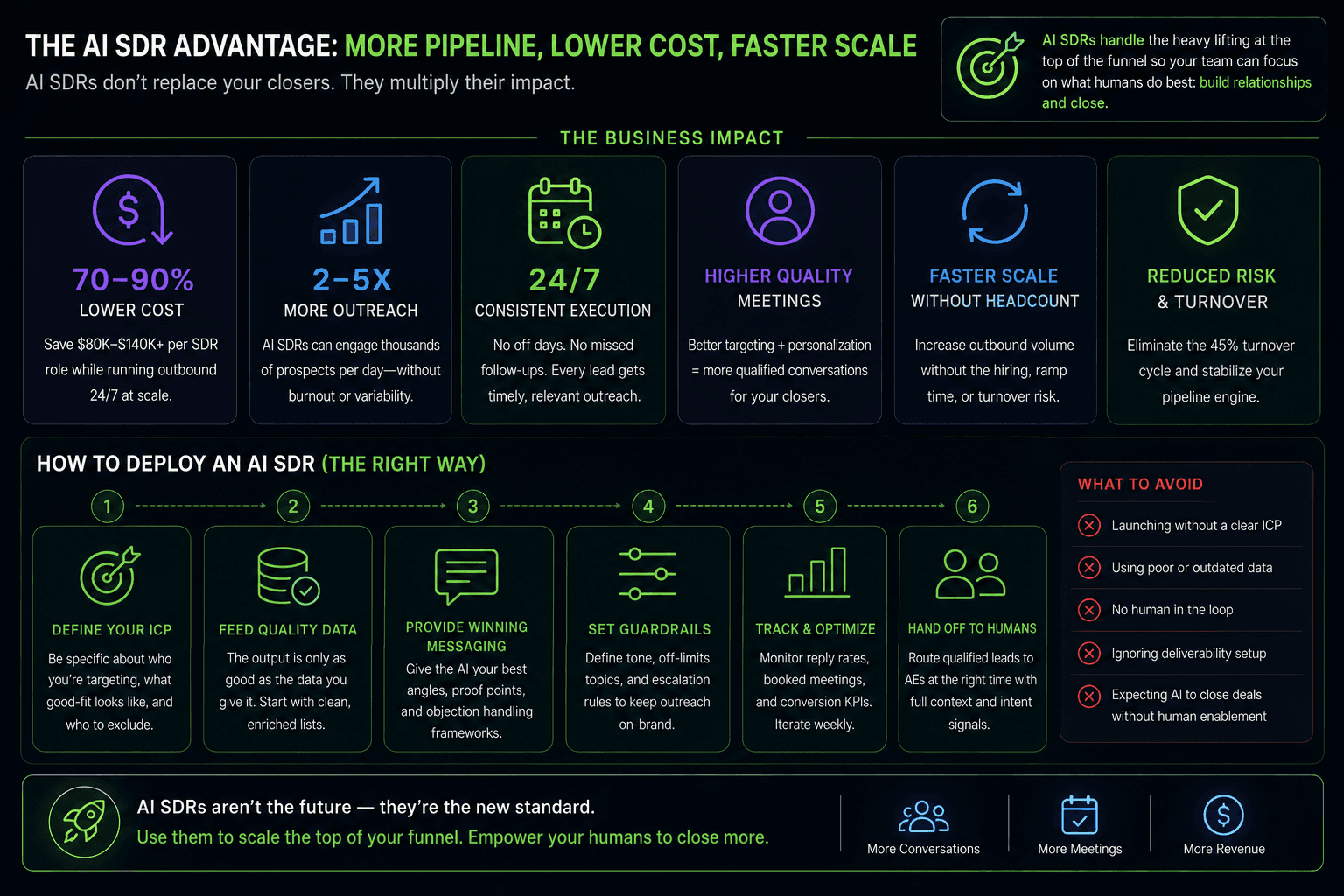
With dozens of AI SDR vendors in the market and new ones launching every quarter, the evaluation process matters as much as the selection.
What to look for beyond the demo
Every vendor demo looks impressive. The real differentiators show up in deployment. Focus your evaluation on data quality (where do they source contacts, and how accurate is that data in your specific market), segmentation capabilities (can you create the kind of hyper-specific segments that actually drive response rates), CRM integration depth (does it flow data back into Salesforce or HubSpot in a way your team can actually use), and deliverability infrastructure (do they handle domain warming, send limits, and inbox placement).
Ask specifically about what happens after the initial sequence finishes. Some tools will just sit idle until you manually reload them. Others, like certain newer platforms, will automatically identify lookalike companies based on who responded and refill your pipeline. That difference in automation depth determines how much ongoing manual work you are signing up for.
When comparing the results you should expect from an AI SDR against AI-written cold outreach in general, remember that the tool is only as good as the playbook you give it. A well-trained AI SDR with tight segmentation and proven copy will outperform a generic AI email generator every time.
The build vs. buy question
Some teams are building their own AI SDR pipelines using tools like Claude Code, Clay, Make.com, and custom API integrations. This approach gives you full control over every step, from lead list generation to email personalization to campaign execution, and can be significantly cheaper than vendor subscriptions at scale.
The trade-off is maintenance. When you build it yourself, you own every integration, every API key, every workflow. If something breaks at 2 AM, there is no vendor support line to call. The general recommendation is to buy when an off-the-shelf tool covers 90% of what you need, and build only when your use case is specific enough that no existing product handles it well.
For operations leaders trying to quantify the impact before committing, auditing your current sales calls with AI can reveal patterns in what messaging works, which objections come up most, and where your reps are losing deals. That data becomes the foundation for training any AI SDR you deploy.
Where This Is Heading
AI SDRs are not a future concept. They are a current operational decision. The market is growing at 32% annually. The companies reducing SDR headcount are not shrinking their pipelines; they are shifting how those pipelines get built.
The playbook is straightforward: prove your sales motion works with humans first, clone it into an AI system, segment your outreach so the context stays sharp, and keep a human in the loop to maintain quality and handle the conversations that close deals. The teams that treat AI SDRs as a way to scale what already works, rather than a replacement for figuring out what works, are the ones seeing measurable returns.
If you are evaluating whether AI SDRs make sense for your sales operation, or you have tried one and the results were underwhelming, the problem is usually in the deployment rather than the technology. Book a call with us to walk through your current pipeline and identify where AI can make an immediate, measurable difference without the failed pilot.