Article
Jun 29, 2026
What Is Revenue Intelligence? A Guide for B2B Teams
Revenue intelligence unifies sales data and uses AI to surface deal risk and forecast gaps. A plain guide for B2B teams in 2026.

Most pipeline reviews run on a version of reality that nobody fully trusts. Leadership looks at a dashboard, reps defend their deals, and everyone leaves the meeting with a number that feels roughly right. The gap between what the dashboard shows and what is actually happening inside those deals is a data problem, and it is the problem revenue intelligence was built to solve.
Revenue intelligence has moved from a niche RevOps term to something most B2B sales leaders are now expected to understand. The shift toward efficient growth and the rise of the Chief Revenue Officer have pushed it into nearly every go to market conversation. This guide explains what revenue intelligence is, how it works, how it differs from the tools it gets confused with, and where most implementations quietly fall apart. It also covers a point that vendor content tends to skip. Revenue intelligence is only as accurate as the pipeline and the data feeding it, which means the work starts well before any platform gets switched on.
What Is Revenue Intelligence?
Revenue intelligence is the practice of unifying sales, marketing, and customer data and using AI to surface deal risk, pipeline gaps, and the next action that moves a deal forward. Instead of relying on what a rep remembered to type into the CRM, it builds a picture of each deal from what actually happened across calls, emails, and meetings. ZoomInfo describes it as replacing gut feel selling with decisions backed by data across the full revenue cycle.
It rests on three pillars. Data unification brings CRM records, marketing activity, and communication data into one view. AI analysis reads that data to identify patterns, predict outcomes, and flag risk. Actionable guidance turns the analysis into real time recommendations a rep can use during the day rather than a report they read after the quarter closes.
The category grew quickly because manual CRM entry never scaled in complex B2B sales. One useful way to frame it, described well by Samskit, is that a CRM report is the box score while revenue intelligence is the game tape. The deeper issue is data creation rather than reporting, because the CRM only knows what someone bothered to enter and update on time. The market reflects how seriously companies are taking this. Custom Market Insights values the revenue intelligence market at roughly 3.8 billion dollars in 2024, with projections near 10.7 billion by 2033. Analysts size the category differently, but the upward direction holds across every estimate.
How Revenue Intelligence Works
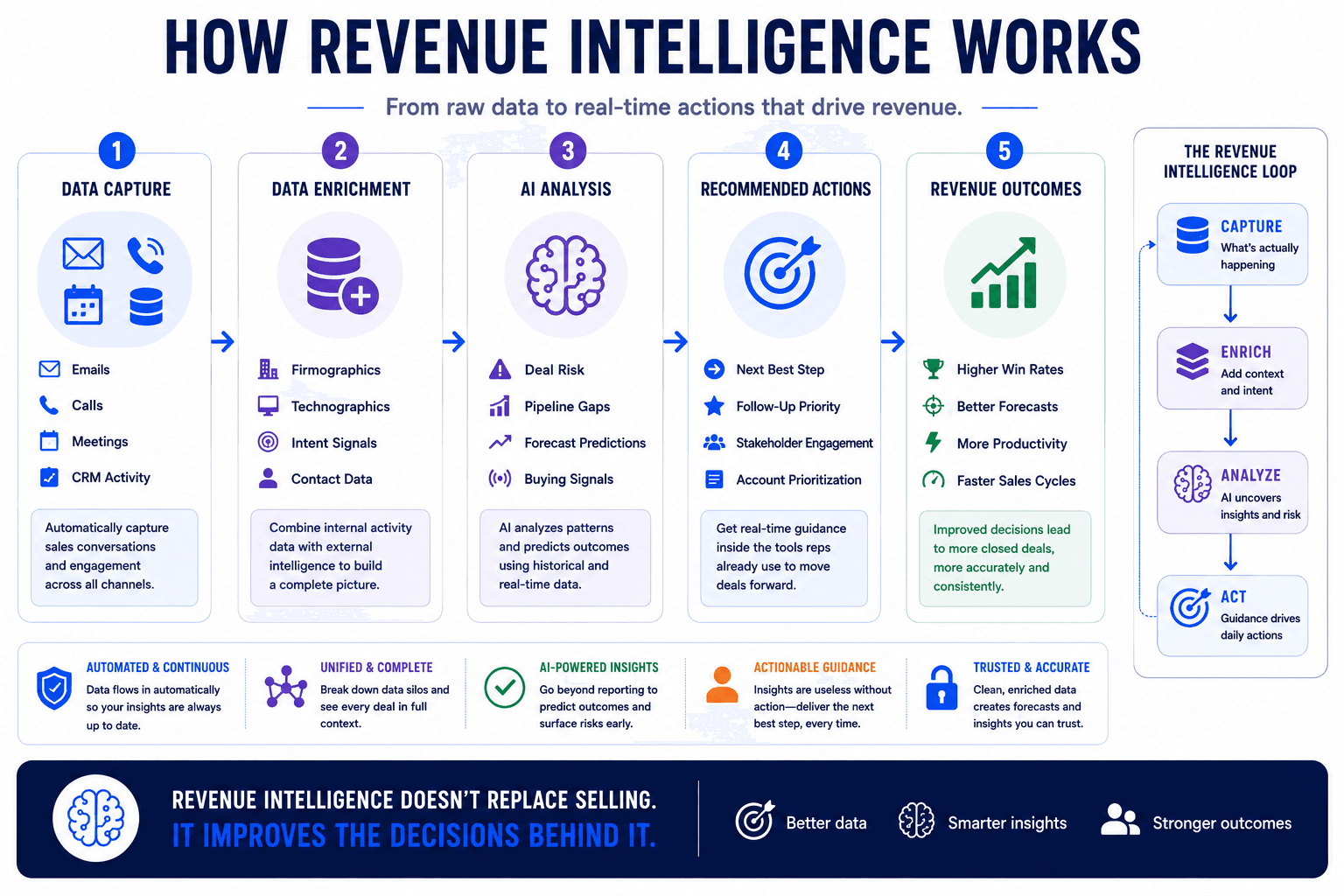
A revenue intelligence system runs on a loop that moves data from capture to action with as little manual effort as possible.
It starts with capture. The system automatically gathers data from emails, calls, meetings, and CRM activity, so the record reflects what happened rather than what a rep had time to log. Conversation data matters here because the richest signals in a deal often live in what the buyer said, not in the stage field. Teams that want to see this in practice can read our walkthrough on analyzing sales calls with AI to extract objections and buying signals from every conversation.
Next comes enrichment. Internal activity data gets layered with firmographic, technographic, and intent data from external providers. This is where intent data earns its place, since it shows which accounts are actively researching a solution and helps the system prioritize them. Enrichment also fills the gaps that CRMs leave behind, including missing contacts and outdated titles, which is why lead list enrichment and clean prospecting data sit underneath any reliable revenue intelligence setup.
Then the system analyzes and acts. AI scores accounts and deals, predicts which ones are likely to stall or close, and delivers prioritized recommendations inside the rep's daily workflow. The output is meant to change what a rep does next, not just describe what already happened.
Revenue Intelligence vs. Sales Intelligence vs. CRM Analytics
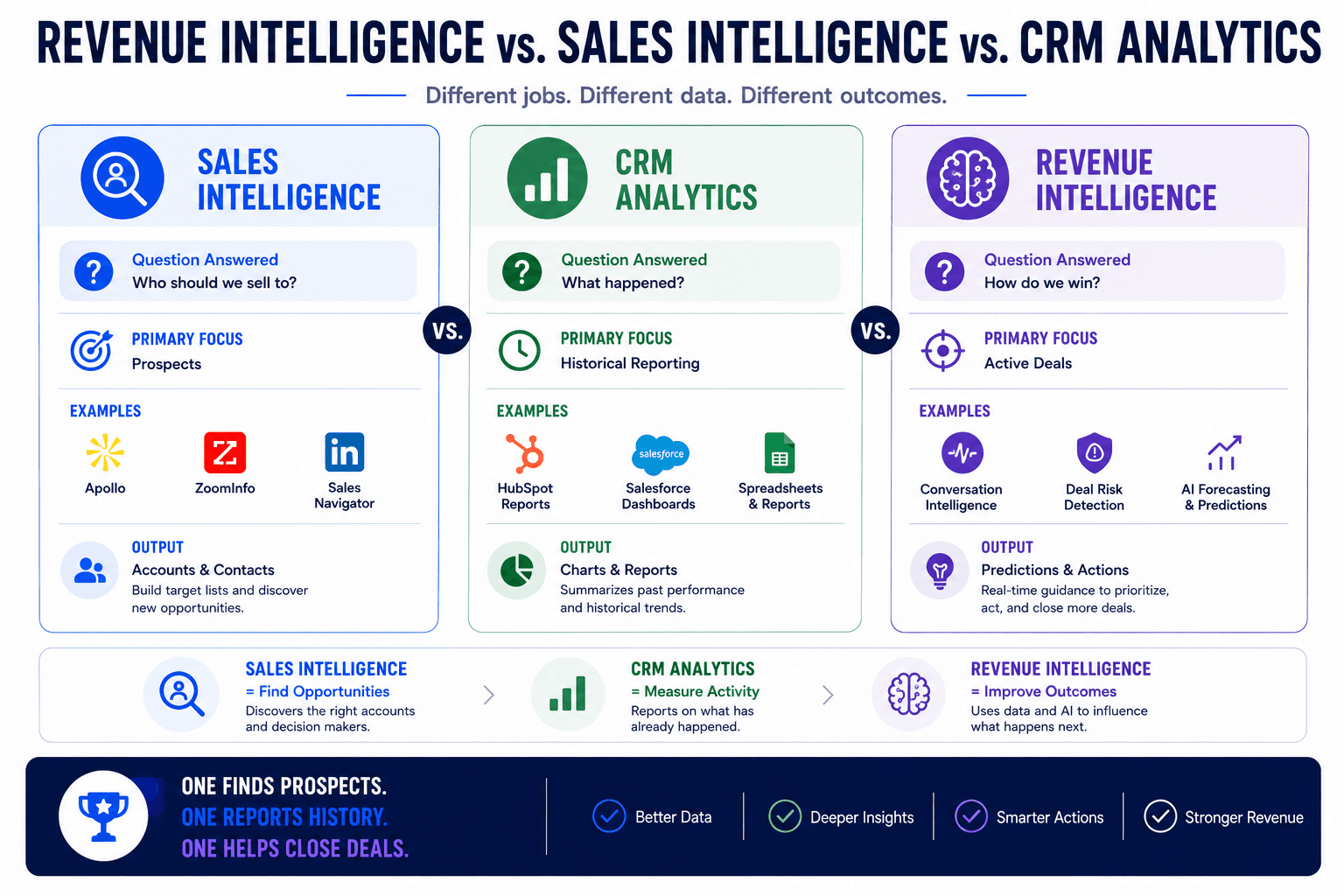
These three terms get used interchangeably, and vendors benefit from the confusion. The cleanest way to separate them is to ask what job each one does.
Sales intelligence finds and qualifies prospects. It provides the external data layer of contact information, firmographics, and company profiles that SDRs use to build target lists. It answers who you should sell to, and it feeds the top of the funnel. Account research and buying signals live in this layer.
CRM analytics reports on data already stored in the system. It shows deal counts by stage, win rates, and historical trends. The limitation is that it inherits whatever the rep entered, so a vague next step or a stale close date becomes a clean looking chart built on a shaky input.
Revenue intelligence takes the external data, combines it with internal CRM records and interaction data, and produces predictive insight, deal guidance, and pipeline analytics. It answers a different question than sales intelligence does, which is how you win the deals already in motion. Sales intelligence is a foundational input to revenue intelligence rather than a competing category.
What Revenue Intelligence Changes for B2B Teams
The practical payoff shows up in four places: forecast accuracy, rep productivity, deal prioritization, and team alignment.
Forecast accuracy is the headline benefit. Teams using traditional forecasting methods tend to hover near 50 percent accuracy, while teams that weight forecasts with real engagement signals push much higher. Platforms built around this, such as those tracked in Landbase's category overview, report forecast accuracy in the mid 90s and conversation intelligence delivering meaningful gains in deal velocity and pipeline. Spotlight.ai reports roughly a 28 percent win rate improvement on deals where qualification data is captured consistently.
Productivity improves because reps spend less time on research and manual entry and more time selling. This is the same logic behind AI SDRs, which automate the repetitive prospecting work so the team can focus on conversations.
Prioritization gets sharper because the system ranks accounts by genuine buying interest rather than alphabetical order or rep preference. Alignment improves because sales, marketing, and RevOps work from the same data instead of three competing versions of the truth. One enterprise sales team Novoslo worked with doubled its sales efficiency after moving to insights driven by AI, engaging leads at the right time with decisions backed by data rather than instinct.
The metrics worth tracking cluster around pipeline health and deal momentum, including open pipeline by stage, stage conversion rates, stalled deals, and stakeholder engagement across the buying committee. The return can be significant when the foundation is solid. Salesmotion points to a Forrester finding of 481 percent ROI over three years on one major implementation, alongside McKinsey figures of 15 percent higher efficiency and 20 percent shorter sales cycles.
Why Revenue Intelligence Implementations Fail
The technology rarely fails on its own. Implementations fail for reasons that have more to do with process and data than with the platform.
The most common failure is buying technology before fixing governance. When teams purchase an analytics platform before agreeing on the data model and metric definitions it will surface, the tool inherits inconsistent inputs and produces reports nobody trusts. As one RevOps analysis puts it, visibility gets mistaken for control, and you end up with better reporting on top of the same broken mechanics.
Data quality is the second failure point, and it is the one most relevant to anyone running outbound. Revenue intelligence operates on partial information when contact data is wrong or incomplete, and the scale of that problem is large. A 2025 Validity survey found that 37 percent of CRM users reported losing revenue as a direct result of poor data quality. Confidence in the underlying data is low across the board, with one industry study reporting that only 27 percent of teams felt very confident in their CRM and AI generated data. Verified contacts and clean lists are not optional here, which is why email verification belongs in the foundation rather than as an afterthought.
Adoption is the third failure point. Many tools capture data but log it as unstructured notes that RevOps cannot report on, which means the intelligence technically exists but never reaches a decision. Mid-market teams in particular struggle when they buy enterprise platforms that assume a dedicated RevOps team and pristine CRM hygiene they do not have. Industry estimates put the share of RevOps implementations missing first year ROI goals around 67 percent, usually because of an overloaded rollout rather than a bad product.
The honest summary is that AI accelerates whatever process it sits on top of. A disciplined revenue process gets faster, and a weak one just produces confident reports of pipeline that was never real. If deals can move stages without real buyer movement, revenue intelligence will help you observe that failure faster rather than prevent it. The work of defining clean stages, trustworthy data, and a pipeline built on real demand comes first. This is the territory where a GTM engineer earns their keep, and where teams that would rather build their own lightweight layer can set up Claude Code for their GTM team instead of carrying a heavy platform.
Common Questions About Revenue Intelligence
Do you need a dedicated RevOps team to use revenue intelligence?
Not necessarily, though it depends on the platform. Enterprise tools were largely built for organizations with 500 or more reps, dedicated RevOps headcount, and the budget for long implementation cycles. Smaller and mid-market teams often pay for features they never configure because nobody owns the setup. If you do not have RevOps capacity, look for systems that deliver insight inside the tools your team already uses, such as the CRM, email, and Slack, rather than a separate platform that requires its own login and ongoing maintenance.
Is revenue intelligence just call recording with a new name?
No. Call recording produces an archive, and an archive is not intelligence on its own. A 45 minute transcript only becomes useful when something extracts the qualification signals from it, including budget mentions, the economic buyer surfacing, or a competitor getting named. Revenue intelligence is the layer that reads those interactions and routes what matters to a decision. Recording is one input, not the product.
How is revenue intelligence different for mid-market versus enterprise?
Enterprise implementations assume infrastructure that mid-market teams usually lack, including pristine CRM hygiene and established forecasting processes. The mid-market question is less about which platform has the most features and more about which one will work without a RevOps team to run it. Lighter and more automated setups tend to fit better, and connecting verified B2B data directly to your own AI tools through approaches like Claude MCPs can deliver much of the value without enterprise overhead.
What data quality do you need before starting?
Enough that the team trusts the output. Revenue intelligence built on incomplete contact records, duplicate accounts, and stale pipeline produces confident forecasts of unreliable numbers. Before adding an intelligence layer, it is worth auditing CRM accuracy, closing obvious coverage gaps, and making sure the pipeline reflects real demand. Teams that struggle to generate clean pipeline in the first place should address that root cause, since pipeline generation problems usually come from broken systems rather than weak reps.
The Bottom Line
Revenue intelligence is a genuine shift in how B2B teams manage deals, moving pipeline decisions from instinct to evidence. The benefits in forecast accuracy, productivity, and alignment are real and well documented. The results depend almost entirely on what sits underneath the platform, which is a clean revenue process and accurate data.
For teams running outbound, this is the part worth holding onto. A revenue intelligence system can only score and forecast the pipeline you give it. Strong forecasting on top of weak pipeline still misses, because the underlying demand was never there. Clean data, real buying signals, and qualified pipeline are the inputs that make every layer above them work.

If you want pipeline built on verified data and genuine buying signals rather than guesswork, book a call with our team and we will walk through what that looks like for your business.