Article
Jun 5, 2026
Why Most SDR Teams Struggle to Generate Pipeline
Most SDR teams miss quota because of broken systems, not bad reps. Here's what's actually failing and how to fix pipeline generation.
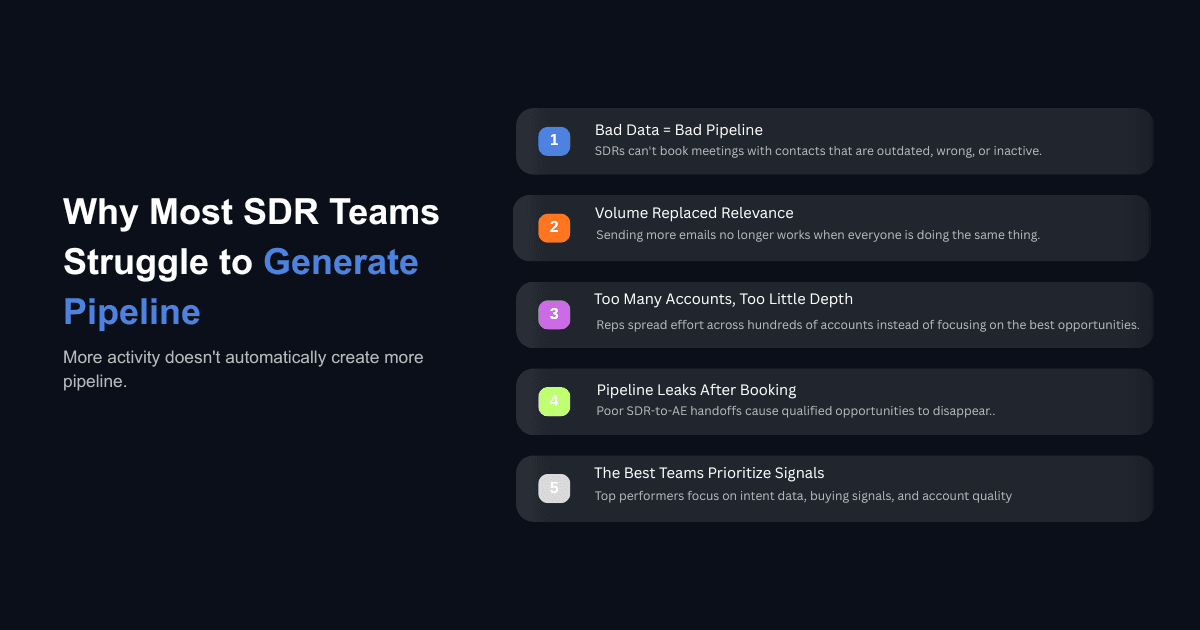
SDR teams are sending more emails, making more calls, and using more tools than at any point in the last decade, and pipeline output is going in the opposite direction. The activity is there. The results are not.
This is not a motivation problem or a hiring problem. When the majority of sales development reps across B2B are missing quota at the same time, you are looking at a structural issue that sits underneath the people doing the work. The playbooks most teams run on were built for a market that no longer exists, where inboxes were less crowded, connect rates were higher, and buyers responded to volume-based outreach.
This post breaks down the specific reasons SDR pipeline generation is stalling, where most teams are misdiagnosing the problem, and what the teams that are actually building pipeline in 2026 are doing differently.
The Numbers Tell the Story
Quota Attainment Is Collapsing Across B2B
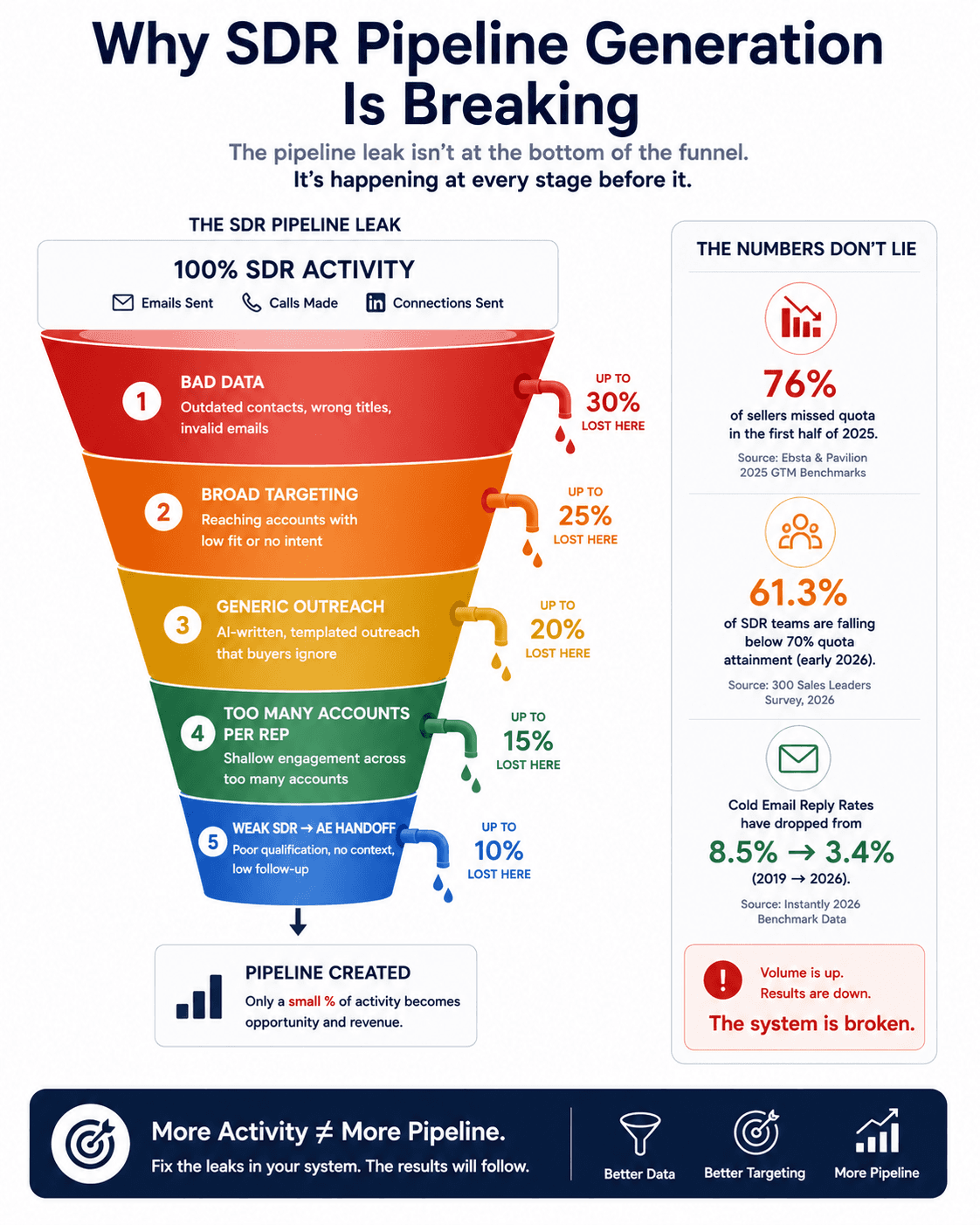
The data on SDR performance has shifted in a direction that is difficult to ignore. According to Ebsta and Pavilion's 2025 GTM Benchmarks, 76% of sellers missed quota in the first half of 2025. Salesforce's State of Sales report found that only 28% of reps met quota in 2023, down from 44% the year before. More recently, survey data from 300 sales leaders indicates that 61.3% of SDR teams are falling below 70% quota attainment as of early 2026.
These numbers are not about individual rep performance. Many companies quietly lowered quotas through 2024 and 2025 to keep attainment figures from looking worse, and the numbers still dropped. When most of an industry misses the same target at the same time, the system is what needs examining.
Reply Rates and Connect Rates Have Cratered
The channels SDR teams rely on have become significantly harder to use effectively. Average cold email response rates have dropped from 8.5% in 2019 to roughly 3.4% in 2026, according to Instantly's benchmark data. Cold call connect rates sit between 3% and 10%. Quality conversations per SDR per day have declined 55% since 2014, landing at around 3.6 per day.
These are not temporary dips caused by seasonal buying cycles. Inbox filtering has gotten more aggressive, buyers have become more resistant to unsolicited outreach, and the sheer volume of automated messages flooding every channel has made it harder for any individual message to land. The math that used to support high-volume SDR motions no longer produces the same output.
Why Volume Stopped Working
Data Quality Is the Invisible Bottleneck
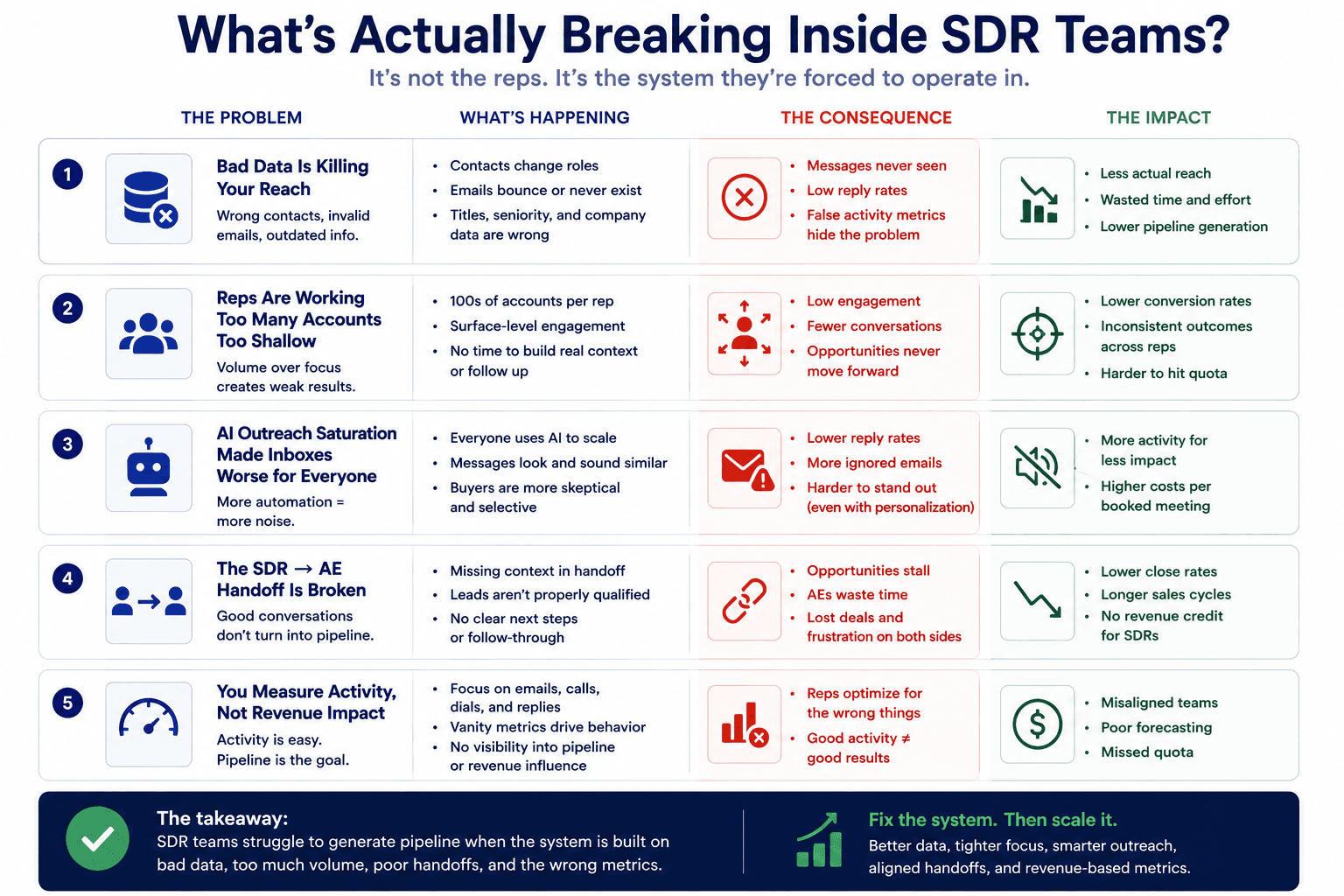
Most SDR teams assume their contact data is accurate enough to work with, and most of them are wrong. Research from Prospeo's SDR challenges report found that 43% of SDRs identify bad data as their number one problem. When a team believes they are reaching 1,000 prospects per week but a meaningful percentage of those contacts have outdated emails, wrong titles, or have left the company entirely, the actual reach is much smaller than what the activity metrics suggest.
This creates a misleading picture. Managers look at dashboards showing high email volume and assume the team is doing enough outreach. In reality, a large portion of that activity is going nowhere. The problem looks like a messaging issue or a rep performance issue, but it is actually a data accuracy issue that sits upstream of everything else.
36% of B2B companies cut their SDR teams in 2025, and many of those cuts were driven by frustration with output that never matched the investment. In a lot of those cases, the reps were not the problem. The data they were working from was.
AI-Generated Outreach Made Inboxes Worse for Everyone
The widespread adoption of AI writing tools for cold outreach created a paradox. Every team now has the ability to produce personalized-sounding emails at scale, which means buyers are receiving more outreach that all looks and sounds similar. The bar for what counts as "personalized" has moved because the baseline quality of automated messaging went up, and with it, the volume went up too.
One real-world test documented by Equanax illustrates this clearly. An AI SDR platform was given full control of outbound for over two months, sending more than 20,000 messages and 3,000 LinkedIn connection requests. Open rates exceeded 40% and click-through rates hit 8%, but the campaign produced zero booked meetings. Activity metrics looked promising at the surface while the pipeline impact was nonexistent.
If you are evaluating which AI writes the best cold outreach, the tool itself matters less than the targeting and workflow underneath it. AI amplifies whatever system already exists, which means it amplifies bad targeting just as efficiently as good targeting.
What's Actually Breaking Inside SDR Teams?
Reps Are Working Too Many Accounts Too Shallow
The most common operational mistake in SDR management is assigning too many accounts per rep. When an SDR is responsible for hundreds of accounts, the math forces them into shallow engagement across all of them rather than deep engagement with the ones most likely to convert.
Data from Chili Piper's SDR leadership guide showed reps sending 200+ emails per day across 600 to 700 accounts without consistently hitting quota. The same guide documented that after shifting to smaller, more focused account lists, teams generated nearly double the revenue. The reps did not get better overnight. The system they operated inside changed.
Account overload also creates an equity problem. Tenured reps tend to get access to better accounts, while newer reps inherit whatever is left. This makes it look like experience is the differentiator when the actual differentiator is account quality.
The SDR-to-AE Handoff Is a Pipeline Leak
Pipeline does not just disappear at the top of the funnel. A significant amount of it leaks out during the transition from SDR to Account Executive. Research from Prospectory estimates that 27% of qualified pipeline is lost at the handoff stage because context, urgency, and buyer intent disappear between the two roles.
When an AE takes a meeting that an SDR booked and spends the first ten minutes re-asking questions the prospect already answered, the prospect's confidence drops. They came in expecting a continuation of the conversation and instead got a reset. For a team booking 400 meetings per quarter at a $45K average contract value, a 27% failure rate at handoff represents a substantial amount of lost revenue that never shows up in the pipeline review because it was technically "generated."
Teams that want to fix pipeline need to look at what happens after the meeting is booked, not just how many meetings are booked. Auditing sales calls in seconds using AI can surface exactly where these handoff breakdowns occur.
Nobody Measures Quality Until It's Too Late
Most SDR teams are measured on activity counts and meetings booked. The problem is that these metrics do not tell you whether the pipeline being created will actually convert. An SDR who books 15 meetings where 10 are unqualified (wrong persona, no budget, bad timing) looks productive on a dashboard but is creating work for AEs that does not lead to revenue.
The metric that matters most is what percentage of SDR-sourced opportunities actually close. If SDR-sourced deals close at 10% while marketing-sourced deals close at 25%, the SDR team is targeting the wrong prospects regardless of how many meetings they book. Pipeline dollars matter more than pipeline count, and most teams do not track this distinction until a quarter has already gone sideways.
Does AI Fix the SDR Problem or Make It Worse?
What AI Does Well in Sales Development
AI is genuinely useful for specific parts of the SDR workflow. Lead enrichment, intent signal detection, call analysis, and initial research are areas where AI reduces the administrative load on reps and frees up time for actual selling. SDRs spend roughly 70% of their time on research and administrative tasks rather than conversations, which means there is a large amount of low-value work that can be handled by automation without losing anything.
Analyzing sales calls for coaching patterns is one example where AI adds clear value. Instead of managers listening to full recordings, AI can extract objections, buying signals, and skill gaps from every call and surface them in minutes. This kind of application directly improves pipeline quality because it feeds back into how reps handle conversations.
The key distinction is understanding the difference between AI agents and AI tools. A tool helps a rep do a task faster. An agent can handle an entire workflow. Most SDR teams are buying tools when what they need is a better system, and no tool fixes a broken system.
Where Automation Fails Without a System Underneath
AI does not replace the need for clear targeting criteria, accurate data, a defined ICP, and a functional handoff process between SDR and AE. When teams deploy automation on top of broken processes, they get the same bad outcomes faster and at higher volume.
This is why most AI initiatives fail in general. The expectation is that the technology will compensate for operational gaps, but what actually happens is that the technology exposes them. If your targeting is off, AI will send more messages to the wrong people more quickly. If your qualification criteria are vague, AI will book more unqualified meetings more efficiently.
Implementing AI with a workflow-first approach means fixing the underlying process before adding automation on top of it. The teams getting results from AI in their SDR motion built the system first and layered the technology on second.
How High-Performing Teams Are Building Pipeline in 2026
Fewer Accounts, Deeper Engagement
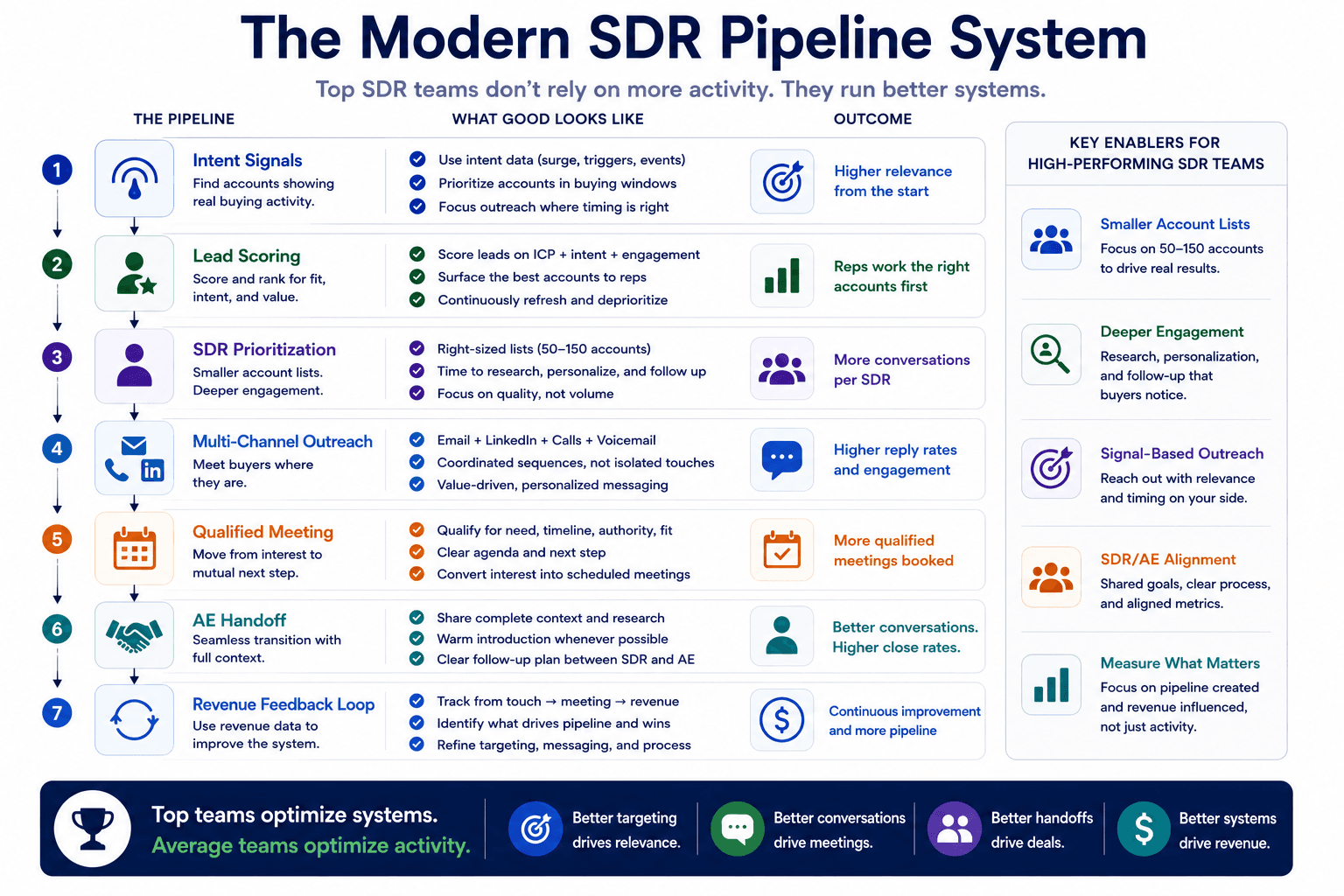
The teams producing the most pipeline per rep in 2026 are working fewer accounts with more depth. Instead of spreading 50 to 80 daily calls across hundreds of accounts, they are concentrating effort on a smaller set of accounts that match their ICP closely and engaging those accounts across multiple channels with research-backed messaging.
Multi-touch sequences that combine email, phone, and LinkedIn convert at 4 to 7%, roughly 2 to 3 times higher than any single channel alone. Top-quartile SDRs generate 12 to 15 qualified meetings per month compared to the median of 8 to 10, and the difference is almost entirely explained by account selection and engagement depth rather than raw activity volume.
One enterprise client we worked with doubled their sales efficiency by restructuring how their team prioritized leads, using AI to identify the right timing for engagement and focusing reps on data-backed decisions rather than activity quotas. The shift was operational, not motivational.
Signal-Based Prioritization Over Spray-and-Pray
High-performing teams are investing in intent signals and behavioral data to decide which accounts to engage and when. Instead of asking SDRs to work a static list from top to bottom, they feed reps a daily set of accounts showing buying signals such as website visits, content downloads, job postings that indicate a relevant need, or technographic changes.
This approach treats the SDR's time as a finite resource and allocates it toward the accounts most likely to convert, which is a fundamentally different operating model than assigning a large territory and telling reps to figure it out. Automating parts of the sales workflow with reusable AI skills for research, outreach prep, and follow-up can free reps to focus entirely on conversations rather than administrative setup.
Teams using the right automation tools for lead scoring, enrichment, and signal detection are seeing meaningfully better conversion from the same headcount, because the headcount is pointed at the right accounts.
Tighter Feedback Loops Between SDR, AE, and Marketing
Pipeline generation is not solely an SDR problem, and treating it as one is part of why it breaks. Only 8% of companies report strong alignment between sales and marketing, and the breakdown most often occurs at the handoff from nurture to sales. Less than 35% of engaged contacts even get a follow-up from the sales team.
The fix is creating a closed loop where AE feedback on meeting quality flows back to SDR targeting criteria, and marketing data on which content and channels produce engaged prospects flows into SDR prioritization. When these three functions operate as separate departments with separate metrics, each one optimizes for its own numbers without visibility into whether those numbers translate to revenue.
When It Makes Sense to Outsource Pipeline Generation
Not every company needs to solve this problem internally. Building and maintaining an SDR team requires ongoing investment in hiring, training, tooling, management, and data infrastructure. For companies where outbound is important but not a core competency, or where the cost of ramping and retaining SDRs exceeds the pipeline value they produce, outsourcing the function can produce better results at lower cost.
The key is working with a partner that operates on outcomes rather than activity. A model where you pay for meetings that actually show up aligns incentives correctly because the partner only gets paid when the pipeline is real. This removes the risk of paying for volume that does not convert, which is the same problem that plagues most internal SDR teams.
This approach works well when combined with AI automation in customer-facing operations and a broader strategy for streamlining operations with AI, because it allows the business to focus internal resources on closing deals and serving customers while pipeline generation is handled by a team that specializes in it.
The Takeaway
SDR pipeline struggles in 2026 come down to three things: the data reps work from is worse than most leaders realize, the systems reps operate inside reward activity over outcomes, and the handoff between pipeline generation and pipeline conversion is leaking qualified opportunities.
Fixing this requires looking at the system rather than the reps. Clean the data, reduce account loads, measure quality instead of volume, and create feedback loops between every function that touches pipeline. The teams doing this are building more pipeline with fewer reps, which is the opposite of how most companies are trying to solve the problem.

If your SDR team is generating activity but not pipeline, and you want a partner that only gets paid when qualified meetings show up, book a call with us and we will walk through what a performance-based pipeline model looks like for your business.