Article
Jun 22, 2026
What Is Intent Data? A Practical Guide for B2B Teams
Intent data shows which B2B accounts are researching now. A practical guide to the types, signals, and how to turn them into booked calls.
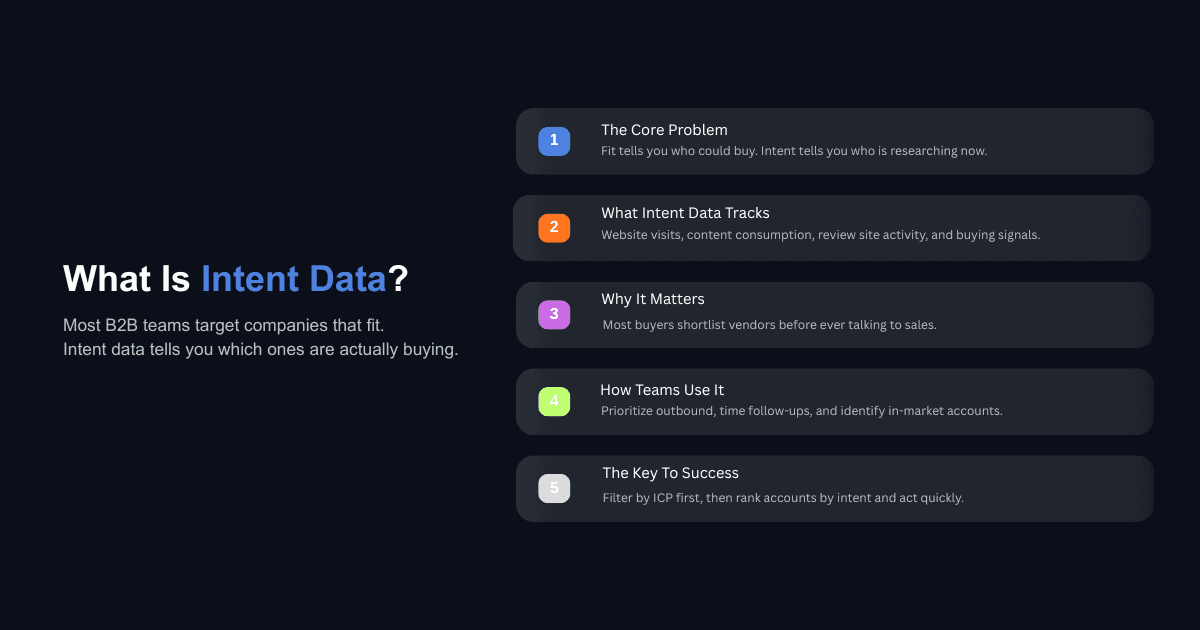
Most outbound lists are built on fit alone. You pull every company that matches your ideal customer profile, hand the list to a rep, and hope a few of them happen to be looking for what you sell this quarter. The problem is that on any given day only a small slice of that list is actually in the market. Everyone else is a guess.
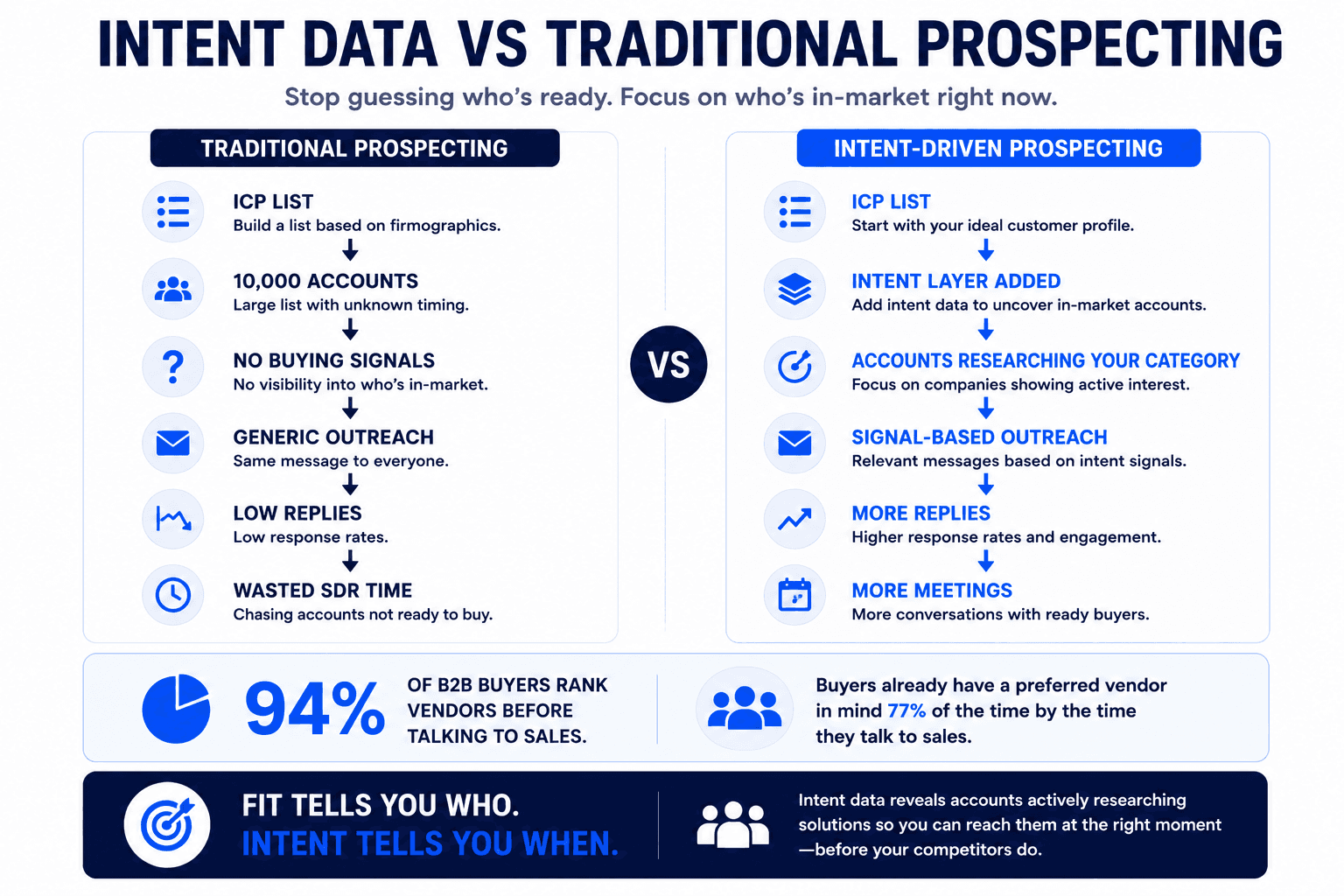
Intent data closes that gap. It tells you which accounts are researching solutions in your category right now, so your team spends its hours on the companies that are already moving toward a decision. By the time a buyer fills out a form, the work is mostly done. Research from 6sense's 2025 Buyer Experience Report found that 94% of B2B buying groups had already ranked their preferred vendors before talking to sales, and they bought from that early favorite 77% of the time. If you cannot see the research that leads to that ranking, you are not in the deal.
This guide covers what intent data is, where it comes from, how it gets collected, and how B2B teams turn it into booked meetings without drowning in noise.
What Is Intent Data?
Intent data is behavioral information that shows which companies are actively researching a solution in your category. It captures digital signals like content downloads, search behavior, website visits, and review site activity, and uses them to identify accounts that are in-market before they raise their hand.
You will see it called buyer intent data, B2B intent data, or sales intent data. The underlying idea is the same across all of them: behavioral signals that tell you which accounts are evaluating, so you can reach them at the right moment.
The distinction worth holding onto is the one between fit and timing. Firmographic data, things like company size, industry, and revenue band, tells you whether a company looks like a good customer. Intent data tells you whether that company is doing something about its problem this week. A firmographic profile says an account belongs on your list. Intent says it belongs at the top of it. The combination is what makes the data useful, and it is why most teams now treat intent as a layer on top of their ICP rather than a replacement for it.
Timing matters because so much of the buying process happens out of view. B2B buyers complete 60 to 90% of their decision-making before they ever contact a vendor, and review around 11 pieces of content along the way. A large share of that research happens in what teams call the dark funnel, the invisible evaluation phase where buyers compare options without filling out a single form. Intent data is the closest thing teams have to a window into that phase. The category has grown into roughly a $4.5 billion market in 2026 as a result.
This sits alongside the broader set of buying signals that GTM teams use to find ready accounts. Intent data is one important category within that wider picture.
The Main Types of Intent Data
Intent data falls into a few distinct categories, and each one shows a different part of buyer behavior. Understanding the differences helps you build a complete view of who is in-market and how seriously.
First-Party Intent Data
First-party intent comes from your own digital properties: your website, CRM, and marketing automation. It shows what pages a known prospect viewed, which assets they downloaded, and how they engaged with your emails. A pricing page visit, a demo request, or a returning visitor reading three product pages in one session all fall into this bucket.
First-party data is the highest quality signal you have because these people are researching you specifically rather than your category in the abstract. The limitation is coverage. You only see the accounts that already came to your properties, which means you miss everyone researching the problem elsewhere before they reach your brand. That is the reason teams pair it with outside sources.
Third-Party Intent Data
Third-party intent is gathered across the wider web from publisher networks, content syndication platforms, and review sites like G2 and TrustRadius. It monitors research behavior off your own properties and flags when a company is consuming content related to your business. Review site activity is particularly valuable because someone comparing vendors on G2 is usually deep into an active evaluation rather than browsing casually.
The trade-off with third-party data is precision. It catches accounts earlier and expands your view well beyond your CRM, but most of it arrives at the company level rather than the individual level, so you still have to work out which person to contact. Bombora runs the largest cooperative behind this kind of data, and many other providers license its signals inside their own platforms.
Derived and Guided Intent
Beyond the first and third-party split, providers often describe intent across a continuum of signal strength. Derived intent blends first and third-party signals to flag interest behaviors like ad engagement and topic research. Known intent comes from surveys where business professionals volunteer their priorities and projects directly. Guided intent looks backward at the topics that spiked for accounts before they converted, which tells you which signals are worth following when you go looking for new business. Each type adds a different angle, and teams that combine them get a fuller read than any single source provides.
How Is Intent Data Collected?
Intent data is collected by tracking online research behavior across publisher networks, review sites, and content platforms. Providers aggregate that activity to establish a baseline for what normal content consumption looks like for each company, then flag the moments when engagement with a specific topic spikes above that baseline.
To decide whether a spike is real, the algorithms weigh several factors together: how much content an account consumed, how many people at that account engaged, the type of content, time spent on the page, and how the activity changed compared with the company's own history. A single page view means little on its own. A sustained increase in research across a relevant topic, from multiple people at the same company, is what counts as a signal.
Raw intent on its own produces a lot of false positives, so it is almost always paired with firmographic and technographic data to narrow the list to accounts that actually fit. A student researching CRM software looks identical to a VP evaluating vendors until you layer in company size, industry, and tech stack. The pairing is what turns a broad surge into a usable shortlist.
Why Intent Data Matters for B2B Teams
At any given time only a small fraction of your total addressable market is in-market. Intent data identifies that subset, which lets your team prioritize accounts showing real research activity over equally qualified accounts doing nothing. That reordering is the whole point. It turns a crowded list into the small set of companies worth a conversation this week.
SDRs and AEs use the data in different ways. SDRs lean on it to rank and prioritize outbound lists, replacing gut-feel sequencing with signal-ranked accounts. According to Apollo, 69% of teams cite account prioritization as intent data's most common use. AEs use it differently, applying signals to time follow-up, prepare for meetings, and re-engage dormant opportunities. The same data also works after the sale, where a customer suddenly researching competitors is an early churn warning that customer success can act on before a renewal conversation.
The payoff shows up when signal connects to action. One enterprise sales team Novoslo worked with doubled its sales efficiency by engaging leads at the right time using data-backed decisions rather than reaching out on a fixed schedule. That is the practical promise of intent data: the right account, the right message, the right moment. It is also why so many teams now build their prospecting workflows around signals rather than static lists, and why bad timing remains one of the main reasons cold outreach fails before the first email is even sent.
How to Act on Intent Data Without Drowning in Noise
Buying the data is the easy part. Most of the value disappears in the gap between detecting a signal and booking a meeting. Three habits separate teams that get a return from teams that end up with an expensive dashboard nobody trusts.
Filter by Fit First, Then Prioritize by Intent
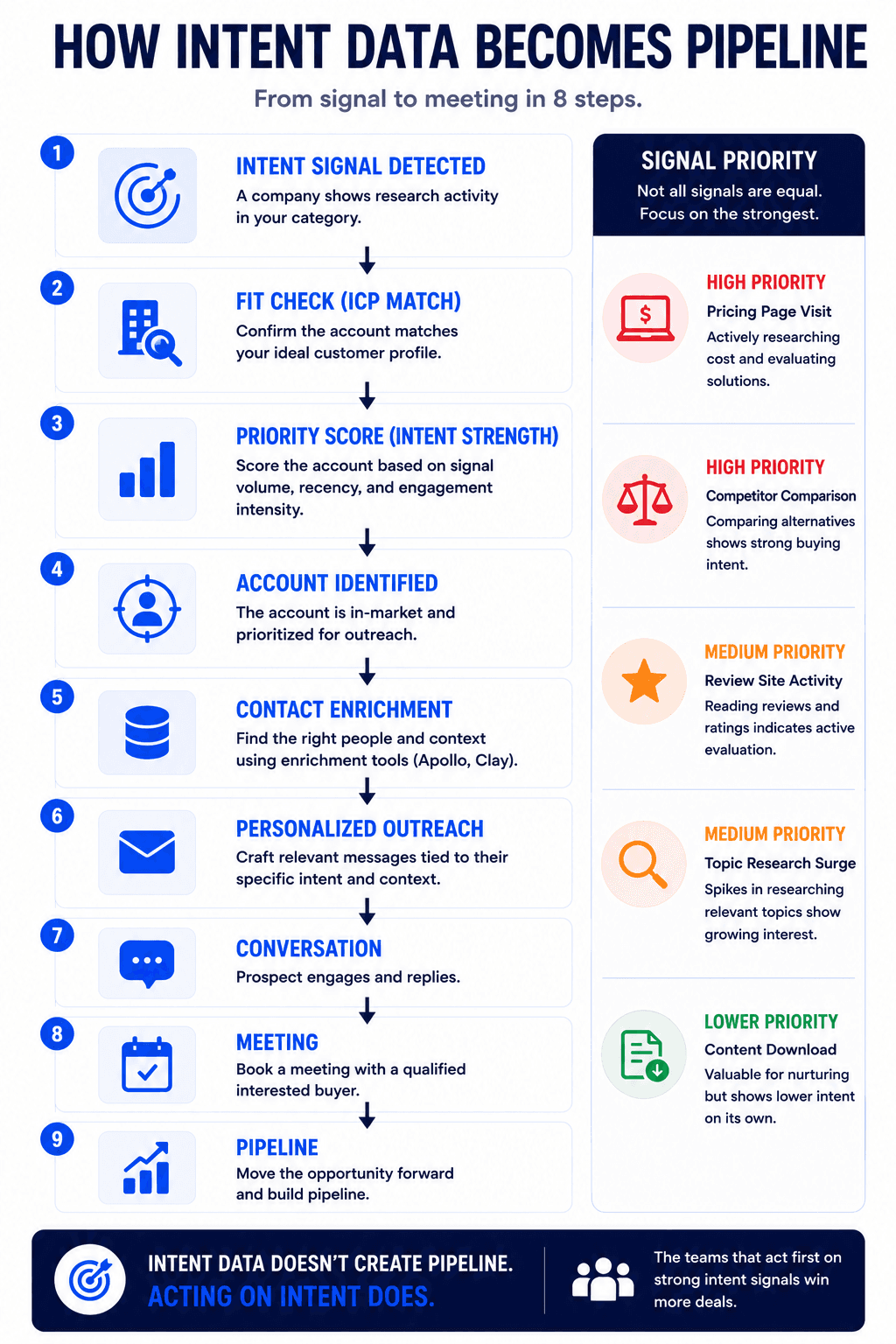
More intent data does not mean better intent data. If your platform surfaces 2,000 accounts surging on your topic but only 200 match your ICP, you have created noise rather than pipeline. The operational rule is to filter by fit first and then rank by intent within that filtered set. An in-market account that does not fit your profile is still a bad account, because intent accelerates fit, it does not override it. Once you confirm fit, speed pays off. G2's own data shows accounts contacted within five business days of a buying signal close at a 30% higher rate than those contacted two or more weeks later.
Respect Signal Decay
Intent signals have a short shelf life. A company researching your category today may have shortlisted vendors by next week, so the window for action is measured in days rather than weeks. A common framework treats signals 0 to 7 days old as high priority, 8 to 30 days as moderate, and anything past 30 days as cooling or stale. The strongest signals, like a pricing page visit or a competitor comparison, deserve a response inside 48 hours. Teams that batch their intent reviews weekly are often reaching buyers who have already moved on. If your workflow cannot route a signal to a rep within two days, that process is worth fixing before you spend another dollar on data.
Close the Account-to-Contact Gap
This is where most programs quietly stall. Your platform flags a surging account, the rep opens it, and finds 80 contacts ranging from an intern to the CTO with no indication of who is actually researching. Account-level intent tells you a company is interested but not who to call or what to say. Closing that gap means pairing the signal with verified contact data and a bit of context, so the rep arrives with a reason for reaching out rather than a generic sequence. This is the step where enriching your lead list and doing real lead research before outreach turns a company name into a conversation. Tools like Apollo and Clay exist largely to handle this activation layer.
Built well, this whole motion becomes part of a repeatable system rather than a manual scramble. It is the kind of work that increasingly sits with a GTM engineer, and it fits cleanly into the frameworks high-performing outbound teams already use.
What's the Difference Between Intent Data and Contact Data?
Contact data tells you who someone is: their name, title, company, email, and phone number. Intent data tells you what they are doing: researching your category, comparing vendors, or reading reviews. They answer different questions, and neither is enough on its own.
Intent without contact data leaves you knowing a company is in-market but unable to reach the right person inside it. Contact data without intent leaves you with a clean list and no sense of timing. The teams that get results combine the two, using intent to decide which accounts to work this week and contact data to reach the specific people involved in the decision. This is why account-level signals so often underperform until they are matched to verified individuals.
Is Intent Data Accurate and Worth It?
Intent data is useful, but the honest picture is more mixed than vendor marketing suggests. A DemandScience survey of 750 senior B2B marketing leaders found that 87% reported unreliable or inflated intent signals, and only 26% of those signals converted into qualified opportunities. The category has a real noise problem, and a lot of teams buy signals they cannot act on.
The accuracy depends heavily on the source and on how you use the data. Signals from consent-based publisher cooperatives, review sites, and your own first-party properties tend to hold up better than inferred signals from IP matching or bidstream activity. The teams that report strong returns are the ones that filter by fit, weight signal types differently, act fast, and track which signals actually lead to meetings so their scoring improves over time. The data rewards discipline more than spend, and an enterprise platform is hard to justify until you have shown you can act on cheaper signals first.
How Fast Do You Need to Act on an Intent Signal?
Fast, especially for the strongest signals. A pricing page visit or a competitor comparison on a review site deserves a response inside 48 hours, because the vendor who reaches a researching buyer first wins a large share of those deals. After about a week, most accounts have moved from "I should look into this" into active evaluation, which changes how you should approach them. Past 30 to 45 days, the signal is effectively stale and belongs in a nurture track rather than a priority sequence.
The practical implication is that speed has to be built into the workflow rather than left to whoever checks the dashboard on Monday. High-priority signals should trigger an alert and a pre-drafted, signal-specific message the rep can polish in a couple of minutes. The lag between signal and outreach is where most of the advantage is lost, and it is a common reason SDR teams struggle to generate pipeline even when they have good data.
Bringing It Together
Intent data is worth understanding for three reasons. It identifies the small share of your market that is actually in-market, so your team stops spreading effort evenly across accounts that will never buy this quarter. It only pays off when you filter by fit first, act on the freshest signals fast, and close the gap between an account name and a real contact. And the data rewards operating discipline far more than it rewards budget, which means a focused team on a modest stack can outperform a larger one buying signals it never activates.
The companies pulling ahead are the ones treating intent as a system rather than a feed: signals that route to reps quickly, paired with verified contacts and a clear reason to reach out. That is the same logic behind a well-built cold email stack and the workflows behind personalizing outreach at scale and scaling outbound with AI.

If you want help turning buying signals into booked calls rather than another dashboard, book a call with our team and we will walk through what a signal-driven outbound system looks like for your business.