Article
Jun 12, 2026
Apollo vs Clay: Which Is Better for B2B Lead Generation?
Apollo vs Clay for B2B lead generation: how they differ on data, personalization, sending, and cost, plus which one fits your team.

Most teams run the Apollo vs Clay comparison as a head to head, looking for one winner to put their budget behind. That framing is where the decision usually goes wrong. Apollo and Clay are both used heavily for B2B lead generation, but they were built to do different jobs, and a lot of the teams getting the best results use both of them in the same workflow.
We build and run outbound systems for a living, so we see this question land in real budgets. Someone has decided to take cold outreach seriously, they have a few hundred dollars a month to spend, and they want to know which platform to commit to. The honest answer depends on what your team already has, how technical you are, and how mature your outbound is. This guide breaks down what each tool actually does, where they separate, what they cost in 2026, and how to choose without wasting a quarter learning the wrong one.
If your reply rates already feel stuck, the tool is rarely the first thing to fix. We cover that in more depth in why most cold outreach fails before the first email is sent, and it is worth reading alongside this comparison.
What Apollo and Clay Actually Are
The fastest way to understand the Apollo vs Clay decision is to stop thinking of them as competitors and start thinking about what each one is at its core.
Apollo is a database with outreach built in
Apollo is a sales database first. It holds a large proprietary contact set, in the range of 240 million people, and the platform is structured so you can find prospects, enrich their details, sequence them, call them, and track deals without leaving the tool. You filter the database by market segment, job title, seniority, department, location, employee count, industry keywords, technologies, funding, and buying intent, then push the results straight into a sequence or export them.
What makes Apollo a database rather than an enrichment tool is that the data already lives inside it. You search and pull instantly, with no requirement to feed it a starting list. Newer AI features sit on top of that: an AI search bar that builds your filters from a plain English prompt, a co-pilot that suggests job titles and keywords, and a research feature that sends an agent to each company's website to confirm whether the lead actually fits before you spend credits on them. There are also persona and lookalike tools that save your ideal customer criteria once and find similar companies from a single example.
The practical summary is that Apollo gives you a full prospect to send workflow in one login. The tradeoff is that you are working with Apollo's data and Apollo's shared sending infrastructure.
Clay is an orchestration layer that needs data fed into it
Clay is not a database. It sits between your inputs and your outputs as a workspace where you import lead lists, then enrich, qualify, and personalize them at scale. The inputs are company data, people data, or job data that you usually source elsewhere, including from Apollo, LinkedIn Sales Navigator, or a scraper. Clay does have its own built in find companies and find people features, but the data there is roughly 60 to 70 percent accurate by the tool's own community estimates, so most serious users treat it as a supplement rather than a primary source.
Where Clay earns its reputation is what happens after the data is in. It can pull missing emails, phone numbers, and firmographics from dozens of providers, score each record against your ideal client profile, and write personalized copy for every row. It does not send the email itself. Once a list is enriched and the copy is written, Clay pushes the records into a sending tool like Smartlead, Instantly, or HeyReach.
So the real distinction underneath the Apollo vs Clay question is this: Apollo owns the data and the sending, while Clay owns the enrichment and personalization and connects to everything else.
The Data Question: Native Database vs Waterfall Enrichment
Data is usually the first thing teams compare, and the two tools approach it in opposite ways.
Apollo serves data from its own index. That gives you speed and volume, since you can build a list of thousands of qualified contacts in a few minutes and start sending the same day. The cost of a self maintained database is freshness. Independent reviews put Apollo's real world accuracy around 65 to 70 percent, with email bounce rates that climb when records go stale. Apollo's own filters help here, especially the email status filter that screens for contacts who actually have a verified address, and the research with AI feature that visits each site to confirm fit. You can get a tight list out of Apollo, but you have to use those filters deliberately rather than exporting raw search results.
Clay takes a waterfall approach. Instead of relying on one index, it queries provider after provider until it finds and verifies a data point, which tends to produce fresher and more accurate records, particularly for emails and direct dials. That accuracy is the main reason revenue teams reach for Clay when a list has to be close to perfect. It comes at a higher cost per record, and Clay charges for enrichment attempts even when a provider returns nothing, so a list with poor source data can quietly burn through credits.
If you would rather control enrichment yourself instead of paying per record, that is a real option now. We walk through one approach in how to enrich your lead list using Claude Code, which replaces several paid enrichment steps with a single workflow. The broader point is that data quality is a spend and effort decision, not a feature you switch on, and both tools push that decision back onto you in different ways.
Personalization Is Where They Separate
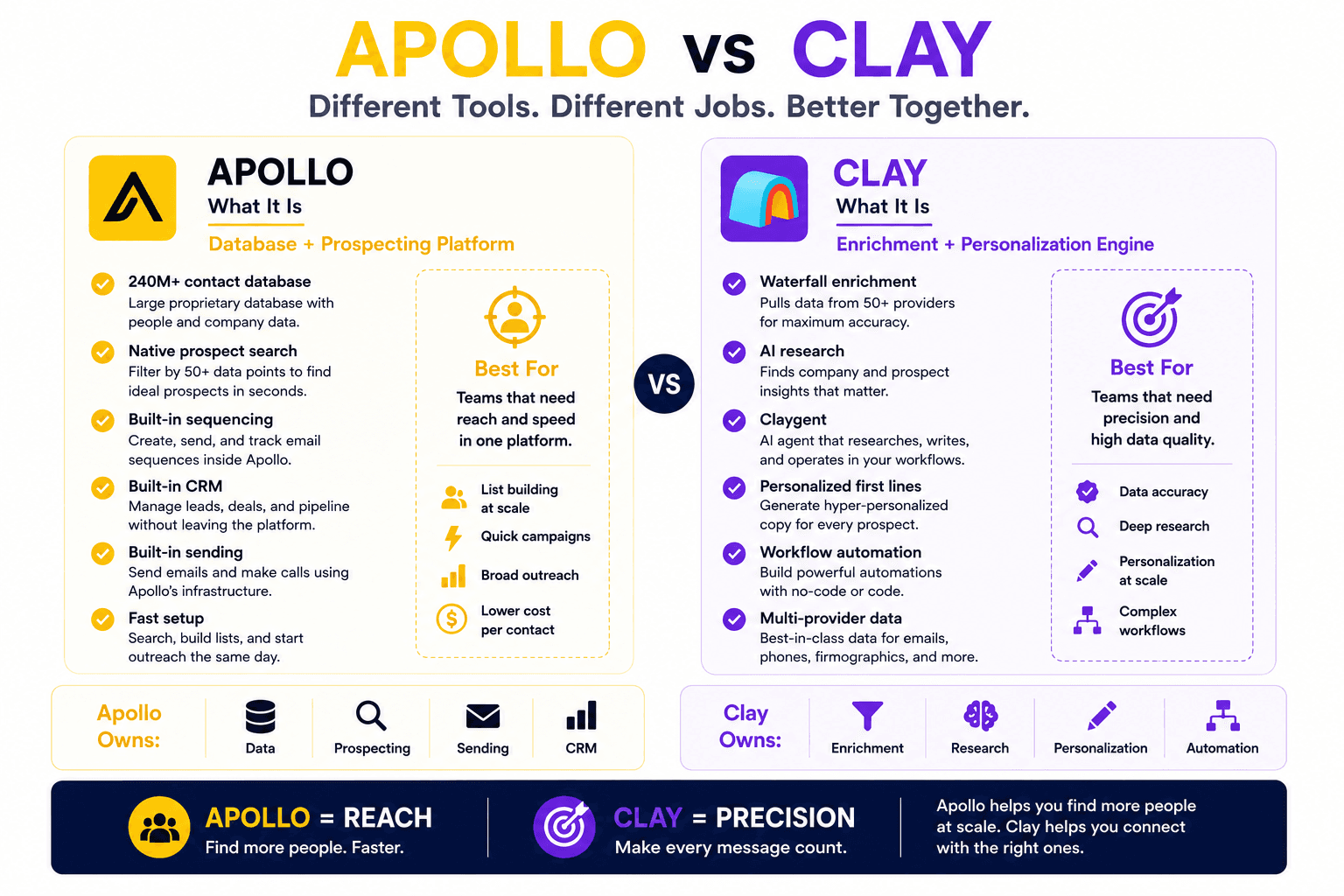
If data is where the tools look similar, personalization is where they clearly diverge, and for cold email in 2026 this is the part that moves reply rates.
Apollo handles personalization through merge tags and templates. You can insert a first name, company name, or title, and its AI email writer drafts copy from those variables and your prompt. This is fast and fine for volume, but it draws from fields rather than live research, so the personalization stays at the surface level of what is already in the record.
Clay goes deeper because of Claygent, its AI web researcher, combined with OpenAI and Claude enrichments. Claygent visits a prospect's website, LinkedIn, or any public page, extracts specific details, and makes judgments the way a researcher would, all for a fraction of a cent per lead. You can ask it to find a company's standout product, a new hire, a recent funding round, or an open role, then feed those findings into an AI written opening line that references something true about that specific company. Recent Clay workflows have compressed this from ten or more separate enrichments down to two prompts, which makes per lead personalization cheap enough to run at scale.
The difference shows up in results. There are documented cases of teams rebuilding a generic Apollo list in Clay with research backed opening lines and lifting reply rates several points on the same domains and inboxes. The mechanism is not magic, it is that the message references something the prospect recognizes about their own business. If you want to build that skill without Clay, we cover the same logic in how to write personalized first lines for cold email outreach using Claude.
Who Actually Sends the Email?
This is the detail that surprises people new to Clay, and it changes how you budget for either tool.
Apollo sends natively. You connect mailboxes, build sequences, set call tasks, and manage replies inside the same platform you used to build the list. For a team that wants one system, that is genuinely convenient. The caution is that sending from a primary domain at volume hurts deliverability, so even Apollo users should send from secondary domains and warm them properly, which is exactly the infrastructure we lay out in the best cold email infrastructure setup for B2B companies.
Clay does not send anything. After enrichment and copy, you push the leads into a dedicated sending tool. Most teams pair Clay with Smartlead, Instantly, or HeyReach, and choosing between them matters more than people expect, which is why we wrote a full breakdown in Smartlead vs Instantly vs PlusVibe. This separation is a feature for advanced teams, since it lets you keep enrichment and sending independent, but it also means Clay is one piece of a stack rather than a complete system. The mailboxes you send from sit underneath all of this, and the provider you pick affects deliverability, so it is worth reviewing the best cold email inbox providers in 2026 before you commit a budget.
What Each One Really Costs
Pricing is where the Apollo vs Clay gap becomes obvious, and where the sticker price hides most of the truth.
Apollo runs four tiers. There is a free plan, then Basic at 49 dollars per user per month, Professional at 79, and Organization at 119, all on annual billing, with monthly billing adding roughly 20 percent. The headline numbers are reasonable, but Apollo is credit driven underneath the subscription. Revealing contacts, pulling mobile numbers, and exporting all consume credits, credits expire at the end of each cycle rather than rolling over, and active outbound teams routinely spend well above the advertised seat price once overages are included. For a small team that mostly emails, Apollo's real monthly cost stays manageable. For a team pulling phone numbers at volume, it climbs.
Clay changed its pricing in March 2026, so any older guide showing Starter, Explorer, and Pro tiers is out of date for new customers. The current self serve plans are Launch and Growth, with Launch at roughly 185 dollars per month and Growth at roughly 495, both billed monthly, and Enterprise starting around 30,000 dollars a year. Clay now splits usage into two separate credit types, Data Credits for the enrichment data itself and Actions for running the workflows, which makes forecasting harder than a single number suggests. Existing customers on the legacy 149, 349, and 800 dollar plans were allowed to keep them, but that window for new sign ups has closed.
The number that catches teams off guard is the total cost of running Clay properly. On its own, Clay is an enrichment layer, so a working setup also needs email domains, a warmup and sending tool, an email finder, a verification provider, and OpenAI and Claude API keys for the AI steps. Added together, a realistic Clay stack runs in the range of 800 to 1,400 dollars a month. There is also a time cost, since teams typically spend 20 to 40 hours building their first production ready workflow and several weeks reaching fluency. If you are assembling that stack, our guide to the best cold email stack for B2B companies shows what each layer does and what it should cost.
Apollo is the cheaper and simpler line item. Clay is the larger investment that pays back only when you actually use its depth.
How to Choose, and Why Many Teams Run Both
With the mechanics clear, the decision comes down to your team rather than the tools.
Choose Apollo when speed to launch matters more than maximum precision, when your team is not technical or does not have revenue operations capacity to build workflows, and when your ideal customer sits inside a large North American database. Apollo gets you from nothing to a live campaign in days, with prospecting, sequencing, and reporting in one place. That is the right call for a founder or a lean sales team that needs pipeline now and does not want to manage a stack. If your SDR function is the thing struggling, the fix is often process before tooling, which we get into in why most SDR teams struggle to generate pipeline.
Choose Clay when your differentiator is data quality and personalization, when you have the technical comfort to build and maintain workflows, and when your outbound is mature enough that small lifts in reply rate justify the spend and the learning curve. Clay rewards teams that want granular control and are willing to assemble a stack around it.
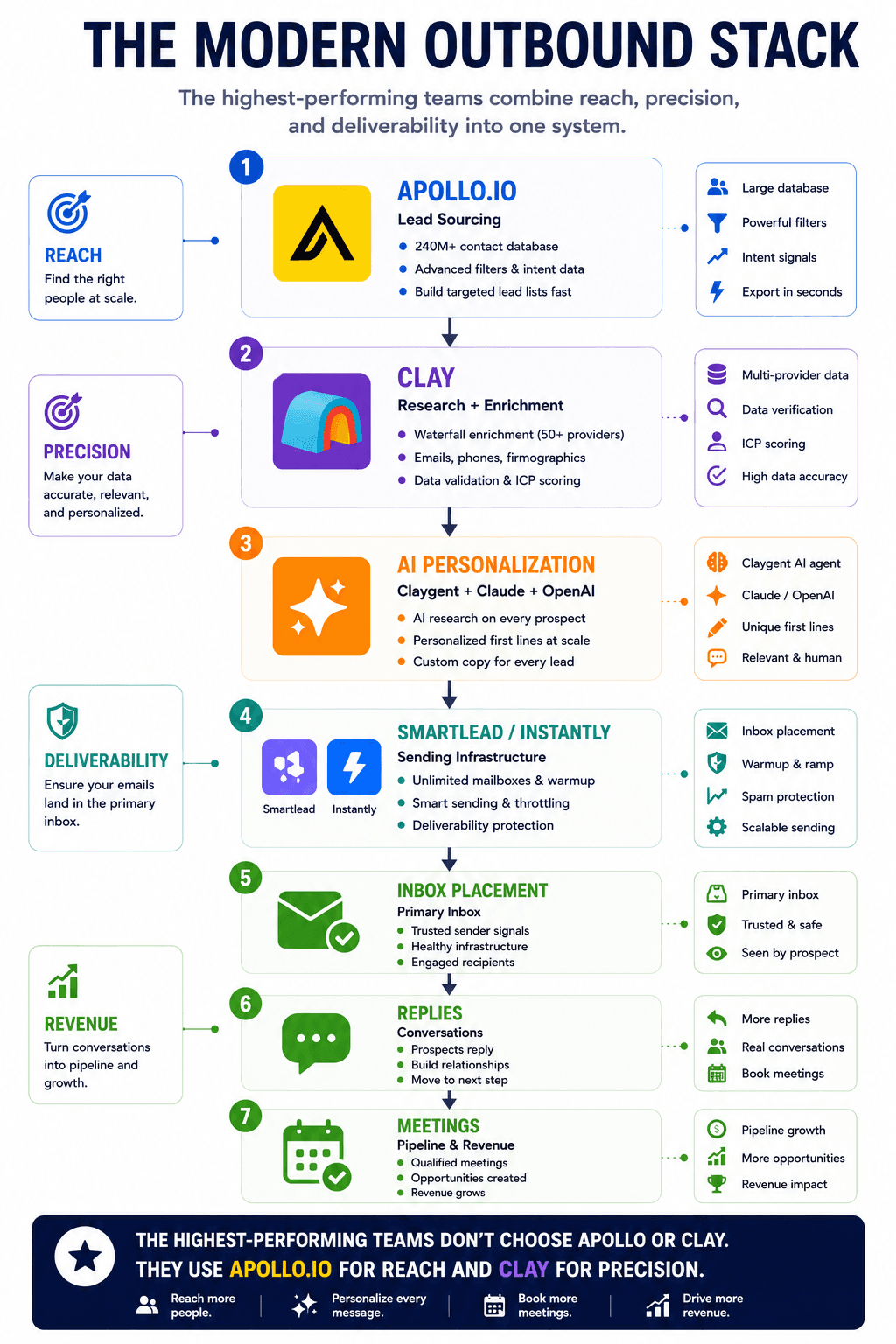
In practice, the most sophisticated teams stop choosing and combine them. They source with Apollo or a scraper for speed and volume, run those records through Clay for waterfall enrichment and research backed personalization, then push the finished list into a dedicated sender. Apollo supplies reach, Clay supplies precision, and the sending tool handles deliverability. This is also how outbound is shifting more broadly, with research and personalization moving to automated layers, a trend we cover in how AI SDRs are replacing manual prospecting. Whichever route you take, the segmentation and offer underneath the campaign decide whether any of it works, which is the foundation we lay out in five cold email system frameworks high performing teams use in 2026.
A closing reality check on the wider market. Average cold email reply rates have fallen sharply, a shift we documented in why most cold email campaigns are dying in 2026. Neither Apollo nor Clay rescues a campaign built on a weak list, a generic offer, or broken infrastructure. The tool you pick should follow from your strategy, not stand in for it.
Frequently Asked Questions
Is Clay better than Apollo for cold email?
Clay tends to produce better personalization and fresher data, which usually means higher reply rates on the same domains. Apollo is faster to launch and far simpler to run because sending is built in. For a technical team chasing reply rate, Clay is often the stronger choice. For a team that needs pipeline quickly without managing a stack, Apollo wins on practicality.
Can you use Apollo and Clay together?
Yes, and many teams do. The common setup is to source contacts in Apollo for speed and volume, run them through Clay for waterfall enrichment and personalized copy, then push the finished list into a sending tool such as Smartlead or Instantly. Apollo covers reach and Clay covers precision, so the two complement each other rather than compete.
Is Clay worth it for a small team?
It depends on capacity more than size. Clay's value comes from building and maintaining workflows, and a realistic stack with sending, enrichment, verification, and AI keys runs several hundred to over a thousand dollars a month. A small team without technical bandwidth is usually better starting with Apollo, then adding Clay once outbound is established and small gains in reply rate justify the investment.
Which has more accurate data, Apollo or Clay?
Clay generally returns more accurate and current data because it queries multiple providers in a waterfall until a data point is verified. Apollo relies on its own index, which is fast and broad but drifts out of date, with real world accuracy commonly reported around 65 to 70 percent. For lists where accuracy is critical, Clay's approach has the edge, though it costs more per record.
Do you need a separate sending tool with Clay?
Yes. Clay enriches and personalizes data but does not send email. You connect it to a dedicated sender like Smartlead, Instantly, or HeyReach to actually run the campaign. Apollo, by contrast, sends natively, so it does not require a separate sending platform.
The Bottom Line
The Apollo vs Clay question rarely has a single right answer because the two tools solve different parts of the same job. Apollo is the all in one database and sending platform that gets a team live quickly and keeps everything in one place. Clay is the enrichment and personalization layer that produces sharper data and better copy for teams with the capacity to build around it. The strongest outbound operations often use Apollo for reach, Clay for precision, and a dedicated sender for deliverability, and they win because their strategy is sound before any tool touches it.

If you would rather have a team build and run that system for you, with the data, personalization, and deliverability handled end to end, book a call with us and we will map the right setup to your market and your goals.