Article
Jun 3, 2026
Why Most Cold Outreach Fails Before the First Email Is Sent
Most cold outreach fails before the first send. Bad data, weak offers, and broken infrastructure kill campaigns. Here's what to fix first.
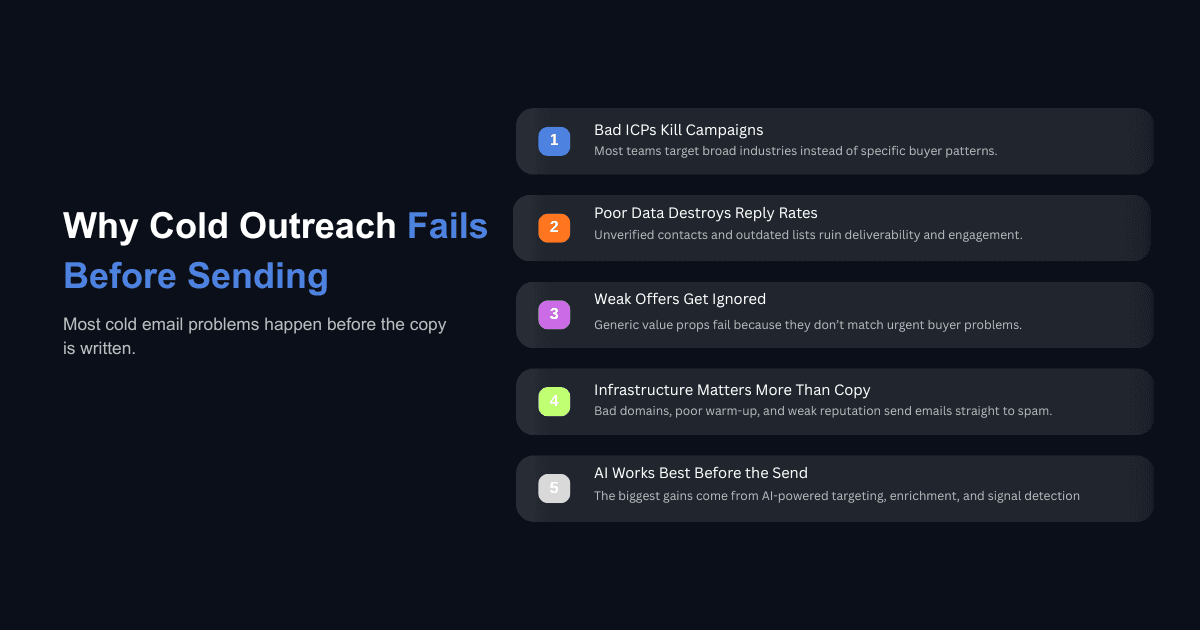
Cold email reply rates have dropped from 8.5% in 2019 to 3.43% in 2026, and the usual response from sales teams is to rewrite the email. New subject line, shorter body, different CTA. Sometimes that helps. Most of the time it doesn't, because the failure already happened before anyone hit send.
The teams that still pull 10%+ reply rates on cold email are not writing dramatically better copy. They are doing fundamentally different work before the campaign launches: tighter targeting, verified data, tested offers, and infrastructure that actually reaches the inbox. When those things are broken, no amount of A/B testing on subject lines will produce a meaningful change.
This post breaks down the specific pre-send failures we see most often and what to do about each one.
The Numbers Tell a Clear Story (And It's Not About Copy)
Average cold email open rates fell from roughly 36% in 2023 to 27.7% in 2024, and they've stayed in the 15-25% range since then. Reply rates have followed the same trajectory. According to Sopro's analysis of 151 million outreach data points, well-executed campaigns now average around 5% response rates, with anything above that reflecting strong relevance and clean data rather than clever writing.
The important detail in that data is the variance. Bottom performers sit below 1%. Top performers clear 10%. The channel is the same. The tools are largely the same. What separates those two groups is the work that happens before the sequence starts: who they're emailing, whether those contacts are real and current, whether the offer matches the recipient's situation, and whether the email infrastructure can actually deliver messages to inboxes.
Most teams invert the time allocation. They spend weeks on sequences and minutes on list quality. Prospeo's targeting research puts it plainly: choosing targets is 80% of the game, and most teams treat it as an afterthought.
Your ICP Is Probably a Guess
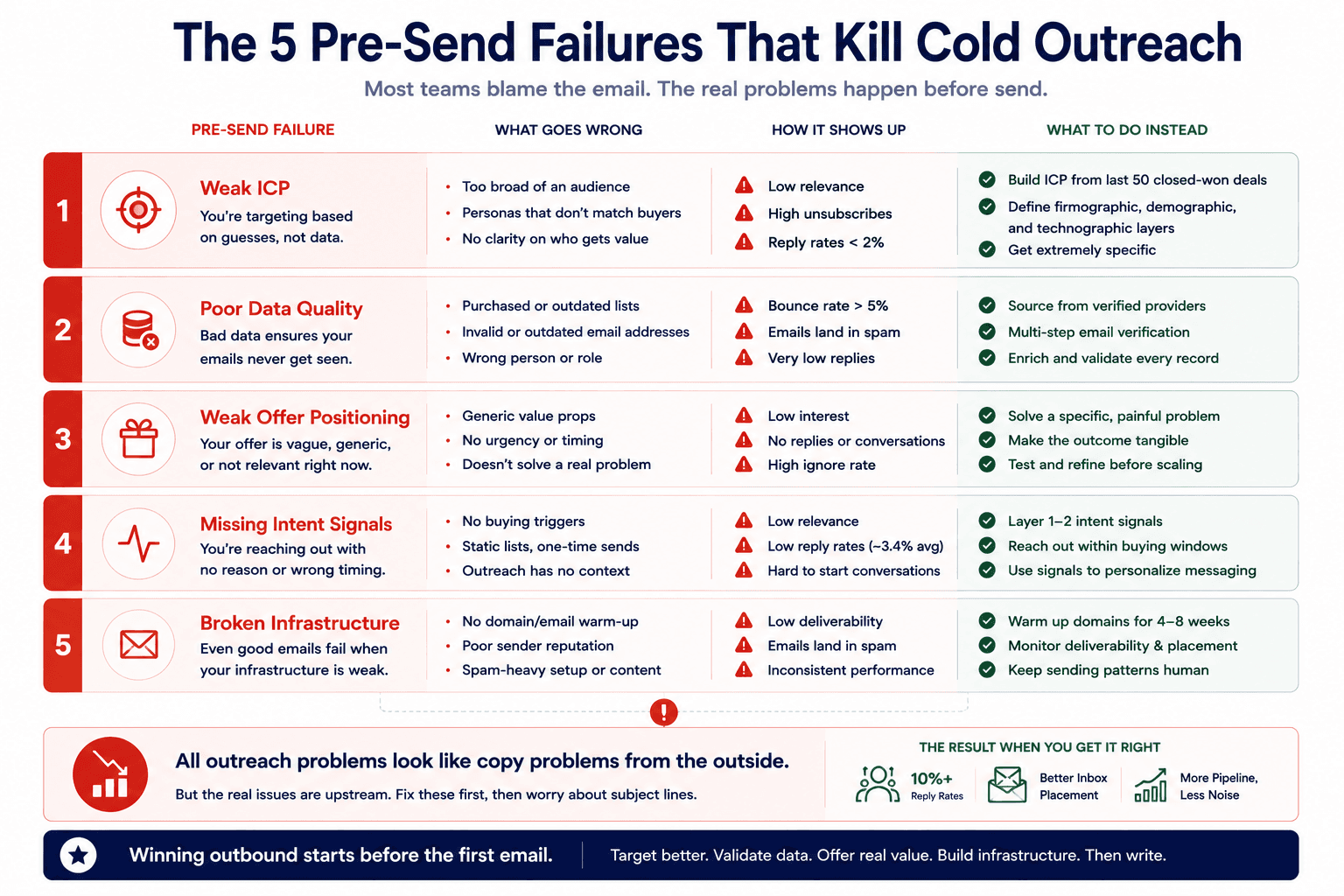
The first pre-send failure is targeting. Many B2B teams define their Ideal Customer Profile based on intuition, a broad industry category, and a job title. That produces a list that looks reasonable but performs poorly because it's too wide to generate relevance.
Build from CRM Data, Not Assumptions
A more reliable approach is to pull your last 50 closed-won deals and look for patterns across three layers. Prospeo's ICP framework breaks this into firmographics (industry, revenue range, headcount, region), demographics (job title, seniority, department), and technographics (tools they already use, platforms they've adopted). Companies that build their ICP from actual customer data rather than market assumptions consistently produce tighter lists that convert at higher rates.
This matters because a CTO at a 50-person SaaS company receives 30+ cold emails per day, while a facilities manager at a manufacturing company might receive two. Knowing which segment you belong in, and what that means for your messaging and offer, changes the entire approach.
Intent Signals Separate Good Lists from Great Ones
Even a well-defined ICP only tells you who could buy. Intent signals tell you who might be ready to buy now. Hiring surges, funding rounds, technology changes, and leadership transitions are all observable events that indicate a company may be entering a buying window. Teams that layer one or two intent signals onto a tight ICP have seen reply rates jump from the 3.4% average to 18% on the same channel with the same general messaging.
If you're running outbound without intent data, you're essentially cold calling the entire addressable market and hoping your timing lines up. That works occasionally, but it's not a system. For companies looking to implement AI using a workflow-first approach, intent signal detection is one of the highest-value starting points because it directly connects to pipeline.
Data Quality Is the Biggest Reply Rate Killer
Sending to the wrong person is the single largest factor in low reply rates. If the contact has changed roles, the email address is invalid, or the company no longer fits your ICP, no personalization or copywriting technique will produce a response.
Purchased Lists Generate Significantly Fewer Responses
Research consistently shows that purchased contact databases generate 3-4x fewer responses than lists built and verified by the team running the campaign. The reasons are straightforward: purchased data decays quickly, contains contacts who have been emailed by every other buyer of that list, and rarely includes the enrichment details needed for meaningful personalization.
The better approach is to source contacts from verified providers and then run multi-level validation before any email enters a sequence. That means verifying email addresses to reduce bounce rates, enriching records with current job titles and seniority, and confirming that each contact still fits the ICP criteria. ZoomInfo's cold outreach research emphasizes combining identity data with company context and dynamic buying signals as the standard for B2B data quality in 2026.
Fix Bounce Rates Before Testing Copy
If your bounce rate is above 5%, you should fix your data before you start A/B testing email copy. This is a common sequencing mistake. Teams notice low reply rates and immediately start testing subject lines and body copy, when the real problem is that a significant portion of their emails are bouncing or landing in spam because of bad data. Signal-backed outreach, where you only email contacts showing active buying behavior, converts at 5-10x the rate of cold sends to static lists.
Understanding the difference between AI agents and AI tools matters here because many teams buy an AI tool that generates email copy when what they actually need is an AI agent that continuously validates and enriches their contact database.
Does Your Offer Actually Solve a Problem They Have Right Now?
The third pre-send failure is the offer itself. Many outbound campaigns carry a generic value proposition that describes what the company does rather than addressing a specific problem the recipient is currently experiencing. The difference between "we help companies automate workflows" and "we help ops teams at logistics companies cut invoice processing from 14 days to 2" is the difference between getting ignored and getting a reply.
Your Value Proposition Needs to Be Segment-Specific
You cannot address different roles with the same value proposition. What matters to a CFO is different from what matters to a VP of Operations, even at the same company. Each micro-segment in your ICP needs its own version of the offer, framed around the problem that role cares about and the outcome they would find credible.
This is where auditing your sales conversations becomes valuable. If you record discovery calls, you can extract the specific objections, pain points, and buying triggers that real prospects mention. That language, used in outreach, sounds different from marketing copy because it comes from the buyer's actual vocabulary.
Match the Offer to Buyer Urgency
A cold email that arrives when the recipient has no active problem related to your solution will almost always be ignored, regardless of how well it's written. This is why intent signals matter at the offer level too. If you know a company just raised a Series B, your offer should connect to scaling challenges. If you know they just lost a VP of Sales, your offer should address pipeline continuity. Matching your offer to the buyer's current situation, rather than your own sales calendar, is what separates outreach that generates conversations from outreach that generates unsubscribes.
For teams exploring what AI transformation actually looks like in practice, offer testing across segments is one of the clearest applications. You can test multiple value propositions simultaneously across micro-segments and measure which specific problem framing produces the highest engagement from each buyer type.
Infrastructure Failures That Kill Campaigns Silently
Even with a strong ICP, clean data, and a relevant offer, campaigns will underperform if the emails don't reach the inbox. Email infrastructure has become the most technical and least understood part of cold outreach, and it's where many teams lose before they start.
Domain Reputation Determines Whether Anyone Sees Your Email
Fresh inboxes start at "Unknown" domain reputation with 40-60% of messages routed to spam. That means a new sending domain, without proper warm-up, will have more than half of its messages filtered out before a single recipient has a chance to read them. SPF, DKIM, and DMARC authentication are baseline requirements, and missing any of them gives inbox providers a reason to deprioritize your messages.
The safest sending limit for cold outreach in 2026 is 50-100 emails per mailbox per day. Going above that, especially without proper warming, triggers rate limiting and spam classification. The math no longer works for high-volume approaches because domain reputation damage from aggressive sending compounds over time and reduces deliverability across all future campaigns from that domain.
The Warm-Up Period Most Teams Skip
Proper inbox warm-up takes four to eight weeks before reliable delivery is established. The standard sequence starts with automated warm-up exchanges in week one, moves to a mix of warm-up and manual emails in week two, introduces low-volume cold outreach in week three, and reaches full sending volume only in week four or later. Most teams absorb this ramp-up period invisibly as underperforming campaigns because they start sending before the domain has earned enough trust with inbox providers.
Using a dedicated sending domain (e.g., outreach.yourcompany.com) that is separate from your primary business domain protects your main email if the sending domain takes a reputation hit. This is a basic structural decision that many companies skip, and it can have lasting consequences. Understanding hidden costs that cause AI projects to fail applies directly here: the cost of rebuilding domain reputation after a botched campaign is real and often unaccounted for.
How AI Changes the Pre-Send Work (When Used Correctly)
AI has made cold outreach both better and worse simultaneously. On one hand, AI tools can handle list building, data enrichment, and intent signal detection far faster and more accurately than manual processes. On the other hand, AI-generated outreach flooding inboxes is one of the three main factors driving the industry-wide decline in reply rates.
The distinction matters. AI applied to the pre-send process (identifying the right contacts, verifying data, detecting buying signals, testing offers across segments) consistently improves outcomes. AI applied to mass-generate and blast emails at scale makes the problem worse for everyone, including the sender. One enterprise client of ours doubled their sales efficiency by using AI to engage leads at the right time with data-backed decisions, rather than using it to simply send more emails.
If you're evaluating which AI actually writes better cold outreach, that's a useful comparison, but the bigger question is whether you're using AI at the right stage of the process. Tools like Claude Cowork for business workflows can automate the research and enrichment steps that most teams do manually or skip entirely. McKinsey's approach to deploying AI agents at scale illustrates the same principle: the value isn't in generating more output, it's in improving the quality of the inputs that drive every downstream decision.
For companies looking at real-world AI transformation examples, cold outreach infrastructure is a practical starting point because the feedback loop is fast. You can measure improvement in reply rates within a few weeks of fixing the upstream issues.
What a Pre-Send Audit Actually Looks Like
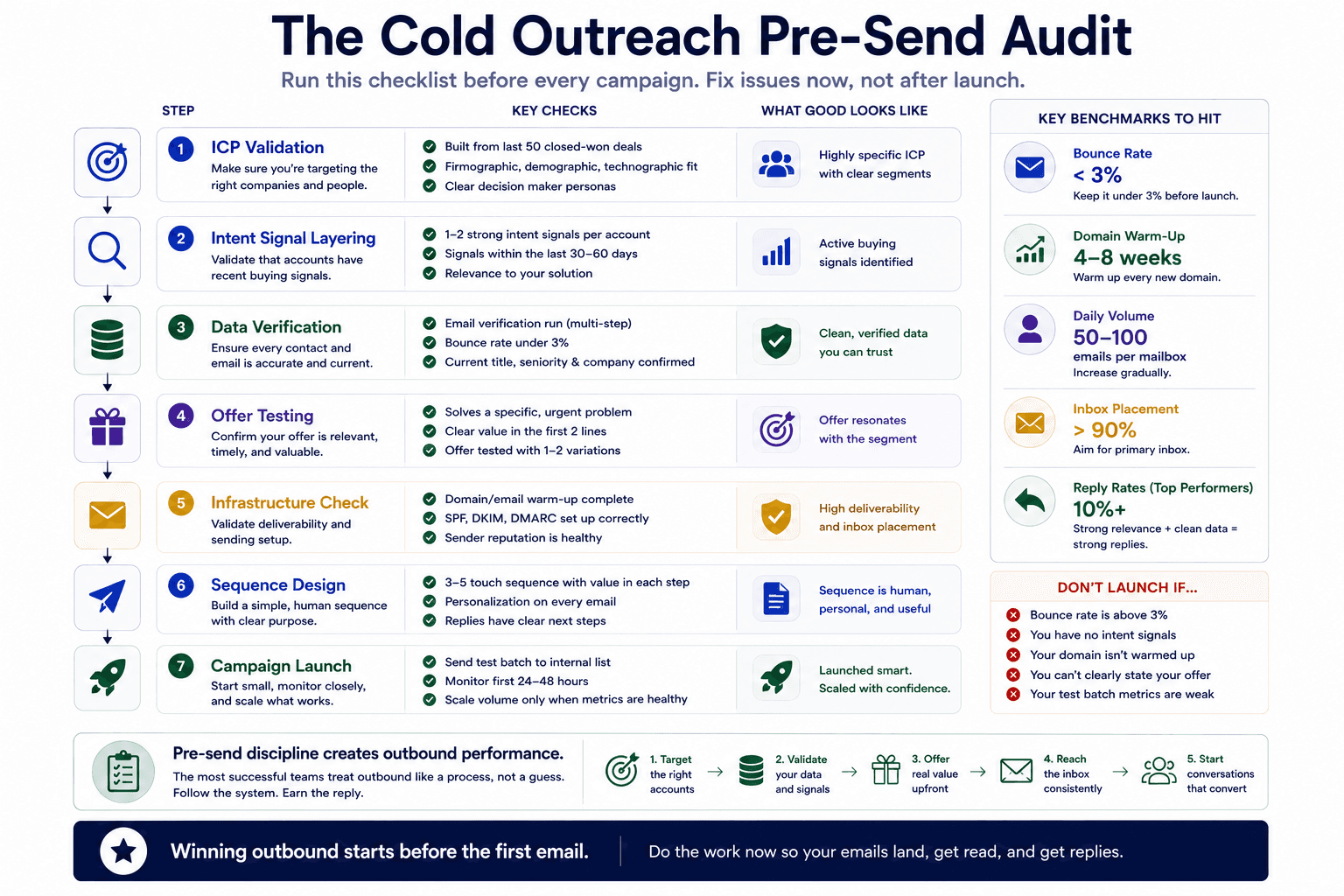
Before launching or relaunching any outbound campaign, run through these checks in order. The sequence matters because each layer depends on the one before it.
ICP Validation. Pull your last 50 closed-won deals. Identify patterns across industry, revenue, headcount, job title, and technology stack. If your current target list doesn't match those patterns, rebuild it.
Data Verification. Run every contact through email verification. Remove addresses with a high probability of bouncing. Enrich remaining contacts with current job titles, company size, and any available intent signals. If your bounce rate on previous campaigns was above 5%, this step is your highest priority.
Offer Testing. Write two or three distinct value propositions, each framed around a different problem your ICP segments experience. Test these in small batches (50-100 contacts per variant) before scaling any single message.
Infrastructure Check. Confirm SPF, DKIM, and DMARC are properly configured on your sending domain. Verify that your domain reputation is in good standing. If you're using a new domain, allocate four to eight weeks for warm-up before running any outbound volume.
Sequence Design. Keep initial sequences to four emails. Each email should offer a new angle or piece of information rather than repeating the same ask. Monitor reply rates and bounce rates after each send and pause the campaign if bounce rates exceed 3%.
The diagnostic logic is straightforward: if your emails aren't reaching inboxes, it's an infrastructure problem. If they're reaching inboxes but not getting opened, it's a subject line or sender reputation problem. If they're getting opened but not generating replies, it's a targeting or offer problem. Knowing what an AI transformation partner actually does in this context means having someone who can diagnose which layer is broken and fix the system rather than guessing at random improvements.
The Takeaway
Cold outreach still works. The channel is not dead. But the margin for error has narrowed significantly, and most of the errors that kill campaigns happen before the first email is ever sent. The teams that win at outbound in 2026 are the ones treating it as an operations problem (data quality, infrastructure, process design) rather than a copywriting problem.
If your outbound pipeline is underperforming and you've already rewritten the emails more than once, the problem is probably upstream. We help companies diagnose and rebuild their outbound systems so the campaigns actually reach the right people with the right message at the right time.
Book a 45-minute call with our team and we'll walk through your current setup, identify where the process is breaking down, and map out what needs to change before the next campaign goes out.