Article
May 15, 2026
Cold Email Mistakes That Kill Your Reply Rates (And How to Fix Them)
Most cold email campaigns fail from fixable mistakes. Learn what kills reply rates in 2026 and the tactical fixes that actually get responses.
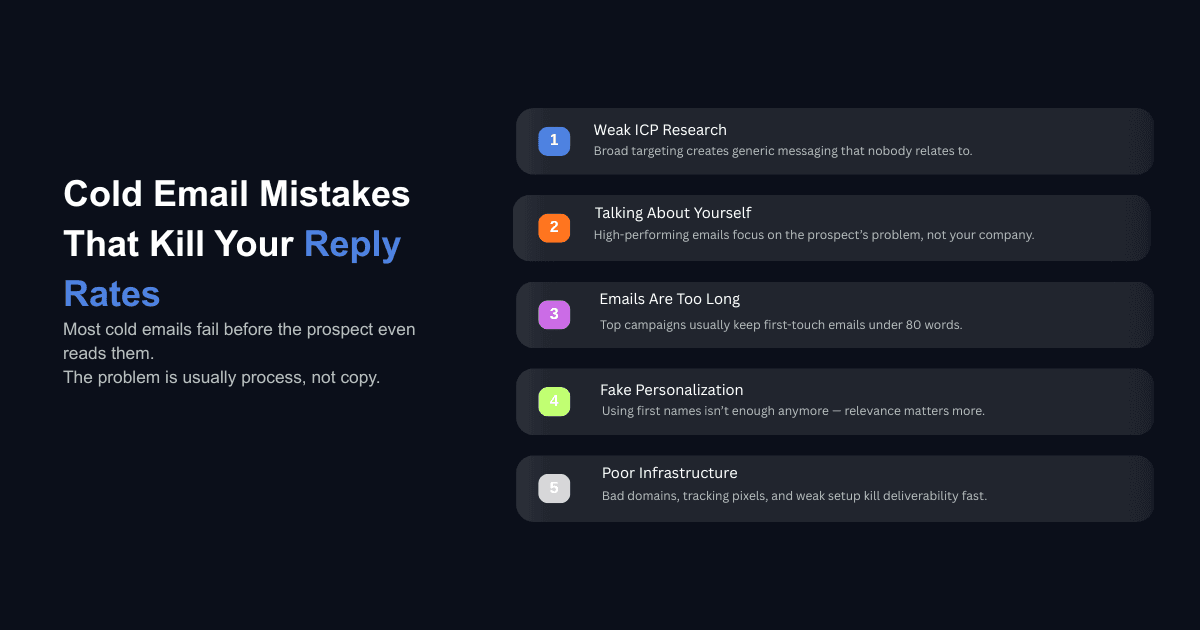
The average cold email reply rate in 2026 sits around 3.4%, according to Instantly's benchmark analysis of over 100 million emails. That means roughly 96 out of every 100 emails you send will get no response at all. Meanwhile, the top performers are consistently clearing 10% and above.
That gap exists because most cold email campaigns are dying from the same repeated mistakes. The problems are structural, not creative. They sit in how teams research their prospects, how they build their infrastructure, and how they write their scripts. This post breaks down the mistakes we see constantly across the campaigns we audit, and the specific fixes that bring reply rates back to where they should be.
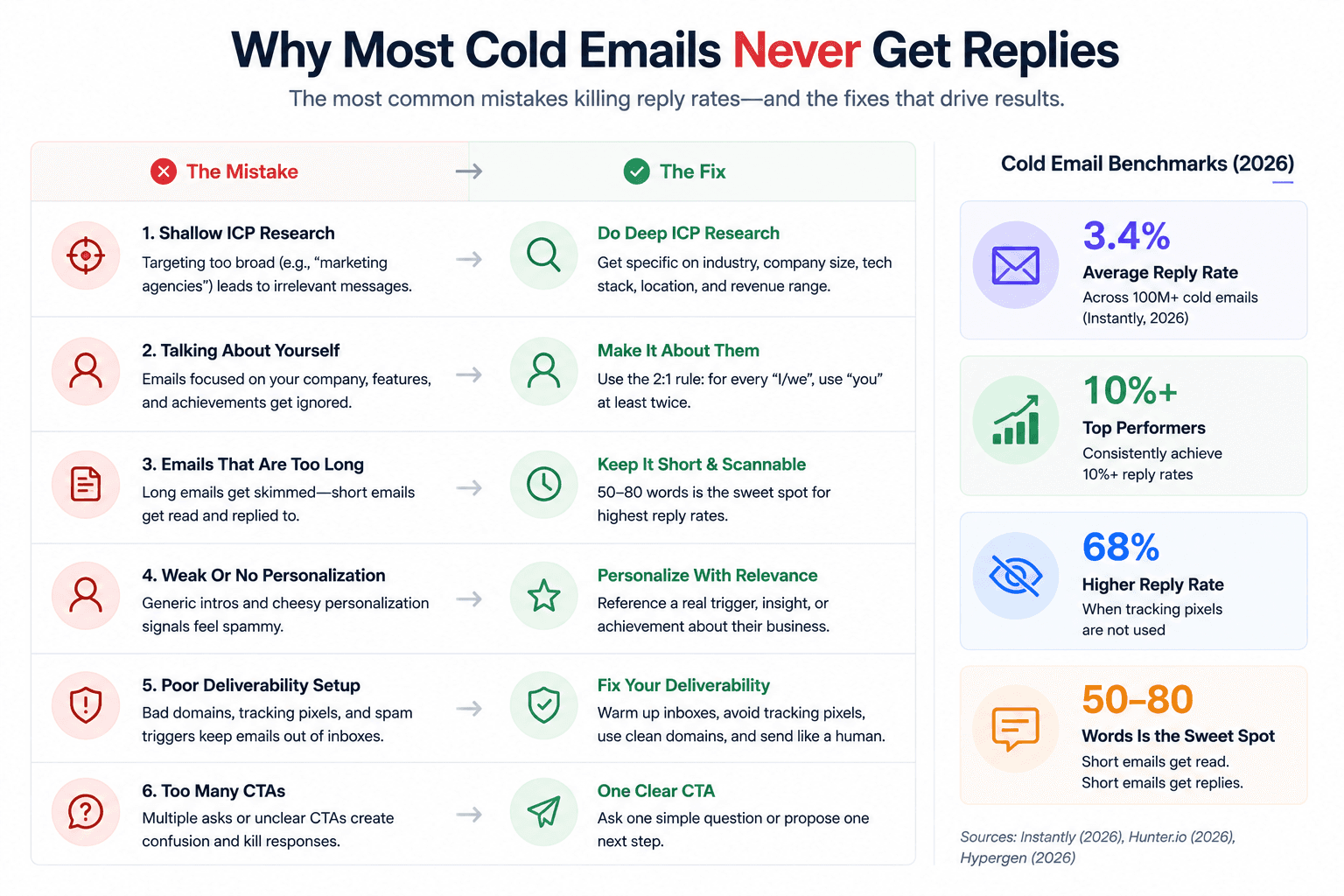
Your ICP Research Is Too Shallow
The single most common reason cold email campaigns underperform is that the sender does not actually know who they are writing to. Most teams define their ICP at the surface level, something like "marketing agencies" or "ecommerce brands," and then start building lists and writing scripts based on that loose definition.
That is not enough. A marketing agency that runs TikTok ads for DTC brands has completely different pain points than a web design firm serving local businesses. Their offers differ, their clients differ, and the language that resonates with the founder of a 5-person shop is nothing like what works on a VP of Marketing at a 200-person company.
Company-Level Targeting Is Just the Starting Line
You need to know the industry, the employee count range, the technologies they use, and where they are located. If you are targeting ecommerce brands, you should know whether they run on Shopify or a custom stack, whether they are spending on paid acquisition, and what their approximate revenue range looks like. These details determine whether your offer is even relevant to the person receiving the email.
Campaigns targeting fewer than 50 recipients consistently outperform larger blasts, with one analysis showing a 5.8% reply rate for smaller lists versus 2.1% for larger ones. The reason is simple: smaller lists force you to be specific. You can write copy that speaks to a real situation instead of a generic category.
Individual-Level Research Changes the Script Entirely
Beyond the company, you need to know the individual you are writing to. Job titles matter because they determine decision-making authority and the problems that person thinks about daily. If you are writing to a founder of a 10-person company, you are talking to someone who handles everything from sales to hiring. If you are targeting a CMO at a 200-person company, you are talking to someone focused on pipeline and attribution.
The script changes entirely based on who is reading it. A founder cares about revenue and time savings. A CMO cares about channel performance and team efficiency. You cannot write a single script that speaks credibly to both audiences, and if you try, it will speak to neither.
This is where enriching your lead list properly becomes a real competitive advantage. Validated contact data, ICP scoring, and personalized signals layered onto each lead allow you to segment accurately before you write a single word.
Your Scripts Talk About You Instead of the Prospect
One of the most persistent patterns we see in underperforming cold email copy is that the sender spends most of the email talking about themselves. Their company, their experience, their awards, their product features. The prospect does not care about any of that, at least not in the first email.
Hunter.io's 2026 State of Email Outreach report found that 65% of decision makers say cold emails fail because they feel too sales-focused. That overtook "lack of relevance" as the number one complaint. The emails that get replies are the ones that make the reader feel understood, not pitched.
The 2:1 Ratio That Keeps Copy Focused
A practical rule that works well: for every time you use the word "I" or "we" in your email, use the word "you" at least twice. This forces you to frame everything in terms of the prospect's outcomes rather than your capabilities.
Instead of "We've been helping brands increase their ROAS for the past five years," try "You could be leaving 30 to 40% of your ad spend on the table if your landing pages aren't converting the traffic you're already paying for." The second version focuses on their situation and a specific problem they are likely aware of.
What a Results-Focused Email Actually Looks Like
The strongest cold emails we see follow a simple structure: reference a relevant result, connect it to the prospect's situation, and ask a clear question. Something like: "We recently helped a company similar to yours add $40K in monthly recurring revenue over six months. Would that be worth a conversation?"
Notice what this email does not include. It does not explain the mechanism, the technology stack, or the sender's background. The prospect does not need to know whether you achieved that result through SEO, paid ads, or cold outreach. They care about the outcome, and the method is what the call is for. If you want to audit your existing scripts and identify what is actually killing replies, running your copy through a structured review process is worth the time.
Why Are Short Cold Emails So Much More Effective?
Length is one of the easiest things to fix and one of the most impactful. Data from Instantly's 2026 benchmark shows that top-performing campaigns keep first-touch emails under 80 words. Other analyses put the sweet spot between 50 and 75 words, with reply rates dropping significantly once emails cross 200 words.
The reason is straightforward. Decision makers are scanning, not reading. They receive dozens of cold emails each week. If your email requires effort to parse, they will skip it entirely. A short, clear email that communicates one idea and asks one question is far more likely to get a response than a detailed pitch that tries to cover everything.
The 50 to 80 Word Range and Why It Works
Short emails work because they force you to eliminate everything that does not serve the reader. You cannot include your company history, a feature list, and a case study in 70 words. You have to pick one angle, make it relevant, and let the prospect decide if they want to learn more.
This constraint also makes your emails easier to scan on mobile, where a large portion of business email gets read first. If your entire message is visible without scrolling, the prospect can process and respond in seconds.
One CTA, One Clear Ask
Multiple CTAs dilute focus. If you end your email with "let me know if you want a demo, a case study, or to hop on a call," you have given the prospect three decisions to make instead of one. Top performers use a single, low-friction question: "Worth exploring?" or "Can I send over a quick breakdown?" or "Any interest in seeing how this would work for your team?"
The question should require minimal effort to answer. A simple yes or no is easier for the prospect to commit to than scheduling a meeting with a stranger. This is also where the approach of leading with value instead of asking for time becomes powerful, which we cover in the offer section below.
Personalization That Goes Beyond First Name Tokens
Adding a first name and company name to a template is not personalization. In 2026, prospects see through that immediately because every other cold email in their inbox does the same thing. According to Hunter.io's research, 69% of decision makers say it bothers them if AI was clearly used to write the email, unless the output feels genuinely human. And 48% specifically call out generic, impersonal messaging as a major problem.
What Real Personalization Means in 2026
Real personalization means referencing something specific about the prospect's situation that shows you have done actual research. That could be a recent company milestone, a specific problem common to their niche, or a competitor insight that is relevant to their business. One of the highest-performing approaches we see is referencing the prospect's competitors by name and connecting that to a specific outcome. For example, mentioning that their competitor is ranking above them for key search terms and offering a specific fix is far more compelling than a generic pitch about SEO services.
The key is that personalization needs to be relevant, not just specific. Congratulating someone on a job anniversary does not make your email more likely to get a reply. Showing that you understand their business challenge and have a relevant solution does.
Writing personalized first lines at scale is one of the areas where AI has genuinely improved cold email quality for teams that do it correctly. The approach works when the research behind the personalization is real and the output is reviewed before sending. It falls apart when teams use AI to generate surface-level flattery at volume.
Using Spintax to Protect Deliverability at Scale
Beyond personalization, you need to make sure your sending infrastructure supports scale without triggering spam filters. Spintax is the practice of creating word and phrase variations throughout your script so that no two emails are identical. Instead of sending "we can book you 10 to 20 meetings" to every prospect, you rotate between "meetings," "calls," and "demos." You do this for every section of the email, not just the greeting.
This matters because email service providers in 2026 are actively detecting identical or near-identical content sent at volume. If you are sending the same email 50 times a day from a single inbox, you will end up in spam regardless of how good the copy is.
How Does Poor Technical Setup Destroy Your Cold Email Campaigns?
You can have the best scripts, the most refined ICP, and strong personalization, and still get zero results if your emails never reach the inbox. Data from Cleanlist's 2026 analysis shows that verified email lists achieve roughly twice the reply rate of unverified lists and nearly three times the meetings booked. The technical foundation is what determines whether all your other work even gets seen.
Domain and Inbox Infrastructure
The first rule is to never send cold emails from your primary business domain. If your outbound campaigns trigger spam complaints, you risk damaging the reputation of every email your company sends, including invoices, client communication, and internal messages. Use dedicated secondary domains or subdomains exclusively for outreach.
Buy .com domains from established registrars. Avoid cheap alternatives like .biz or .net for cold outreach because they are flagged more frequently by spam filters and carry less credibility with recipients. Set up your email accounts through Google Workspace or Microsoft 365. The extra cost per inbox is worth the deliverability advantage.
Scale horizontally. Instead of sending 100 emails per day from one inbox, send 20 to 25 from each of four or five inboxes. This keeps your sending volume within safe thresholds and protects each domain's reputation. Tracking deliverability across multiple domains becomes essential once you are running campaigns at any real scale.
DNS Authentication: SPF, DKIM, and DMARC
These three records are non-negotiable. SPF tells email providers which servers are authorized to send on your domain's behalf. DKIM adds a cryptographic signature that verifies your emails have not been tampered with. DMARC ties the two together and tells providers what to do with emails that fail authentication. Without all three configured correctly, you are signaling to Gmail and Outlook that your emails may not be legitimate.
You also need to warm up new email accounts for at least two to three weeks before sending any outbound campaigns. This process gradually builds the domain's reputation by simulating normal email activity. Skipping or rushing this step is one of the fastest ways to get flagged as spam from day one.
Why Open Rate Tracking Does More Harm Than Good
This is one of the less obvious mistakes that causes significant damage. To track open rates, your sending tool inserts a tracking pixel into every email. Gmail and Outlook detect these pixels, and they do not like them. It is the same reason you should avoid including images, HTML formatting, or links in your cold emails. Plain text emails with no tracking consistently outperform. Hunter.io's data shows that campaigns without open tracking saw a 68% higher reply rate compared to those with tracking enabled. If you are currently tracking opens, turn it off. The metric is unreliable anyway due to privacy features in modern email clients, and it actively hurts your deliverability.
Your Follow-Up Strategy Is Either Missing or Excessive
Analysis of over 2 million cold emails by Sales.co found that the first email drives 79.4% of all replies, and follow-ups show diminishing returns after the second or third touch. Yet 48% of senders never send a second message, which means they are leaving nearly half of their potential responses on the table.
The Two to Three Touchpoint Sweet Spot
A two-step sequence is often enough. The first email presents your offer. The follow-up reframes the same value from a different angle, because some prospects may have missed the first email or simply did not connect with that particular framing.
Going beyond three touchpoints introduces real risk. Spam complaints more than triple by the fourth email in a sequence, and unsubscribes climb sharply. If someone has not responded to your first two or three emails, the more productive move is to contact additional leads rather than continuing to email the same person. Your time and inbox reputation are both better spent on fresh contacts.
If you are still manually managing sequences, automating your cold email sequences removes the operational burden while keeping your follow-up cadence consistent and disciplined.
Responding to Leads in Under 10 Minutes
Inbox management is one of the most overlooked parts of cold email operations. Every minute that passes after a prospect responds reduces your chance of converting that reply into a booked call. These are cold audiences who are warm for a brief window. If someone replies at 2 PM asking for more information and you respond the next morning, there is a strong chance they have already moved on.
The target should be five to ten minutes. If you cannot monitor your inboxes that closely, set up notifications or use a reply tool that alerts you immediately when a response comes in. One enterprise client we worked with doubled their sales efficiency by using AI-driven insights to engage leads at exactly the right moment instead of batching replies at the end of the day. The difference between a five-minute response and a five-hour response is often the difference between a booked call and a ghost.
What Should Your Cold Email Offer Actually Look Like?
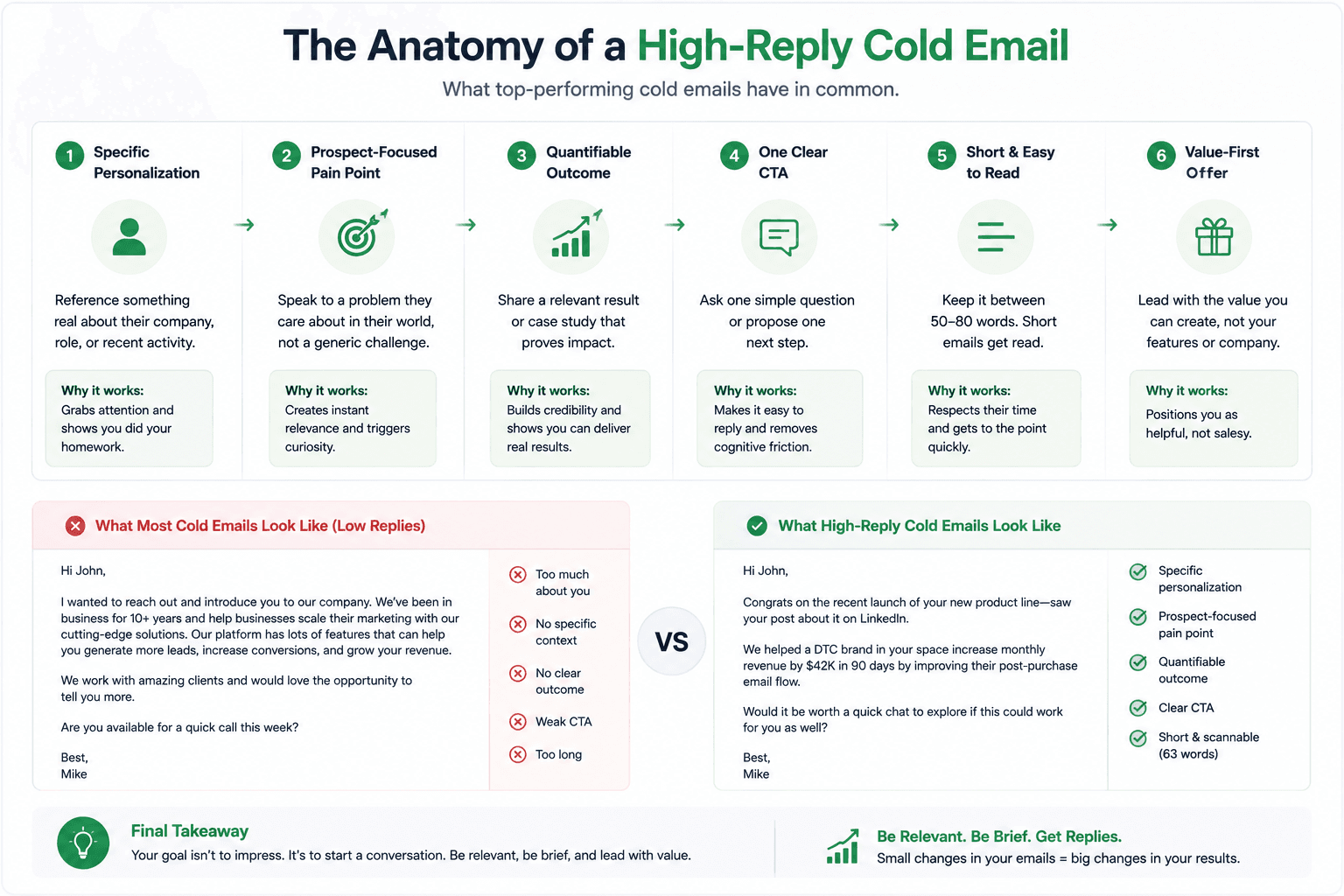
This is where most campaigns leave the biggest opportunity on the table. You can get everything else right and still struggle if your offer is weak, unclear, or asks for too much too soon. The standard "worth a quick call?" CTA is overused and increasingly ignored because it asks the prospect to give their time to a stranger with no proof of value.
The Four Components of a Strong Offer
A complete cold email offer has four parts. First, a quantifiable end result: what exactly will you deliver? Not "more leads" but "10 to 20 qualified calls" or "a 30% increase in conversion rate." Second, a timeframe: in how long? "Within 30 days" is specific. "Over time" is not. Third, a guarantee or risk reversal: what happens if you do not deliver? This answers the objection before the prospect has to raise it. Fourth, a USP or mechanism: how will you do it? This does not need to be detailed, just enough to differentiate your approach from everyone else in their inbox.
When you combine all four, the offer becomes concrete enough to evaluate. "We can book you 10 to 20 qualified calls within 30 days using targeted cold email campaigns, and if we don't hit that number, we continue working for free until we do." That is a complete offer that gives the prospect a reason to respond.
Leading with Value Instead of Asking for Time
One of the most effective shifts in cold email strategy in 2026 is replacing the meeting request with a value offer. Instead of "can we hop on a call?" the CTA becomes "I put together a two-minute breakdown of how your competitors are outranking you. Want me to send it over?"
This works because it requires almost no commitment from the prospect. Saying yes to receiving a short video or document is far easier than agreeing to a meeting with a stranger. And once they watch the video or review the document, you have built trust, demonstrated competence, and created reciprocity, all of which make the eventual call booking dramatically easier.
High-performing teams use cold email system frameworks that build this value-first approach into every sequence. The teams that are still leading with "let's book 15 minutes" are competing with every other cold email in the inbox that asks the same thing. The ones leading with value are standing out because 95% of senders are still pitching the meeting directly.
Bringing It All Together
The gap between a 3% reply rate and a 10% reply rate comes down to a handful of fixable problems. Shallow ICP research produces irrelevant lists and generic scripts. Scripts that focus on the sender instead of the prospect get ignored. Long emails never get read. Surface-level personalization gets treated like spam. Poor technical infrastructure means good emails never reach the inbox. Missing or excessive follow-ups waste opportunities. And weak offers fail to give the prospect a compelling reason to respond.
Each of these problems has a specific fix, and most of them do not require new tools or bigger budgets. They require better process, clearer thinking about who you are writing to and what they actually care about, and a willingness to do the research that most teams skip.
If you are running cold email campaigns and the results are not where they should be, we can audit your current setup and identify exactly what needs to change. We work with sales teams that are using AI to personalize outreach at scale, and with operations leaders replacing manual prospecting with systems that actually convert.
Book a 45-minute call with our team and we will walk through your campaigns, your infrastructure, and your scripts to find where the replies are getting lost.