Article
May 4, 2026
5 Cold Email System Frameworks High-Performing Teams Use in 2026
Five cold email system frameworks used by teams booking real meetings in 2026. Infrastructure, lists, copy, personalization, and feedback loops.
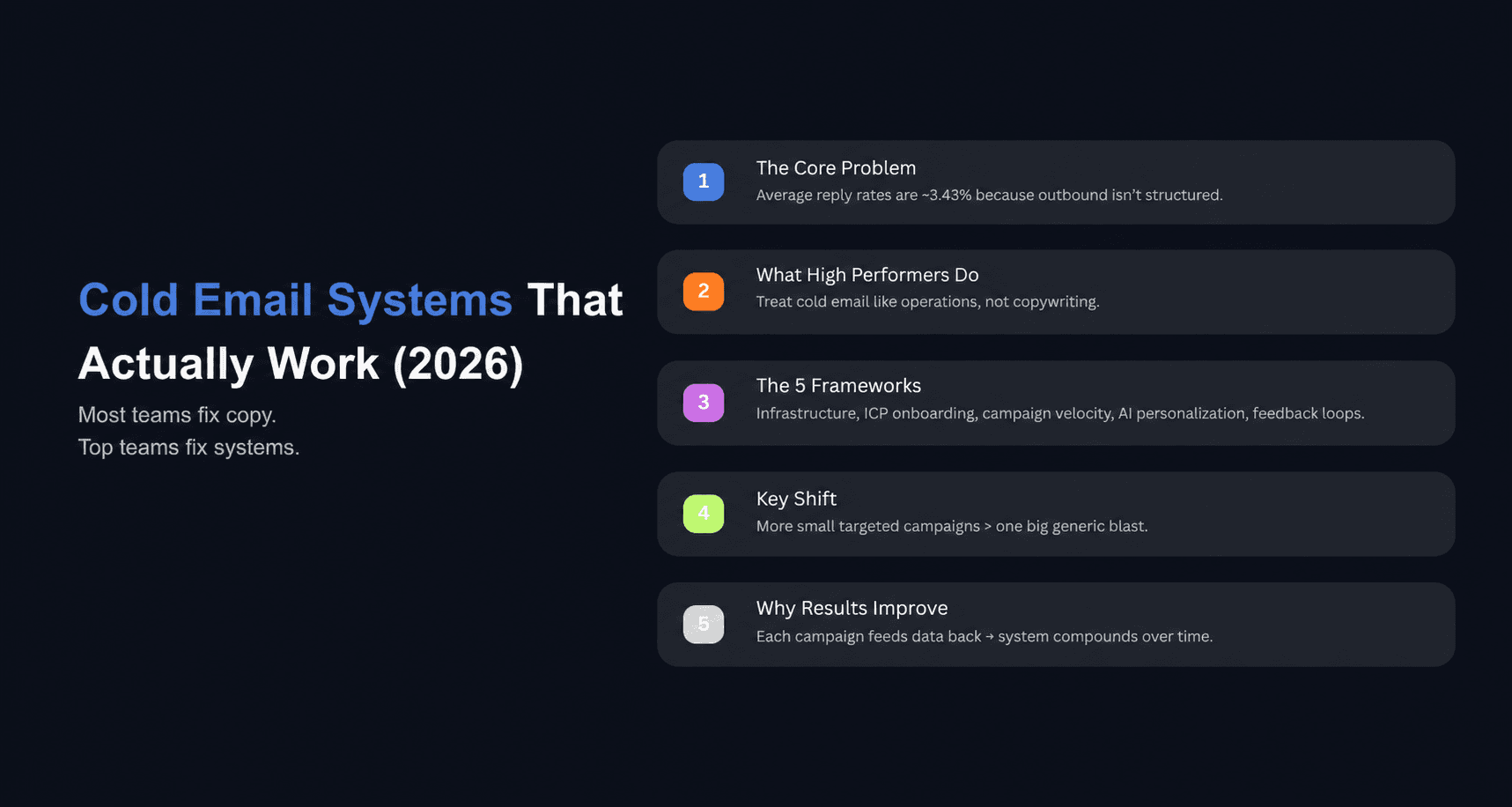
The average cold email reply rate in 2026 is 3.43%, according to Instantly's benchmark report. Most teams see that number and assume they need better subject lines or a new copywriting formula. That is rarely the actual problem.
The teams consistently generating pipeline from cold outbound are not writing better emails. They are running better systems. They treat outbound as an operations discipline with repeatable processes, clear inputs, and measurable outputs at every stage. The copy matters, but it is the last thing they work on, not the first.
This post covers five system frameworks that separate teams booking meetings every week from teams constantly rewriting their sequences hoping something sticks. These are not copywriting templates. They are operational structures that compound over time.
Framework 1: Infrastructure First, Copy Second
Most teams spend their first week writing emails. High-performing teams spend their first week building sending infrastructure that will protect every campaign they run for the next twelve months.
As of 2026, Google, Yahoo, and Microsoft all enforce sender authentication for bulk email. Emails sent from domains without properly configured SPF, DKIM, and DMARC records are rejected outright by Gmail. Not filtered to spam. Rejected entirely, meaning the message never arrives. This is a binary gate. Either your technical setup passes or your emails do not exist in your prospect's inbox.
The Domain and Inbox Math
The infrastructure math is straightforward but most teams get it wrong because they try to send too many emails from too few accounts. The general rule is to cap sends at 30 emails per inbox per day after warmup completes. Sending above that threshold pushes your patterns toward bulk sender behavior, which increases spam filter flags and damages sender reputation over time.
For a team sending 3,000 emails per month, that works out to roughly 136 emails per day across about 5 inboxes on 2 to 3 separate sending domains. Each domain needs its own DNS authentication configured correctly, and each inbox needs a warmup period of 2 to 4 weeks before production sends begin. Start new domains at 5 to 10 emails per day and scale gradually.
The cost of this infrastructure is trivial compared to the cost of burning a domain. At roughly $6 per inbox per month on Google Workspace or Microsoft 365, a 5 inbox setup runs $30 per month. Rebuilding a burned domain portfolio takes 3 to 6 months. Teams that skip the infrastructure step and send 200 emails a day from two inboxes end up spending more time managing deliverability problems than they ever would have spent setting up properly.
Deliverability Is an Operations Problem
The part people miss is that deliverability is not something you fix once. It requires ongoing monitoring of bounce rates, spam complaints, and inbox placement. Bounce rates above 2% damage sender reputation. Spam complaint rates need to stay well under 0.3%. These are not vanity metrics. They are operational KPIs that determine whether your next campaign reaches anyone at all. Teams that treat deliverability as infrastructure rather than an afterthought are the ones whose campaigns consistently land in the primary inbox.
Framework 2: ICP Onboarding as a Structured Process
Before pulling a list or writing a single email, high-performing teams run a structured onboarding process to define exactly who they are going after and why. This is not a quick brainstorm or a one-line description of their target market. It is a systematic interview that covers 10 to 12 specific questions about the business, its customers, and the offer.
The onboarding covers questions like: What does the company sell, and to whom? Who are the two or three best existing customers, and what makes them the best fit? What job titles should be targeted? What headcount range matters? Which industries are in scope and which are explicitly excluded? What geographic restrictions apply? Are there specific triggers that indicate a company might be ready to buy, such as a recent fundraise, a new hire in a relevant role, or heavy spending on paid acquisition channels?
One of the most valuable parts of this process is identifying disqualifiers early. Direct competitors, companies that are already customers, businesses in adjacent but wrong industries. Removing these before building a list saves time and protects reply rates. When an agency called Growth EngineX ran this onboarding process for a streaming TV ad platform, the system automatically identified competitors to exclude, proposed trigger events like Shopify installations and heavy Meta ad spending, and suggested targeting parameters based on public information about the company's existing customer base. The entire process happened before a single prospect was added to a list.
This structured approach also creates a reusable asset. Once the onboarding document exists, every future campaign builds on the same foundation. New team members, new campaigns, and new market segments all start from a validated baseline instead of a blank page.
Framework 3: Campaign Velocity Over Campaign Volume
The traditional approach to cold email is to build one large list, write one sequence, and send it to everyone. The math on this approach stopped working several years ago. According to Autobound's 2026 cold email guide, which aggregates data from Instantly, Belkins, Woodpecker, and Backlinko, emails that reference specific buying signals like funding rounds, leadership changes, and hiring surges achieve response rates of 15 to 25%. That is a 5x improvement over generic cold outreach sent to broad lists.
The framework that captures this advantage is campaign velocity, which means running more campaigns with smaller, more targeted segments instead of fewer campaigns sent to larger audiences. A team running this framework might create 15 to 25 campaign strategies from a single ICP onboarding document, each with its own targeting angle, value proposition, and copy direction.
What a Campaign Strategy Document Looks Like
Each campaign in the document includes a campaign name, the targeting criteria and list filters, the specific value proposition, the AI personalization strategy, and a brief overview of the angle. For example, one campaign might target Shopify DTC companies with 10 to 500 employees where the CMO or head of growth is the primary contact, and the angle is helping them add a second attributed channel beyond Meta. Another campaign from the same onboarding might target companies currently running heavy Google Ads spend, with a completely different hook and proof point.
This approach mirrors how paid media teams operate. They do not run one ad to one audience. They test dozens of creative and targeting combinations, measure results, and double down on what works. The teams that brought this mindset to cold email are the ones seeing the strongest results in 2026. The compounding effect of running eight campaigns a month instead of two is larger than any single copy improvement, because each campaign generates its own data about what messaging and targeting combinations produce replies.
Framework 4: AI Personalization Through Sub Agent Patterns
The biggest shift in cold email personalization over the last year is not that teams started using AI. It is how the best teams structured their AI workflows to produce lines that recipients cannot immediately identify as automated.
The problem with most AI personalization in 2026 is that it all looks the same. When every email in someone's inbox opens with "I noticed that [Company] recently [trigger event]" and then pivots to the exact same pitch regardless of the trigger, recipients see through it immediately. The format looks personalized. The substance is not. A 2026 survey found that 69% of US decision makers say it bothers them when they sense AI was used to write an email. The bar for what counts as personalization has moved well past first name and company name.
How Sub Agent Patterns Work
The framework that solves this is a sub agent pattern where the AI does not just fill in variables but actually researches the company and generates a contextual line that connects their business to the product's value proposition. Rather than saying "I noticed you sell hunting equipment," a well-structured sub agent might generate something like: "While your target customer is watching TV, you could show a fast-paced nature scene of hunters using your gear to get back home faster to their families." That line connects the prospect's product category to a specific use case for the sender's product in a way that would be difficult to automate with simple variable insertion.
The operational key is an iterative prompt loop. The system generates a batch of personalized lines, then evaluates them against a set of quality criteria. Lines that sound too much like AI or use phrases that nobody would actually say in conversation get flagged and rewritten. The prompt itself gets refined through this loop until it produces two consecutive batches that pass quality review, at which point the prompt is locked in and run across the full contact list.
Teams building a cold email system in Claude have found that this sub agent approach allows them to generate thousands of personalized lines in a single session at a fraction of the cost of traditional enrichment tools. One operator reported writing 100,000 personalized lines in a single day on a $200 monthly plan. The quality comes not from the volume but from the iterative refinement loop that runs before scaling. For a deeper walkthrough of this process, the guide on writing personalized first lines at scale covers the prompt structure and review criteria in detail.
One enterprise client doubled their sales efficiency by applying AI-driven insights to lead engagement, reaching prospects at the right time with data-backed decisions rather than guesswork.
Framework 5: Closed Loop Feedback Systems
The fifth framework is the one most teams skip entirely. They measure campaign performance. They know their open rates and reply rates. But they do not feed that information back into the system in a structured way.
High-performing teams build a closed loop where positive replies are analyzed, patterns are extracted, and those patterns directly inform the next campaign. This means reading every positive reply and identifying what the recipient responded to. Was it the subject line? The personalization line? The specific offer? The social proof? Was there a pattern in which industries or job titles responded best?
Turning Replies Into System Inputs
The operational version of this is not just a spreadsheet review. It is a structured process where the best performing campaigns from the last 90 days are pulled from the sending tool, the subject lines and body copy are compared, and the common structures are identified. Those patterns become the template for the next round of campaigns. This is important because your best copy contains patterns you probably cannot articulate by looking at it once, and pulling from real results keeps those patterns intact.
Teams auditing and rewriting weak cold email copy through this kind of structured review consistently improve reply rates over time because each campaign builds on validated data rather than assumptions. The system also includes deliverability monitoring as a feedback input. If spam rates creep up or inbox placement drops, those signals get fed back into the infrastructure layer so that sending patterns, domain rotation, and warmup schedules get adjusted before the next campaign launches.
The teams that automate their cold email sequences through this full loop are not just sending more emails. They are building an institutional memory of what works for their specific market, offer, and audience. Over six months, that compounding knowledge creates a significant advantage that competitors running ad-hoc campaigns cannot replicate.
What Happens When You Combine All Five
Each of these frameworks produces results on its own. Infrastructure protects your sending reputation. ICP onboarding improves targeting accuracy. Campaign velocity generates more data faster. AI personalization increases reply rates on each individual email. Closed loop feedback compounds every improvement across future campaigns.
The real advantage comes from running all five as one integrated system. The ICP onboarding feeds the campaign strategy document. The campaign strategies inform the personalization prompts. The personalization quality protects deliverability because relevant emails get fewer spam complaints. The feedback loop refines every layer for the next round. Each part strengthens the others.
Teams personalizing cold outreach with AI as part of this integrated system report reply rates in the 4 to 10 percent range depending on niche and offer quality. That is 2 to 3x the industry average, and the gap widens over time as the feedback loop compounds.
Conclusion
The teams getting consistent results from cold email in 2026 are not doing anything mysterious. They are running systems. Infrastructure before copy. Structured ICP onboarding before list building. Multiple targeted campaigns instead of one broad blast. AI personalization that goes beyond variable insertion. Feedback loops that turn every campaign into training data for the next one.
None of this requires a large team or a massive budget. It requires treating outbound as an operations discipline with the same rigor you would apply to any other repeatable business process. Start with the framework that addresses your biggest current gap, build it properly, and let the system compound from there.