Article
Sep 9, 2026
Why Recruitment Agencies Should Stop Asking for Meetings in Cold Outreach
The meeting ask is the highest-friction ask in cold outreach. Why recruiters get more replies by leading with a candidate, and booking calls later.

Most recruitment cold emails end the same way, with a request for fifteen minutes on the calendar. The rest of the email might be sharp, relevant, and well targeted, and then that final line asks a person who has known you for a few seconds to hand over their time and commit to a call. That single ask does more to suppress replies than almost anything else in the message, and it is the easiest thing to fix.
This is not an argument that meetings do not matter, because a call is often where a client relationship actually starts. The point is narrower and more useful: the meeting request is the wrong thing to ask for in a first cold message, and leading with it costs recruiters replies they would otherwise get. This guide covers why the meeting ask fails cold, what to offer in its place, and how the meeting still happens once you have earned it.
The meeting request is the highest friction thing you can ask for
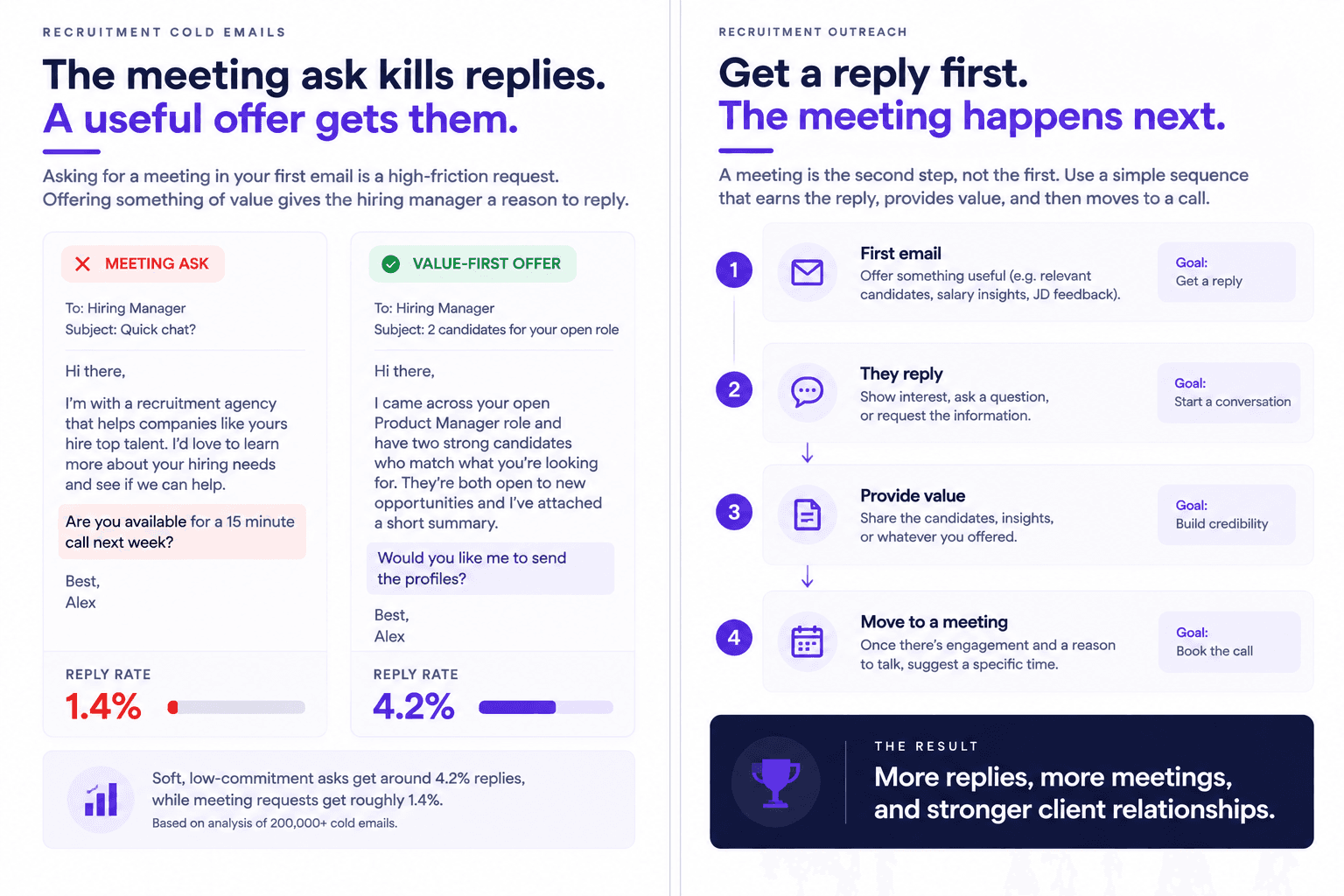
Every cold email asks the reader to do something, and the size of that request determines how many people say yes. A meeting is a large request. It asks for time, attention, and a slot on a calendar, and it does so before the reader has any evidence that the time will be worth it. The result shows up clearly in the data. One analysis of more than 200,000 cold emails found that soft, low commitment asks reply at around 4.2% while hard requests to book a meeting or demo reply at roughly 1.4%, which is a threefold difference driven entirely by the size of the ask.
The reason is straightforward once you look at it from the reader's side. A hiring manager who does not know your agency has no basis on which to justify a meeting, so the safe response to a calendar request is to ignore it. Leading with that ask is one of the most common cold email mistakes that kill reply rates, and it turns an otherwise strong email into one more message that gets skimmed and deleted.
Getting a reply and getting a meeting are two different sales
The deeper issue is that a meeting request tries to close two sales at once. The first sale is getting the person to reply at all, and the second is getting them to agree to a call. These are separate decisions with very different levels of friction, and a first touch meeting ask forces the reader to make both before they have made the first one. That is why the gap between replies and booked meetings is so wide, with industry benchmarks showing that many campaigns reply at five to ten percent while only a fraction of a percent actually book meetings.
Sequencing the two asks separately works far better. A large study of cold outreach found that interest-based asks generate more replies when a prospect is cold, while specific requests for a meeting time convert best once the prospect is already engaged, with direct time asks performing several times better after engagement than they do on a first touch. The lesson is to match the size of the ask to how well the person knows you, earning the reply first and moving to the meeting once there is a reason to.
For recruiters, the best thing to offer is a candidate
Recruitment agencies have an advantage here that most B2B senders do not, because the value they can offer is concrete and immediate rather than a vague promise of insight. The strongest first move is to give a hiring manager something they can use, and the most compelling version of that is a candidate. Telling a manager you have two or three people who fit their open role and asking whether they would like to see the profiles is a message worth replying to, because it addresses the exact problem they are trying to solve.
Candidates are not the only thing you can lead with. A read on the salary a specific role commands this quarter, a short list of improvements to a job description that is not attracting applicants, an availability report for a hard to fill position, or a view of how a competitor is hiring all give the reader a reason to engage. The common thread is that each one helps the hiring manager before asking anything in return, which is what makes a recruiter stand out in a crowded inbox. Being able to produce a matched shortlist quickly is what makes the candidate offer credible, and running your pool against the open role with a tool like Claude Code for candidate matching means you can make that offer within minutes of spotting the role.
What to ask for instead
If the meeting is off the table for the first email, the ask becomes small and specific. The most effective version invites a one-word reply, such as asking whether the manager would like you to send the profiles, or whether a salary benchmark for the role would be useful. The reader can say yes without committing to anything beyond reading what you send, which removes the friction that a calendar link creates.
Two rules make this work in practice. Keep it to a single ask, since emails with one clear call to action see reply rates lift by 35 to 42% over emails that offer several options at once and leave the reader to choose. And keep the calendar link out of the first message entirely, because a link to book time belongs later in the sequence rather than on a first touch. The shift that underpins all of this is moving the email from what you want, which is a meeting, to what the prospect needs, which is a low risk reason to reply. The frameworks high performing teams use all follow this pattern of escalating the ask as the relationship warms.
The meeting still happens, just later
Removing the meeting request from the first email does not remove the meeting from the process. It moves it to the point where it is easy to say yes. Once a hiring manager has replied to ask for the candidate profiles, reviewed them, and seen that you understand their role, a request for a short call to discuss the search is a natural next step rather than a cold imposition. This is exactly the stage where a specific time ask performs well, and it is how you actually book more sales meetings without leading with the ask that kills replies.
Timing matters once the reply lands. A hiring manager who has just responded with interest is most receptive in the first few minutes and cools quickly after that, so acting fast on the reply is what converts interest into a booked call. The meeting is the goal in the sense that it moves toward signed terms and the new clients your agency needs, and the way to reach it reliably is to earn the reply first and let the call follow from a conversation that is already underway.
How to run value-first outreach at scale
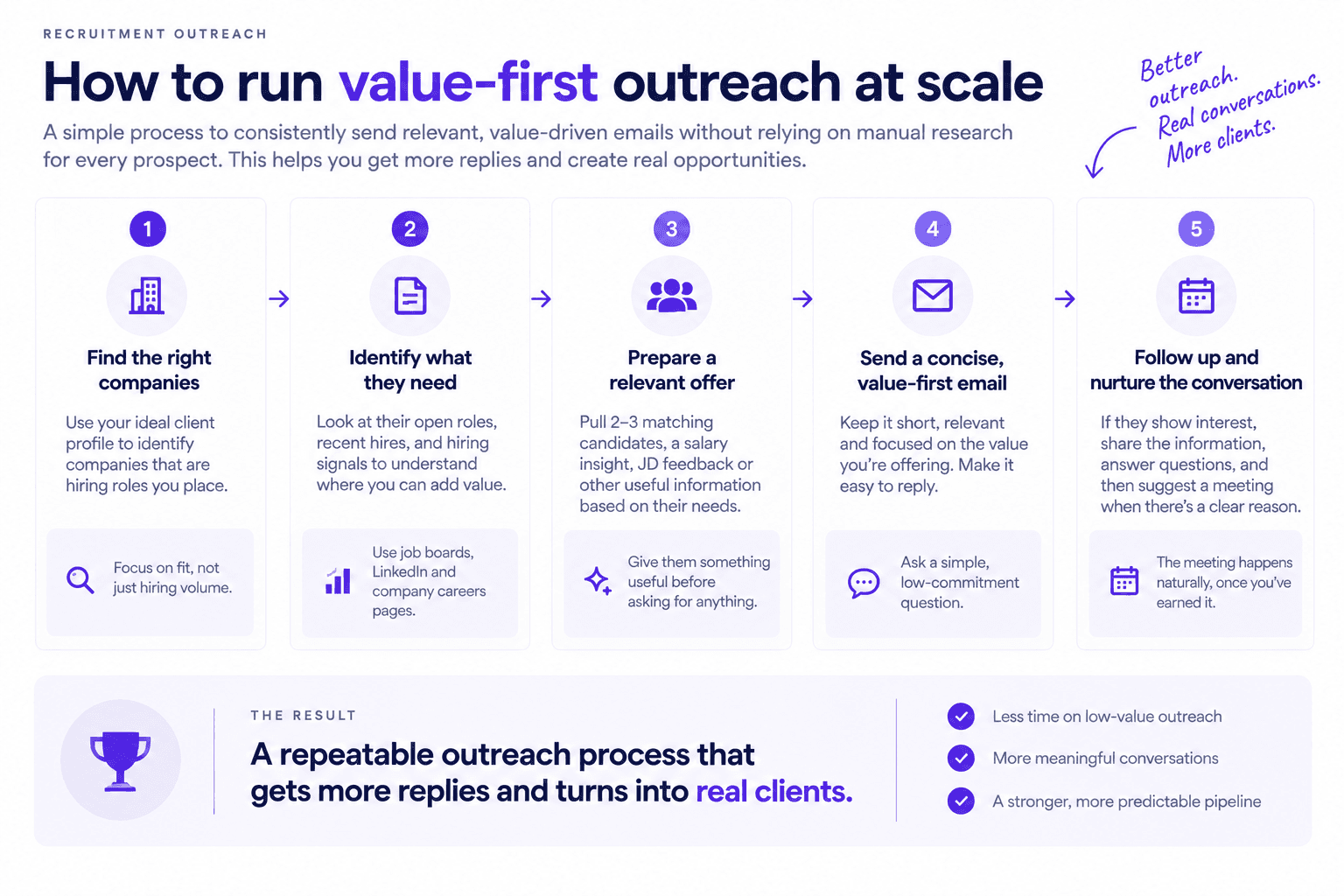
Leading with value works for a single thoughtful email, and it needs a system to work across a full desk. The foundation is relevance, because an offer of candidates only lands if the person is actually hiring for that role, which means qualifying the company first and targeting based on real hiring signals so your value offer matches a live need. Reaching the right hiring manager rather than a generic inbox is the other half of getting the value in front of someone who cares.
From there the sequence should rotate a different value on each touch rather than repeating the same offer, which is the core of an effective follow-up strategy. A first email might offer matched profiles, a second might offer to sharpen the job description, and a third might share salary data, with the request for a call introduced only after a reply. Structuring the whole message this way is covered in depth in our guide to recruitment agency cold email, and building it to run across many roles at once is part of the broader shift in how agencies generate leads with AI. Testing your asks matters as much as writing them, since the only reliable way to know which value offers earn replies on your desk is to measure positive reply rate across variations and keep what works.
Should recruitment cold emails ask for a meeting at all?
Not in the first email to a cold prospect. A meeting is a high commitment request, and asking for it before the person has any reason to trust you suppresses replies, with hard meeting asks converting at a fraction of the rate of low friction ones. The meeting belongs later in the conversation, after the prospect has replied to a value offer and seen that you understand their role. At that point a specific request for a short call is welcome and converts well, so the question is one of timing rather than whether to ask at all.
What should a recruitment agency ask for instead of a meeting?
Ask for permission to send something useful. The strongest option for a recruiter is a small set of matched candidate profiles for the open role, since that speaks directly to the hiring manager's problem. Other effective offers include a salary benchmark for the role, a short review of the job description, an availability report for a hard to fill position, or a read on how competitors are hiring. Each of these needs only a one-word reply to accept, which is far easier to give than a slot on a calendar, and each one positions you as a recruiter who helps before asking.
When should you send a calendar link in cold outreach?
After the prospect has engaged, not in the first email. A calendar link on a first touch asks a stranger to commit time before they have a reason to, and it tends to be ignored. Once a hiring manager has replied to a value offer and a real conversation has started, a link or a specific time suggestion becomes a natural next step and converts far better. The rule of thumb is to keep the first email focused on earning a reply, and to introduce scheduling only once interest is clear.
Bringing it together
The meeting request feels like the point of cold outreach, and leading with it is what stops most recruitment emails from working. A cold email has two jobs that happen in order: earn a reply, then earn a meeting. Recruiters are unusually well placed to earn that first reply because they can offer something concrete, whether a matched candidate, a salary benchmark, or a sharper job description, all of which a hiring manager can accept with a single word. Once that conversation is underway, the call follows naturally, and it converts because the prospect already knows you understand their role.
If you want help building outreach that leads with value and books calls once interest is real, we can walk you through a system that qualifies companies, finds the right hiring managers, and reaches them with a candidate in hand. Book a call with the Novoslo team and we will show you exactly how it works.