Article
Aug 27, 2026
Cold Email Follow-Up Strategy: How Many Emails Should You Send?
Cold email follow-up strategy for 2026: how many emails to send, the ideal cadence, and why the first follow-up drives most of your replies.

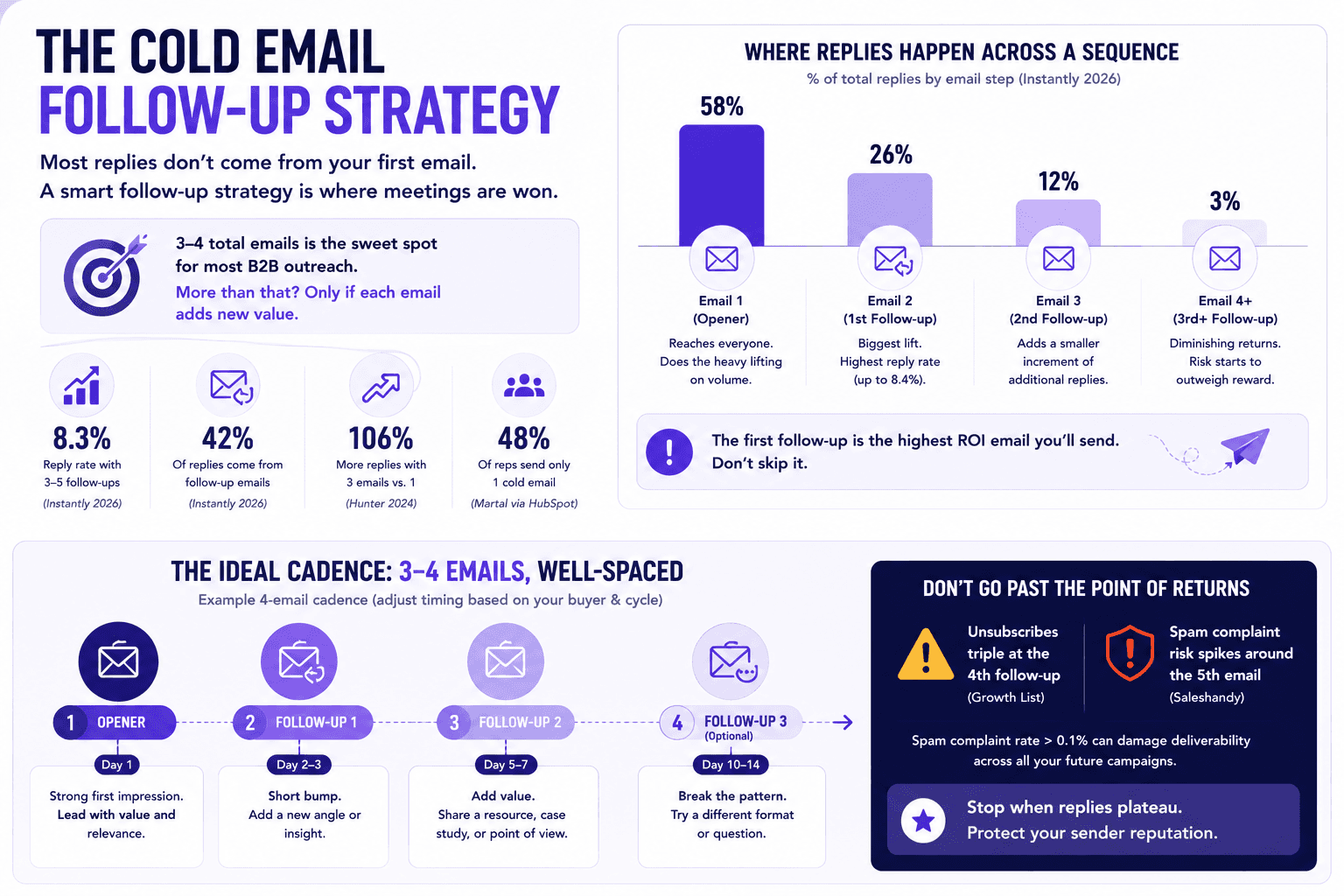
Close to half of sales reps send one cold email and stop. According to HubSpot data cited by Martal, 48% never follow up after an unanswered first message, and another 44% give up after a single follow-up. That habit is expensive, because Instantly's 2026 benchmark report found that only 58% of replies come from the first email in a sequence. The other 42% come from follow-ups that most senders never send.
So the useful question is not whether to follow up. It is how many emails to send, how far apart, and where the point sits when another email starts working against you. This guide gives a clear cold email follow-up strategy backed by current data, along with a cadence you can copy and adjust for your own segment.
The short answer on how many follow-up emails to send
For most B2B outreach, three to four total emails is the range that captures the majority of available replies without damaging your sender reputation. That means one opener and two or three follow-ups. You can extend to five or seven touches, but only when each additional email carries a genuinely new reason to reply rather than a restatement of the last one.
The data supports treating follow-ups as core to the campaign rather than an optional extra. Instantly's 2026 report found that campaigns with three to five follow-up steps hit an 8.3% reply rate, roughly double the 4.1% rate for campaigns that send a single email with no follow-up at all. Hunter's State of Cold Email report, based on 31 million emails, found that using three messages instead of one increased total replies by 106%.
You will see some guides recommend four to seven emails and others recommend three to four. The disagreement is smaller than it looks. Both camps agree that the first follow-up produces most of the additional lift and that returns fall sharply after the third or fourth touch. The right number for your team depends on your buyer, your list quality, and how much fresh value you can actually add to each message. If you are already fighting low reply rates, the sequence length is rarely the first thing to fix. Start with the cold email mistakes that quietly kill reply rates before you add more sends.
Why the first follow-up matters more than the rest
If you only change one thing about your outreach, add a single follow-up to every sequence. Backlinko's analysis of 12 million outreach emails found that one follow-up increases reply rates by 65.8% on its own, which makes it the highest-return message in the entire sequence. Belkins data cited by Woodpecker puts the peak reply rate for the first follow-up at 8.4%, often higher than the opener itself.
The reason is straightforward. Your first email lands in a busy inbox on a day when the prospect had no reason to prioritize you. A well-timed second email reaches some of those people on a calmer day, and it signals that your outreach is deliberate rather than a one-off blast. This is also why sequence quality compounds with deliverability: an email that lands in spam cannot generate a reply no matter how good the copy is, so your cold email infrastructure setup has to be sound before any of these numbers apply to you.
Where replies actually happen across a sequence
The pattern across most large datasets is consistent. The opener does the heavy lifting on volume because it reaches the full list. The first follow-up produces the biggest single jump in reply rate. The second follow-up adds a smaller increment, and the third adds less again. By the time you reach the fourth or fifth touch, the incremental replies are thin and the downside starts to grow. Understanding this shape helps you decide where to spend your editing time, which is almost always on the opener and the first follow-up.
The point where more emails start hurting you
More follow-ups do not keep adding replies indefinitely. The evidence points to a clear ceiling. Growth List found that unsubscribe rates triple at the fourth follow-up, and Saleshandy data shows spam complaint risk rising steeply around the fifth email. This matters because the industry spam complaint threshold sits at roughly 0.1%. Cross it and your deliverability drops across every future campaign from that domain, not just the one that caused the problem.
That is the real cost of an over-long sequence. You are not only annoying a few extra prospects, you are teaching Gmail and Outlook to distrust your sending domains. A campaign that pushes past seven touches to squeeze out a fraction of a percent in extra replies can quietly reduce the reply rate on everything you send afterward. If you want to see this happening before it becomes a crisis, you can track deliverability and complaint signals across your sending domains as part of your weekly review.
How to read your own data to find the stop point
Benchmarks give you a starting range, but your own numbers tell you where to stop. Watch two figures as the sequence lengthens. The first is the incremental reply rate per step, which shows you when each new email stops earning its place. The second is the unsubscribe and complaint rate per step, which shows you when you are starting to burn the list. When an additional email adds almost no replies while pushing unsubscribes above roughly 0.3% for that step, cut it. Different segments tolerate different lengths, so recruiting and high-intent audiences can often take more touches than regulated verticals like healthcare, where anything past four or five tends to backfire.
A cadence that captures most of your replies
Spacing matters as much as the number of emails. Sending follow-ups too fast reads as pressure, and waiting too long lets the prospect forget the first message entirely. The approach that works across most datasets is graduated spacing, where the gaps widen as the sequence goes on.
A reliable default looks like this. Send the opener on day zero. Send the first follow-up two to three days later. Send the second follow-up three to four days after that. Widen later touches to five to seven days, and stretch anything beyond that to a week or two. This cadence gives each email room to breathe while keeping the sequence tight enough to stay in the prospect's memory. Sending on Tuesday through Thursday mornings tends to line up with the strongest engagement windows across platform data.
Timing rewards speed on the other side of the conversation too. Roughly 95% of cold emails that get any reply get it within 24 hours of a send, and the chance of a reply drops steeply after two days of silence. That short window is why speed to lead on positive replies decides how many of your hard-won responses actually turn into booked meetings. A great sequence that sits on a reply for a day loses meetings it already earned.
What each email in the sequence should do
Every email in the sequence needs a distinct job. If you cannot say in one sentence what a specific email is trying to accomplish, it should be cut or rewritten. The opener leads with the prospect's problem and a single clear ask. The first follow-up adds a new angle or a relevant proof point rather than repeating the pitch. The second introduces a different value proposition or a short, specific case. A final low-pressure message can close the loop and often pulls replies from people who meant to respond earlier. If your follow-ups tend to blur into slightly reworded versions of the first email, it is worth auditing and rewriting the copy so each touch stands on its own, and building the whole thing into a repeatable cold email system instead of a set of one-off messages.
How long should you wait between cold email follow-ups?
Use graduated spacing rather than a fixed gap. Two to three days before the first follow-up, three to four days before the second, then widen to five to seven days and eventually a week or two for later touches. Next-day follow-ups reduce replies because they read as impatient, while a slightly longer gap gives the prospect time to see the message on a day they can act on it. The full sequence usually spans two to three weeks. Map send times to the recipient's time zone, not yours, and lean toward mid-week mornings where engagement is highest.
What should each follow-up email actually say?
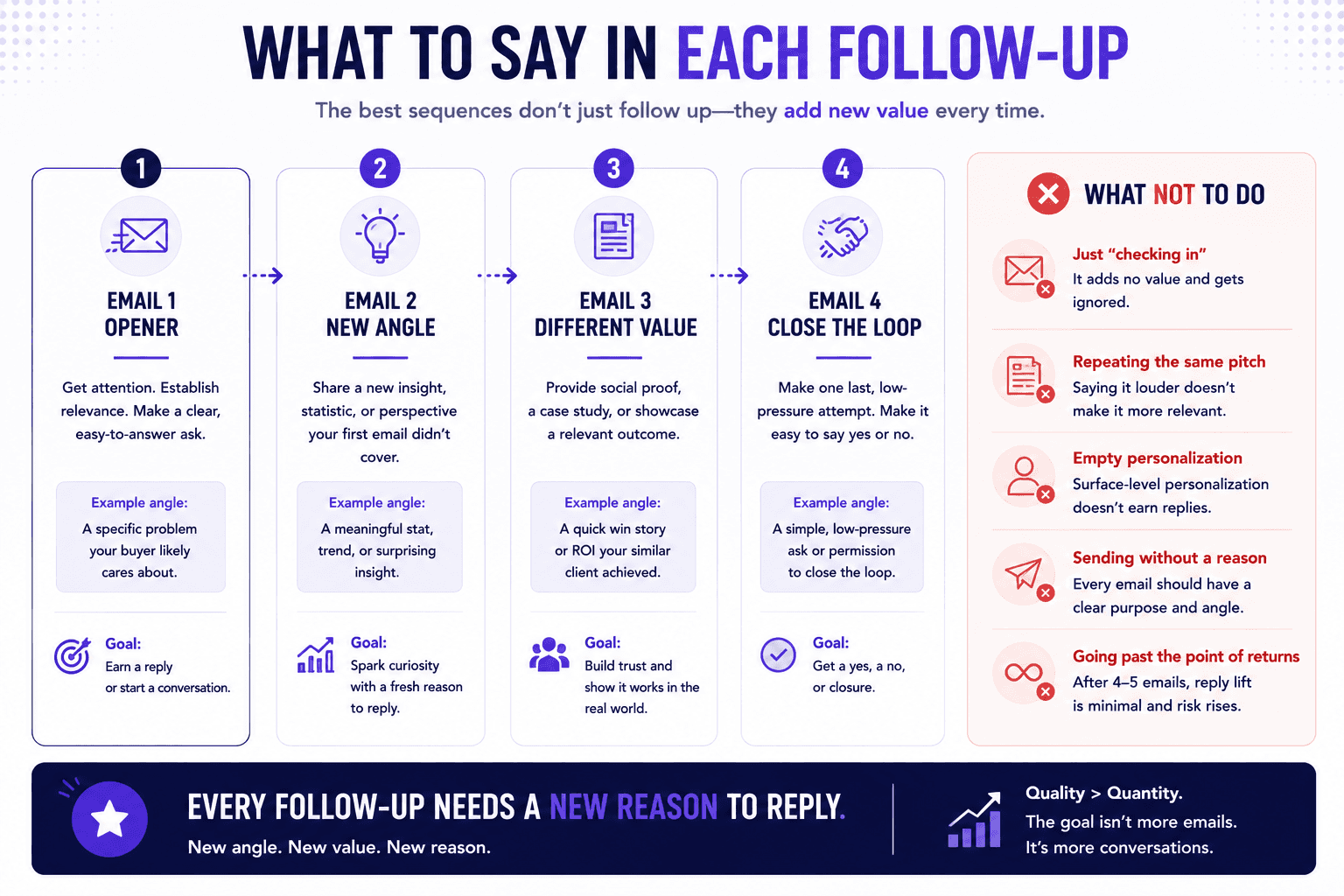
Each follow-up should add something the previous email did not: a new angle on the problem, a specific proof point, a relevant resource, or a question that is easy to answer. Avoid generic check-in language. Saleshandy found that the phrase "just checking in" alone decreases meetings booked by 14%, because it signals that you have nothing new to offer and are simply asking again. Keep every email short, ideally under 125 words, with one clear and low-friction ask. The personalization that lifts replies is context about the prospect's business, not their first name, so strong personalized opening lines do more work than any clever subject line. Once the structure is set, you can automate the sequence and its timing so no follow-up gets missed and every send stops the moment a prospect replies.
Should your follow-ups stay email-only?
Email-only sequences leave results on the table. Coordinated outreach that combines email with a light LinkedIn touch consistently outperforms email alone, and some datasets show reply rates above 11% for that combination. The point is not to hit the same person on five channels at once, but to add one or two well-placed non-email touches that reinforce the message. If you are weighing where to put that effort, our comparison of LinkedIn DMs versus cold email covers the trade-offs, and the framework for a full multichannel outbound system shows how to sequence the channels so they support each other. Tight targeting amplifies all of this, since micro-segmented campaigns built around small, well-defined lists reliably beat large batch sends on reply rate.
Putting it together
A strong cold email follow-up strategy comes down to three decisions. Always send at least one follow-up, because it is the single highest-return message you can add and most of your competitors skip it. Cap the sequence at three to four emails for most audiences, and extend further only when each new touch carries real value. Space the touches with widening gaps and act on replies within the day they arrive, because the reply window closes fast.
None of this works on top of a broken list, a weak offer, or poor deliverability, so treat sequence length as a lever you pull after the fundamentals are solid. If you would rather have a team build and run the full system for you, from infrastructure to sequencing to reply handling, book a call with Novoslo and we will map it to your pipeline.