Article
Sep 4, 2026
How AI Is Changing Recruitment Agency Lead Generation
How AI is changing recruitment agency lead generation in 2026: what it automates, why generic AI outreach is failing, and where the edge now sits.

For a long time, recruitment business development ran on three things: a Rolodex, LinkedIn, and whoever was loudest on the phone. That worked well enough while the constraint was finding candidates. Now that the harder problem is finding clients, the old model has started to show its ceiling, and AI is reshaping how agencies build pipeline.
The change is real, but it is not the change most vendors describe. AI is not a button that produces clients while you sleep. What it actually does is collapse the manual grind that used to cap how many companies an agency could reach, while quietly commoditizing the obvious plays that everyone now runs the same way. This guide covers both sides honestly: what AI genuinely changes about recruitment agency lead generation, where it is creating new problems, and where the real advantage has moved as a result.
Where recruitment lead generation stood before AI
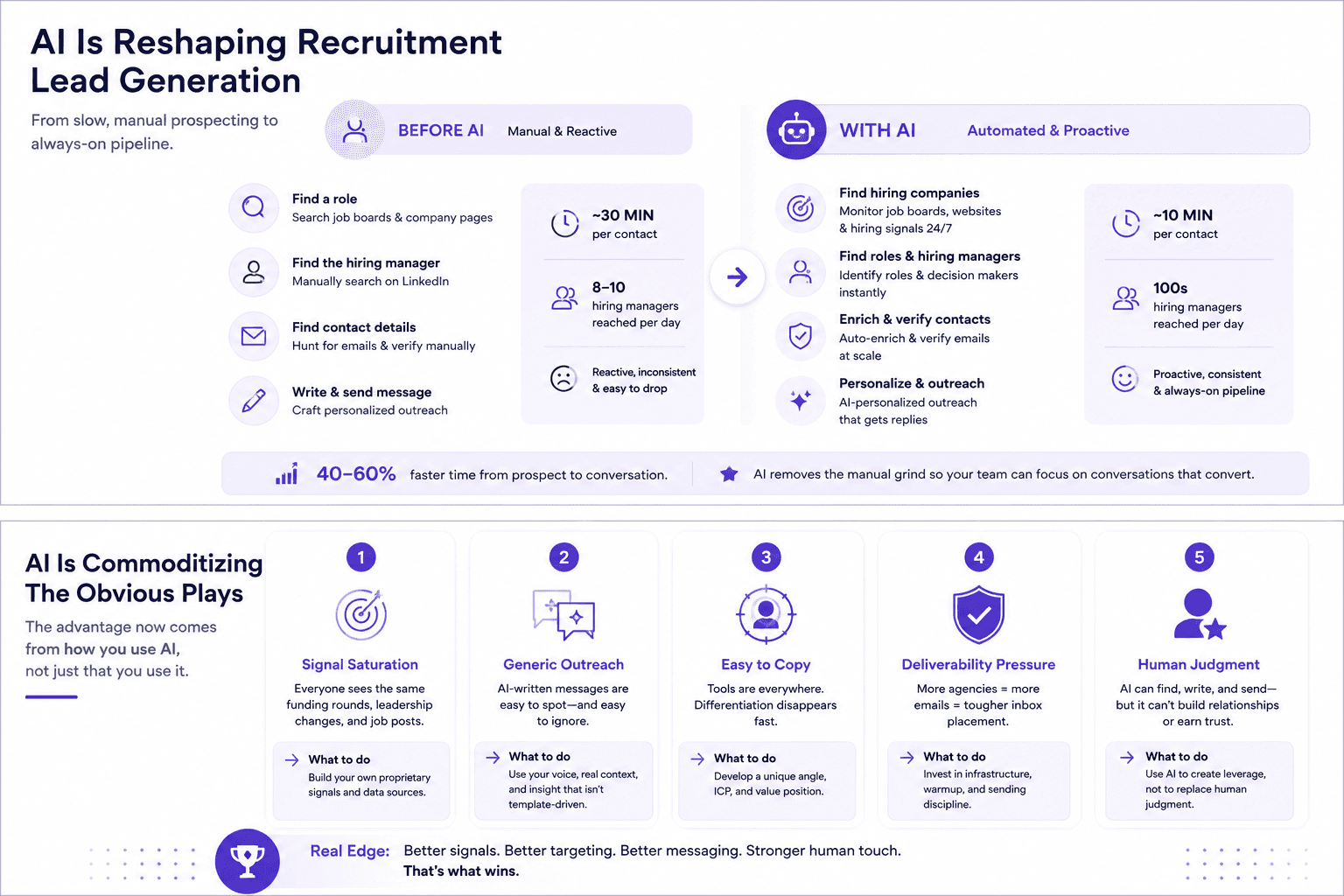
The traditional model was slow by design. A recruiter would find a role, read the description, work out who the hiring manager might be, hunt for them on LinkedIn, track down contact details, and send a carefully written message. That whole process took roughly 30 minutes per contact, which capped a busy recruiter at eight to ten hiring managers a day. Most of those messages then opened with the agency talking about itself, which is the pitch hiring managers have learned to ignore.
The result was a business development motion that was reactive, capped by human hours, and easy to abandon the moment the desk got busy with delivery. It produced enough to survive in an easier market, and it leaves agencies exposed now that client acquisition has become the harder half of the job.
What AI actually changes
The clearest thing AI changes is the economics of reach. The manual steps that used to eat hours can now run automatically, so the same recruiter who once reached ten hiring managers a day can sit on top of a system that reaches hundreds. Agencies that have wired this up report the time from spotting a prospect to the first real conversation dropping by 40 to 60 percent, because the research and enrichment that created the delay are no longer done by hand.
That compression shows up across the entire lead generation workflow. AI can identify hiring companies before they advertise a role, find the roles and the hiring managers behind them, enrich and verify contact data, score leads by fit, and draft personalized outreach at a volume no team could match manually. Sourcing is consistently the first function agencies hand to AI, because it is high volume and repeatable, which is exactly the kind of work automation does well.

From manual prospecting to always on monitoring
The biggest practical shift is from prospecting in bursts to monitoring continuously. Instead of a recruiter refreshing a search a few times a day, a system watches job boards, company pages, and hiring signals around the clock and surfaces opportunities the moment they appear. This is what lets an agency spot new roles before competitors rather than joining the same day pile, and it is the core of moving from manual prospecting to an automated motion that runs whether or not anyone feels like doing BD that week.
From assistive tools to agentic systems
The 2026 version of this is more capable than the AI most agencies first tried. Early recruiting AI was assistive, meaning it suggested a match or drafted an email while a human triggered each step. The newer pattern is agentic, where a system is handed a goal and then plans and runs the steps itself, adapting as it goes, which is a meaningful jump in what can run without supervision. Understanding how this differs from simple automation matters before you buy anything, and the landscape of AI sales agents is moving quickly. The direction of travel is clear: around 61 percent of staffing agencies had adopted AI by 2026, and more than half of talent leaders plan to add autonomous agents to their teams this year.
The catch: AI is commoditizing the obvious plays
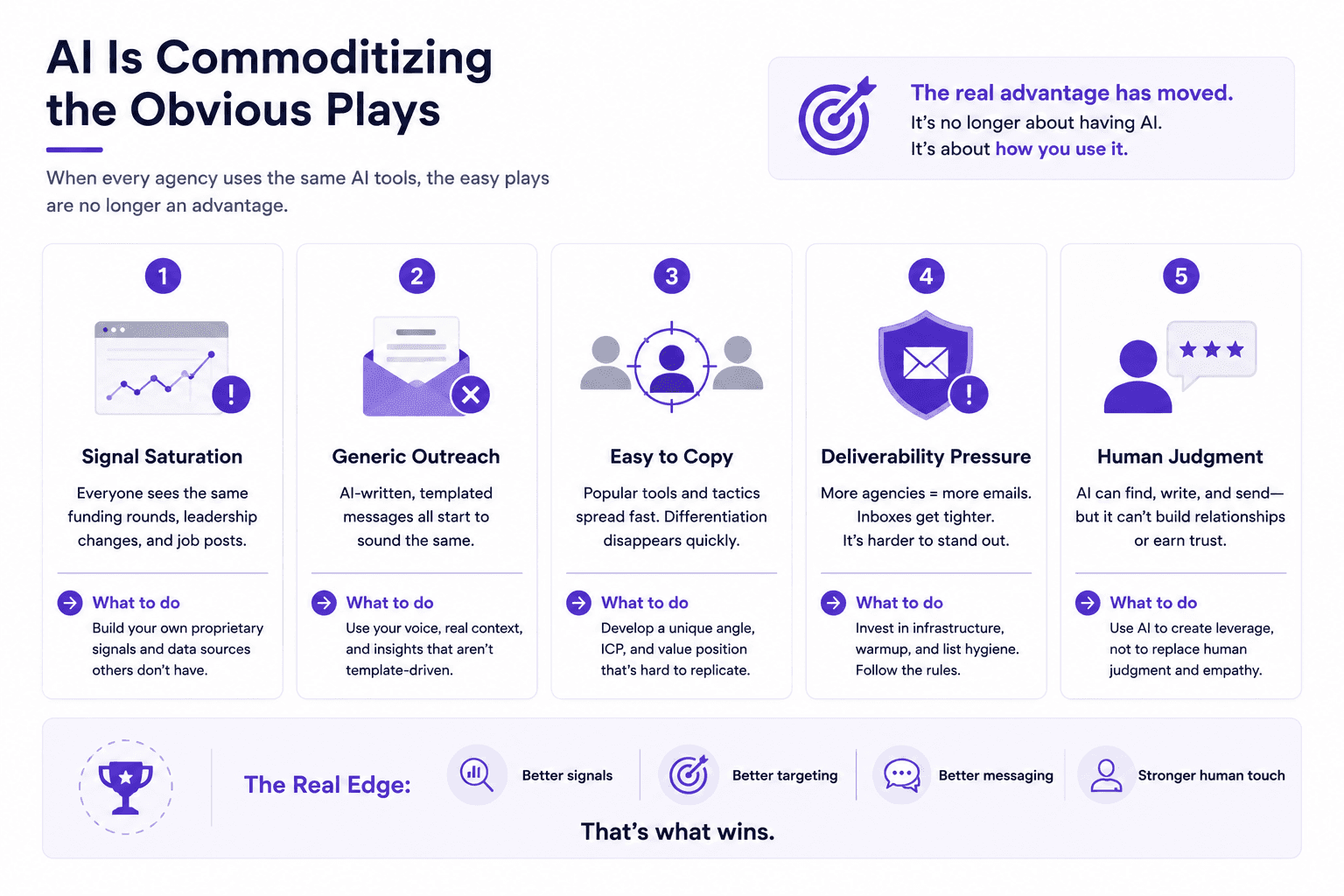
Here is the part the tool demos leave out. When every agency in your niche uses the same popular prospecting tool, you are all looking at the same data at the same time. The funding round your AI flags on Monday morning was flagged for 40 other recruiters on Sunday night, so a signal that feels like an edge is often already saturated by the time you act on it.
The outreach side has the same problem. As AI assisted sending scaled, McKinsey's sales research found that response rates to AI assisted outreach fell by around 18 percent between 2023 and 2025, because volume went up while distinctiveness went down. Hiring managers now receive more messages that look and read alike, and they filter the whole category harder.
Owning the tools is also not the same as getting results. Most HR leaders report no significant business value yet from their AI investments, and adoption across the industry is wide but shallow, with only about 6 percent of companies automating most of their process and nearly half using AI in only a thin slice of the funnel. The gap between installing a tool and building something that produces pipeline is where most agencies are stuck.
Where the advantage actually moves
Once the obvious plays are commoditized, the advantage shifts to four things that are harder to copy.
The first is signal quality. The agencies winning with AI are not using it to do the same thing faster; they are using it to find signals others are not watching, and to combine several weaker signals into a picture that a single saved search would miss. Getting specific about which buying signals you track, and reaching accounts when intent is highest, is what separates a timely message from a saturated one. One enterprise sales team roughly doubled its efficiency by engaging leads at the right moment with data behind the decision, and that timing advantage is exactly what AI makes repeatable.
The second is precision over volume. Sending fewer, better targeted messages to companies with a real, current need beats blasting a large list, both for reply rates and for sender reputation. Building the pipeline around a signal based system rather than raw volume is the shift that actually moves numbers.
The third is distinctiveness. Since generic AI copy is now everywhere, the message that references the specific role, a real placement at a competitor, or a concrete piece of value stands out precisely because so few others bother. This is where the message itself does the work, and where clean, enriched data makes genuine personalization possible rather than superficial mail-merge. Keeping that underlying data accurate is unglamorous and decisive.
The fourth is human judgment. The agencies pulling ahead protected the space where a person still matters: vetting candidates properly, reading a client relationship, positioning an offer, and knowing when to pick up the phone instead of sending another email. AI handles the repeatable 80 percent so recruiters can spend their time on the 20 percent that requires judgment.
How to use AI in recruitment lead gen without adding to the noise
The practical approach follows from all of this. Build your lead generation around signals and timing rather than volume, so AI helps you reach the right hiring managers first instead of reaching everyone at once. Keep humans on the parts that need judgment, and use AI to remove the research and admin that used to consume their day. Study the AI driven approaches to generating B2B leads that fit a recruitment context rather than adopting a generic sales playbook.
Aim for depth rather than a drawer full of half-used tools. A connected system that monitors roles, identifies and verifies hiring managers, personalizes outreach, and routes replies will always outperform one tool doing one thing, which is the whole idea behind an owned lead generation engine. The economics favor this too. Building a system your agency owns is a one-time setup with modest running costs, set against the six figure annual cost of hiring, training, and retaining a dedicated BD person who may still leave. Finally, measure outcomes such as booked meetings and signed terms rather than activity counts, since AI makes it trivially easy to generate more activity that produces nothing.
Will AI replace recruitment business development or recruiters?
No, and the framing misses what is happening. AI is replacing the manual tasks inside business development, such as research, list building, enrichment, and first draft personalization, rather than the function itself. The judgment work that BD depends on, including reading a client, positioning an offer, and building a relationship, still sits with people. The agencies that treat AI as the thing that finally frees recruiters to do the high value parts of the job, rather than a straight replacement, are the ones getting real value from it.
Does AI driven lead generation still work if everyone is using AI?
Yes, but not if you use it the way everyone else does. When every agency runs the same tool on the same data with the same generic copy, results converge toward the falling average, which is why response rates to lookalike AI outreach have dropped. It keeps working for agencies that use AI to find signals others are not watching, to target precisely instead of blasting, and to send messages distinctive enough to stand out. The tool is not the edge. How deliberately you use it is.
Where should a recruitment agency start with AI lead generation?
Start with the single most repeatable, time consuming part of your current BD, which for most agencies is sourcing: finding the companies that are hiring and the hiring managers behind the roles. Automating that one step frees the most hours and produces the clearest return, and it gives you a foundation to build on. From there, add enrichment and verification, then personalized outreach around real signals, keeping a human reviewing quality at each stage. Building depth in one part of the funnel beats spreading a thin layer of AI across all of it.
Bringing it together
AI is changing recruitment agency lead generation by removing the manual ceiling on how many companies you can reach, and by pushing the whole industry toward the same automated plays at the same time. The first shift is an opportunity, and the second is why simply buying tools no longer differentiates anyone. The advantage now belongs to agencies that use AI for signal quality, precision, and genuine personalization, while keeping human judgment on the parts that need it. Used that way, AI turns lead generation from a manual scramble into a system that reaches the right clients earlier than competitors who are still dabbling.
If you want to see what this looks like built for your agency, we can walk you through a system that monitors roles and hiring signals, finds and verifies the right decision makers, and reaches them with personalized outreach at scale, with your team kept on the judgment calls. Book a call with the Novoslo team and we will show you exactly how it works.