Article
Sep 2, 2026
Recruitment Agency Cold Email: How to Get More Clients
How recruitment agencies use cold email to win clients in 2026: deliverability, list building, hiring-manager targeting, and messages that reply.

Cold email still books client meetings for recruitment agencies, but the version that worked a few years ago now lands in spam or gets skimmed and deleted. Inboxes are more crowded, the major providers have tightened what they let through, and hiring managers have learned to ignore the wall of near identical pitches that arrives every time they post a role.
None of that means the channel is finished. It means recruitment agency cold email now rewards a different setup than the batch and blast approach most firms are still running. With client acquisition now the top challenge for a growing share of staffing firms, a cold email system that actually reaches decision makers is one of the more reliable ways to build a pipeline of new job orders. This guide covers the working build in four parts: deliverability, list, message, and sequence.
Does cold email still work for recruitment agencies?
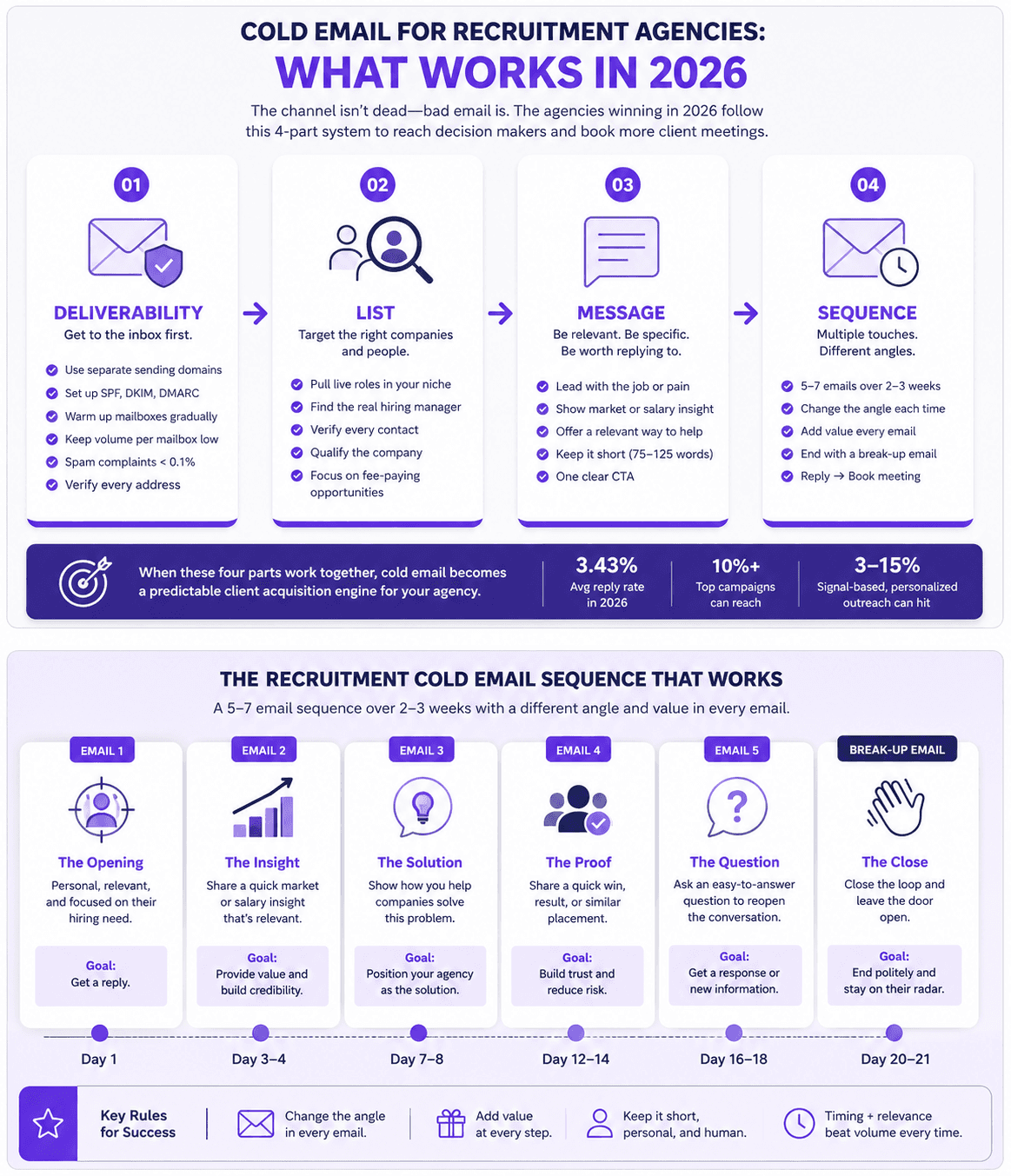
Yes, when it is built properly. The honest picture is that average reply rates have fallen to around 3.43% in 2026, down from roughly 5% in 2025 and 8.5% back in 2019. The decline tracks inbox saturation, with most professionals now receiving well over 120 emails a day, and the flood of low effort AI generated outreach that trained recipients to tune the category out.
The averages hide a wide spread. Top campaigns still clear 10% reply rates, and signal based personalized outreach sent to companies showing real hiring intent can reach much higher. The difference comes down to two things a recruitment agency controls: whether the email reaches the inbox at all, and whether the targeting and message are relevant enough to earn a reply. Both are fixable, which is why so many agencies are seeing weak numbers from a channel that still works for the firms doing it well. It is worth understanding why most cold email campaigns are failing in 2026 before you build your own.
Get your emails into the inbox first
Deliverability is the part most agencies skip, and it quietly caps everything else. Roughly half of your real reply rate is decided before a single email is opened, because a message that lands in spam or the promotions tab was never going to get read. Primary inbox placement in 2026 typically sits between 55 and 75%, and it drops as your volume per mailbox climbs.
The rules also changed in a way that punishes sloppy sending. Google and Yahoo introduced bulk sender requirements in February 2024, Microsoft followed for Outlook in May 2025, and through 2026 the penalty shifted from the spam folder to outright rejection at the receiving server. Mail that fails authentication now often arrives nowhere at all.
Domains, authentication, and warmup
Send from separate domains rather than your main company domain, so a reputation problem never touches your brand or your team's day to day email. Set up SPF, DKIM, and DMARC correctly on each one, warm the mailboxes gradually before real sending, and keep volume per mailbox modest so your pattern looks human. Spam complaint rates need to stay under 0.3%, and under 0.1% is the safer operating target. Getting this foundation right is the entire point of a proper cold email infrastructure setup, and it is not optional in the current environment.
Verify every address before you send
Bounces damage sender reputation quickly, and a high bounce rate can get an account throttled or suspended. Run every contact through a verification tool before it enters a sequence and remove hard bounces after each send. This one habit protects the reputation that all of your future sending depends on, and choosing among the best email verification tools is a small decision with an outsized effect on results.
Build your list the recruitment way
The list is where recruitment agency cold email is won or lost, and recruiters have an advantage here that most B2B senders do not: your prospects announce their need publicly every time they post a role. The build has four steps.
First, pull live roles in your niche from job boards and company career pages, filtered by the titles, seniorities, and salary bands where your placements actually stick. Second, find the real hiring manager behind each role rather than emailing a generic careers address, since the person shaping the brief is the one worth reaching. Third, verify the contact so it does not bounce. Fourth, qualify the company before you spend any effort on it.
That qualification step saves more time than anything else. A five person company that just raised a small round is unlikely to pay a full fee, a business with a large internal talent team probably does not need you, and a job description that says it will not work with recruiters is a clear instruction to move on. Generic junior roles rarely justify an agency fee either. Assembling this pipeline is a matter of connecting the right prospecting tools into one flow, and keeping the underlying records clean is where enriching your lead data earns its place.
Layering in buying signals sharpens the list further. A recent funding round, a newly hired leader, or a role that has sat open for 30 or more days all point to companies under real pressure to hire, and those are the accounts most likely to reply to a well timed email.
Write cold emails hiring managers actually reply to
Most recruitment cold email fails on the same mistake: it talks about the agency. The message opens with what the firm does, the sectors it covers, and the methodology it has developed, and the hiring manager stops reading because none of that is their problem. Leading with your own capabilities is one of the most common cold email mistakes that kill reply rates, and correcting it changes your numbers more than any subject line test.
A message that earns a reply is built around the reader. Prove you actually read the job description and understand the requirement. Reference a specific, relevant placement, ideally naming the competitor companies where you have placed similar people, because specificity is what makes you believable. Then lead with something useful before asking for anything, most powerfully a candidate: telling a manager you have someone with the exact skill set available right now is a message they will read to the end. The personalized opening line is what carries this, since it shows in the first sentence that the email was written for them.
Keep the format tight. The strongest performing cold emails run under about 80 words, make a single clear ask, and lead with the prospect's problem rather than your pitch. Long emails with three different requests give a busy manager an easy reason to close the tab.
Sequence and follow up, where most agencies quit
A single email is rarely enough, and this is where a lot of recruitment cold email leaves money on the table. The first email captures the majority of replies, roughly 58% in large benchmark datasets, while the remaining 42% come from follow ups. Despite that, close to half of senders never send a second message at all, which means they abandon a large share of their possible replies by default.
Plan for a sequence of four to seven emails. The pattern that works for recruitment is to offer a different piece of value on each touch rather than repeating the same ask. The first email might offer to send two or three matched résumés. If there is no reply, the next could offer to help sharpen the job description so it attracts stronger applicants, and a later one could share salary benchmarks for that specific role. Each touch gives the manager a fresh reason to engage and positions you as the recruiter who helps before asking, which is the core of an effective cold email follow-up strategy. Running the sending itself is straightforward once you pick a platform, and a comparison of the main sending tools will help you match one to your volume and budget.
Measure what matters and keep testing
Track the metrics that reflect real outcomes. Positive reply rate tells you whether your targeting and message are landing, and inbox placement monitoring tells you whether your emails are reaching humans in the first place. Open rate alone is a weak signal in 2026 and should not drive your decisions.
From there, improve one variable at a time. Test which company signals produce the best replies, which value offers get taken up, and which opening lines earn responses, then keep what works. The small, steady gains compound and are difficult for slower competitors to copy, and studying the frameworks high performing teams use gives you a sensible structure to test against. Run all of this as a standing operation rather than something you switch on when the desk goes quiet, because consistency is what turns cold email into a predictable source of new job orders.
What is a good cold email reply rate for a recruitment agency?
The 2026 average sits around 3.43% on managed sending infrastructure, so anything above 5% is strong and 8 to 12% is elite. Recruitment has an advantage that can push you toward the higher end, because you are reaching companies with a visible, active hiring need rather than guessing at demand. If your reply rate is under 1%, the problem is almost always deliverability or targeting rather than copy, so check inbox placement and list quality before rewriting the message.
How many follow-ups should a recruitment cold email sequence have?
Four to seven emails is the practical range. The first email captures most of the replies, but follow ups add roughly another 42%, so stopping after one or two touches gives up a large share of your potential meetings. The key for recruitment is to make each follow up useful in its own right by offering a different piece of value, such as résumés, a job description review, or salary data, rather than sending the same request again.
How many cold emails can a recruitment agency send per day safely?
There is no single number, because safe volume depends on how many warmed mailboxes you run and how clean your list is. The reliable approach is to keep volume per mailbox modest, spread sending across multiple domains and inboxes, verify every address first, and watch your complaint and bounce rates closely. Chasing high daily volume on a few domains is what collapses deliverability, and once reputation drops, more sending only makes it worse.
Bringing it together
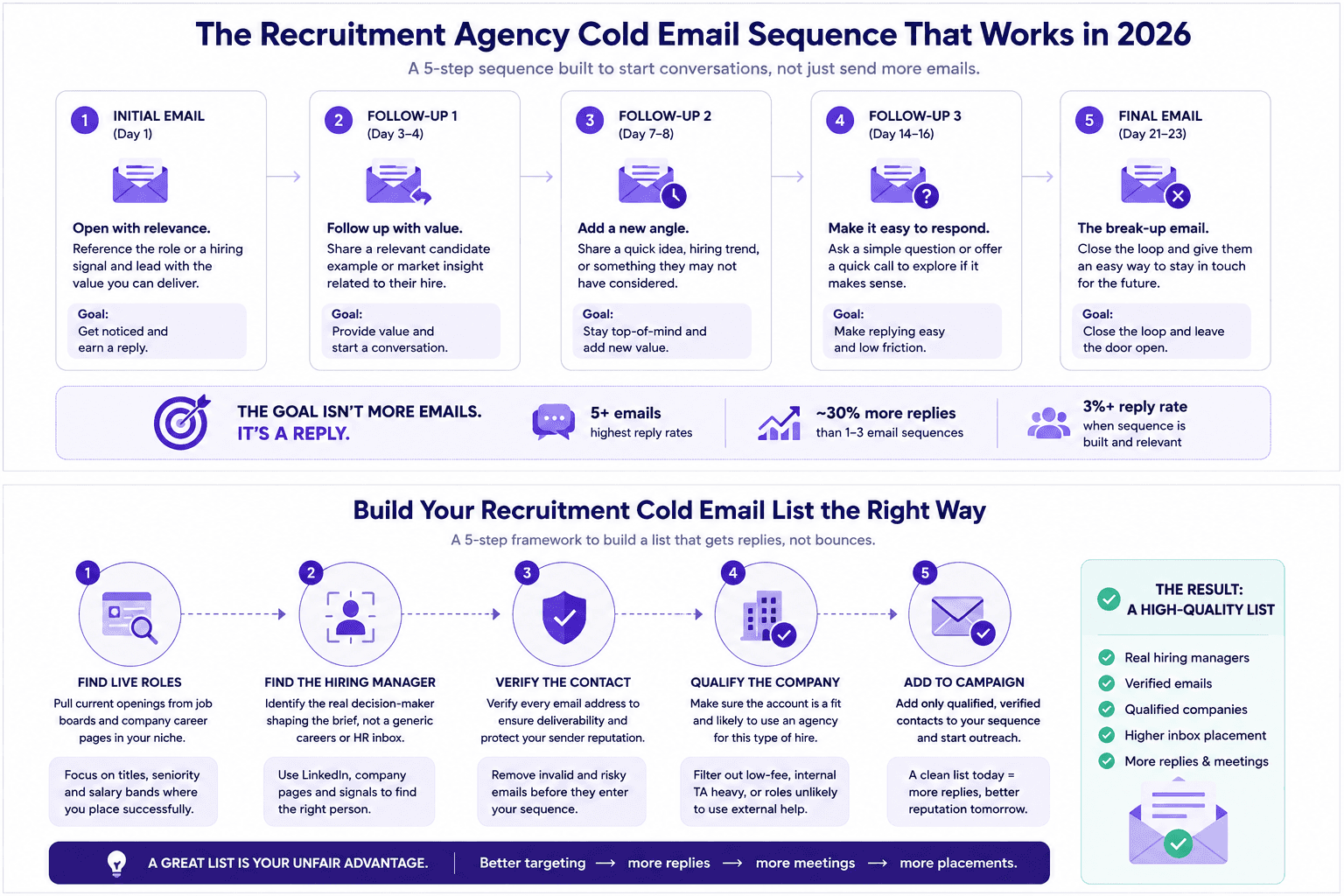
Recruitment agency cold email still works in 2026 for the firms that build it in the right order. Get your infrastructure right so the emails reach the inbox, build a list around live roles and real hiring managers at companies that can actually pay, write messages about the manager's outcome that lead with a specific candidate, and follow up with fresh value until you get a reply. Done consistently, this is what turns cold email from a frustrating experiment into a steady source of new clients, and it pairs naturally with the broader work of winning more clients for your recruitment agency.
If you want to see this built for your desk, we can walk you through a system that scrapes roles in your niche, finds and verifies the right hiring managers, and reaches them with personalized cold email that offers value and generates replies. Book a call with the Novoslo team and we will show you exactly how it works.