Article
Sep 8, 2026
How to Tell If a Company Is Actually Worth Prospecting for Recruitment Services
A practical framework for qualifying recruitment prospects: can they pay, do they need you, can you deliver, and are they hiring now.

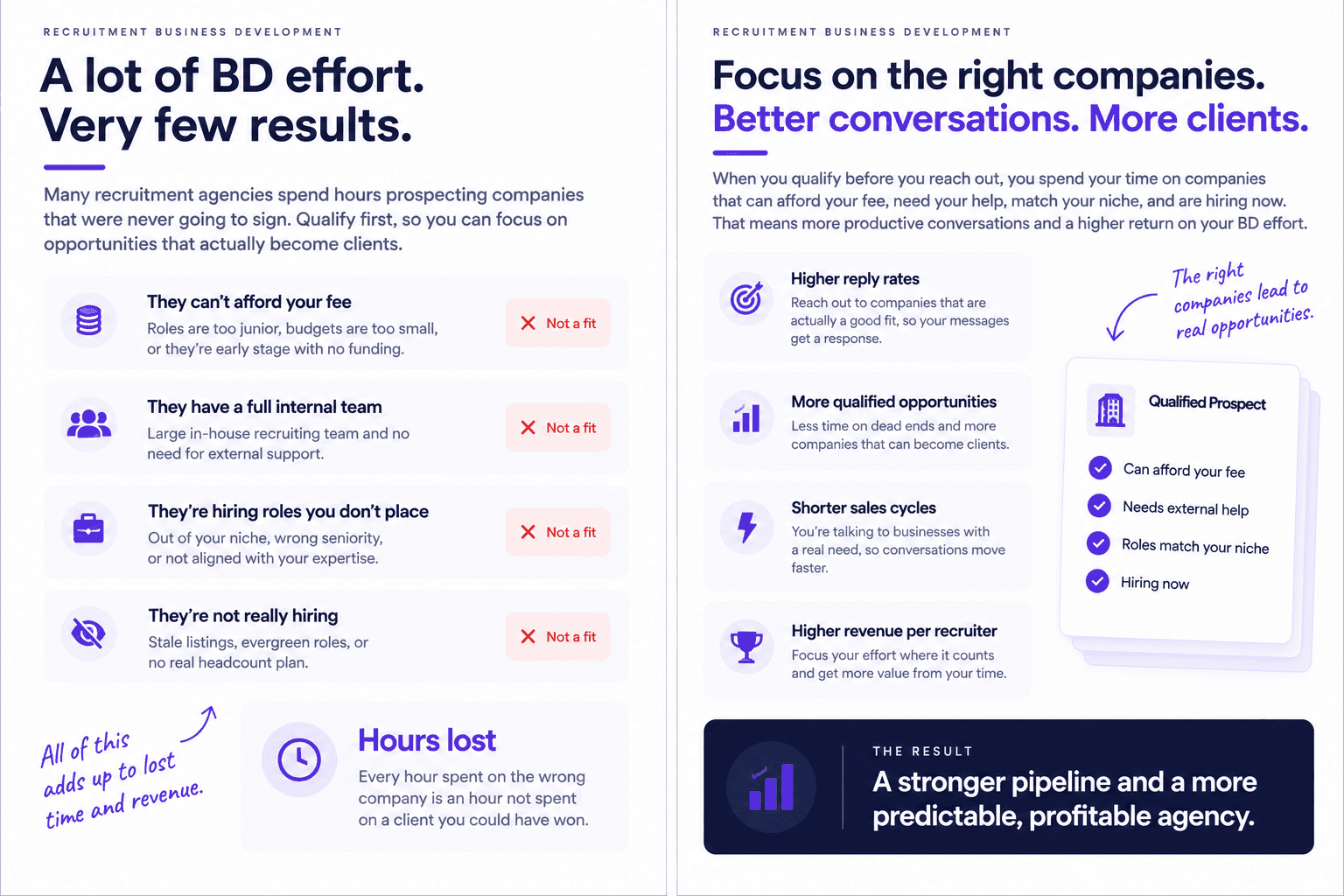
A large share of recruitment business development time gets spent on companies that were never going to sign. They cannot pay a fee, they have a full internal recruiting team, they are hiring roles you do not place, or they are not really hiring at all. Every hour spent on one of those accounts is an hour not spent on a company that would actually become a client, and in a tight market that trade is expensive.
Qualifying a company before you invest effort is the highest return habit in recruitment BD, and it does more to win more clients than any change to your messaging, yet it is the one most desks skip in the rush to hit send. This guide lays out a practical framework for telling, before you write a single message, whether a company is worth prospecting for recruitment services. It comes down to four questions: can they afford you, do they need you, can you deliver for them, and are they hiring right now.
Why qualification is the highest leverage step
The market makes this discipline more important than it used to be. Winning new clients was the top priority for around 40% of staffing firms heading into the year, and US staffing sales fell roughly 8.5% year over year through late 2025, so more agencies are competing for fewer job orders. Spreading thin outreach across every company that happens to be hiring produces a lot of activity and very few signed terms.
The fix starts with knowing who you are actually good for. The most useful ideal client profile is built from your own placement history rather than from assumptions, because the companies that paid well, paid on time, and gave you repeat business reveal a pattern that no template will. Combining that firmographic picture with behavioral signals is what turns a vague target market into a list you can qualify against, and it is the same discipline behind knowing how to find the right potential customers for any B2B service. With that profile in hand, the four questions below become a fast filter.
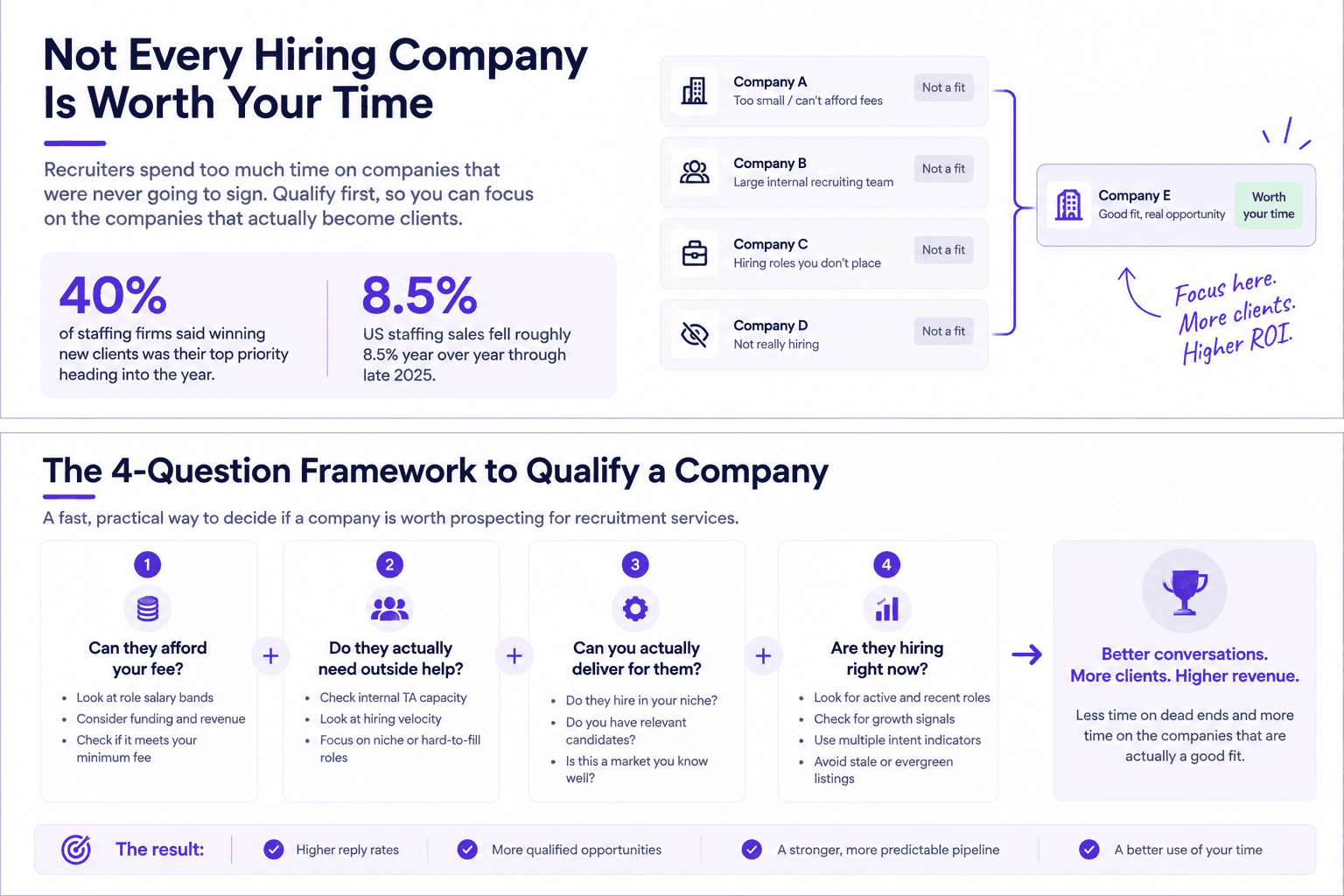
Can they afford your fee?
Recruitment fees are large enough that affordability is a real gate, not a formality. A contingency placement usually costs a percentage of the hire's first-year salary, commonly in the high teens to low twenties, and retained and contract models carry their own economics. That structure means the salary band of the roles a company is hiring tells you most of what you need to know about whether the math works. A 22% fee on a $130,000 engineering role is a meaningful placement worth pursuing, while the same percentage on a $38,000 role rarely covers the effort involved.
Company stage and funding fill in the rest of the picture. A business with revenue, recent funding, or a track record of paying agencies can absorb a fee, whereas a five-person company that just closed a small pre-seed round is unlikely to have the budget or the appetite for one. This is not about company size for its own sake but about whether a placement clears your minimum viable fee, so a lean but well-funded scale-up hiring senior people is often a better prospect than a large company hiring only entry-level staff. If a company's open roles all sit below the level where a placement pays for itself, it is not worth prospecting no matter how much they are hiring.

Do they actually need outside help?
A company can afford you and still have no reason to call you, so the second question is about need. The clearest read is their internal talent acquisition capacity. A business with a large in-house recruiting team can usually handle its own hiring and will treat an agency as a last resort, while a company with several open roles and no internal recruiter is signalling that it lacks the capacity to fill them alone. The gap between the hiring a company needs to do and the resources it has to do it is where agency demand actually lives.
Two other factors sharpen this. Hiring velocity matters because a business that hires continuously generates far more potential job orders than one that fills a couple of roles a year, so a 200-person company hiring engineers every month is a fundamentally different prospect from a similarly sized firm that hires twice a year. Role difficulty matters just as much, since niche, senior, and hard-to-fill positions are exactly the ones companies struggle with internally, and niche expertise commands 15-25% higher fees precisely because clients pay for reach they do not have. Generic junior roles that a company can fill through its own careers page are the opposite, and a posting that states it will not work with recruiters has told you plainly to spend your time elsewhere.
Can you actually deliver for them?
The third question turns the lens back on your own agency, because a company can be a perfect target on paper and still be wrong for you if you cannot fill the role well. A prospect is only worth pursuing if the work sits in a niche where you have candidates, contacts, or genuine market knowledge. A generalist reaching into an unfamiliar sector competes against specialists who already have the network, and loses on both credibility and time to fill, which is the metric a client feels most.
Capacity is the other half of deliverability. Your team size should shape the accounts you chase, so a large bench can take on enterprise clients with high volume needs while a smaller agency is usually better served by mid-market companies where it can be responsive and visible. Before adding a company to your list, it is worth confirming you could actually produce a strong shortlist quickly, and running your candidate pool against the open roles with a tool like Claude Code for candidate matching is a fast way to check that you have the people to deliver before you pitch.
Are they ready to hire now?
A company can pass the first three questions and still not be worth reaching this week, because timing decides whether your message lands on a live need or an idle one. The difference between a good fit company someday and a prospect worth contacting now is a visible trigger that hiring is active or about to be.
The triggers worth watching are consistent across the industry. A recent funding round frees budget and usually precedes a hiring wave, a new leader or a newly hired talent acquisition head arrives with a mandate to build, several roles opening at once points to growth that outpaces internal capacity, and a role that has sat open for weeks marks a company that has proven it cannot fill the seat alone. Expansion into a new market or a product launch tends to create urgent, specialized hiring on a deadline. Learning to read these buying signals and layering in intent data is what lets you reach a company while the need is real, and building the habit of spotting these openings early is how agencies get to a hiring manager before competitors do.
Turn this into a repeatable scorecard
Applied ad hoc, these four questions live in a senior recruiter's head and get skipped under pressure. Applied as a simple scorecard, they let a whole team qualify the same way and disqualify quickly. The practical version assigns each prospect a read on affordability, need, deliverability, and timing, drawn from firmographics such as size, funding, and sector, and from signals such as open roles, tenure of leadership, and internal recruiting headcount. A company that scores well on all four goes to the top of the list, one that fails on affordability or deliverability comes off the list entirely, and the rest are ranked by how many timing signals are currently firing.
Gathering that data by hand for every company does not scale, which is where automation earns its place. Pulling the firmographic and signal data automatically and enriching each record means the scorecard populates itself, and scoring prospects this way is the recruitment version of outbound lead scoring that sales teams already run. Wiring the whole thing into a signal-based system turns qualification from a manual chore into a filter that runs continuously, so your recruiters only ever spend time on companies that have already cleared the bar.
What makes a company a good prospect for a recruitment agency?
A good prospect clears all four questions at once. They are hiring roles at a salary level where your fee makes sense, they lack the internal capacity to fill those roles alone, the work sits in a niche where you can genuinely deliver, and there is a live signal that hiring is active now. In practice the strongest prospects tend to be growing companies with lean internal recruiting, hiring niche or senior roles, and showing a recent trigger such as funding or a new leader. The more of those conditions line up, the higher the company belongs on your list.
Which companies should recruitment agencies avoid prospecting?
Avoid companies where the economics or the fit are wrong regardless of how active their hiring looks. That includes very early-stage businesses without the budget for a fee, companies whose only open roles fall below your minimum viable fee, and businesses with a large internal talent acquisition team that rarely uses agencies. It also includes roles outside your niche where you have no candidate network, and any company whose postings explicitly rule out working with recruiters. Chasing these accounts feels productive because it fills the day with activity, and it produces almost no signed terms.
How do you know if a company will pay recruitment agency fees?
The most reliable indicators are the salary band of their open roles, their funding or revenue position, and any history of working with agencies. A percentage-based fee only works when the underlying salary is high enough to make the placement worthwhile, so senior and specialized roles are a strong sign the numbers will work. Recent funding, visible revenue, and a pattern of paying for outside services all point to a company that can absorb a fee, while a lack of any of these, combined with low salary roles, is a sign the math will not hold up.
Bringing it together
Telling whether a company is worth prospecting for recruitment services comes down to answering four questions before you invest any effort: whether they can afford your fee, whether they need outside help, whether you can actually deliver, and whether they are hiring right now. A company that clears all four is worth real attention, and one that fails on affordability or fit is worth removing from your list so your time flows to accounts that can sign. Run this as a consistent scorecard rather than a gut call, and your outreach starts landing on companies that are ready to become clients.
Once a company clears the bar, the next steps are reaching the right person and giving them a reason to reply, which is where finding the hiring manager and a specific recruitment cold email come in, all as part of the wider shift in how agencies generate leads with AI. If you want help building a qualification and outreach system that does this automatically, book a call with the Novoslo team and we will show you exactly how it works.