Article
Aug 31, 2026
How to Get More Clients for Your Recruitment Agency
Client acquisition is now the top challenge in staffing. A practical system to find hiring companies, reach decision-makers, and win terms.
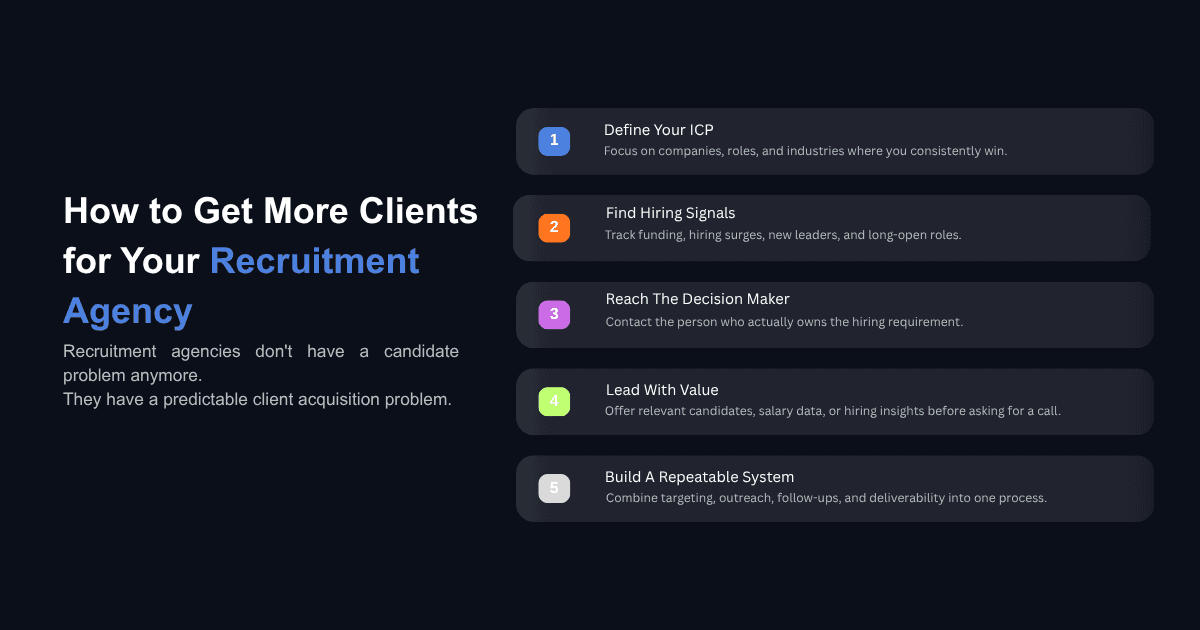
For most of the last decade, recruitment agencies competed on the candidate side. Sourcing strong people was the hard part, and any firm that could deliver reliably had willing clients waiting. That situation has reversed. Agencies now sit on solid candidate pipelines and struggle to find companies willing to pay a fee, which is a very different problem than the one most desks were built to solve.
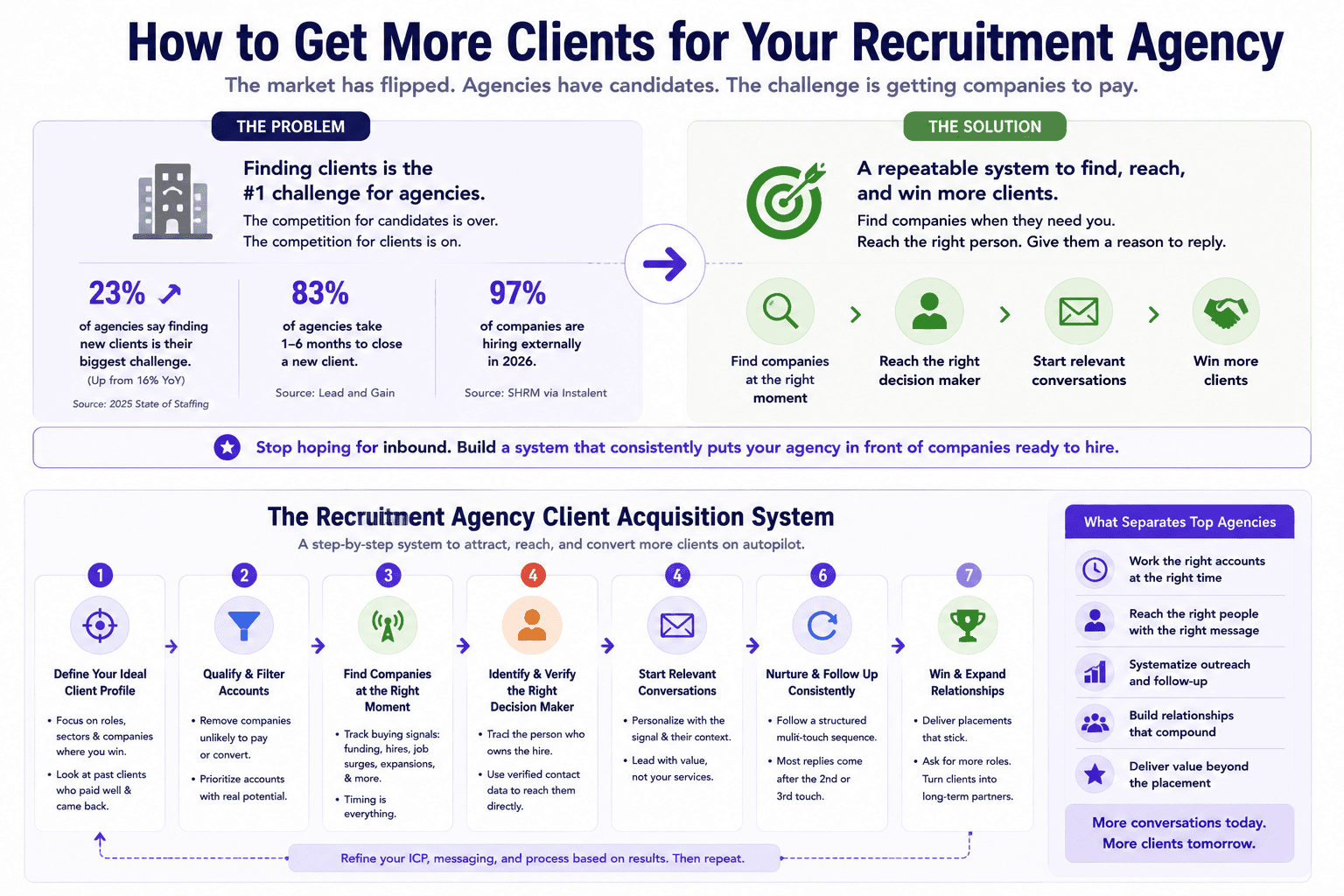
The data backs this up. According to the 2025 State of Staffing report, finding new clients became the single biggest challenge for 23% of agencies, up from 16% a year earlier, while candidate shortage concerns dropped to 12%. Getting more clients for your recruitment agency in this market comes down to a repeatable system for finding companies at the moment they need you, reaching the person who owns the requisition, and giving them a reason to reply, rather than adding more hours on the phones. This guide walks through that system the way we would explain it to another agency owner.
Why finding clients got harder
The client shortage is not a temporary dip. A saturated market means more agencies are chasing the same open roles, and over 65% of staffing firms now name client acquisition as their biggest obstacle. Economic caution has tightened permanent headcount budgets, and procurement teams have trimmed their preferred supplier lists, so there are fewer vendor slots to compete for.
Sales cycles have stretched at the same time. Recent industry research found that 83% of agencies now need between one and six months to close a new client, and that assumes consistent follow-up, which is exactly where a lot of firms fall down. The demand for hiring is still there. SHRM benchmarking cited by Instalent puts median time to fill for nonexecutive roles at 39 days, with external hiring rising to 97% of organizations in 2026. Companies are hiring, and many of them use agencies. The scarce thing is a steady, predictable way to reach the ones who will pay.
Treat client acquisition like candidate sourcing
Here is the reframe that changes how a desk runs. You already know how to source. You define a profile, build a list, work through it methodically, and follow up until you get a result. Client acquisition responds to the same discipline, and most agencies simply never apply it. Business development gets treated as something you do when the desk goes quiet, which is the worst possible time to start because that is when you need results fastest.
Applied properly, this means a defined ideal client profile, a way to find matching companies when they need you, verified contacts for the person who signs off, and outreach that runs whether or not anyone feels like prospecting that week.

Build your ideal client profile the way you build a candidate shortlist
An ideal client profile is more than an industry and a headcount band. The version that actually helps you answers two questions. First, where do you win, meaning the roles, seniorities, and sectors where your placements stick and your fees stay healthy. Second, who feels the pain, meaning the companies whose hiring is urgent, specialized, or bigger than their internal team can handle. Look at which clients gave you repeat business, paid on time, and had the shortest time to fill. Those patterns define your profile more accurately than any template. The same thinking that helps you find potential customers for any B2B business applies directly here.
Stop chasing companies that will never pay you
A large share of prospecting time gets spent on companies that were never going to convert, and filtering them out early frees your team for accounts that can. A five person company that just closed a small pre-seed round is unlikely to pay a 20 to 25% fee. A company with a large internal talent acquisition team probably does not need you. When a job description explicitly says it will not work with recruiters, that is a clear instruction to move on. Generic, junior, easy to fill roles rarely justify an agency fee either.
Qualifying accounts before you spend effort on them is the point of outbound lead scoring, which ranks prospects by fit and buying signals so your team works the accounts most likely to sign first.
Find companies at the moment they need you
The highest leverage change you can make is in timing. A company is far more receptive when something has just changed in its hiring situation, and those moments are visible if you know where to look. The signals worth watching include a recent funding announcement, a new leadership hire who now has budget and a team to build, a newly onboarded HR or talent acquisition lead, a surge in job postings, roles that have sat open for 30 or more days, expansion into new markets, and product launches that require sales and delivery staff quickly. A guide to signal based client acquisition for staffing describes this same approach: build the list around accounts where a change has just happened.
This is where buying signals and intent data earn their place in a recruitment context. A role open for six weeks is a company under real pressure that other agencies may have already given up on. A newly hired VP of engineering is a person with a mandate to grow a team and no established agency relationships yet.
Finding these moments used to mean four to six hours of manual research per day: reading job descriptions, hunting for the hiring manager on LinkedIn, chasing down contact details. At that pace a recruiter reaches eight or nine companies in a day. The same work can now be automated so the system watches job boards and company pages, identifies fresh roles that match your profile, and finds the verified decision maker, which is the core of a signal based outbound engine. Teams that have wired this up with AI driven sourcing reach hundreds of relevant companies a week without adding a single hour of manual prospecting. One enterprise sales team we worked with roughly doubled its efficiency by engaging leads at the right time using data backed decisions, and the timing advantage is what did most of the work.
Reach the decision-maker with something worth reading
Volume alone stopped working a while ago. When a hiring manager posts a role, a queue of recruiters contacts them the same day, and almost all of those messages sound identical. They open with what the agency does, what it specializes in, the methodology it has developed, and the playbook it follows. The hiring manager does not care about any of that. They care about one outcome: whether you can find the best available candidate, attract that person to the role, help them fill it cleanly, and make sure the hire shows up on day one and performs. Leading with your own capabilities is one of the most common cold email mistakes that kill reply rates, and it is fixable.
A message that earns a reply proves three things quickly. It shows you actually read the job description and understand the requirement at a real level. It references specific, relevant placements, ideally naming the competitor companies where you have placed similar people and the exact roles you filled, because specificity is what makes you believable. And it demonstrates that you know the candidate market by sharing an insight the hiring manager will find useful, such as what strong candidates are currently turning down or what a realistic salary looks like this quarter.
Lead with value, not a meeting request
Most agencies reach out repeatedly asking for the same thing, which is a quick call. A more effective pattern is to offer something useful up front and expect nothing in return the first time. It helps to remember that the outcomes producing revenue are signed terms, placed candidates, and long term client relationships that keep sending you job orders, so a call only matters when it moves toward one of those. Many decision makers would rather reply to a message on their own schedule than block time for a stranger, which makes a value led message an easier thing to say yes to than a meeting request.
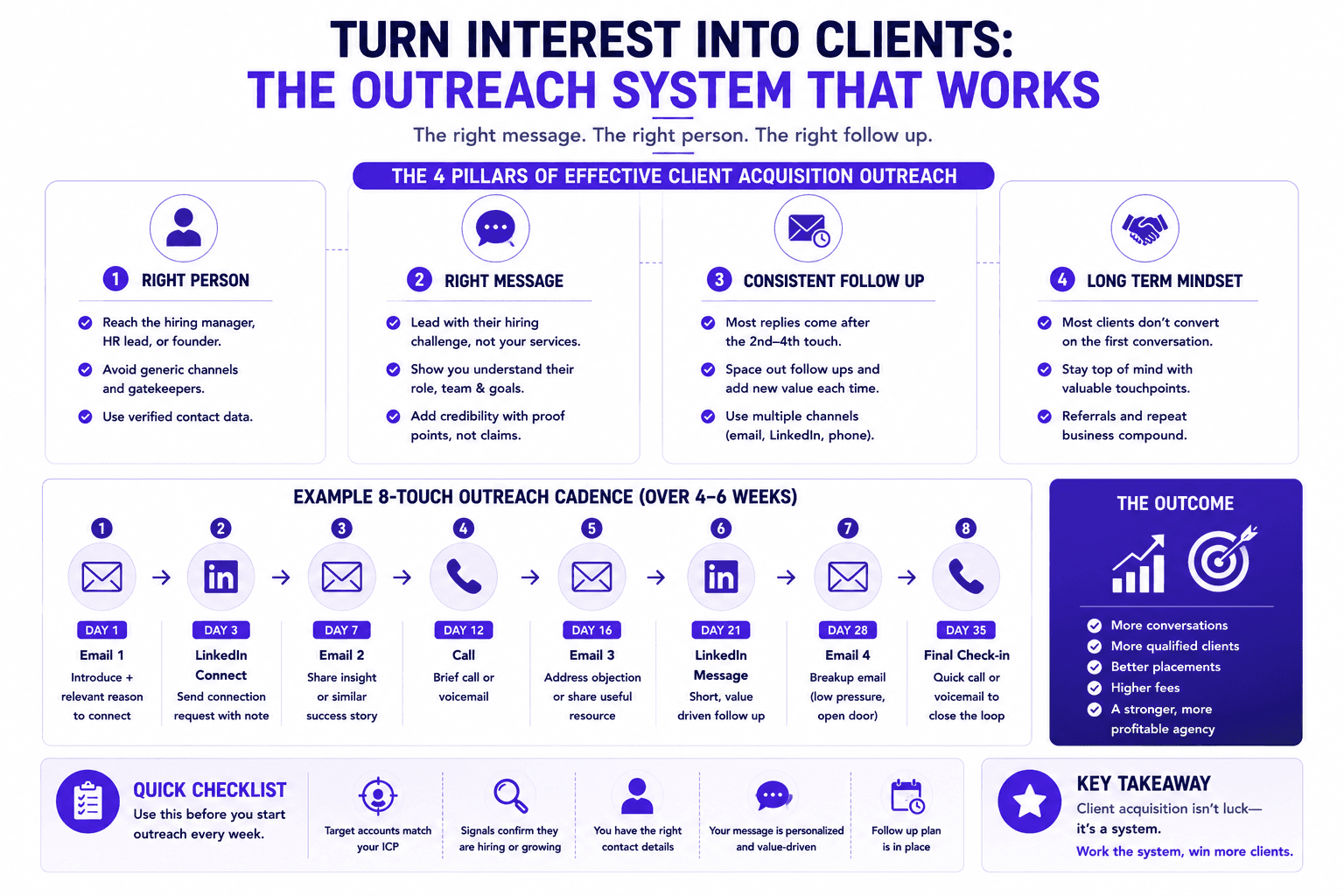
That reframe opens up a much stronger sequence, where each touch offers a different piece of value instead of repeating the same ask. On the first contact you might offer to send two or three résumés of candidates who fit the role, no strings attached. If there is no reply, the next message could offer to help improve the job description so it attracts more relevant applicants. A later touch might share salary benchmarks for that specific role, or an availability report for their hardest to fill position, or even a short view of how their competitors are hiring. Each of these gives the hiring manager a reason to keep reading and positions you as the recruiter who helps before asking. Structuring these touches deliberately is the difference a good cold email follow-up strategy makes, since the first follow up is where most replies actually come from.
Run it as a system, then keep testing
None of this works if your emails land in spam, so the plumbing matters before the message does. Proper domain setup, authentication, warmup, and deliverability monitoring are what keep your outreach in front of human eyes, which is the entire purpose of a sound cold email infrastructure setup. Skipping this step is why a lot of well written campaigns quietly fail.
Balance where the effort goes, too. Expanding job order volume with an existing client is typically three to five times more efficient than winning a brand new logo, so a sensible split is roughly 60 to 70% of business development effort on expansion and referrals and 30 to 40% on net new prospecting. A structured 30, 60, and 90 day check in after each placement confirms the hire is working and surfaces the next opening naturally.
Finally, keep testing. Small, steady improvements to your targeting, your offers, and your messaging compound over time and separate you from the agencies still running the same stale outreach. Cold email remains one of the most direct ways to reach a decision maker, and it works best as one channel inside a broader set of B2B lead generation strategies rather than as a standalone effort. The whole system exists to do one thing: put more qualified hiring conversations in front of your recruiters so they can book more meetings and get back to making placements.
How do recruitment agencies find clients in 2026?
The most reliable approach is to treat client acquisition with the same rigor as candidate sourcing. Define an ideal client profile based on where your placements stick and your fees stay healthy, build a prospect list around companies showing a hiring signal, find the verified decision maker who owns the requisition, and reach out with value before asking for anything. Referrals and existing account expansion still produce a large share of new business, so the strongest agencies run outbound as a system alongside a deliberate referral process rather than choosing one over the other.
Does cold email still work for recruitment agencies?
Yes, when it is done with good infrastructure and a genuinely relevant message. Campaigns tend to fail when they are untargeted, focused on the agency rather than the client, and asking for a call in the opening line. The ones that produce replies reach a decision maker at the moment they have an open role, prove you understand that role, and offer something useful such as matched résumés or salary data. Deliverability is the quiet requirement underneath all of it, so domain setup, warmup, and monitoring have to be in place before volume goes up.
How long does it take to sign a new recruitment client?
Plan for a cycle of one to six months, which is where most agencies now land. Consistent follow up is the deciding factor, since a single touch rarely closes a client and many firms give up after one or two attempts. A value led sequence that reaches the right accounts at the right time shortens this in practice, because you are contacting companies when their need is already urgent rather than trying to create demand that is not there.
Bringing it together
Winning more clients for your recruitment agency comes down to three things done consistently. Point your effort at companies showing a real hiring signal so your timing is right. Reach the decision maker with a message about their outcome, backed by specific proof and a useful piece of value. And run the whole thing as a repeatable system with sound deliverability and steady follow up, rather than a scramble that only starts when the desk goes quiet. The agencies pulling ahead in this market are the ones that treat business development as seriously as they treat sourcing.
If you want to see what this looks like built for your desk, we can walk you through a system that finds hiring companies, identifies the right decision makers, and reaches them with personalized outreach on autopilot. Book a call with the Novoslo team and we will show you exactly how it works.