Article
Sep 25, 2026
Why Recruitment Agencies Need Better Candidate Filtering, Not More Candidate Searches
The candidate funnel is flooded, not empty. Why recruitment agencies win with better filtering on capability, not more searches, and how to do it.

For most of recruitment's history, the constraint was finding enough candidates, so the instinct when a role is hard to fill is to search wider. That instinct is now backwards. AI-assisted applications turned the top of the funnel from a stream into a flood, with candidate pools growing by an average of 340% once sourcing tools arrived, and a single posting now attracts hundreds of polished, similar-sounding resumes. The problem is no longer finding candidates, it is telling the right ones apart from the noise.
That changes what an agency should invest in. When the funnel is already overflowing, adding more searches makes the pile bigger and the shortlist no better, while screening time per role climbs instead of falling. The advantage now comes from better filtering, meaning the ability to identify the genuinely strong candidates quickly and reliably. This guide explains why precision beats volume in 2026, why keyword filtering fails, and how agencies build the filtering that actually produces better placements.
The funnel is flooded, not empty

The old model treated the funnel as an inverted pyramid, pouring hundreds of prospects in at the top on the assumption that enough volume would compensate for poor fit further down. That model peaked around 2023 and has been visibly breaking since, with reply rates collapsing, hiring manager satisfaction falling, and candidate experience damaged by mass outreach landing in the wrong inboxes. Volume stopped being an advantage once everyone had the tools to generate it.
The 2026 model is the inverse: smaller pipelines of better-matched candidates, with filtering done up front so a recruiter spends time on five strong fits rather than fifty maybes. Job seekers now send between 30 and 80 applications each, often AI-written, which is why a role fills with hundreds of resumes that read alike. Sorting that pile is the actual job, and doing it well is what separates a fast, accurate agency from one drowning in applications it cannot process.
Why keyword filtering fails
The reason more searching does not help is that the filter most agencies rely on is broken. Keyword and title filtering checks whether specific words appear on a CV, which does two damaging things at once. It passes candidates who happened to use the right terms, including those whose resumes were written to match, and it rejects strong candidates who described the same capability in different words. In a flooded funnel, that means the filter lets noise through and screens genuine fit out.
Skills-based evaluation is the shift that fixes it, and adoption has climbed steadily, with the share of employers using skills-based hiring rising from 57% in 2022 to 81% in 2024. Instead of filtering by job titles and years of experience, the approach evaluates what a person can actually do, which surfaces qualified candidates who would never survive a keyword filter and eliminates the ones whose resumes only look right. Reading a candidate on capability rather than vocabulary is the core of what AI sourcing that understands a role does, and it is the difference between a filter that sorts on words and one that sorts on fit.

Define the outcome before you filter
Better filtering starts before any candidate is reviewed, with a clear definition of what a strong hire for this specific role looks like. Precision hiring front-loads that definition and the design of the skills that matter, then keeps the pool small on purpose, and the result is that total hours per quality hire fall even though the setup feels heavier. Volume hiring does the opposite, front-loading the sourcing and back-loading the filtering, which is how recruiters end up drowning in screening.
For an agency, defining the outcome usually comes from the intake conversation with the client and from your own record of who has succeeded in similar roles. Feeding that definition into the filter, rather than a list of keywords, is what lets you rank a flooded pool by genuine fit. Running a role against your candidates with a matching setup that reasons about the requirement produces a ranked shortlist with the reasoning attached, so a recruiter reviews the strongest handful with the logic visible rather than skimming hundreds of CVs. It is the same discipline you apply to qualifying which clients are worth pursuing, turned toward candidates.
Keep the filter reliable and verifiable
Precision only helps if the filter itself is consistent, and this is where agencies need to be careful. Industry testing found that some AI screening tools returned only a 14% overlap in shortlists when run twice on identical candidate data, which means a black-box score you cannot inspect is not a filter you can trust. The answer is to use filtering whose reasoning you can see, so you can check why a candidate ranked where they did, and to apply consistent criteria through scorecards and shared definitions of what strong, moderate, and weak fit look like.
Verification has also become part of filtering rather than a separate step. The same report that flagged the consistency problem noted that deepfake interviews and AI-written resumes are eroding the hiring signals recruiters relied on for years, so confirming that a candidate can actually do what their resume claims is now a core skill. A filter that pairs fit with some proof of capability, rather than accepting a resume at face value, protects you from the noise the flood introduced. One caution runs the other way too, since over-filtering at the application stage with too many hard knockouts eliminates qualified people, so the essentials belong in the filter and everything assessable later should stay out of it.
What better filtering does for the agency
Getting filtering right changes the economics of the desk. It cuts the screening hours that a flooded funnel inflates, it raises quality of hire because the shortlist is built on capability, and it reduces bias by replacing pedigree filters with evidence of ability. Those gains show up directly in the metrics that matter, particularly submittal-to-interview ratio and quality of hire, which is why filtering precision is worth tracking through your KPIs.
The advantage compounds across the agency. Better filtering makes your own database more valuable, since precise matching is what turns dormant records into placements and what unlocks the candidates hidden in a decaying CRM. It speeds up delivery, which is how an agency out-delivers an internal team on the roles that matter, and the reclaimed screening time becomes capacity for more placements, which is the return that productivity automation is measured by and a large part of the ROI of AI. Building the filter as part of a workflow that reads for meaning, rather than a fixed keyword rule, is the practical meaning of how an agent differs from basic automation, and packaging it into workflows that run on their own is what makes precision scale.
Why is more candidate sourcing not the answer in 2026?
Because the top of the funnel is already flooded. AI-assisted applications have grown candidate pools dramatically, so a single role attracts hundreds of similar-looking resumes, and adding more searches only enlarges a pile that is already too big to process well. Screening time per role has climbed rather than fallen, and reply rates and hiring manager satisfaction drop when agencies chase volume. The constraint has moved from finding candidates to identifying the right ones, which makes better filtering, not more sourcing, the higher-leverage investment.
What is skills-based candidate filtering?
Skills-based filtering evaluates what a candidate can actually do, rather than filtering by job titles, years of experience, or the presence of specific keywords on a resume. It surfaces qualified people who described their capability in different words and would fail a keyword search, and it screens out candidates whose resumes look right on paper but lack the underlying ability. Adoption has risen sharply because it produces better-matched shortlists in a market where keyword filtering both admits noise and rejects genuine fit.
How do you filter candidates without missing good ones?
Filter on capability rather than keywords, define what a strong hire looks like before you review anyone, and keep hard knockout criteria limited to true essentials so you do not eliminate qualified people unnecessarily. Use filtering whose reasoning you can inspect rather than a black-box score, apply consistent criteria through scorecards, and pair fit with some verification of ability given the rise of AI-written resumes. Anything that can be assessed later in the process should stay out of the early filter, so the first pass narrows the pool without discarding good candidates.
Bringing it together
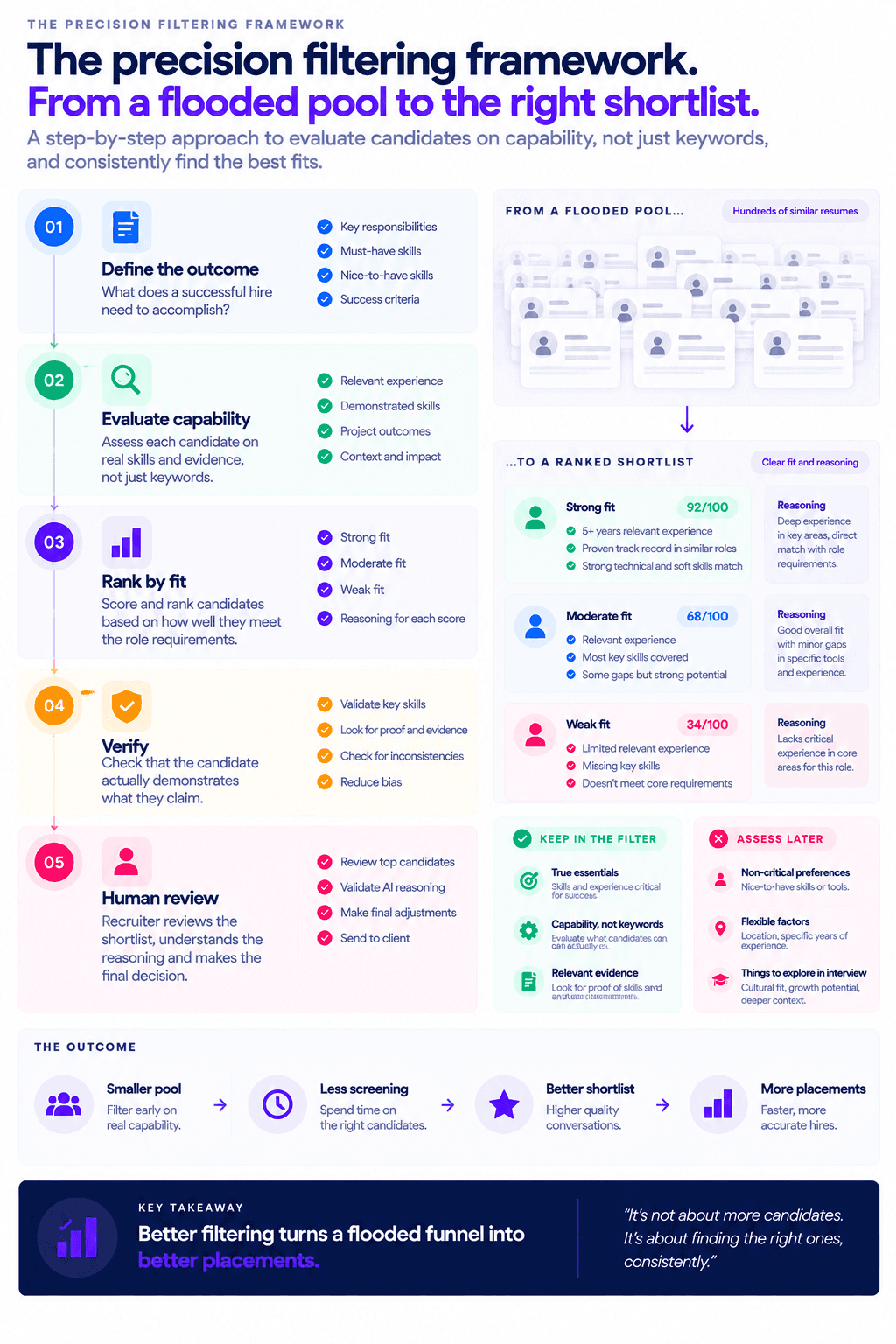
The recruitment funnel is flooded, not empty, so the agencies winning in 2026 are the ones that filter better rather than search more. Keyword filtering fails in a flooded funnel because it admits noise and rejects genuine fit, and the fix is to define the outcome first, evaluate candidates on capability, and keep the pool deliberately small. Use filtering you can inspect, keep it consistent, and verify that a candidate can do what they claim. Done this way, filtering cuts screening hours, raises the quality of your shortlists, and turns a flood of applications into the small set of strong candidates that actually wins the placement and, in turn, more clients.
If you want help building candidate filtering that sorts on real fit rather than keywords, book a call with the Novoslo team and we will show you exactly how it works.