Article
Sep 23, 2026
How Recruitment Agencies Can Measure the ROI of AI
A practical framework for measuring AI ROI in a recruitment agency: baseline first, count the real returns, and prove it survives a finance review.

Most agencies adopting AI cannot say what it returned, which is a measurement problem rather than a technology one. The common statistic that most organizations have not realized value from their AI investments is misleading, because the issue is usually that they never measured it correctly rather than that the tools failed. Without a baseline and a clear formula, an AI spend becomes an act of faith, and the first budget review puts it at risk.
Measuring the ROI of AI is not complicated, and it is worth doing properly because it turns a vague sense that AI is helping into a number you can defend and build on. This guide covers a practical framework for a recruitment agency: what to count as returns, how to account for the full cost, how to baseline before you start, and how to keep the result honest enough to survive a finance review.
Start with the formula, then make it agency-specific
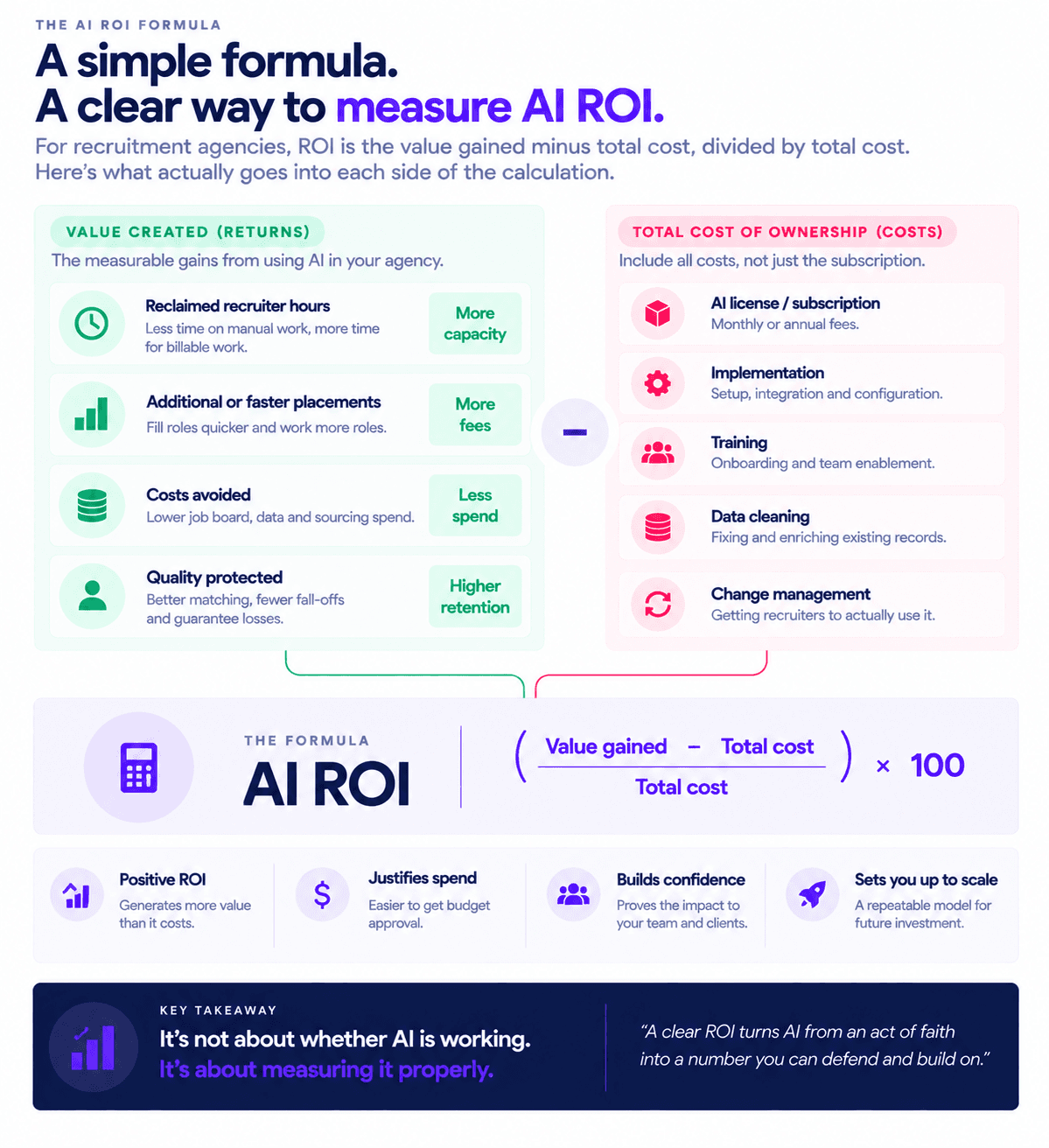
The underlying formula is simple. ROI is the net benefit divided by the total cost, expressed as a percentage, so ROI equals the value gained minus total cost, divided by total cost. A positive result means the investment generates more value than it costs. The work is in defining the two sides honestly for an agency rather than a corporate hiring team.
For an agency, the returns are not abstract hiring efficiency, they are recruiter capacity and placements. The value side comes from three sources: the recruiter hours AI reclaims that convert into more billable work, the additional or faster placements that produce fees, and the costs avoided, such as reduced job board and data spend. The cost side is the full cost of the AI, not just the subscription. Keeping both sides as named variables, so anyone reviewing the calculation can challenge each input, is what separates a believable ROI from a marketing number.

Count the returns that actually reach revenue
The standard four metrics people track for AI in recruiting are time to hire, cost per hire, quality of hire, and recruiter productivity, and organizations adopting AI well commonly report reductions of around 42% in time to hire and 37% in cost per hire alongside meaningful quality gains. These are useful, and for an agency they need translating into revenue terms.
Recruiter productivity is the clearest driver, because the hours AI reclaims from screening, scheduling, and admin become capacity for more placements, which is why giving recruiters their time back sits at the center of agency ROI. Speed matters because a faster time to first submittal and time to fill wins more of the roles you work and lets each recruiter handle more of them. Quality matters most of all in the medium term, because cost per hire measures whether your process is getting cheaper while it says nothing about whether it is getting better, and a fast process that produces bad placements destroys value through fall-offs inside your guarantee period. Better sourcing and matching feed this directly, since AI that finds better candidates and matches them accurately improves both speed and retention. Tracking all of these through your KPIs is what makes the returns measurable rather than assumed.
Put the full cost in the denominator
The most common way an ROI number falls apart under scrutiny is an incomplete cost side. The denominator should be the total cost of ownership, which includes the license plus implementation, training, data cleaning, and the change management needed to get recruiters actually using the tool. Leaving those out inflates the ROI and produces a figure that collapses the moment a finance reviewer asks about the hidden costs.
Anchoring the cost side properly also means being honest about the baseline you are measuring against, which is your real cost base before AI, including recruiter time at a fully loaded rate, per-seat tools, and the admin hours lost per vacancy. When both sides are complete, the maths usually holds comfortably on hard, measurable savings alone. A worked industry example showed that even at a generous all-in cost for the AI stack, the hard savings alone justified the spend several times over, which is the reassuring point: you do not need to reach for the fantasy multiples that appear when people fold in the full theoretical value of every vacancy. Understanding your true operating costs first is what makes the whole calculation credible, which is why it connects to knowing what it actually costs to run your agency.
Baseline before you start, then measure again
The single practice that makes ROI provable is establishing a baseline before deployment. One agency tracked time to shortlist, consultant utilisation, and cost per placement for six weeks before implementing AI, then showed a 38% reduction in time to shortlist and a 22% improvement in fill rate per consultant afterward, and because the baseline was clean, the gains were defensible across several quarters.
Without that before-picture, any improvement is arguable, since you cannot separate the effect of the tool from everything else that changed. The practical approach is to instrument a handful of metrics from day one, capture the current numbers before you switch anything on, and measure again at 90 days. Where you can, holding out a small control group, such as one team or desk that adopts later, is the difference between a believable result and a hopeful one. Payback period is the metric to lead with when presenting it, calculated as total investment divided by monthly net benefit, since it answers the simplest question of when the money comes back, and recruitment AI payback commonly lands in the range of a few months rather than years.
Measure the right things, in the right order
ROI is easiest to prove when you deploy AI where the returns are clearest first. Starting with screening, scheduling, and first-touch outreach produces measurable savings quickly, which builds the evidence and the internal confidence to extend further. Reactivating your existing database is another high-return starting point, since turning dormant records into placements draws on relationships you have already paid for, and the business development side pays back through more qualified pipeline, which is increasingly how an agency competes against clients taking hiring in-house.
Two principles keep the measurement meaningful. Keep a human gate on every consequential decision, both because it protects placement quality and because it is increasingly a legal requirement, and be clear about whether you are buying a tool that follows a fixed rule or an agent that reasons about a task, since the distinction between the two changes what it can return. Approaching adoption deliberately, rather than buying tools and hoping, is the difference most firms miss, and it is why thoughtful implementation matters as much as the tool. Much of the measurable return comes from the workflows you build, which is where running recruitment workflows that operate on their own turns reclaimed time into revenue, provided you have not spent on the wrong kind of solution.
How do you calculate the ROI of AI in recruitment?
Use net benefit divided by total cost, expressed as a percentage. For an agency, the net benefit combines the value of reclaimed recruiter hours that become billable work, the fees from additional or faster placements, and the costs avoided such as reduced job board spend, minus any quality losses from bad hires. The total cost is the full cost of ownership, including the license, implementation, training, and data work. Baseline your current numbers before deploying, measure again at 90 days, and keep every input as a named variable so the calculation survives a finance review.
What ROI can a recruitment agency expect from AI?
Reported returns vary widely, and the reassuring pattern is that the hard, measurable savings usually justify the spend on their own, with payback periods commonly measured in months rather than years. Rather than anchoring on a headline multiple, which often depends on folding in the full theoretical value of every vacancy, focus on the concrete gains: reclaimed recruiter hours converted to placements, faster time to fill, reduced cost per placement, and fewer fall-offs. Your own figure depends on how much manual work you start with and how completely you count the costs.
What is the biggest mistake agencies make measuring AI ROI?
Two mistakes dominate. The first is not establishing a baseline before deployment, which makes any later improvement impossible to attribute to the tool. The second is leaving costs out of the denominator, since counting only the subscription and ignoring implementation, training, and data work produces an inflated number that collapses under scrutiny. Both are avoidable by capturing your current metrics before you start, including the full cost of ownership, and measuring again at a set point such as 90 days.
Bringing it together
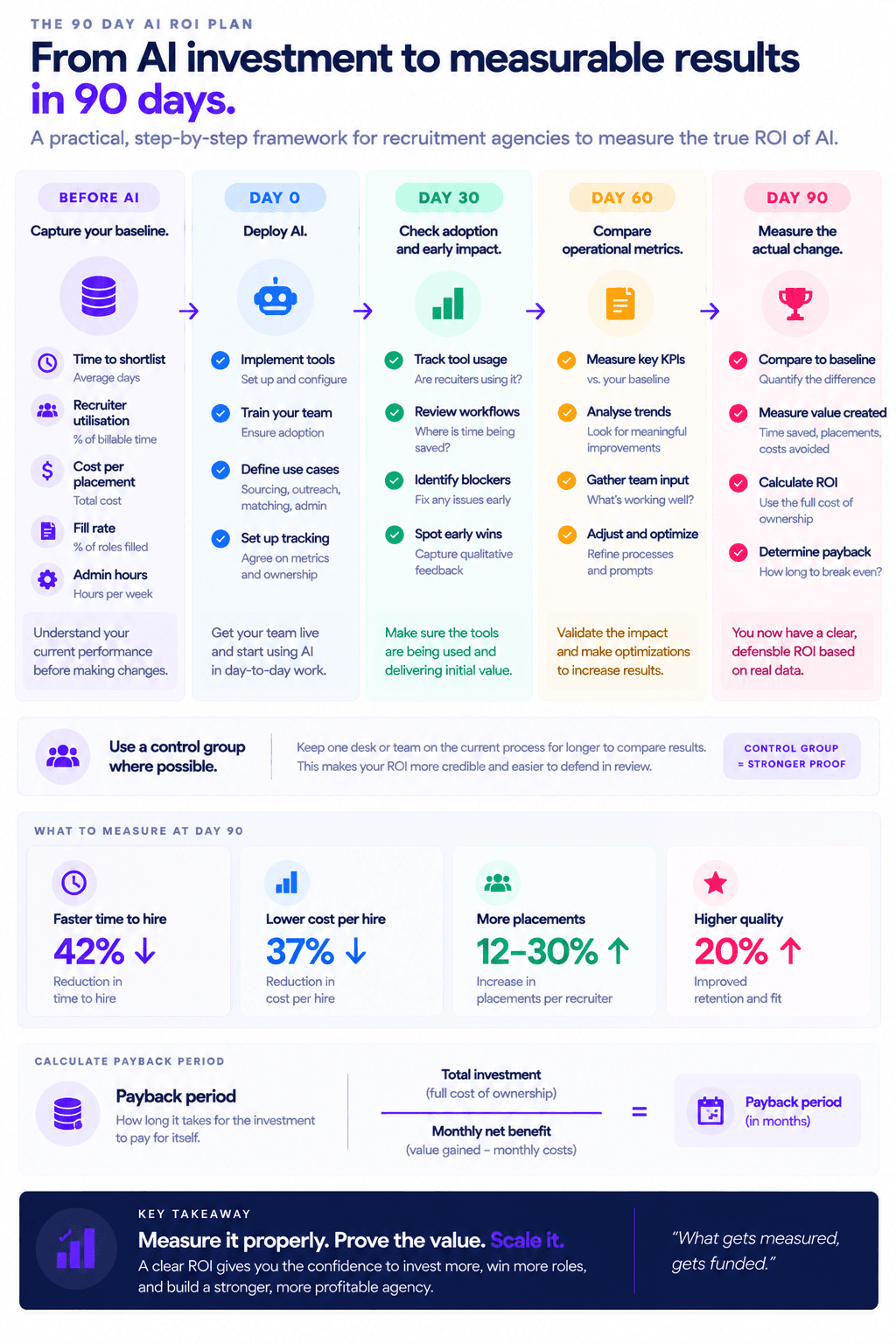
Measuring the ROI of AI in a recruitment agency comes down to a clean baseline, an honest count of the returns, and a complete view of the cost. Translate the standard metrics into agency terms, meaning reclaimed hours turned into placements, faster fills, and fewer fall-offs, put the full cost of ownership in the denominator, and measure against a before-picture you captured on purpose. Start where the returns are clearest, keep a human on the consequential decisions, and lead with payback period when you present it. Done this way, AI stops being an act of faith and becomes a number you can defend and grow.
If you want help building AI into your agency and measuring what it returns, book a call with the Novoslo team and we will show you exactly how it works.