Article
Sep 15, 2026
How Recruitment Agencies Can Use AI to Find Better Candidates
How recruitment agencies use AI to find better candidates: semantic matching, passive talent, your own database, and screening for real ability.

Most conversations about AI in recruitment focus on speed, and the more interesting shift is in quality. The traditional way agencies found candidates, typing Boolean strings into a search bar and hoping the right keywords surfaced the right people, was always limited by design. It found the people who happened to describe their experience in the exact words the search was built around, and it missed the roughly 70% of the workforce that is passive and not writing CVs for your search at all. AI changes what an agency can find, not just how fast it finds it.
This matters most for recruitment agencies specifically, because the quality of the shortlist is the product. A client can post a job themselves, so what they pay an agency for is a better candidate than they would have found alone. This guide covers how agencies use AI to find better candidates: matching on meaning rather than keywords, reaching passive talent, mining the database you already have, and screening for who can actually do the job while keeping judgment and fairness human.
What "better candidates" actually means
Before adding any tool, it is worth defining the goal, because more is not the same as better. A recruiting team with a larger database does not automatically make better placements, and a list of eight strong, well-matched candidates is worth more than a list of eight hundred loosely related ones. Better candidates are the ones who fit the role on demonstrated capability, who are likely to accept and stay, and who a keyword search would never have surfaced.
That definition shapes everything that follows. The value of AI in sourcing is not that it can generate more names, since volume was never the constraint that hurt placement quality. The value is that it can find the right people faster and surface candidates who were invisible to the old approach, which is a different and more useful outcome than a bigger pile of profiles to screen.
Move from keyword search to semantic matching
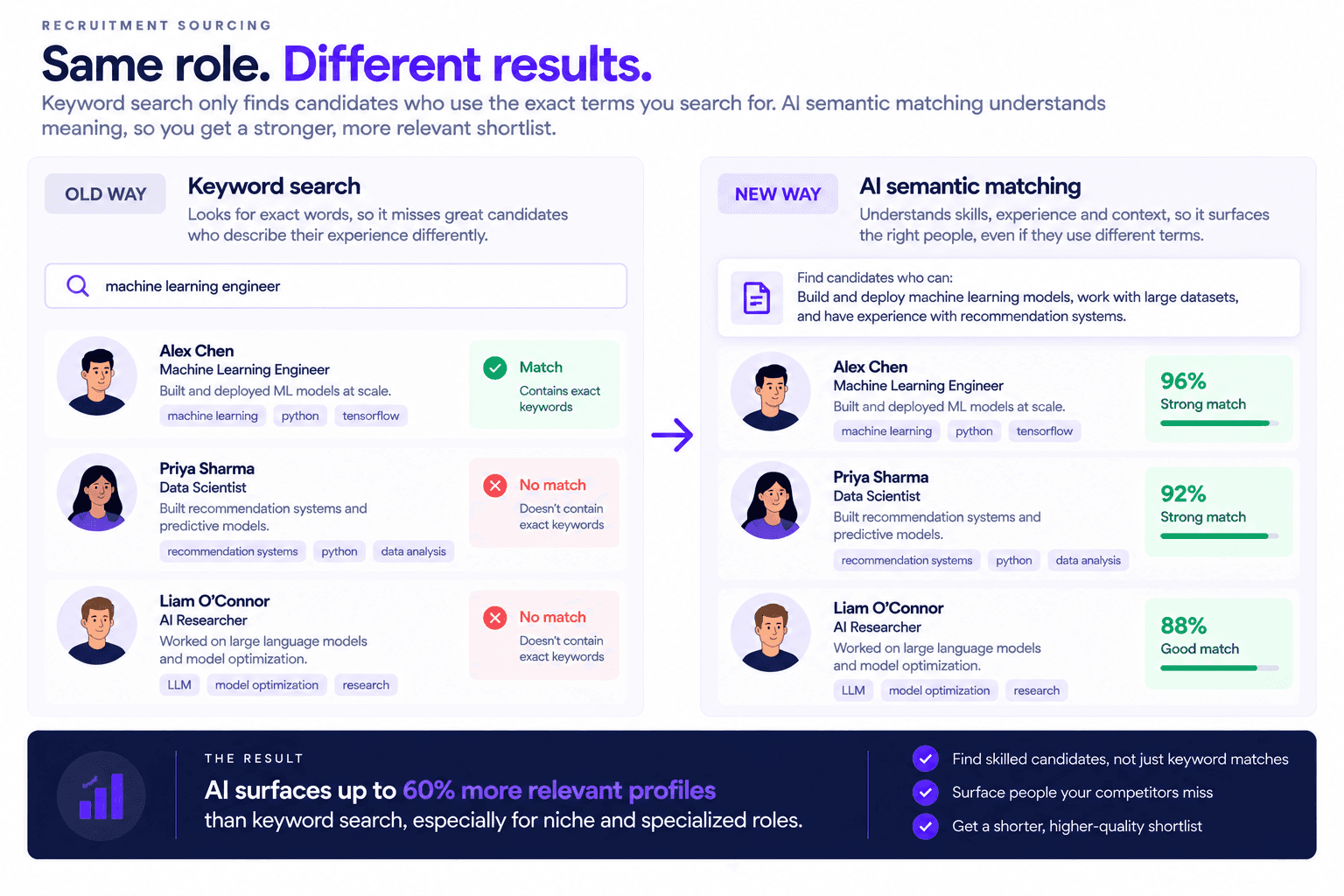
The core change is in how matching works. Keyword search checks whether specific terms appear on a CV, so a search for a machine learning engineer returns people with that exact title and misses a strong candidate who described the same work as building recommendation models. Semantic matching reads for meaning and competency instead, understanding that two differently worded CVs describe the same capability. In practice this surfaces around 60% more relevant profiles than keyword search, and the gap is widest exactly where agencies earn their fees, in niche and specialized roles.
This is the difference between a rule that scans for text and a system that reasons about fit, which is the practical meaning of how AI differs from basic automation. It also changes the recruiter's workflow, because sourcing shifts from searching to matching. Rather than building Boolean strings, you give the system a job description, an intake call summary, or even a description of your best past hire, and it returns a ranked list of people who fit that profile. Running your candidate pool against a role with a matching setup means the recruiter reviews a short, relevant shortlist with reasoning rather than digging through hundreds of results.

Reach the passive candidates keyword search never surfaces
The biggest quality gain comes from reaching people who are not applying. Passive candidates make up the majority of the workforce, and they tend to make stronger hires, with passive hires showing around 40% higher retention and staying meaningfully longer than active applicants, because they are selected on ability rather than availability and face less competition during outreach.
AI expands your reach into that pool in two ways. It scans signals well beyond a single platform, reading GitHub activity, conference speaker lists, technical writing, certifications, and events such as a funding round or a layoff that make someone more likely to move, which surfaces people who never appear in a standard search. It can also build a success profile from your best-performing placements and then find people with similar trajectories and skill combinations, which turns your own track record into a sourcing engine. Reaching these candidates well still depends on the message, and the same principle that works in client outreach applies here, where leading with something specific and relevant rather than a generic approach is what earns a reply from someone who was not looking.
Mine the candidates you already have
The most overlooked source of better candidates is your own database. An agency with a few years of history is sitting on thousands of silver medalists, candidates who were qualified but did not get the role for reasons of timing, headcount, or a narrow preference for someone else. Many of them now have more experience and fit today's roles well, and because they already know your agency, response rates from past candidates run several times higher than cold outreach to strangers.
AI makes that database usable by scanning it against a new role and surfacing the people worth re-approaching, which is work no recruiter has time to do manually across thousands of records. The prerequisite is clean data, since matching is only as good as the records underneath it, so enriching and tidying your candidate data is the groundwork that makes this source productive. Mining what you already have is often faster and higher quality than sourcing new people from scratch.
Screen for who can actually do the job
Finding people who look right is only half the work, and it is the half AI does most easily. AI is very good at inferred signal, meaning it can identify candidates who appear qualified on paper, and the teams getting the best results pair that with measured signal, meaning some proof of actual ability, before anyone reaches a shortlist. This matters because the screening funnel is brutal, with only around 8% of applicants surviving initial screening while sourced candidates convert far better, so the goal is a shortlist built on evidence rather than keyword overlap.
Used this way, AI reduces manual screening time substantially while improving what reaches the recruiter, and it frees hours that go back into candidate conversations. The measure that matters is quality of hire rather than speed alone, and it is worth noting that only about a quarter of organizations feel confident measuring it. Tracking outcomes such as 90-day retention, hiring manager satisfaction, and performance for the candidates AI surfaces, which are the metrics that show whether your sourcing is actually better, is part of running the agency on the KPIs that matter.
Keep humans and fairness in the loop
AI changes what you can find, and the judgment about who to put forward stays human. This is clearest on senior and specialized roles, where the best passive candidates are often skeptical of automated outreach and respond to a genuine human approach rather than an obviously automated one. The effective division is that AI surfaces and ranks the field while a recruiter builds the relationship and closes, which plays to the strengths of both.
Fairness needs the same attention. Matching systems trained on historical data can carry the biases in that data, so agencies should score candidates on skills and demonstrated ability rather than proxies, keep a human reviewing the shortlist, and confirm that any tool they use has undergone independent bias testing. In some places this is also a legal requirement, with New York City's Local Law 144 mandating bias audits and candidate notification for automated hiring tools, and similar rules spreading, so verifying compliance is part of using AI responsibly.
Where better sourcing fits the agency's edge
Better candidate sourcing is not just an internal efficiency, it is how an agency defends and grows its position. As companies build internal hiring capability and take standard roles in-house, the agencies that win are the ones that consistently produce candidates a client's internal team cannot find, particularly in niche and senior searches. Using AI to source better and faster is what lets you out-deliver an internal team on the roles that matter, and automating the repetitive parts of it gives your recruiters hours back to spend on relationships and closing.
That quality advantage then feeds business development, because the strongest pitch to a hiring manager is a specific, well-matched candidate you can name, which is why sourcing and outreach work best when connected. Focusing on the roles where an agency genuinely wins, qualifying the clients worth pursuing, and reaching them through a proper cold email system turns better sourcing into more placements. Run together, this is a large part of winning more clients and of the broader shift in how agencies generate leads with AI.
How does AI find better candidates than keyword search?
AI matches candidates on meaning and demonstrated competency rather than the presence of specific words, so it recognizes that two differently worded CVs describe the same capability and surfaces strong people a keyword search would skip. It also reads signals across many sources beyond a single platform, which reveals qualified candidates who never appear in a standard search. The result is a shortlist ranked by fit rather than keyword overlap, which is both more relevant and broader, especially for niche and specialized roles.
Can AI source passive candidates?
Yes, and passive talent is where AI adds the most value. Because most of the workforce is not actively applying, keyword-based search misses the majority of the available talent, while AI can identify passive candidates by reading career signals, technical activity, and trigger events that suggest someone is open to a move. Passive hires also tend to stay longer and perform well, since they are chosen on ability rather than availability. Reaching them still requires a genuine, personalized approach rather than obvious automation, particularly for senior roles.
Does AI improve quality of hire?
It can, when it is used to improve the shortlist rather than just enlarge it. AI improves quality of hire by surfacing better-matched and passive candidates, by mining strong past applicants from your own database, and by pairing profile fit with some proof of actual ability before shortlisting. The important step is measuring the outcome, tracking retention, hiring manager satisfaction, and performance for AI-sourced candidates, since quality of hire is the metric that shows whether the technology is genuinely helping rather than simply producing more names.
Bringing it together
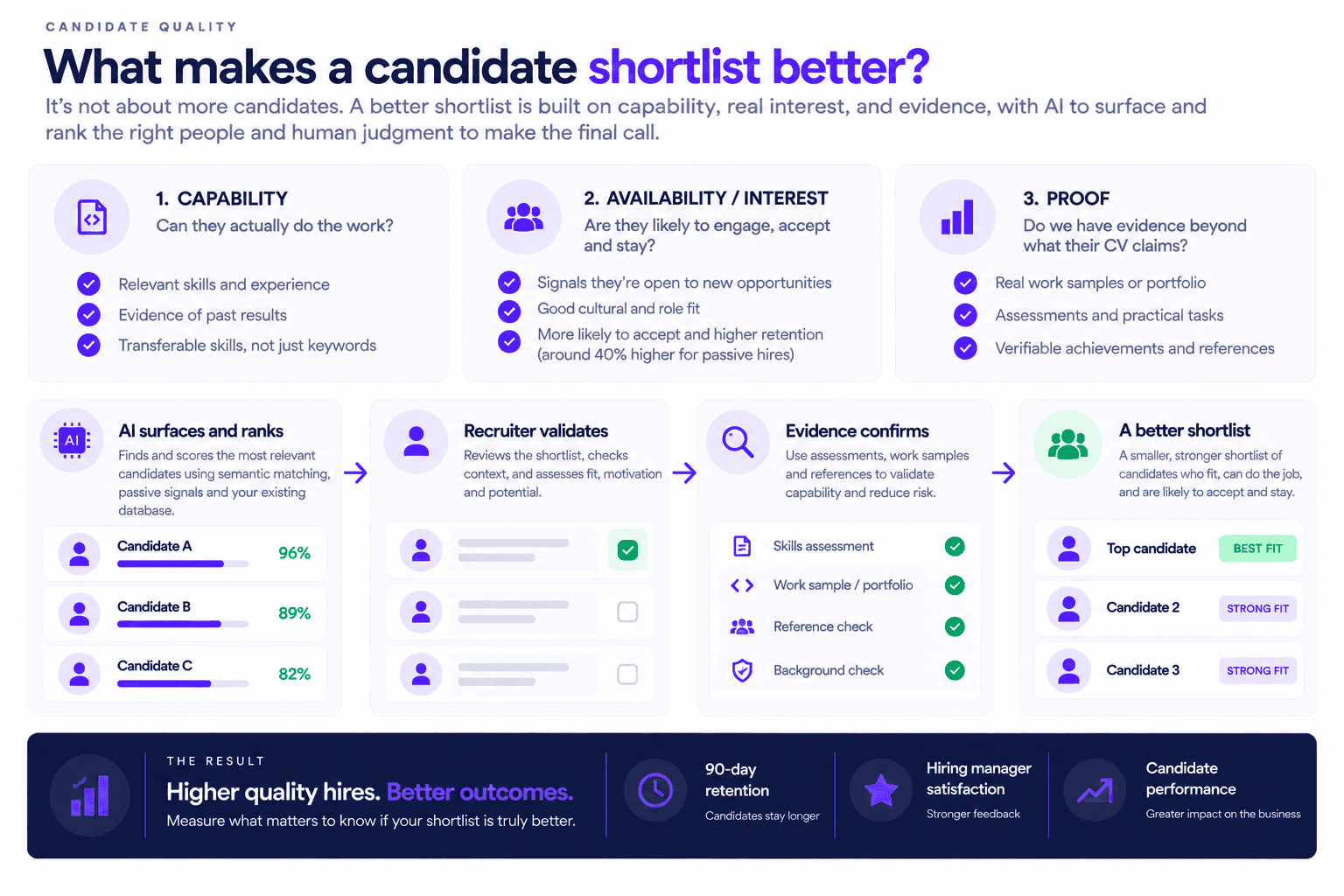
Using AI to find better candidates comes down to changing what you can find rather than just working faster. Match on meaning instead of keywords so you surface the right people, reach the passive majority that traditional search misses, mine the strong candidates already in your database, and screen for demonstrated ability rather than keyword overlap. Keep a recruiter on the judgment and the relationships, measure quality of hire so you know it is working, and use the resulting advantage to deliver candidates internal teams cannot. That is how better sourcing becomes better placements and a stronger agency.
If you want help building AI sourcing that finds better candidates and connects to your client outreach, book a call with the Novoslo team and we will show you exactly how it works.