Article
Sep 18, 2026
How Recruitment Agencies Can Use AI to Save Hours of Recruiter Time Every Week
Where recruiter hours actually go, and how AI reclaims them task by task: screening, scheduling, notes, and outreach, without replacing judgment.

Recruiters are not short on effort, they are short on hours, and most of the hours they lose disappear into work that never needed their judgment. Surveys of recruiting teams put the scale of it plainly, with recruiters spending close to two hours a day on administrative tasks, which is more than a full working day each week lost to scheduling, data entry, status updates, and manual screening rather than to sourcing, closing, or client relationships.
That waste is not a motivation problem, it is a design problem, and it is exactly what AI is good at fixing. The value of AI in a recruitment agency is not some abstract transformation, it is the concrete return of hours across specific tasks, so recruiters spend their week on the work that actually produces placements. This guide covers where recruiter time really goes, how AI reclaims it task by task, what those hours are worth to an agency, and how to make sure you actually get them back.
Where recruiter time actually goes

The hours are invisible on a profit and loss statement until you multiply them by a year. One 2025 study of HR leaders found recruiters spend around 17.7 hours per vacancy on manual admin, which at a handful of roles a month adds up to roughly 850 hours per recruiter a year. The breakdown is specific, with about three hours per vacancy spent typing up notes on conversations that already happened and another two and a half hours finding a slot in a diary.
Stepping back to the whole week, close to 40% of a recruiter's time goes to screening calls, scheduling loops, and rejection admin that never required a recruiter's judgment in the first place. This happened because recruiting teams shrank while application volume climbed, with team sizes down 56% and applications per recruiter up over 400% in recent years. The hours are real, and they simply sit in the wrong part of the funnel. Understanding that is the starting point, because it tells you where the time to reclaim actually is.
Screening: the biggest single reclaim
Screening is where the most time disappears and where AI returns the most. Recruiters spend an average of 23 hours screening resumes for a single hire, reading stacks of applications against a brief in a task that is repetitive and rules-based. AI handles the first pass by matching skills, experience, and requirements, and teams using it complete 66% more candidate screens per week while spending 41% less time on documentation and admin.
The important part is what the recruiter does with the reclaimed time, which is apply judgment to the shortlist that actually deserves it rather than skim two hundred CVs to find it. Running your pool against a role with a matching setup returns a ranked shortlist with reasoning in minutes, and pairing it with better sourcing means the shortlist is also stronger, not just faster to produce.
Scheduling: a largely solved problem
Scheduling is the single biggest time drain in the process, accounting for around 35% of recruiter time in some studies, and it is also the easiest to eliminate. Self-scheduling and coordination tools handle candidate booking, multi-party coordination, reminders, and rescheduling across calendars, saving 15 to 30 minutes per interview and recovering 10 to 15 hours a week across an agency that is still emailing back and forth to find a slot. There is little judgment involved in finding a mutual time, which is why this is one of the clearest wins available. The recovered hours show up directly as more time on calls, and recruiter phone time has roughly doubled at agencies where automation took over the coordination.
Admin, notes, and follow-ups
The quieter drain is the administrative tail that follows every conversation. Writing up call notes takes around three hours per vacancy, and AI now drafts those notes from the call transcript so the recruiter reviews and edits rather than types from scratch. The same applies to the follow-up email after every candidate or client call, which AI can draft from the conversation for the recruiter to personalize in a line or two, a small saving per instance that compounds quickly across ten or more calls a day.
Data entry and status updates are the third piece, and keeping records current is both a time cost and a quality one, since matching and reporting are only as good as the underlying data. Automating the capture, and periodically enriching and cleaning your records, removes a task recruiters dislike while making everything downstream sharper. Across notes, follow-ups, and data entry, this is where the 41% reduction in documentation time mostly comes from.
Sourcing and client outreach
Sourcing and business development carry their own manual load, and both respond well to automation. On the candidate side, AI surfaces matching profiles across many sources so recruiters stop trawling job boards by hand. On the client side, the hours lost to writing and personalizing outreach one message at a time are recoverable by drafting at scale from your templates and signals, so recruiters review and send rather than compose from a blank page.
This matters because business development is usually the first thing that gets dropped when delivery work piles up, which is how pipelines run dry. Automating the outreach behind a value-first cold email approach and reaching the prospects worth pursuing keeps the top of the funnel active without consuming recruiter hours, and running it as a system is the core of generating leads with AI and of a working cold email operation.
What the reclaimed hours are worth
The individual savings look small until they are added up. A realistic estimate for an agency that automates screening, scheduling, and admin is 5 to 8 hours per recruiter per week, which across a ten-person team is 50 to 80 hours a week, or the equivalent of one and a half to two additional full-time recruiters over a year without the cost of hiring them.
The return is not in cutting headcount, it is in raising revenue per recruiter, because the reclaimed hours go into more business development, more candidate conversations, and more placements. This is where the productivity gain connects to the agency's economics, since the manual time inside sourcing and admin is the hidden cost that drives the gap between a low-margin and a high-margin agency, and lifting output per recruiter is what moves that margin. It is also how an agency out-delivers an internal team that has taken hiring in-house, by being faster and more available on the roles that matter. Tracking the effect through your KPIs is what confirms the hours turned into results rather than just disappearing elsewhere.
Make sure you actually get the hours back
Adopting AI tools does not guarantee the time savings, and the difference comes down to targeting the right tasks. Recruiter trust in AI rises sharply when it replaces repetitive admin rather than judgment, and the deployments that work automate screening, scheduling, and documentation while leaving the assessment, the relationship, and the close with a person. If a team adopts sourcing or screening tools and does not see recruiters gaining time for candidate and client conversations, the automation was pointed at the wrong workflow or failed to integrate properly.
The distinction that matters here is between a tool that follows a fixed rule and one that reasons about a task and hands the judgment back, which is the practical meaning of how AI differs from basic automation. Keep a human on every decision that affects a candidate or a client, measure whether recruiter availability actually increased after each rollout, and treat any tool that does not return real hours as a candidate for replacement. Used this way, the reclaimed time reliably becomes more of the work that wins clients and fills roles.
How many hours can AI save a recruiter per week?
Most agencies that automate screening, scheduling, and admin reclaim around 5 to 8 hours per recruiter per week, with some studies putting the average saving near 4.5 hours. Across a team, that adds up to the capacity of one or two extra recruiters without hiring anyone. The exact figure depends on how much manual work a desk starts with, since a team still coordinating interviews by email and screening every CV by hand has far more to gain than one that has already automated the basics.
What recruiting tasks should you automate first?
Start with the highest-volume, lowest-judgment tasks, which for most agencies means scheduling and resume screening. Scheduling is close to a solved problem and returns 10 to 15 hours a week across an agency, and automated first-pass screening removes the biggest single time sink while improving the consistency of the shortlist. From there, add note-taking and follow-up drafting, then data capture, keeping a human review step at each stage. Automating in this order returns the most time soonest and builds trust before you extend to more sensitive parts of the process.
Does AI replace recruiters or free up their time?
It frees up their time when it is aimed at the right tasks. AI is strongest at the repetitive administrative work that fills a recruiter's week, such as screening, scheduling, and documentation, and weakest at the judgment, assessment, and relationship work that actually determines whether a placement succeeds. The evidence from agencies using it is that recruiters end up spending more time on calls and candidate conversations, not less, because the tools handle the admin rather than the decisions. The goal is more output per recruiter, not fewer recruiters.
Bringing it together
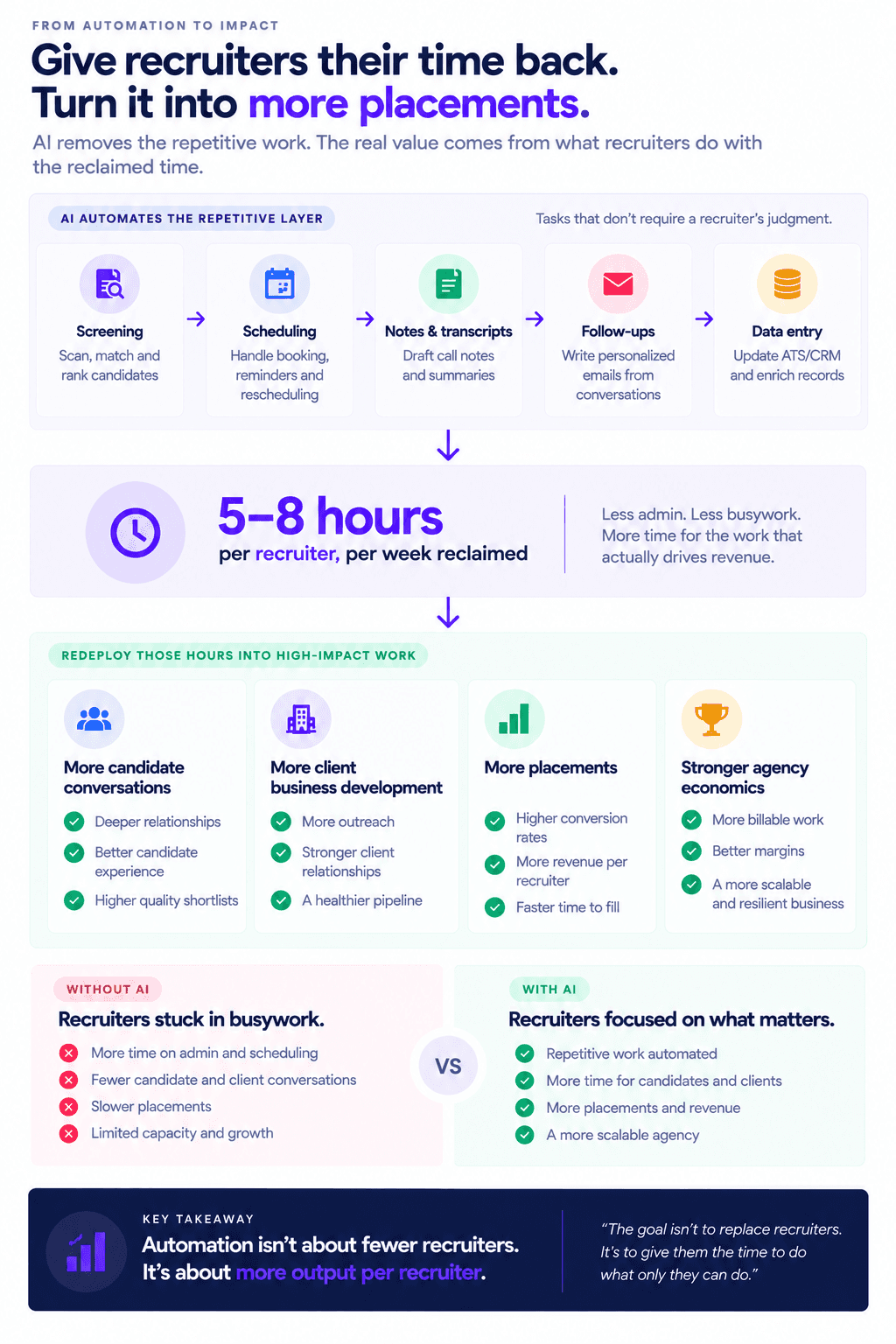
Recruitment agencies lose more than a day a week per recruiter to work that never needed a recruiter, and AI's real value is returning those hours task by task. Automate screening to reclaim the biggest single block of time, remove scheduling almost entirely, take the admin tail of notes and follow-ups off the desk, and automate the outreach that keeps the pipeline full. Aim the tools at repetitive tasks rather than judgment, measure that recruiters actually gain availability, and redeploy the reclaimed hours into business development and placements. Done that way, the same team bills more without working longer, which is the productivity gain that matters.
If you want help putting these time savings in place across sourcing, outreach, and admin, book a call with the Novoslo team and we will show you exactly how it works.