Article
Sep 21, 2026
How Recruitment Agencies Can Turn Their Old Candidate Database Into New Placements
Your database is the highest-ROI channel most agencies ignore. How to reactivate dormant candidates into placements, and run it without manual effort.
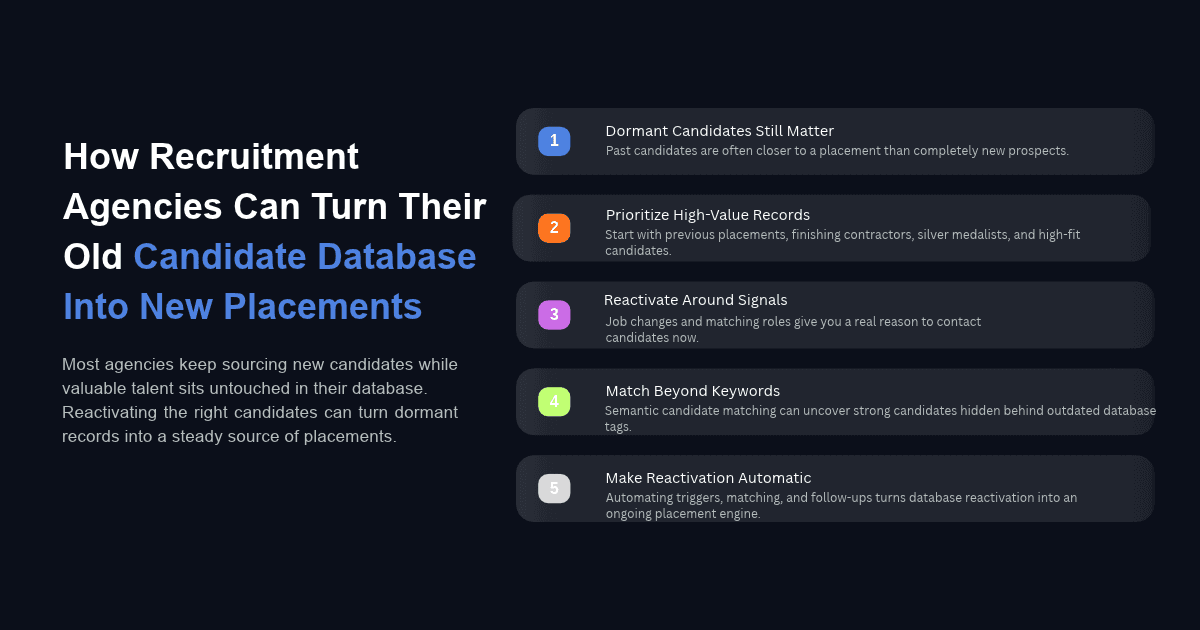
Most agencies chase new candidates while their next placement sits untouched in their own database. The people you have already sourced, interviewed, and built a relationship with are the warmest talent you will ever have, and yet dormant records rarely get contacted again once the role they applied for closes. That is a placement problem hiding as a data problem.
The scale of the opportunity is easy to miss. Analysis across more than 2,100 firms found that 71% of placements come from candidates already in the CRM before the job ever opened, and the existing candidate database is consistently the highest return channel available to an agency, with the majority of firms reporting positive ROI from it. This guide covers how to turn your old candidate database into new placements: who to reactivate, when the timing is right, how to surface the right people, and how to run the whole thing without it collapsing after the first batch.
Dormant is not the same as dead
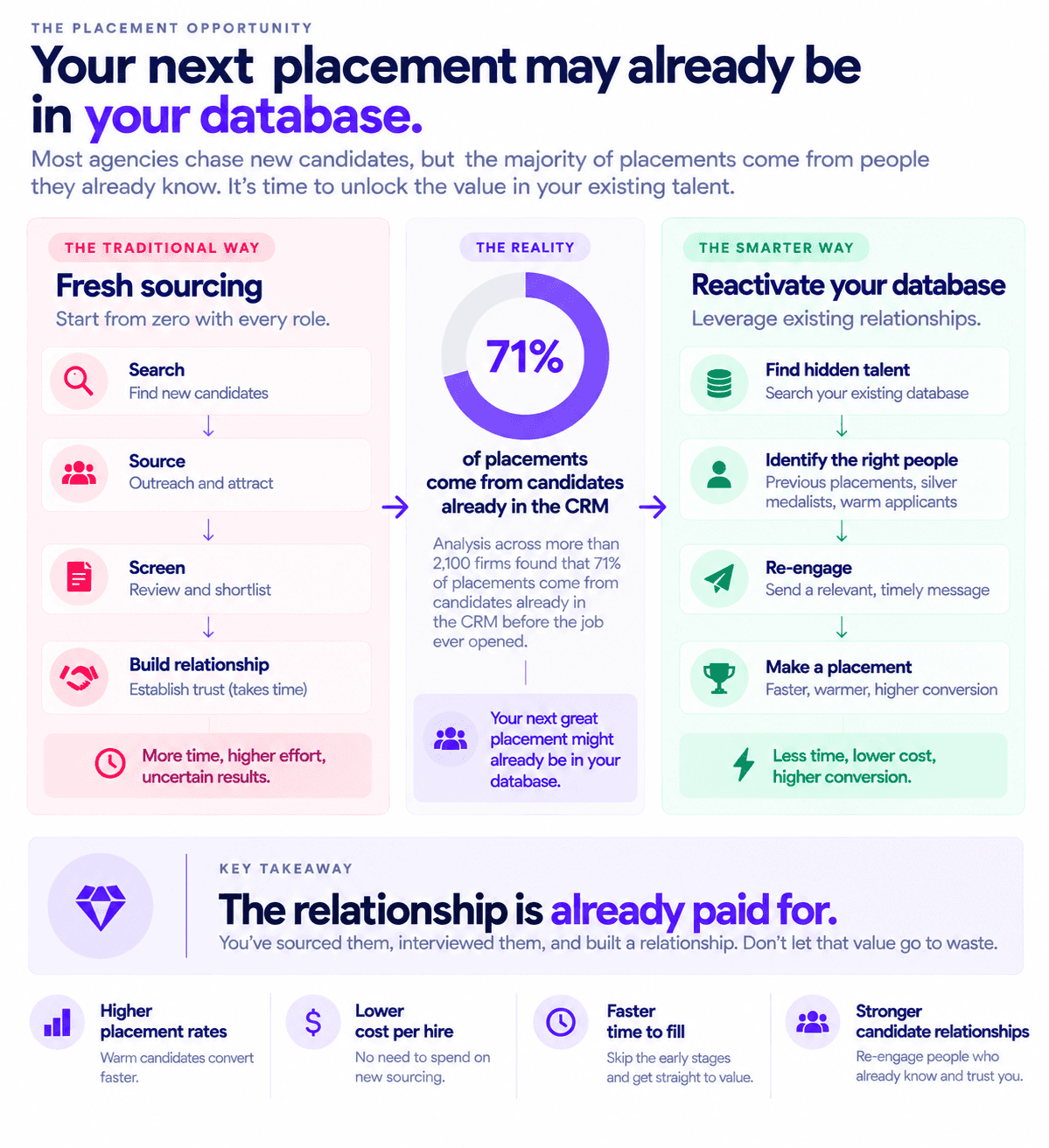
The first shift is in how you think about a quiet candidate. Someone who went silent eighteen months ago is not uninterested, they are un-contacted. They changed jobs, finished a contract, grew restless, or simply lost the thread of a conversation that had no reason to continue at the time. The relationship did not end, it went idle, which means the work of building trust and understanding their situation has already been paid for.
That is what makes reactivation so much cheaper than fresh sourcing. A reactivation approach is warmer than cold outreach because you have history with the person, and it is faster than starting a search from scratch because the relationship already exists. The database holds candidates who are, on average, far closer to a placement than anyone you could find cold, and reaching them first is a genuine advantage over competitors still sourcing net-new for the same roles.
Who to reactivate first
Not every dormant record is worth the same effort, so start with the candidates closest to revenue. Previous placements and finishing contractors are the clearest opportunity, since you know their work and they know you, and a contractor coming off an assignment is available right now. Silver medalists, the candidates who reached a final stage but lost out for reasons of timing or a narrow preference, are the next tier, because they were already good enough to shortlist and many have since gained the experience that closes the earlier gap.
Beyond those, warm applicants and high-fit dormant candidates who match a live role round out the priority list. The point is to work from who can still be placed, redeployed, shortlisted, or introduced to a client, rather than treating the database as a record of who your agency used to know. Filtering the pool down to these high-value records is where precise candidate filtering matters, since the goal is a short list of people worth re-approaching, not a mass mailout to everyone on file.
Timing is the reason to reach back out
Reactivation works when there is a real reason for the message to land now, and the strongest reason is a change in the candidate's situation. A job change is the clearest trigger, since a candidate who has just moved, or who has been in a role long enough to consider moving again, is far more receptive than one contacted at random. A matching new role is another, as is a past finalist worth a second look for something similar, or a qualified candidate who simply went quiet and can be re-engaged with a specific opportunity.
Tracking these moments turns a static database into a stream of timely openings. Agencies that monitor for job changes and other signals see the payoff directly, with firms using change alerts reporting a 34% reduction in time to first submittal and 12% more placements, and one agency generating £25,000 from change alerts alone while cutting time to fill from 106 days to 37. Watching for these triggers is the same discipline agencies use to spot new roles before competitors, applied to the talent side.
Surface the right people, despite messy records
The obstacle most agencies hit is that their database is hard to search. Records were tagged years ago in inconsistent ways, a candidate labelled a senior consultant three years ago may now be a director, and the plain-language way you describe a role to a client rarely matches the exact keywords sitting in old fields. Keyword search built on decayed tags misses the people you are looking for, which is why so many agencies conclude, wrongly, that there is nothing useful in their database.
Reading records semantically solves this, because it matches on what a candidate's experience means rather than the specific words on an old CV. Running a live role against your database with candidate matching surfaces the people whose experience fits, regardless of how they were tagged, and pairing that with AI sourcing that reads for meaning turns a dead archive back into a working shortlist. The prerequisite is reasonably clean data, so periodically enriching and updating your records keeps the database searchable and the matches accurate, and it is closely tied to the wider problem of revenue trapped inside a decaying CRM.
Run it as a system, not a one-off
Manual reactivation collapses past the first batch, which is why most attempts fizzle out after a burst of enthusiasm. A recruiter can hand-write a few dozen re-engagement messages, and then the daily desk work takes over and the effort stops. The agencies that get lasting results run reactivation as a standing system rather than a project, and firms that automate their reactivation sequences report 15 to 25% increases in redeployment rates as a result.
In practice that means monitoring for the triggers automatically, surfacing the matching records when a role opens or a candidate's situation changes, and running a sequence that leads with a specific reason for the message. The message itself should follow the same principle as good client outreach, leading with a relevant opportunity rather than a generic check-in, and it can be sequenced across a few touches the same way a cold email follow-up is. Building this into your broader sourcing and outreach automation means the database works continuously in the background, and giving recruiters that time back lets them focus on the conversations that close.
Put a number on the opportunity
Before investing recruiter time, it is worth estimating the size of the prize so you can prioritize it honestly. Start with the number of high-value dormant records rather than every name in the CRM, apply a conservative reactivation or placement rate, and multiply the likely placements by your average placement fee. Treat the result as an opportunity estimate rather than a forecast, since its purpose is to tell you whether the upside justifies the effort.
Even a small recovery rate across a large historical database tends to produce meaningful upside, because the cost of acquiring those relationships has already been spent. That favorable math is what makes database reactivation one of the highest return activities an agency can undertake, and measuring it through your KPIs, particularly redeployment rate and time to first submittal, confirms whether the effort is converting. Repeat placements from your own database also build the kind of steady revenue that underpins winning and keeping more clients.
What is candidate database reactivation?
Candidate database reactivation, sometimes called database resurrection or talent rediscovery, is the practice of systematically re-engaging dormant records in your ATS and CRM to generate placements, instead of always sourcing new candidates. It covers past placements, finishing contractors, silver medalists, and qualified candidates who went quiet, and it works because those relationships already exist and most placements come from people already in the database. Done well, it turns a static archive into a live source of shortlists and repeat revenue.
How do you re-engage dormant candidates without annoying them?
Lead with a specific, timely reason for the message rather than a generic check-in. Reach out when something has changed, such as a candidate's job move, a new role that matches their experience, or a search where they were previously a strong finalist, and keep the message short and personal. Because you have history with the person, a relevant opportunity is welcome rather than intrusive, and the key is relevance and timing rather than volume, so a targeted approach to the right records beats mass-messaging the whole database.
Is it worth reactivating an old candidate database?
Usually yes, because it is the highest return channel most agencies have and the cost of building those relationships is already paid. The majority of placements come from candidates already in the CRM, and reactivation is warmer and cheaper than fresh sourcing. The practical test is to estimate the number of high-value dormant records, apply a conservative placement rate, and multiply by your average fee, which tells you whether the upside justifies prioritizing it. For most agencies with any history, the answer is clearly worth the effort.
Bringing it together
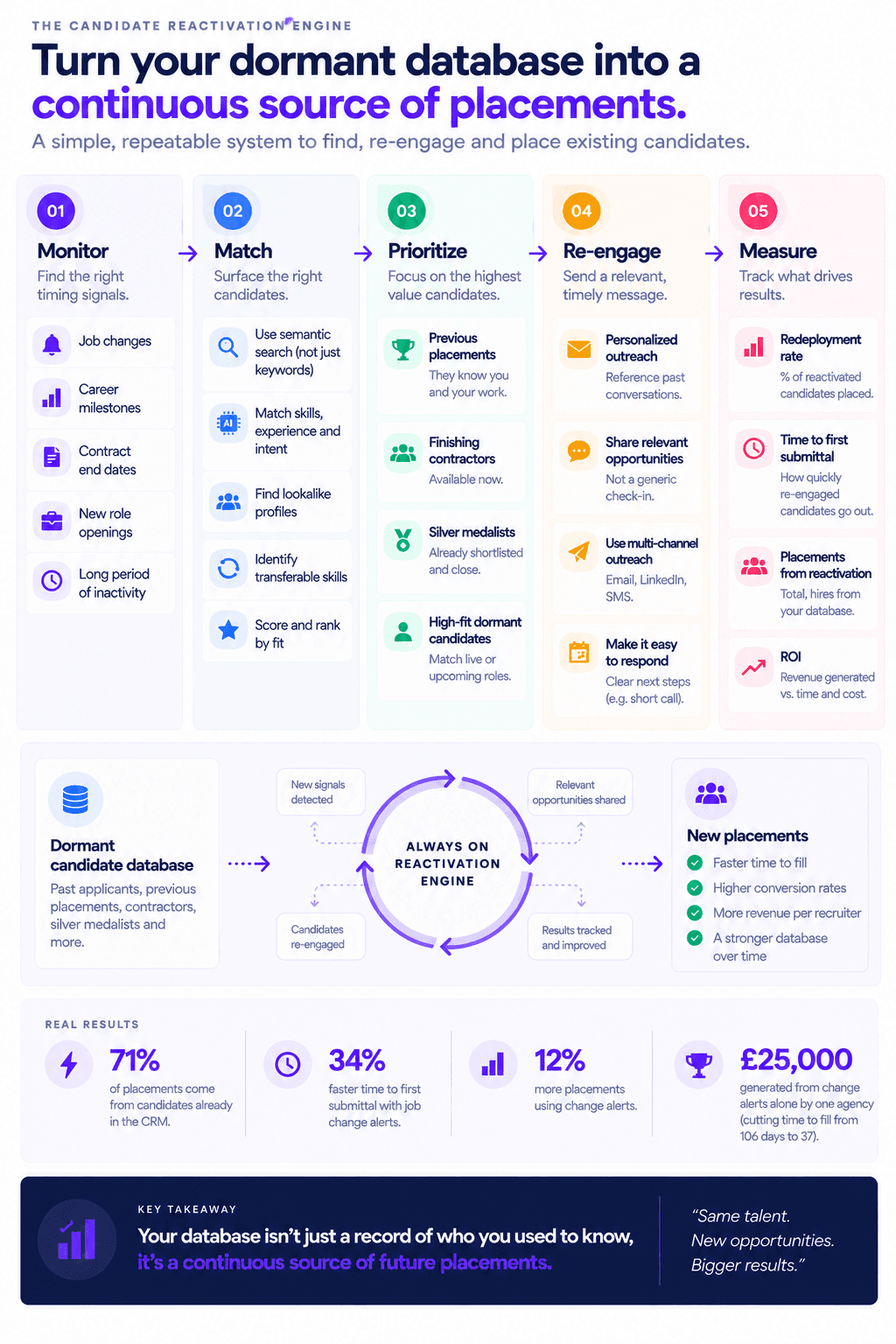
Your next placement is often already in your database, sitting in a record you stopped contacting when a role closed. Treat dormant candidates as un-contacted rather than uninterested, prioritize the ones closest to revenue, reach out when a real change gives you a reason, and surface the right people by matching on meaning rather than decayed keywords. Run it as an automated system so it does not collapse after the first batch, and measure the redeployment it produces. Done this way, the database you already paid to build becomes one of the most profitable sources of placements you have.
If you want help turning your candidate database into a working reactivation system, book a call with the Novoslo team and we will show you exactly how it works.