Article
Mar 4, 2026
How Is AI Different From Automation
AI vs automation: learn what each actually does, where they overlap, and how to decide which one your business needs before spending a doll
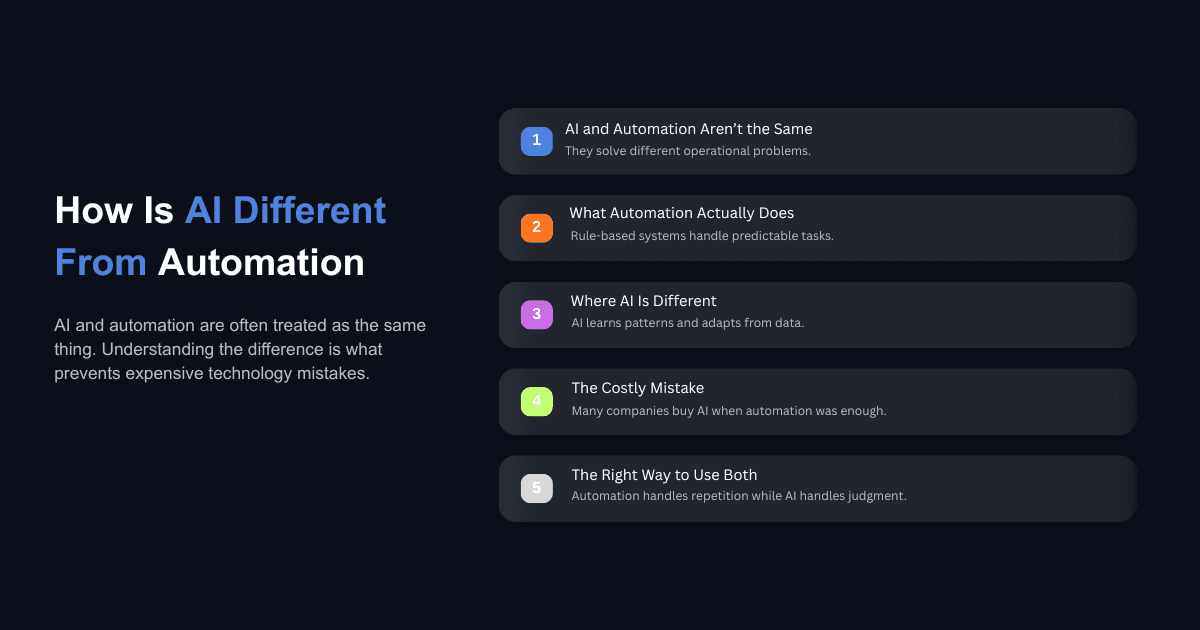
Most leadership teams use the words "AI" and "automation" as if they mean the same thing. In budget meetings, strategy decks, and vendor calls, the two get bundled together under a single line item. The problem is that they are fundamentally different technologies with different capabilities, different costs, and different outcomes. Treating them as interchangeable is one of the most common reasons companies invest in the wrong solution and end up with tools nobody uses.
This matters because the stakes are real. According to S&P Global's 2025 survey of over 1,000 enterprises, 42% of companies abandoned most of their AI initiatives this year, up from 17% in 2024. A meaningful share of those failures trace back to a basic misunderstanding: the team didn't know whether they needed AI, automation, or some combination of both.
This post breaks down the actual difference between AI and automation, explains where each one fits inside operations, and gives you a framework for deciding what AI transformation actually looks like for your business versus where straightforward automation would serve you better.
What Automation Actually Does (And Where It Stops)
The logic is fixed, and that's the point
Automation runs on rules that people define in advance. If a condition is met, the system takes an action. If an invoice arrives, it gets routed to the right approver. If a customer places an order, a confirmation email goes out. If a support ticket hits a certain keyword, it lands in a specific queue.
There is no judgment happening here, and that is precisely what makes automation valuable. The system does the same thing the same way every time, which removes human error from predictable, repeatable processes. Payroll calculations, data entry, scheduled reporting, inventory updates, and basic quality checks all fall squarely into automation territory.
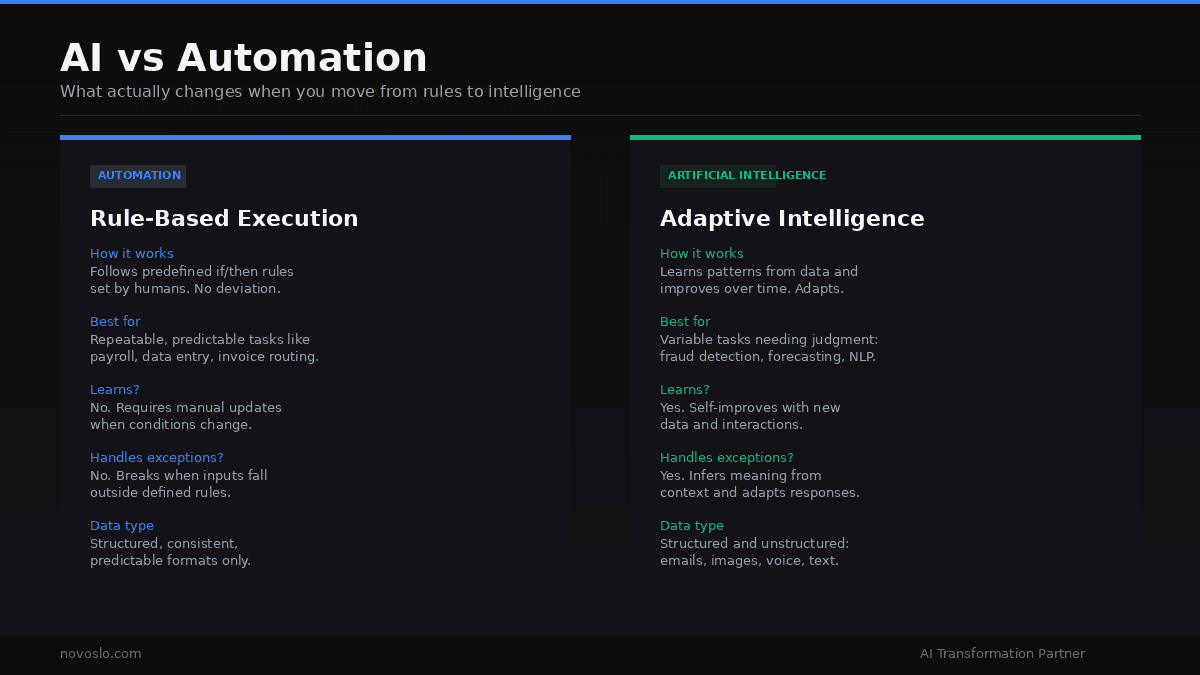
The constraint is equally straightforward: automation does not learn, adapt, or improve on its own. If conditions change or new scenarios appear, someone has to go back and rewrite the rules. This makes automation excellent in stable environments where the process is well understood and rarely changes, and it makes automation a poor fit for anything that requires interpretation or context.
Where automation works best inside operations
Understanding why automation matters in business comes down to recognizing the types of work it handles well. Invoice matching, contract renewals, employee onboarding checklists, data syncing between systems, appointment reminders, and escalation triggers are all strong candidates. These are tasks where speed and consistency matter more than judgment.
The real value of automation is that it frees your team from spending hours on work that follows the same pattern every day. When done well, it reduces costs, cuts down on errors, and lets people focus on the parts of their job that actually require thinking.
What AI Brings That Automation Cannot
Learning from data instead of following rules
The core difference between AI and automation is that AI systems are designed to learn from data rather than follow instructions written by a human. Instead of executing a fixed set of steps, an AI model gets exposed to large volumes of information and identifies patterns on its own. Over time, it gets better at recognizing those patterns without anyone rewriting the underlying logic.
A practical example: a traditional automation system can route customer support tickets based on keywords. If someone types "billing," the ticket goes to the billing team. An AI system, by contrast, can read the full message, understand the context and sentiment, determine urgency, and route it to the right team even if the customer never uses the word "billing." The AI adapts based on what it has learned from thousands of previous conversations.
This distinction between AI agents versus AI tools matters because many companies buy what they think is AI and end up with a slightly fancier version of rule-based automation. True AI learns, adapts, and handles situations it was not explicitly programmed for.
Handling unstructured information and context
Traditional automation struggles with anything that does not follow a clean, predictable format. Emails written in natural language, PDF contracts with varying layouts, voice recordings, images, and free-text customer feedback are all examples of unstructured data that automation cannot process meaningfully.
AI thrives in exactly these areas. Natural language processing allows AI to read and interpret text the way a human would. Computer vision lets AI analyze images and detect patterns. Machine learning models can take messy, inconsistent data and extract useful insights from it. This capability is what makes AI suited for tasks like fraud detection, demand forecasting, document analysis, and personalized recommendations, all of which involve variability that rules alone cannot handle.
Why Does the Difference Between AI and Automation Matter for Your Business?
The investment mistake most companies make
When companies conflate AI and automation, they tend to make one of two errors. Either they buy expensive AI tools for problems that only needed simple automation, or they try to automate processes that actually require intelligence and adaptability. Both paths waste money and create frustration.
The first scenario is more common than most people admit. A team decides they need "AI" because it sounds advanced, and they end up paying for machine learning capabilities they never use. The workflow they needed to fix was predictable and repeatable, which means a basic automation tool would have handled it at a fraction of the cost.
The second scenario is equally expensive but shows up differently. A company implements rule-based automation for a process that involves too many variables, and the system breaks constantly because it cannot handle exceptions. The team spends more time fixing the automation than they would have spent doing the work manually.
What the failure data actually tells us
The numbers on enterprise AI failure are striking. A 2025 MIT report found that roughly 95% of generative AI pilots fail to deliver measurable impact on profits. RAND Corporation research puts the broader AI project failure rate at over 80%, which is about twice the failure rate of non-AI technology projects. Meanwhile, S&P Global found that the average organization scrapped 46% of its AI proof-of-concepts before they ever reached production.
What is interesting is that these failures are rarely about the technology itself. They happen because organizations skip the foundational work. They do not define clear business outcomes before choosing tools. They do not assess whether the problem requires AI, automation, or both. And they do not invest in data readiness, which is the single biggest predictor of whether an AI project will succeed.
Understanding why AI transformations fail is the first step toward not becoming part of that statistic. The companies that succeed tend to be the ones that start with the problem, not the technology.
Can AI and Automation Work Together?
Where they complement each other in real workflows
The question is not whether to use AI or automation. It is where each one fits within the same workflow. The most effective operations teams use both, with automation handling the predictable steps and AI handling the parts that require judgment or adaptation.
Consider accounts payable. Automation can handle the routine matching of invoices to purchase orders, processing payments on schedule, and sending reminders. AI can sit on top of that same workflow and detect duplicate invoices, flag unusual vendor behavior, or identify patterns that suggest fraud. The automation provides consistency and speed while the AI adds a layer of intelligence that catches things a rule-based system would miss.
This layered approach is how AI can streamline your operations without requiring you to replace everything you already have. One enterprise sales team that adopted this kind of combined approach doubled their sales efficiency by using AI to identify the right moment to engage leads while automation handled the follow-up sequences and data logging.
The layered approach that works
The companies seeing real results from AI workflow transformation strategies tend to follow a consistent pattern. They automate the basics first. They get the predictable, repeatable work running smoothly on rule-based systems. Then they layer AI on top for the parts that benefit from learning and adaptation.
This sequence matters because AI depends on clean, structured data to function well, and automation is often what creates that clean data in the first place. If your underlying processes are messy and inconsistent, adding AI on top will only amplify the mess. Fix the foundation with automation, then build intelligence on top of it.
The MIT research supports this approach: back-office automation consistently produces the highest returns, while the biggest failures tend to come from organizations that jumped straight to complex AI without getting the operational basics right first.
How Do You Decide What Your Business Needs?
Start with the workflow, not the technology
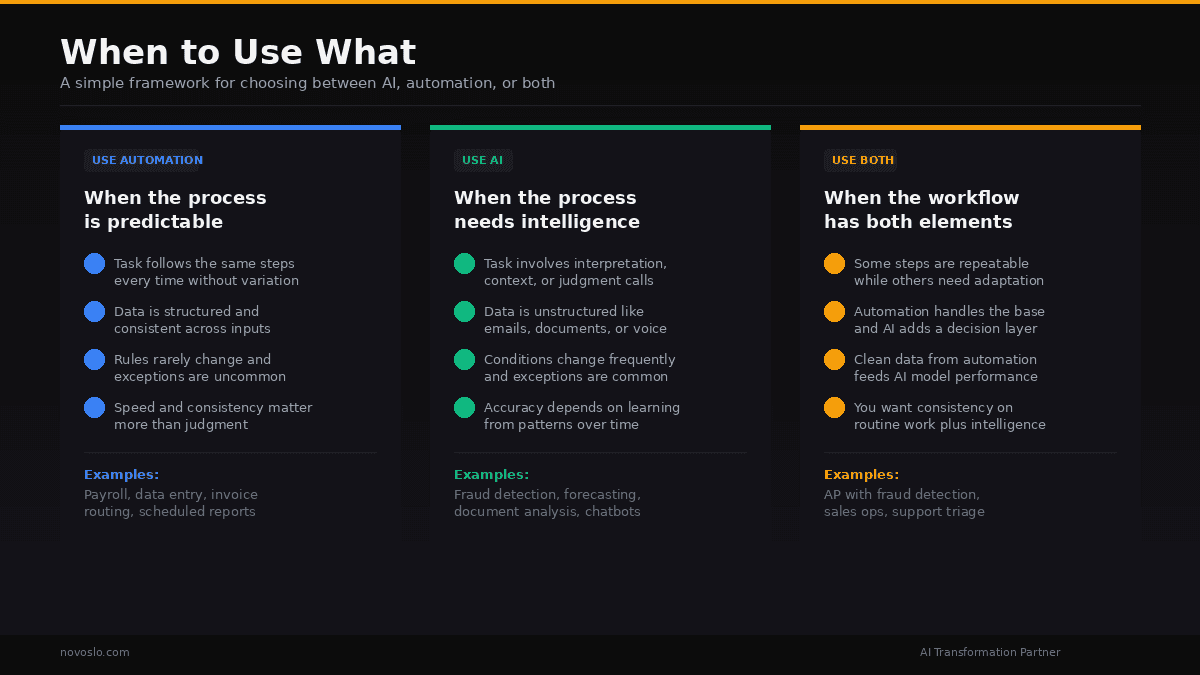
The decision between AI and automation should begin with a clear understanding of the work itself. Before evaluating any tool, map the workflow you want to improve and ask a few questions: Is the process predictable and repeatable? Does it require judgment, interpretation, or handling of exceptions? How often do the rules change? What kind of data is involved, and is it structured or unstructured?
If the work follows the same steps every time and the data is clean and consistent, automation is probably the right starting point. If the work involves variability, requires context, or depends on interpreting unstructured information, AI is likely what you need. And if the workflow has both predictable and variable components, a combination of the two will serve you best.
This is the framework that separates successful implementations from expensive failures. The companies that get this right are not necessarily the ones with the biggest budgets. They are the ones that took the time to understand the problem before choosing a solution.
Questions to ask before buying anything
Before you commit to any platform or vendor, run through these considerations. What specific business outcome are you trying to achieve? Can you define that outcome in measurable terms? Is the process you want to improve well documented and stable, or does it involve frequent exceptions? Do you have the data infrastructure to support AI, or do you need to invest in data readiness first?
These questions might seem basic, but they are the ones that most organizations skip. And skipping them is exactly what leads to the 42% abandonment rate that S&P Global documented. If you want a structured way to evaluate your readiness, implementing AI in your business starts with this kind of honest assessment, not with a demo.
Moving Forward Without the Confusion
The difference between AI and automation is not academic. It directly affects how much money you spend, what results you get, and whether your team actually adopts what you build. Automation handles repeatable, rule-based work with speed and consistency. AI handles variable, data-dependent work that requires learning and adaptation. Both are valuable, and neither one replaces the other.
The companies that get this right start with the workflow, choose the right tool for each part of the process, and build in layers rather than trying to solve everything at once. They also measure outcomes from the beginning so they know whether what they built is actually working.
If you are trying to figure out where AI fits in your operations and whether the investment makes sense, you can estimate the ROI of AI for your business before committing to a full implementation. The clarity you need starts with understanding what you are actually buying.