Article
Sep 14, 2026
Why Recruitment Agencies Are Losing Clients to In House Hiring Teams
Companies are shifting hiring in-house as AI closes the gap. Why recruitment agencies lose clients, and how to win the work they should keep.

The balance between agencies and internal hiring teams has moved sharply in the past two years. A 2026 industry survey found that 78% of companies now operate primarily through direct hiring, with only 22% relying mainly on agencies, and 42% said they had cut agency usage over the previous two years. For a recruitment agency, that is a client base quietly shrinking, and the reasons are worth understanding clearly rather than dismissing as a passing trend.
The shift is real, and it is also more nuanced than agencies being replaced outright. Internal teams and agencies break under different kinds of pressure, and companies are getting more deliberate about which work stays inside and which goes out. This guide explains why in-house teams are taking work that agencies used to own, where agencies still hold a genuine advantage, and what an agency can do to stop losing the clients it should be keeping.
The shift in the numbers
Two forces sit behind the move to direct hiring. The first is capability. Internal talent acquisition teams have invested heavily in sourcing technology and AI hiring tools since the pandemic hiring spike, and that investment has closed much of the gap that once made agencies necessary for everyday roles. With 87% of companies now using AI-powered screening tools, an internal recruiter can source and filter for a standard role at a speed that would have required an agency a few years ago.
The second force is cost pressure. As hiring demand softened with the economy, internal teams came under scrutiny to deliver more for less, and finance leaders started questioning contingency fees that run 15 to 30% of a salary. Cost-per-hire has risen roughly 14% since 2019, so every line item in the hiring budget gets examined, and an agency fee is an obvious target when an internal team believes it can do the work itself. The combination of better internal capability and tighter budgets is what turned a gradual trend into a visible drop in agency usage.
Why in-house teams are winning work agencies used to own
For a large share of roles, the internal case has become genuinely strong, and it helps to see why rather than argue with it.
The economics favor internal hiring once volume is predictable. Agency fees apply only when you hire, which makes them efficient for occasional or difficult roles, while an internal recruiter is a fixed cost that pays off once hiring is regular. The common break-even guidance is that companies making fewer than about 15 external hires a year usually do better outsourcing, a hybrid model fits from 15 to 30 hires, and beyond 30 predictable hires a year a dedicated internal recruiter starts to make commercial sense. A CFO running that math on a company with steady headcount growth will often conclude that the fixed cost is cheaper than a stack of success fees.
The capability gap has also narrowed for standard roles specifically. When a position sits in a common function with a deep local talent pool, an internal team with a modern applicant tracking system and AI sourcing can fill it without much of the market access an agency provides. The agency advantage on those roles was always reach and speed, and technology has handed a workable version of both to internal teams.
The third driver is the one agencies control, and it is positioning. Many agency relationships were built purely on filling individual vacancies, with little pipeline visibility, market mapping, or strategic input offered alongside the placements. When the relationship is transactional, a client that builds internal capacity has no reason to keep paying for it, because the agency never became anything the internal team could not replace.

Where in-house teams still break, and agencies still win
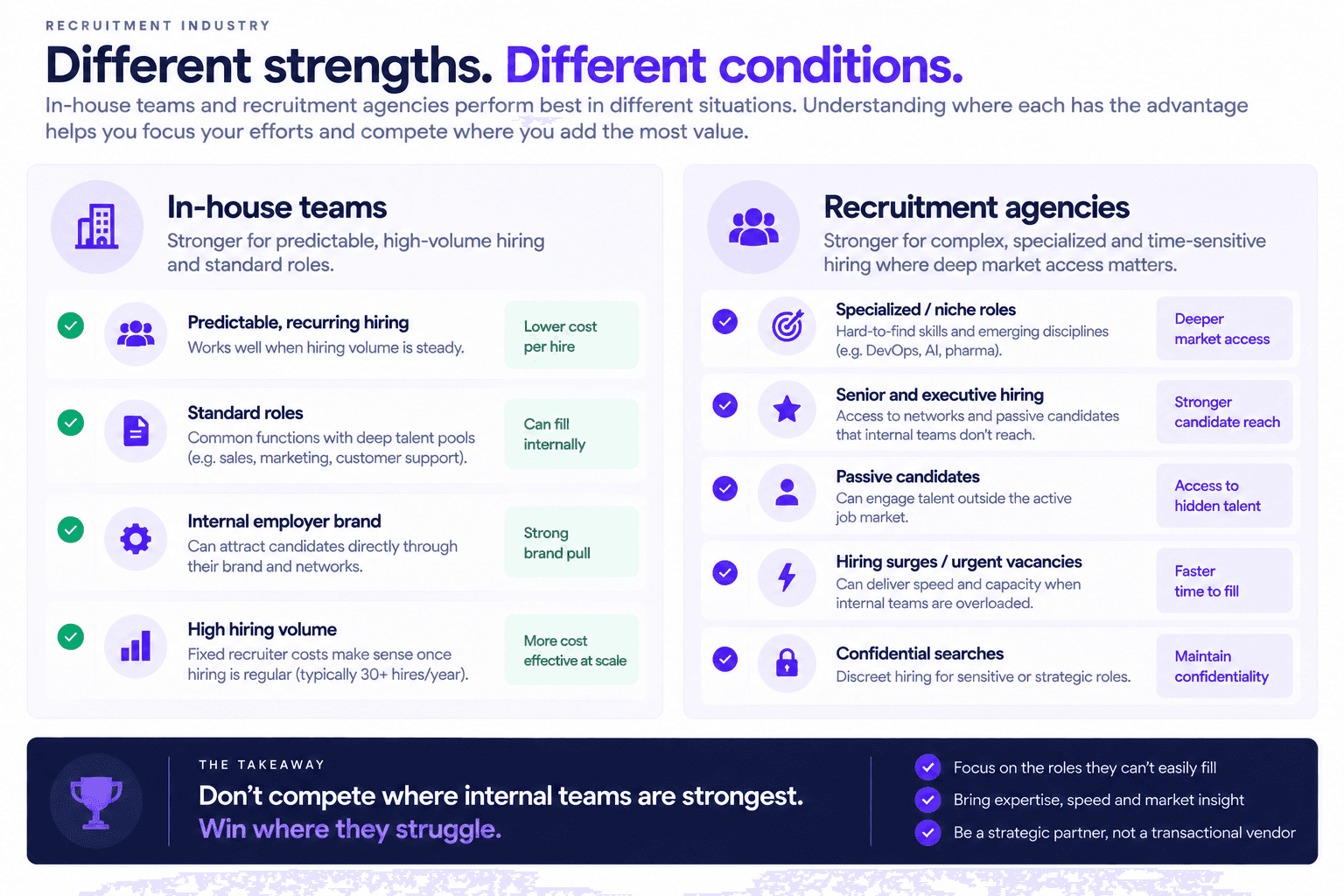
The move inward has limits, and those limits are exactly where agencies keep their value. Internal teams are strongest when hiring is steady and predictable, and they struggle under load and outside their core. During a growth spurt, a wave of backfills, or a confidential search, an internal team carrying too many requisitions sees quality drop and time to fill stretch. They also tend to have limited access to passive candidates in specialized or competitive markets, since their networks are built around the company rather than the discipline.
Specialized and senior roles are where this gap is widest. Internal teams often lack the niche technical networks and the market intelligence to fill a hard DevOps, pharma, or executive role well, and agency partnerships stay cost-effective wherever cost-per-hire runs above roughly $28,000. Speed compounds the case, because a critical senior vacancy can cost a company $250,000 or more in lost output over a slow search, which makes a fee that fills the role in two weeks look cheap rather than expensive. The honest summary is that both models work, and each breaks in different ways under pressure, so the agencies that thrive are the ones concentrated where the internal model breaks.
Why agencies lose clients they should keep
Given all of that, most client losses come down to positioning rather than the agency model being obsolete. An agency competing as a generalist vacancy-filler is fighting on the exact ground an internal team with modern tooling now holds, and that is a losing position regardless of how good the recruiters are. The roles it wins on price today are the ones internal teams will take in-house tomorrow.
Speed is the second place agencies quietly lose. When an agency's own sourcing and business development run on manual work, it cannot always beat an internal team that has automated its top of funnel, and a client that gets a faster shortlist internally stops seeing the point of the fee. The third is proof, because an agency that cannot show the market mapping, salary intelligence, and pipeline data behind its work looks interchangeable with an internal recruiter who at least sits in the building. And the fourth is targeting, since agencies waste effort pitching companies that have already committed to internal hiring instead of the ones where the internal model is actively straining.
How to stop losing clients to in-house teams
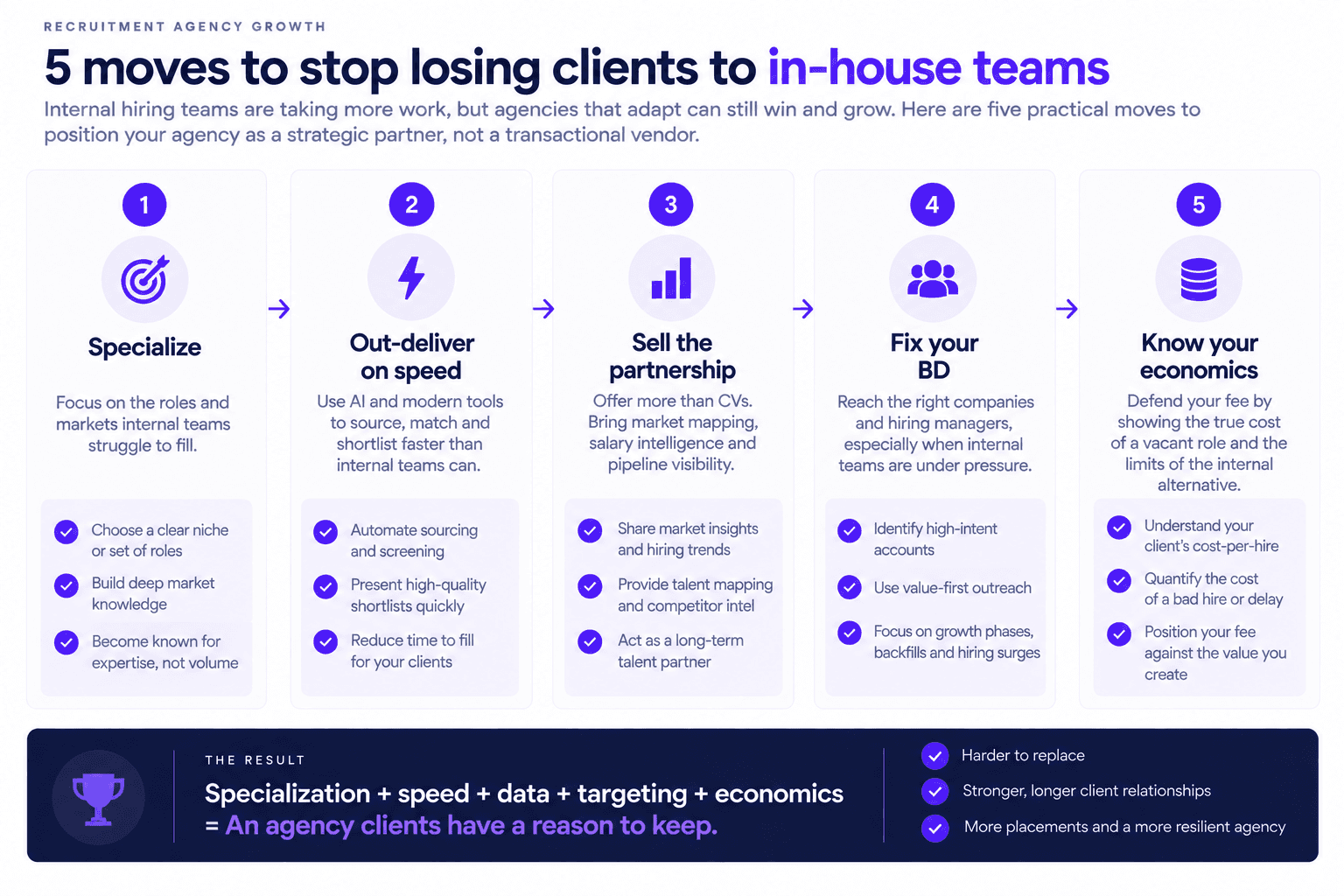
The response is not to compete harder on the transactional work, but to move decisively toward where agencies win and to out-execute internal teams there. Five moves matter most.
Specialize where in-house teams cannot follow. Concentrate on the niche, senior, and passive-candidate roles that internal teams struggle to fill, and build the deep market knowledge that a generalist internal function will never match. Focusing your prospecting on the roles and companies where an agency genuinely wins, and filtering hard for the accounts worth pursuing, keeps your effort on ground you can hold.
Out-deliver on speed by using the same technology internal teams do. If an internal recruiter can source and screen with AI, an agency has to be faster still, which means automating your own sourcing and matching so you return a strong shortlist before the internal team finishes its first pass. Using AI to find better candidates and running open roles against your pool with candidate matching is how you win the speed argument rather than lose it, and automating the admin around it gives your recruiters hours back to spend on the work that closes placements.
Sell the partnership and prove it with data. Offer the market mapping, salary benchmarks, and pipeline visibility that a transactional relationship never included, and report on the metrics that show your impact, which is where tracking the KPIs that actually matter turns your value into something a client can see on a page rather than take on trust.
Fix the business development that reaches those clients. Winning back share means reaching the companies where the internal model is straining, at the moment it strains, which depends on finding the right hiring manager and reaching them with a message that leads with a candidate rather than a meeting request. Building that into a consistent motion is the core of winning more clients through a proper cold email system, and running it at scale is part of the wider shift in how agencies generate leads with AI.
Finally, know your own economics so you can defend your fee. When a client questions the cost, an agency that understands its true cost to operate can frame the fee against the vacancy cost and the internal alternative with confidence, rather than discounting out of uncertainty.
Are recruitment agencies dying?
No, though the transactional, generalist model is under real pressure. The data shows companies shifting standard, high volume hiring in-house as their internal capability improves, which shrinks the market for agencies that only fill ordinary vacancies. At the same time, demand remains strong for agencies that deliver on specialized, senior, and hard-to-fill roles, on speed during hiring surges, and on market access that internal teams lack. The agencies struggling are the ones that never differentiated, and the ones growing have concentrated on the work internal teams cannot do well.
Why do companies prefer in-house recruiting?
For predictable, ongoing hiring, internal teams offer control, cost efficiency, and closeness to the business. An internal recruiter owns employer branding, builds pipelines for recurring roles, and represents the company directly, and once hiring volume is regular the fixed cost usually beats repeated agency fees. Improved sourcing technology and AI screening have also made internal teams capable of handling standard roles that once needed an agency. The preference is strongest where hiring is steady and roles are common, and it weakens quickly for specialized, senior, or surge hiring.
How can recruitment agencies compete with in-house teams?
By competing where internal teams are weakest rather than where they are strong. That means specializing in niche and senior roles, building genuine market and salary intelligence, and moving faster than an internal team can by using AI in your own sourcing and matching. It also means shifting the relationship from filling vacancies to a data-backed partnership, and proving your impact with clear metrics. Agencies that make these moves stop competing on the transactional work internal teams now own and win on the work those teams cannot deliver.
Bringing it together
Recruitment agencies are losing clients to in-house teams because improved internal capability and cost pressure have made direct hiring the default for standard roles, and because too many agencies stayed transactional while that shift happened. The work has not disappeared, it has concentrated. It sits in the specialized, senior, and urgent hiring where internal teams break under pressure, and in the market access they cannot build. Agencies that specialize there, out-deliver on speed with their own technology, prove their value with data, and run disciplined business development will keep winning, while those still competing as generalist vacancy-fillers will keep losing ground.
If you want help building the business development and sourcing systems that win the work internal teams cannot do, book a call with the Novoslo team and we will show you exactly how it works.