Article
Sep 22, 2026
Why Recruitment Agencies Are Leaving Revenue Inside Their CRM
Data decay, keyword search, and lost context trap real revenue inside recruitment CRMs. Why it happens, what it costs, and how to unlock it.

Every established recruitment agency is sitting on a CRM full of paid-for revenue it never collects. The candidates already interviewed, the clients who went quiet, the notes from hundreds of conversations, all of it represents relationships the agency invested in and then stopped using. The money is real, and it stays locked inside the system because the CRM has quietly become a place data goes to be stored rather than a place revenue gets generated.
This is not a discipline problem, it is a structural one. Records decay, search tools miss the best candidates, and the most valuable context never gets captured in the first place, so recruiters conclude there is nothing useful in the database and go back to sourcing net-new. This guide explains why revenue gets trapped inside a recruitment CRM, what that leak actually costs, and how to turn a static system of record back into a source of placements and repeat business.
The CRM became a graveyard, not an engine
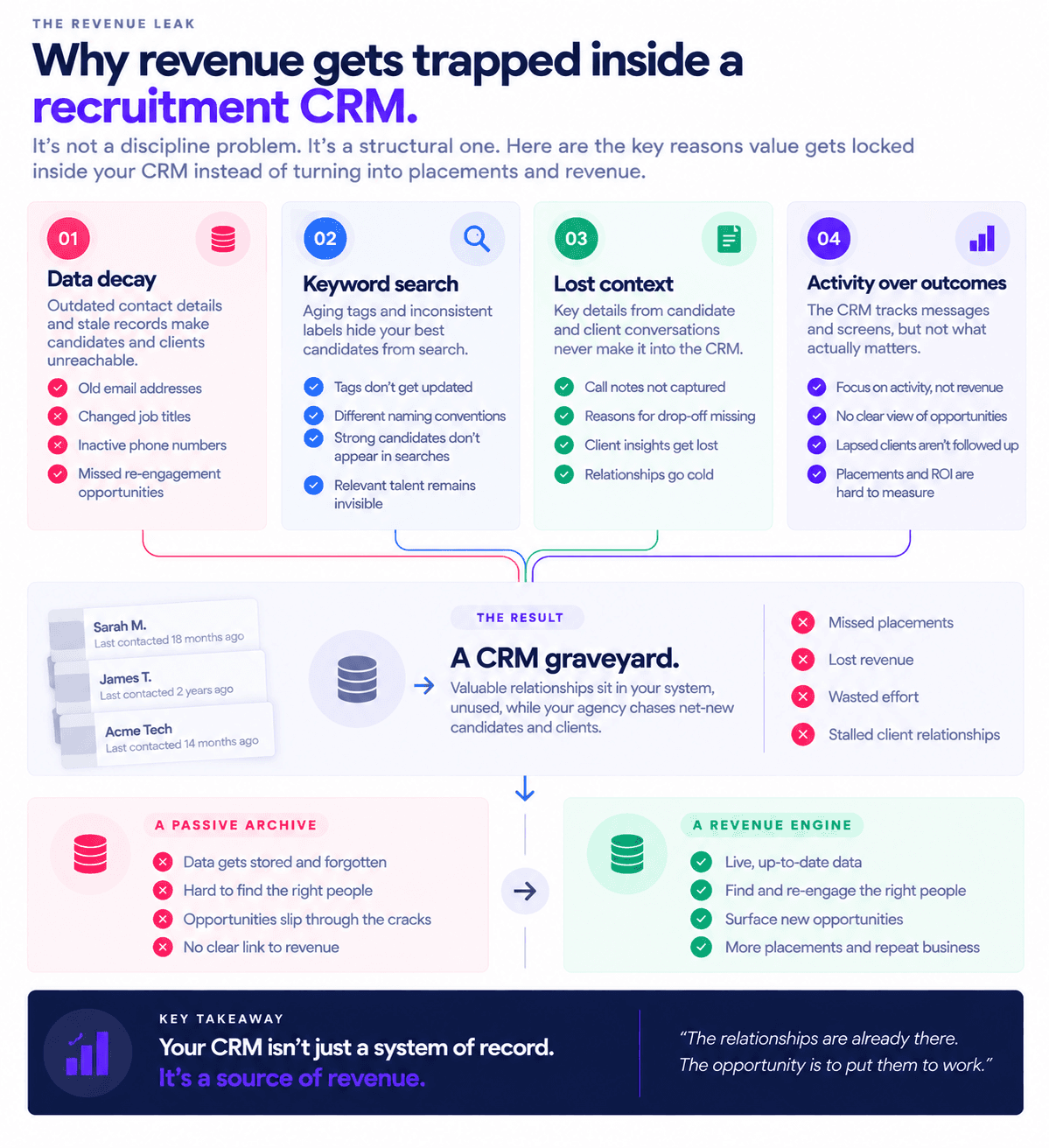
The traditional CRM is a passive archive. A recruiter searches a keyword, gets a static list, and starts the slow work of manual screening, which is a bottleneck rather than an engine. Over time the system fills with records nobody revisits, and it turns into what many recruiters privately treat as a candidate graveyard, a store of names rather than a working pipeline.
That matters because the database is where an agency's next placements actually live. Most placements come from candidates already in the CRM before a role opens, so a system that makes those people hard to find is directly suppressing revenue. The same is true on the client side, where lapsed accounts and stalled relationships sit unworked while the agency spends its energy chasing cold prospects. Turning the archive back into an engine is the whole opportunity, and it starts with understanding the three things that trap the value.

Data decay is quietly destroying your records
The first cause is decay. Candidate and client data goes stale the same way a phone number does, and across B2B more broadly 44% of companies report losing more than 10% of annual revenue to CRM data decay. For an agency that shows up as missed re-engagement windows, records that no longer reach anyone, and shortlists that omit the strongest people because their details are out of date.
Reactivating an old record is often harder than sourcing fresh precisely because the record has decayed, which is the trap: the database that should be your cheapest source of placements becomes unusable through neglect. Keeping records current is therefore not housekeeping but revenue protection, and periodically enriching and updating your data is what keeps the CRM worth mining. Decay also carries a compliance dimension, since data protection rules tie your lawful basis for holding personal data to a stated purpose and time window, and a record untouched for three years raises a legal question as much as a quality one.
Keyword search hides your best candidates
The second cause is that search itself fails on an aging database. Tags decay alongside the data, so a candidate tagged a senior consultant three years ago may now be a director, and the tag never updated. Labels are inconsistent because different consultants tag differently, so business development manager, head of growth, and BD lead can all describe the same person while a keyword search returns only one of them. Most fundamentally, the way you describe a role to a client in plain language was never the search query, and translating it into a boolean string that matches whatever tags your team happened to use years ago loses candidates at every step.
The effect is that your best-matched people are in the database and invisible to the search. Reading records semantically fixes this, because the system matches on what a candidate's experience means rather than the exact words on file, which surfaces qualified people who would never survive a keyword filter. Running a live role against your records with candidate matching turns the same database that felt empty under keyword search into a source of real shortlists.
The most valuable context never gets captured
The third cause is subtler and more expensive. The fields that carry the most commercial value are the ones legacy systems never captured at all, such as what a candidate said on a call, why they turned down the last offer, or the real reason a client relationship stalled. That context is the difference between a name and a warm candidate, and without it a record is just an entry rather than a relationship you can act on.
When that context is lost, recruiters rebuild information they already owned, which is both a time cost and a revenue cost, since the insight that would have made a re-approach land is gone. Capturing and keeping it is what allows a dormant record to be reactivated with a message that actually resonates, and it is why the richest source of your next placement is often a conversation from two years ago rather than a fresh search. Building workflows that capture this context automatically, rather than relying on recruiters to log it, is part of running recruitment workflows that operate on their own.
You are measuring activity, not outcomes
A final reason revenue stays trapped is that most agencies measure the wrong things. Tools report activity such as messages sent and candidates screened, and they struggle to connect that activity to placements made and revenue per recruiter, so the value sitting in the CRM never shows up as a number anyone acts on. When the dormant database is invisible on the dashboard, it stays invisible in practice.
Connecting your measurement to outcomes changes that. Tracking redeployment rate, placements sourced from existing records, and revenue per recruiter through your KPIs makes the trapped value visible and gives you a reason to work it. The cost of leaving it alone is real, since the decay and the wasted re-sourcing feed directly into the economics that separate a healthy agency from a struggling one.
How to unlock the revenue in your CRM
Freeing the trapped revenue follows from the causes. Keep the data current so records stay usable, search semantically so your best candidates surface regardless of old tags, and capture the context that turns a name into a warm relationship. From there, work the two dormant populations deliberately: reactivate the candidates already in your database, and re-approach lapsed clients when a trigger such as a contact moving or a new role gives you a reason. Watching for those triggers is the same discipline as finding new opportunities early, and re-approaching a quiet client works through the same outreach system you use to win new ones.
The through-line is that the CRM should show who can still be placed, redeployed, or sold to, not who your agency used to know. Automating the hygiene, the surfacing, and the outreach means the database works in the background rather than waiting on a recruiter to remember it, which is where productivity automation pays off. A CRM you can actually search and act on is one of the most direct ways to win more clients and placements from relationships you already own, and keeping the pool precise matters, which is where candidate filtering comes in.
Why do recruitment agencies lose revenue in their CRM?
Revenue gets trapped because the database becomes hard to use. Records decay so they no longer reach anyone or reflect a candidate's current situation, keyword search built on inconsistent old tags misses the best-matched people, and the most valuable context from past conversations never gets captured. On top of that, most agencies measure activity rather than outcomes, so the dormant opportunity never appears on a dashboard. Together these mean placements that should come cheaply from existing relationships get missed while recruiters source expensive new candidates instead.
How much revenue is lost to CRM data decay?
Across B2B, around 44% of companies attribute more than 10% of annual revenue loss to CRM data decay. For a recruitment agency the loss shows up as missed re-engagement windows, records that no longer reach candidates or clients, and shortlists that omit strong people because their details are outdated. The exact figure varies by agency, but because most placements come from existing records, decay in the database maps closely to lost placements, which makes it one of the more expensive and least visible problems an agency carries.
How do you get more value out of a recruitment CRM?
Make the database current, searchable, and actionable. Keep records enriched so they stay usable, search semantically so strong candidates surface regardless of how they were tagged years ago, and capture the context from conversations that turns a name into a warm relationship. Then work both dormant candidates and lapsed clients with timely, relevant outreach, and measure the placements and revenue that result so the effort stays prioritized. The aim is a CRM that shows who can still be placed or sold to, rather than a static record of past contacts.
Bringing it together

The revenue trapped inside a recruitment CRM is real, and it stays trapped because records decay, keyword search hides the best candidates, valuable context goes uncaptured, and dashboards measure activity instead of outcomes. Fixing those causes turns a candidate graveyard back into an engine, because the database already holds the relationships your next placements will come from. Keep the data alive, search it by meaning, capture the context, and work both dormant candidates and quiet clients deliberately, and the CRM stops being a cost of storage and becomes one of your most profitable assets.
If you want help turning your CRM into a system that surfaces and works the revenue already inside it, book a call with the Novoslo team and we will show you exactly how it works.