Article
Sep 16, 2026
How Much Does It Cost to Run a Recruitment Agency in 2026?
A 2026 cost breakdown for running a recruitment agency: startup costs, the tool stack, salaries, overheads, and the margins that decide profit.

The cost of running a recruitment agency is easy to underestimate, because the visible bills are only part of it. Owners tend to budget for software and rent, then get caught by the fully loaded cost of recruiters, the annual rise in tool prices, and the gap between headline revenue and what the agency actually keeps. Understanding the real numbers is what separates an agency that scales profitably from one that stays busy and broke.
This guide breaks down what it costs to start and to run a recruitment agency in 2026, category by category, and then covers the margin math that decides whether those costs are worth it. The figures below are indicative ranges drawn from current industry data, and your own numbers will vary with your location, your niche, and whether you run permanent placement or contract staffing, so treat them as a planning baseline rather than a quote. This is general information, not financial advice.
What it costs to start
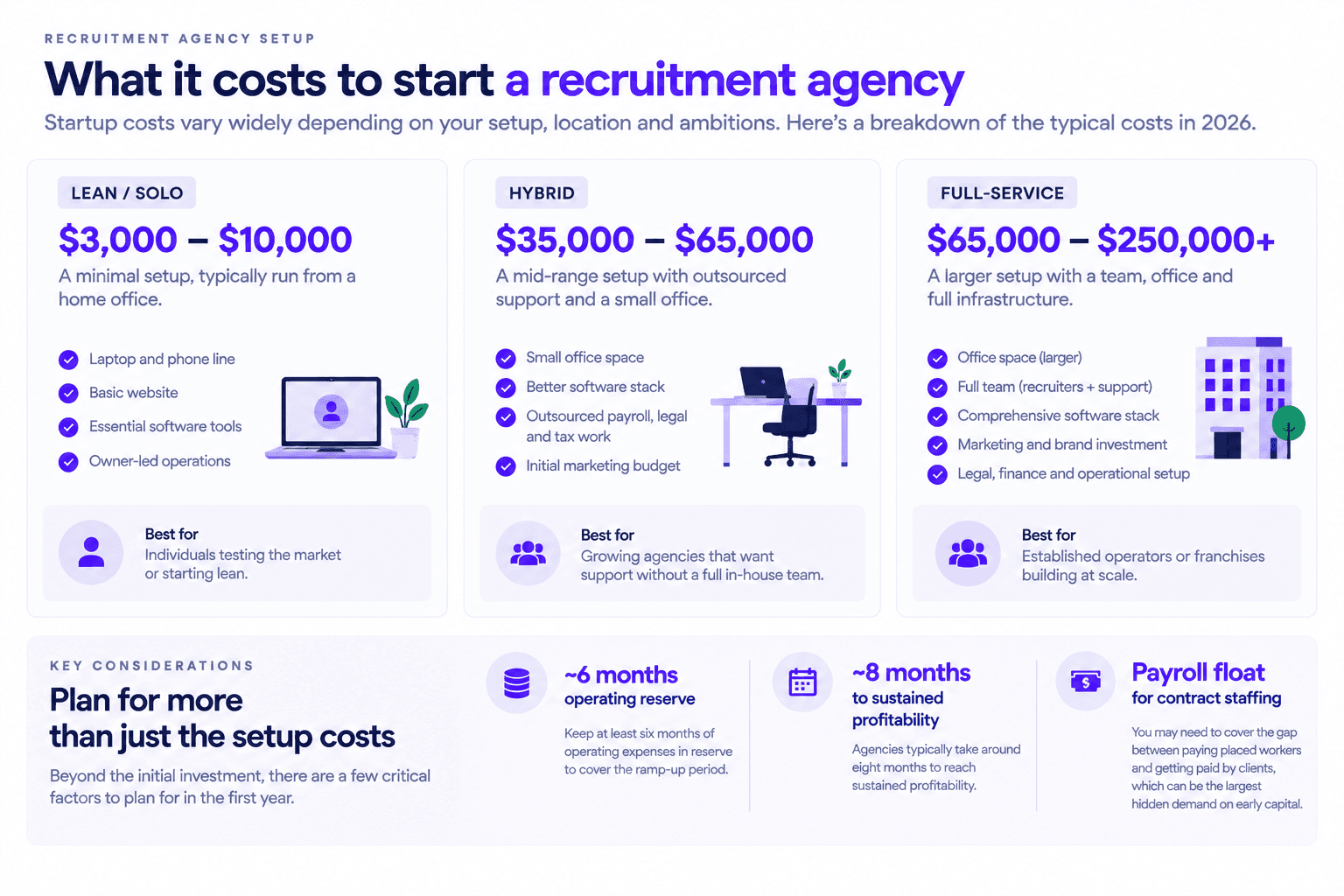
Startup cost depends almost entirely on how you set up. A lean, solo operation run from a home office, where you handle your own back-office and legal work, typically costs between $3,000 and $10,000 and covers little more than a laptop, a phone line, a simple website, and basic tools. A hybrid setup that outsources payroll, legal, and tax work while adding a small office and better software runs $35,000 to $65,000, and a full-service firm or franchise with an office, a team, and a marketing budget starts around $65,000 and climbs past $250,000.
Location moves these numbers as much as anything. Analysis across cities puts the median startup cost at roughly $15,879, ranging from about $4,600 in low-cost cities to $34,751 in expensive ones such as Zurich, driven mostly by differences in salaries and rent. Two planning points matter more than the exact figure. The first is a cash reserve, since agencies typically take around eight months to reach sustained profitability and need roughly six months of operating expenses in reserve to survive the ramp. The second, for anyone running contract or temp staffing, is payroll float, the cash gap between paying placed workers and getting paid by clients, which is often the largest hidden demand on early capital.
The tool stack, and why it keeps rising
The software bill is the cost most agencies underestimate, because it compounds. Even a solo recruiter spends upwards of $1,300 per month per recruiter on tools before a single salary, covering an applicant tracking system, a CRM, job boards, sourcing tools, and outreach software. At scale the number grows faster than headcount, and a realistic tool budget for a 10-person mid-market agency lands between $175,000 and $227,000 a year.
The dominant line is LinkedIn Recruiter, which consumes 55 to 65% of that budget on its own. A 10-seat corporate plan runs around $129,600 in 2026 and rises about 15% a year, so the same seats cost roughly $149,000 in 2027 and $171,000 in 2028, and the LinkedIn line alone can total about $450,000 across three years. Because of that trajectory, the tool stack rewards discipline: auditing subscriptions for actual usage, consolidating overlapping tools, and building your own prospecting and outreach stack rather than paying for every platform. Two areas worth investing in deliberately are a reliable cold email infrastructure for business development and AI sourcing that reduces your dependence on the most expensive seats.

People: your largest cost by far
Salaries are the biggest expense in almost every agency, accounting for 50 to 60% of ongoing costs. A full-time recruiter costs around $80,000 to $120,000 a year in salary, plus another $20,000 to $30,000 in benefits and tools, and a productive recruiter makes roughly 8 to 12 placements a year. That ratio is the core of agency economics, because your fixed people cost is locked in the moment you hire, while the revenue those recruiters generate ramps over months.
The practical implication is to hire behind revenue rather than ahead of it. Adding a senior recruiter before placement volume justifies the salary is the fastest way to burn through a cash reserve, so tying each hire to a revenue milestone, and using contractors for specialized or variable needs first, keeps the largest cost line under control. The alternative to adding headcount, which is raising the output of the recruiters you already have, is where technology has changed the math, and it is covered further down.
The overheads that add up
Around salaries and software sit the recurring overheads. Office rent for a small team runs roughly $3,500 to $6,000 a month, which a remote-first structure can cut substantially. Marketing and business development commonly run around $4,000 a month once an agency is actively growing, a legal or compliance retainer around $2,000 a month, and outsourced payroll and accounting around $1,200 a month. On top of these sit insurance, background check fees that vary with placement volume, and the per-placement costs of closing a hire.
Added together, a small agency of a handful of people often carries a monthly burn in the region of $25,000 to $30,000 before it makes a placement, which is why the reserve and the ramp period matter so much. Every fixed line you can convert to a variable one, by outsourcing back-office work or going remote, lowers the revenue you need just to break even.
The economics: what you actually keep
Headline revenue in recruitment looks generous, and the net is where the reality sits. A $150,000 hire placed at a 20% contingency fee produces $30,000 in revenue, and a C-suite retained search at 30% on $300,000 of compensation produces $90,000. After fully loaded recruiter cost, the tool stack, office overhead, and the time lost to manual work, net margins across agencies range from about 4% to 25%, a spread that reflects how differently agencies of similar size can perform.
What separates the low end from the high end is mostly revenue per recruiter and cost discipline. An agency where recruiters spend much of the week on manual sourcing and admin carries a heavy time tax that never shows up as a line item but crushes the margin, while an agency that keeps recruiters on billable work converts far more of its revenue to profit. On the revenue side, fees themselves have some room, since headline rates are negotiable by a few percentage points in exchange for volume, faster payment terms, or longer guarantee periods, which typically run 60 to 120 days. Knowing your fully loaded cost per placement is what lets you defend a fee rather than discount out of uncertainty, and tracking that alongside revenue per recruiter is part of running the agency on the KPIs that actually matter.
Where the cost base is changing in 2026
The reason margins vary so widely is that the largest hidden cost, the manual time inside sourcing and business development, is now reducible. The agencies improving their economics are using automation to raise output per recruiter rather than adding headcount to grow, which is what actually moves the margin. Automating candidate sourcing and matching means a recruiter produces more shortlists in the same week, so using AI to find better candidates and to match them to roles turns hours of research into minutes and gives that time back to billable work.
The same applies to winning clients. Wasting business development spend on companies that were never going to sign is a silent cost, so qualifying the prospects worth pursuing and reaching the roles where an agency wins through a disciplined cold email system keeps the marketing and BD budget productive. Running that outreach as a system is part of the broader shift in how agencies generate leads with AI, and it is increasingly what lets an agency compete on cost and speed against internal teams that have taken hiring in-house. Lower cost per placement and higher revenue per recruiter are the two levers that decide profitability, and both improve when the manual work shrinks. Ultimately, the cost of running an agency only makes sense against the revenue it supports, which is why winning more clients efficiently sits at the center of the economics.
How much does it cost to start a recruitment agency in 2026?
It depends on the model. A lean solo operation from a home office runs roughly $3,000 to $10,000, a hybrid setup with outsourced back-office support and better tools runs $35,000 to $65,000, and a full-service firm or franchise starts around $65,000 and can exceed $250,000. Across cities the median lands near $16,000, with location driving most of the variation through rent and salaries. Beyond the setup cost, plan for around six months of operating expenses in reserve, since most agencies take about eight months to reach sustained profitability.
What is the biggest cost of running a recruitment agency?
Salaries, by a wide margin, usually accounting for 50 to 60% of ongoing costs. A recruiter costs roughly $80,000 to $120,000 in salary plus $20,000 to $30,000 in benefits and tools, and because that cost is fixed once you hire, scaling headcount too quickly is the fastest way to erode runway. The second largest cost is the tool stack, dominated by LinkedIn Recruiter, which can consume more than half of a software budget that runs into six figures for a mid-sized team.
What profit margin does a recruitment agency make?
Net margins vary widely, from around 4% to 25%, depending mostly on revenue per recruiter and cost discipline. Headline fees look large, with a 20% contingency on a $150,000 hire producing $30,000, but the net shrinks after fully loaded recruiter costs, software, overhead, and the time lost to manual work. Agencies at the high end keep recruiters on billable activity and control their tool spend, while those at the low end lose margin to manual processes and underused subscriptions.
Bringing it together
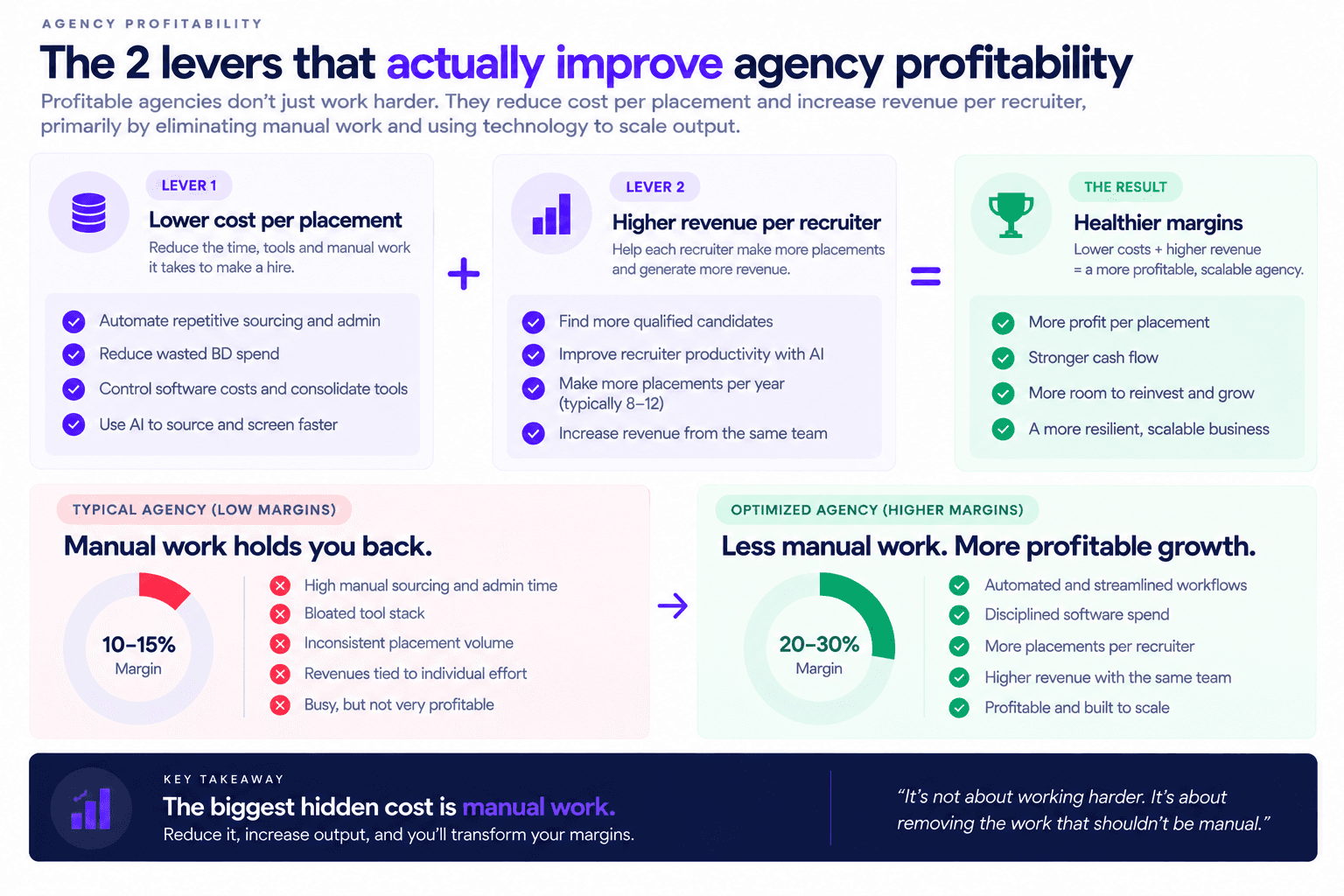
Running a recruitment agency in 2026 means carrying a fixed base of salaries and software before you place anyone, with a small team often burning $25,000 to $30,000 a month and a tool stack that rises around 15% a year. Starting costs range from a few thousand for a solo operation to six figures for a full-service firm, and the margin you keep depends far more on revenue per recruiter and cost discipline than on your headline fees. The clearest path to a healthier margin is reducing the manual time inside sourcing and business development, since that is the hidden cost that separates a 4% agency from a 25% one.
If you want help lowering your cost per placement and raising revenue per recruiter with AI-driven sourcing and outreach, book a call with the Novoslo team and we will show you exactly how it works.