Article
Sep 1, 2026
How Recruitment Agencies Can Find New Job Opportunities Before Their Competitors
Learn how recruitment agencies spot hiring opportunities before rivals using intent signals, job monitoring, and fast decision-maker outreach.

The moment a role goes public on a job board, a queue of recruiters starts contacting the hiring manager the same day. Every one of them opens with a version of the same message, and the person on the receiving end has learned to ignore all of it. The agencies that win consistently in this market are not sending a better version of that message. They are seeing the opportunity earlier, often before the role is advertised at all, and reaching the decision maker while the field is still empty.
That head start is where the real advantage sits. With client acquisition now the top challenge for a growing share of staffing firms, the ability to find new job opportunities before your competitors do is one of the few edges that still compounds. This guide covers how to do it in practice: how to spot hiring intent before a role is posted, how to catch fresh roles the moment they appear, and how to reach the person who owns the requisition first. We will walk through it the way we would explain it to another agency owner.
Why getting there first is worth so much
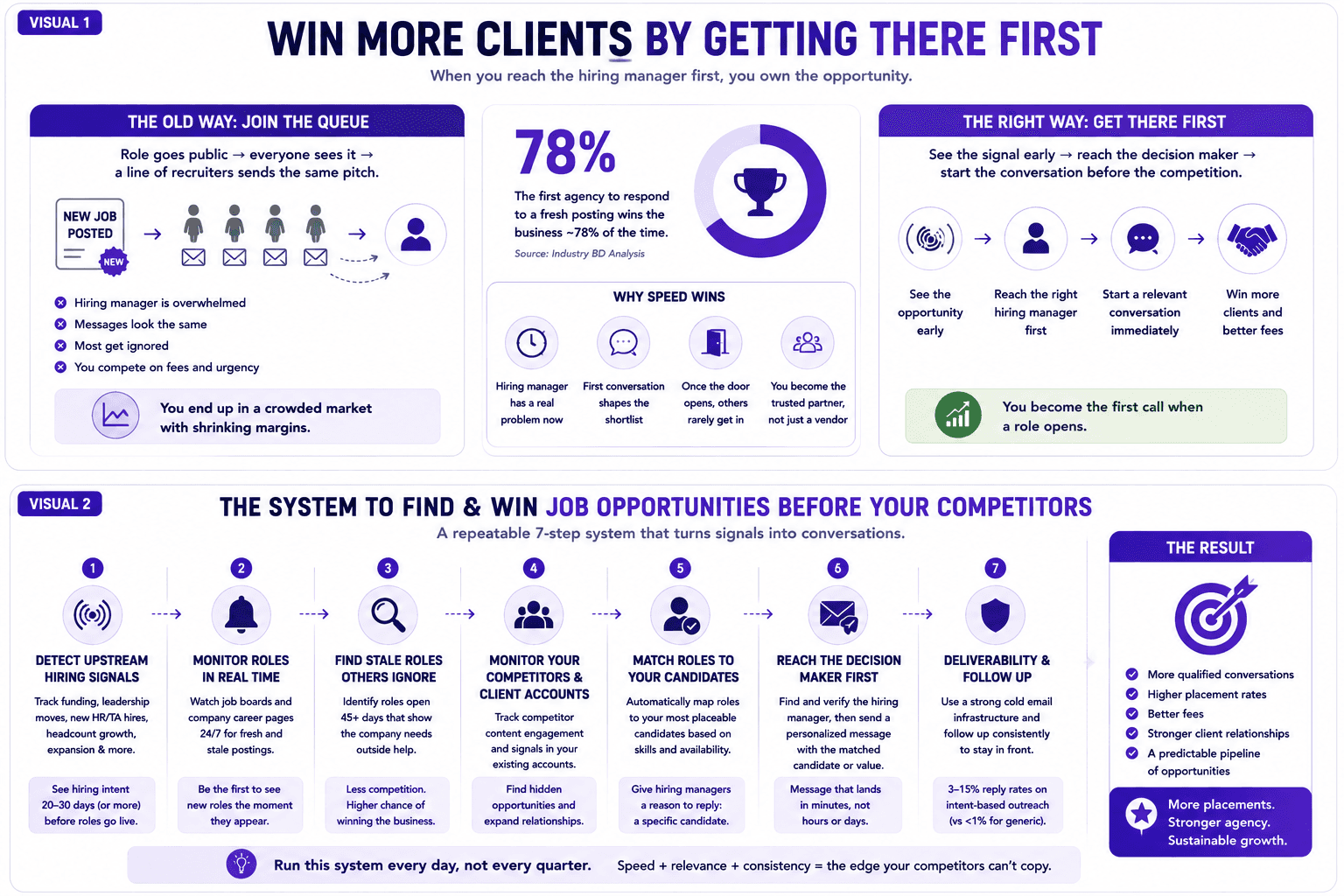
Speed is not a soft advantage in recruitment. Industry BD analysis suggests that the first agency to respond to a fresh posting wins the business roughly 78% of the time. The reason is straightforward. A hiring manager with a live role and mounting pressure will engage with the recruiter who reaches them early with something relevant, and once that conversation starts, the remaining agencies are competing for a door that is already closing.
The same dynamic explains why so much BD effort produces so little return. When ten recruiters contact the same manager on the same afternoon with near identical pitches, those messages cancel each other out and the manager tunes out the whole category. Getting there first is what lets you identify opportunities before competitors rather than joining the back of the line, and it changes a message from one pitch among many into a timely note that arrived before the noise.
Why waiting for the job board puts you behind
The obvious place to look for new roles is also the most crowded and the least reliable. By the time a vacancy appears on LinkedIn, every agency running a saved search for that title sees it in the same window you do, so a public posting is effectively a starting gun fired for the whole field at once.
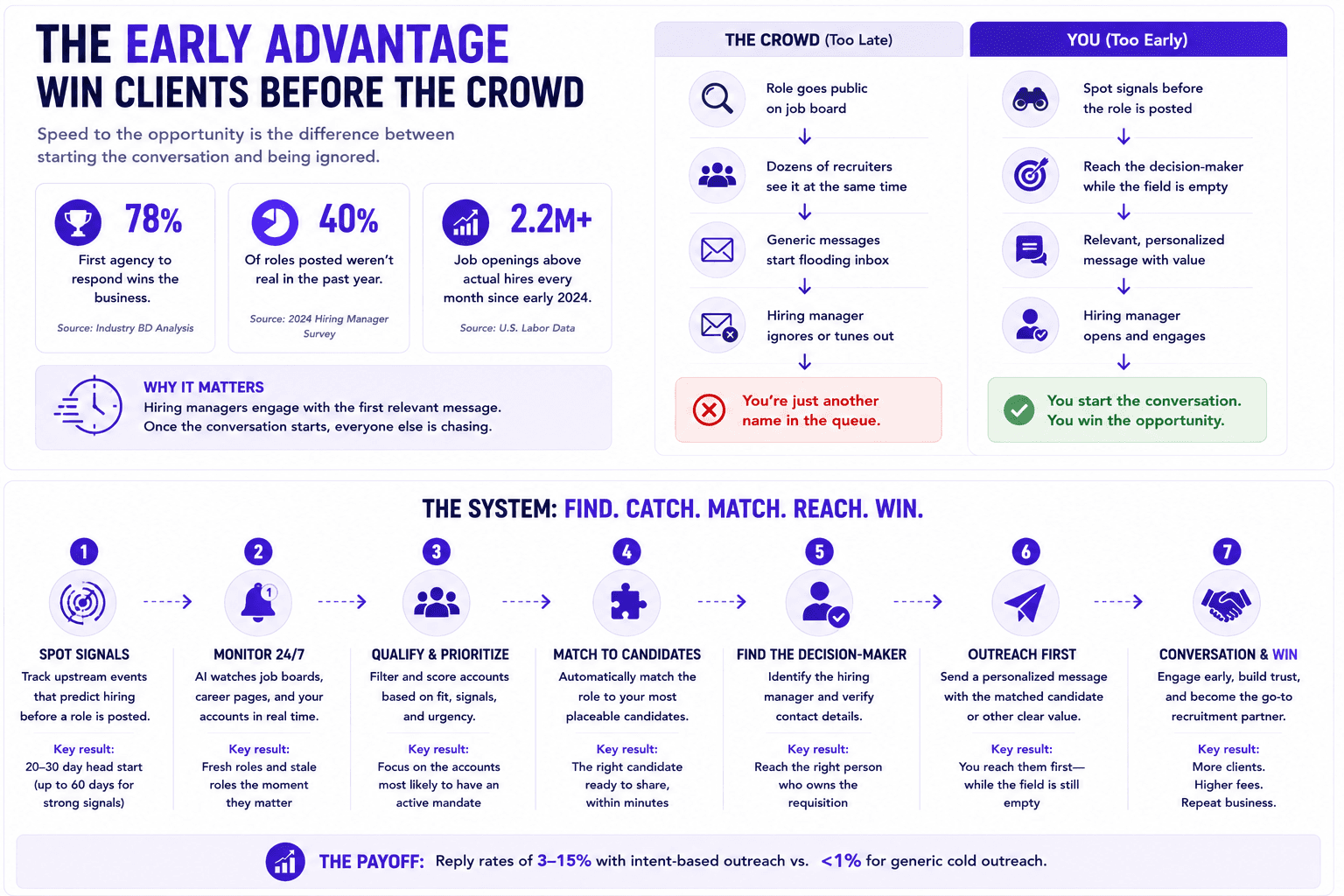
Raw job posting data has also become a weaker proxy for genuine intent. A 2024 survey of hiring managers found that 40% said their company had posted a role that was not real in the previous year, and US labour data shows job openings running more than 2.2 million above actual hires each month since early 2024. Acting on individual postings in isolation means chasing a mix of stale listings, evergreen ads, and roles that were already filled internally. The more dependable approach is to read the events that cause hiring before the vacancy itself shows up.

Spot the opportunity before the role is posted
Hiring rarely happens without warning. Before a company advertises a role, a chain of visible events usually sets it in motion: a funding round closes, a new leader joins with a mandate to build a team, headcount in a department starts climbing, or the business expands into a new market. These are the upstream indicators that predict a hiring need, and reading them gives you a window that the job board never will.
The size of that window is meaningful. Well combined hiring intent signals typically point to a company entering a hiring cycle 20 to 30 days before any role is advertised, and stronger signals such as later stage funding can indicate a wave up to 60 days out. Watching for these events is where buying signals and intent data move from marketing theory into a recruitment BD advantage, and it is the same discipline revenue teams already use to generate pipeline ahead of demand.
The strongest signals to track
Not every signal carries the same weight. Funding rounds and senior leadership appointments consistently show the highest correlation with a near term hiring mandate, because both involve budget decisions that are already in motion. A Series B announcement generally precedes a hiring wave by three to six weeks, and a new VP of Sales joining a scale up almost always triggers commercial headcount growth within about 30 days. New executives in particular are worth watching closely, since research suggests they are roughly three times more likely to make buying decisions in their first 90 days. A newly hired HR or talent acquisition lead is another reliable marker that a company is preparing to grow. The confidence rises sharply when two or more of these signals point at the same company in the same period.
Timing matters as much as the signal
Reading the signal is only half of it, because acting at the wrong moment puts you right back in the crowd. The common mistake is reaching out the day funding news breaks, which lands you in the same pile as every agency that set a Crunchbase alert. A company that just closed a Series B is not hiring tomorrow, since the money has to be allocated, the board has to approve headcount plans, and leadership has to align on priorities first. In practice the real hiring wave tends to start eight to twelve weeks after a funding announcement, so the agency that logs the signal and reaches out with context a few weeks later arrives exactly when the need has become concrete. Engaging leads at the right moment with data behind the decision is what one enterprise sales team credited with roughly doubling its efficiency, and the same timing logic applies directly to recruitment BD.
Catch fresh roles the moment they appear
Upstream signals cover the roles you can predict, and a monitoring layer covers the ones that surface without much warning. For these, the game is pure speed: watch the job boards and company career pages continuously, identify the roles that match your niche as soon as they post, and move before the field has assembled. Setting this up as AI driven sourcing and monitoring means the system watches for relevant roles around the clock instead of relying on a recruiter to refresh a search a few times a day.
Work the roles that have sat open for weeks
A fresh posting is one kind of opportunity, and a stale one is another that most agencies overlook. A role that has been open for 45 or more days is a company that has proven it cannot fill the position on its own, which changes the conversation entirely. Instead of asking whether they need help, you can reach out acknowledging that the search has been running for a while and offer a specific way to solve it. These roles carry far less competition because the recruiters who piled in on day one have already moved on.
Monitor your competitors and the companies they serve
Two quieter sources of opportunity are worth building into the monitoring layer. The first is your competitors and their audiences, since the companies engaging with a rival agency's content are often the same companies weighing whether to bring in outside help. The second is any signal that a client's internal hiring capacity is about to be stretched, such as a new HR or TA leader arriving, which tends to precede a broader hiring push. Watching your existing accounts for these movements is one of the most efficient ways to expand into more roles with companies that already know your work.
Match roles to your candidates automatically
Finding a role early only converts if your outreach gives the hiring manager a reason to reply, and the strongest reason you can offer is a specific candidate. This is the mapping step. When a relevant role is identified, the system checks it against your pool of most placeable candidates and pairs it with the profiles whose skills fit, so within minutes you have the role and a matched candidate sitting together. Reaching a manager to say you noticed their opening is mildly useful, while reaching them to say you have a candidate with the exact skill set available right now is a message they read to the end. Keeping candidate and contact data clean enough for this to work is where enriching your lead and contact data earns its place, since accurate matching depends on accurate underlying records.
Reach the decision-maker before anyone else
The final step is getting the right message to the right person quickly. The system finds the likely hiring manager at the company, verifies their contact details, and sends a message that leads with the matched candidate or another piece of value, ideally within minutes of the role appearing or the signal firing. The person you want is usually the hiring manager shaping the brief, since they are involved well before the requirement reaches procurement.
None of this works if the message lands in spam, so deliverability is the quiet requirement underneath the whole approach. Proper domain setup, authentication, and warmup are what keep your first mover outreach in front of a human, which is the entire point of a sound cold email infrastructure setup. The payoff for getting the targeting and the plumbing right is substantial: outreach sent to companies showing confirmed hiring intent generates reply rates of 3 to 15%, compared with the sub 1% that generic cold outreach produces.
Run it as a system, not a scramble
The agencies that pull ahead treat all of this as a continuous operation rather than something they switch on when the desk goes quiet. One benchmark of more than 2,100 firms found a revenue gap of around $168,000 per recruiter between the top quartile and everyone else, and that gap came from running BD as an always on motion structured around signals, not from better sourcing or a fancier tool stack. Assembling the pipeline is a matter of connecting the right prospecting tools into a single flow that monitors, maps, and reaches out on repeat, which is the core of a working signal based outbound engine.
Two habits keep the system sharp over time. The first is speed to lead on the replies it generates, because a hiring manager who responds with interest is most valuable in the first few minutes and least valuable a day later. The second is steady testing of your targeting, your signals, and your messaging, since the small improvements compound and are difficult for slower competitors to copy. All of it feeds the same goal as your broader effort to win more clients for your recruitment agency: more qualified hiring conversations, reached earlier, so your recruiters spend their time placing candidates rather than hunting for roles.
How do recruitment agencies find job openings before they are posted?
They track the events that cause hiring rather than waiting for the vacancy. Funding rounds, new leadership appointments, a newly hired HR or TA lead, rising headcount in a department, and expansion into new markets all appear weeks before a role goes live, typically giving a 20 to 30 day head start. Agencies build a monitoring layer that watches for these signals across their target accounts, then prioritize the companies where two or more signals line up at once, since those accounts are most likely to have an active mandate forming.
What are the best hiring signals for recruitment business development?
Funding announcements and senior leadership changes are the most dependable, since both reflect budget decisions already in motion and correlate most strongly with a near term hire. First time role creation in a function, a spike in headcount velocity, and site or market expansion also carry high predictive value. Confidence rises considerably when several signals point at the same company in the same window, and timing then matters as much as the signal itself, since funding driven hiring waves usually build over the following weeks rather than the next day.
How fast do you need to respond to a new job posting?
As fast as you reasonably can, because the advantage decays quickly once a role is public. The first agency to reach the hiring manager with a relevant message wins the business a large majority of the time, so a monitoring setup that flags matching roles within minutes and pairs them with a candidate gives you a real edge over recruiters refreshing a search by hand. Roles that have already been open for weeks are a separate opportunity worth working, since the company has shown it needs outside help and most competitors have stopped paying attention.
Bringing it together
Finding job opportunities before your competitors comes down to three moves done consistently. Read the upstream signals so you can see hiring forming before the role is advertised, monitor job boards and your own accounts so you catch fresh and stale roles the moment they matter, and reach the decision maker first with a specific candidate and outreach that actually lands. Run as a continuous system rather than a quarterly scramble, this is what separates the agencies growing in a tight market from the ones fighting over the same public postings as everyone else.
If you want to see what this looks like built for your desk, we can walk you through a system that monitors for new roles and hiring signals, matches them to your candidates, and reaches the right decision makers before your competitors know the opportunity exists. Book a call with the Novoslo team and we will show you exactly how it works.