Article
Jun 26, 2026
Best Prospecting Tools for B2B Sales Teams
A practical look at the best prospecting tools for B2B sales teams in 2026, organized by the job each one does in your outbound stack.

Most sales teams do not have a prospecting tool problem. They have a stack problem. They own a CRM, a data provider, and an outreach tool, and reps still spend half their week building lists by hand and chasing contacts who left their company six months ago. The tools overlap in some places and leave gaps in others, and nobody can say which one is actually moving pipeline.
The issue is that "prospecting tool" describes at least four different jobs. Finding the right accounts is not the same job as finding verified contacts inside them, which is not the same job as catching a buyer who is already on your website. When you compare a contact database against a website-visitor pixel as if they competed, you end up paying for features you never use and missing the layer you actually needed.
This guide covers eight of the best prospecting tools for B2B sales teams in 2026, organized by the job each one does. Read each tool inside its category, not against the full list, because the right stack is usually two or three tools that cover different jobs rather than one tool that claims to do everything.
How to think about prospecting tools before you buy one
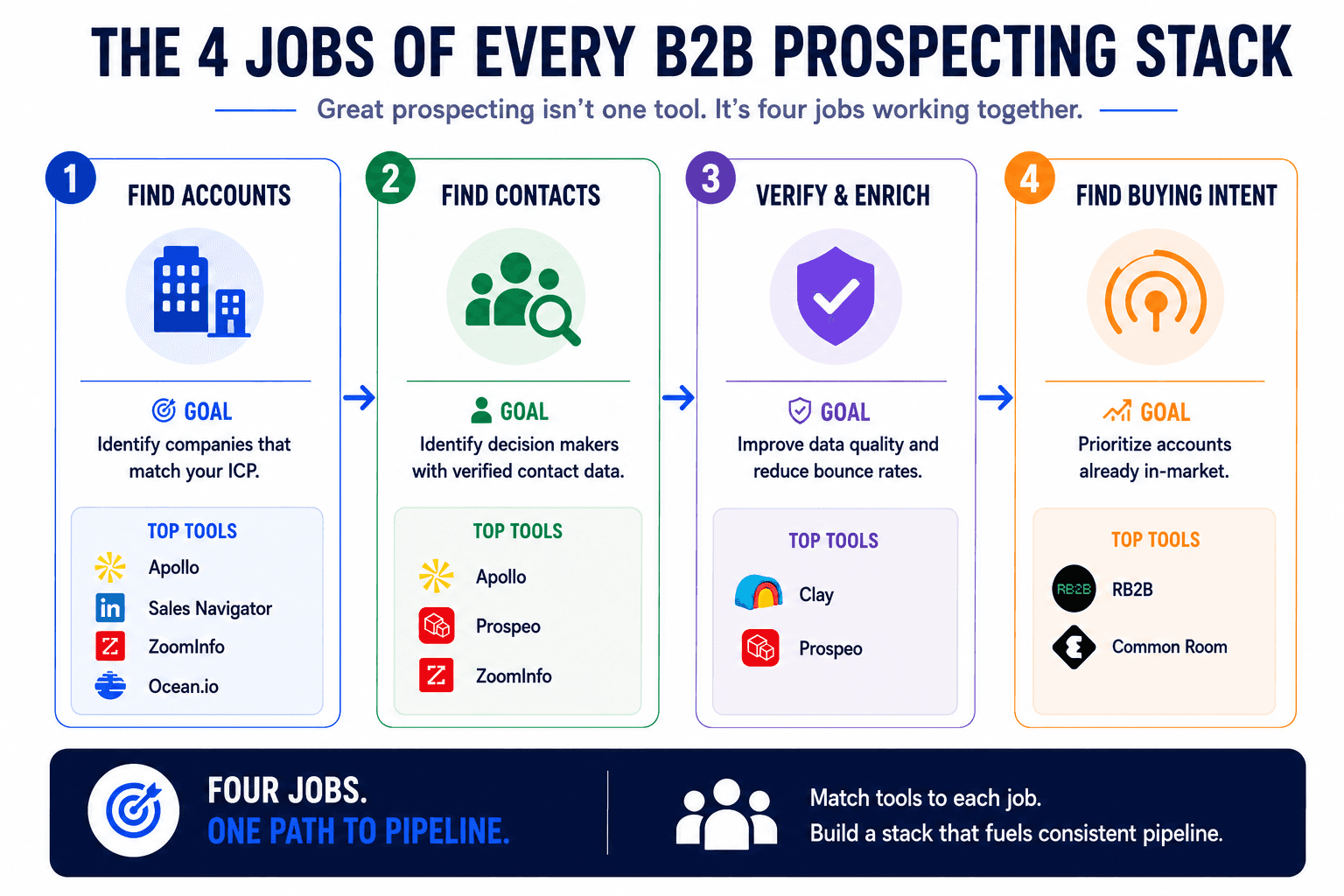
A working outbound stack does four things. It finds accounts that match your ideal customer profile. It finds the right people inside those accounts with current contact details. It enriches and verifies that data so your emails land and your sender reputation survives. And it surfaces intent, meaning it tells you which of those accounts are already in a buying cycle so your timing is not random.
Most teams over-invest in the first job and underinvest in the rest. They buy the biggest database they can afford, then wonder why reply rates stay flat. The reason is usually that a large database with stale records produces more bounces, not more meetings, and bad data makes every other problem in your funnel worse. A clear view of why most cold outreach fails before the first email is sent tends to point back to the same root causes: wrong targets, decayed contact data, and timing that ignores whether the account is even in market.
If you are building from scratch or rebuilding a broken setup, it helps to map your tools to these jobs first and then shop. Our breakdown of the best cold email stack for B2B companies walks through how the layers fit together so you can see where each tool below belongs.
Tools for finding the right accounts and contacts
These platforms are where most teams start. They hold contact and company records, let you filter by firmographics and technographics, and in some cases handle outreach too. The trade-off across all of them is coverage versus accuracy, and the published accuracy numbers rarely survive contact with a real list.
Apollo
Apollo is the default starting point for lean teams because it combines a large contact database with built-in email sequencing, a dialer, and basic CRM in one product, without enterprise pricing. Its database sits around 230 million contacts, and the free plan is usable rather than a lead magnet, which is why so many founders and early SDR teams run their entire outbound motion inside it. Paid plans start near $49 per user per month.
The honest caveat is data accuracy. Apollo relies on a single database, so gaps that one source cannot fill stay unfilled, and independent tests put real-world email accuracy in the 65 to 80 percent range with bounce rates that can climb to 15 to 35 percent depending on the segment. For a small team that values having data and outreach under one roof and can tolerate cleaning the list before sending, that is a reasonable trade. If you are weighing it against a pure enrichment approach, our Apollo vs Clay comparison covers where each one earns its place. Apollo also ships an MCP server, which matters if you are wiring data into AI workflows, a pattern we cover in the best Claude MCPs for lead generation.
LinkedIn Sales Navigator
Sales Navigator is close to table stakes for B2B prospecting. Its advanced search filters, lead recommendations, and InMail credits make it the primary place reps identify and reach decision-makers, and at roughly $99 to $119 per month for the core tier it is one of the more affordable tools on this list.
The limitation is that its intelligence is LinkedIn-native. You get job changes, headcount signals, and account activity inside LinkedIn, but you will not find earnings-call mentions, funding news, or competitive intel there. Sales Navigator also does not hand you verified work emails, which is why it almost always pairs with an email finder. Most teams use it to build and watch lists, then push those profiles into a tool that resolves contact details.
ZoomInfo
ZoomInfo is the largest B2B database on the market, with a contact pool reported above 500 million records and roughly 100 million company profiles, plus Bombora intent data built into the platform and conversation intelligence through Chorus. For enterprise teams prospecting into large North American accounts, that depth and the cross-signal layer that fuses CRM data with behavioral signals is a real advantage that the lighter tools do not match.
The cost is the obvious filter. ZoomInfo quotes custom pricing, and most deployments land well above $15,000 a year, so it makes sense when the breadth and intent data justify the spend and you have the operations team to use them. If buyer intent is the specific capability you are after, it is worth understanding what intent data actually is before paying enterprise rates for it, because you may be able to assemble the signal you need from cheaper sources.
Ocean.io
Ocean.io does one thing that the broad databases do not. You feed it the URL of a strong customer, and its AI returns a ranked list of companies that resemble it, using a model that reads how companies describe themselves rather than relying on blunt SIC and NAICS codes. For teams with a defined ICP who want to expand into more accounts that look like their wins, that lookalike approach is genuinely differentiated, and it is GDPR-friendly for European targeting. Clay even uses Ocean.io's lookalike API under the hood.
Its database is smaller, around 35 million company profiles, so it is built for ICP expansion and total-addressable-market mapping rather than deep contact coverage across every region. It also does not flag whether a company is a parent or a subsidiary, which means some manual research on complex org structures. Think of it as a targeting engine that tells you which doors to knock on, paired with a contact tool that finds the people behind them.
Tools for enriching and verifying your data
Finding a record is only half the job. The email has to be deliverable, and the firmographic data has to be current, or you are burning sender reputation and rep time. These two tools sit on top of your data sources and clean what comes through.
Clay
Clay is not a database. It is the orchestration layer that sits on top of many databases. You build waterfall workflows that query providers in sequence, so when provider A cannot find an email, Clay tries B, then C, then D, and merges the best result into one record. In practitioner tests this approach produces bounce rates around 10 to 14 percent, which is meaningfully better than any single source, and it gives RevOps teams full control over which providers run and in what order.
Clay overhauled its pricing on March 11, 2026. The new model uses two currencies, data credits for buying data and actions for orchestration, with the Launch plan at $185 a month and Growth at $495. The important change is that failed lookups no longer cost credits, so you only pay when data is found. The trade-off is the learning curve. Clay rewards people who understand data operations and workflow design, which is part of why the GTM engineer role exists in the first place. If you would rather automate enrichment without building waterfalls by hand, our guide to enriching a lead list with Claude Code shows a lighter path to the same outcome.
Prospeo
Prospeo is a focused LinkedIn email finder and verifier. You point it at a profile or a Sales Navigator list, and it returns verified emails and, at higher credit cost, mobile numbers, with exports of up to 2,500 contacts per list and around 45 data points per record. Plans start near $39 to $49 a month for 1,000 credits, with a free tier of 75 credits to test it.
What makes Prospeo worth a place here is its verification approach. It runs a conservative, multi-step check and prefers false negatives over false positives, so it flags risky and catch-all addresses aggressively. In testing it finds fewer total emails than some rivals, roughly 68 percent on a typical list, but a higher share of what it returns is actually deliverable, which protects your sender reputation. It is single-source, so it can miss contacts a waterfall would catch, and bulk imports consume credits per row whether or not an email is found. It connects cleanly to Clay, so many teams use Prospeo as one provider inside a larger enrichment flow. If deliverability is your concern, it is worth pairing this with a dedicated look at the best email verification tools for cold email.
Tools for catching buyers who are already showing intent
The hardest part of timing is that most buyers research silently before they ever talk to sales. A March 2026 Gartner survey found that 67 percent of B2B buyers now prefer a rep-free buying experience, which means they form vendor preferences before you know they exist. These two tools try to make that invisible activity visible. If the concept is new to you, start with what buying signals are and how teams act on them.
Common Room
Common Room aggregates signals from across the places buyers actually spend time: Slack and Discord communities, GitHub, LinkedIn, social channels, and your own website through de-anonymization. It resolves those scattered touches into unified person profiles and pushes the high-intent names to the top, so a prospect asking about your category in an industry Slack or starring a competitor's repo becomes a prioritized account rather than noise. For community-led and product-led motions with a lot of off-site activity worth tracking, that breadth is its genuine edge.
The cost is the filter again. The entry tier starts around $2,100 a month billed annually, and there is no self-serve free plan, so it suits teams that already have meaningful signal volume to act on. For traditional B2B segments where your buyers are not active in public communities, much of what Common Room listens for simply is not there, and a website-focused tool may return more usable pipeline.
RB2B
RB2B identifies individual website visitors, not just the companies they work for, by matching US-based traffic to LinkedIn profiles and pushing real-time Slack alerts. When a prospect hits your pricing page, a rep gets their name, title, company, LinkedIn URL, and the pages they viewed, which is useful intel for same-day outreach. Setup takes a few minutes with a pixel, there is a free tier of 150 credits a month at the company level, and paid person-level plans start at $79 a month.
Two limits matter. Coverage is US-only, so international visitors are excluded from person-level matching, and realistic person-level match rates sit in the 5 to 20 percent range, meaning most of your traffic stays anonymous regardless of the tool. The category also carries ongoing privacy and compliance debate that is worth understanding before you deploy a pixel like this. RB2B works best when you already have steady US traffic and a defined workflow for what happens the moment a name appears in Slack.
What is the best prospecting tool for a small B2B team?
For a team of one to five reps on a limited budget, Apollo is usually the most efficient single starting point because it bundles data, sequencing, and a basic CRM at a price that does not require an enterprise contract. Pair its free or low tier with a focused email verifier so your deliverability holds up, and you have a functional outbound stack for very little.
As you grow past a few reps, the economics shift. Per-seat tools get expensive, and credit-based or orchestration tools like Clay or a dedicated finder like Prospeo often deliver better data per dollar. The signal that you have outgrown an all-in-one is simple: reps are spending more time cleaning and researching than sending, which means the data layer, not the outreach layer, is now the bottleneck.
Do I need all of these tools?
No. Most high-performing teams run two or three tools that cover different jobs, not eight that overlap. A common working setup is one source for accounts and contacts, one layer for enrichment and verification, and one signal source for intent. Buying a tool from every category usually creates duplicate data and handoff problems rather than more pipeline.
The practical test before adding anything is whether it does a job your current stack does not. If you already own a strong database, you do not need a second one. If your bounce rate is high, the missing piece is verification, not another contact source. Once the tools are in place, the harder work is the workflow that turns their output into outreach, which is where teams using Claude Code for prospecting close the gap between a signal firing and an email going out.
What matters more, database size or data accuracy?
Accuracy, in almost every case. The math is unforgiving: a tool that matches 90 percent of your list but only verifies 60 percent of those emails gives you fewer usable contacts than a tool with 70 percent coverage and 98 percent validity. On a 10,000-contact campaign, the gap between a 3 percent and a 30 percent bounce rate is the difference between a healthy sender reputation and one that takes weeks to recover.
This is why the biggest database is rarely the right answer on its own. B2B contact data decays at roughly 2 percent a month, so a quarter of any list goes stale within a year regardless of how large the source was. The teams that win treat verified, current data as the priority and treat raw volume as secondary, which is why a verification layer earns its place in almost every stack.
Building the stack, not collecting the tools
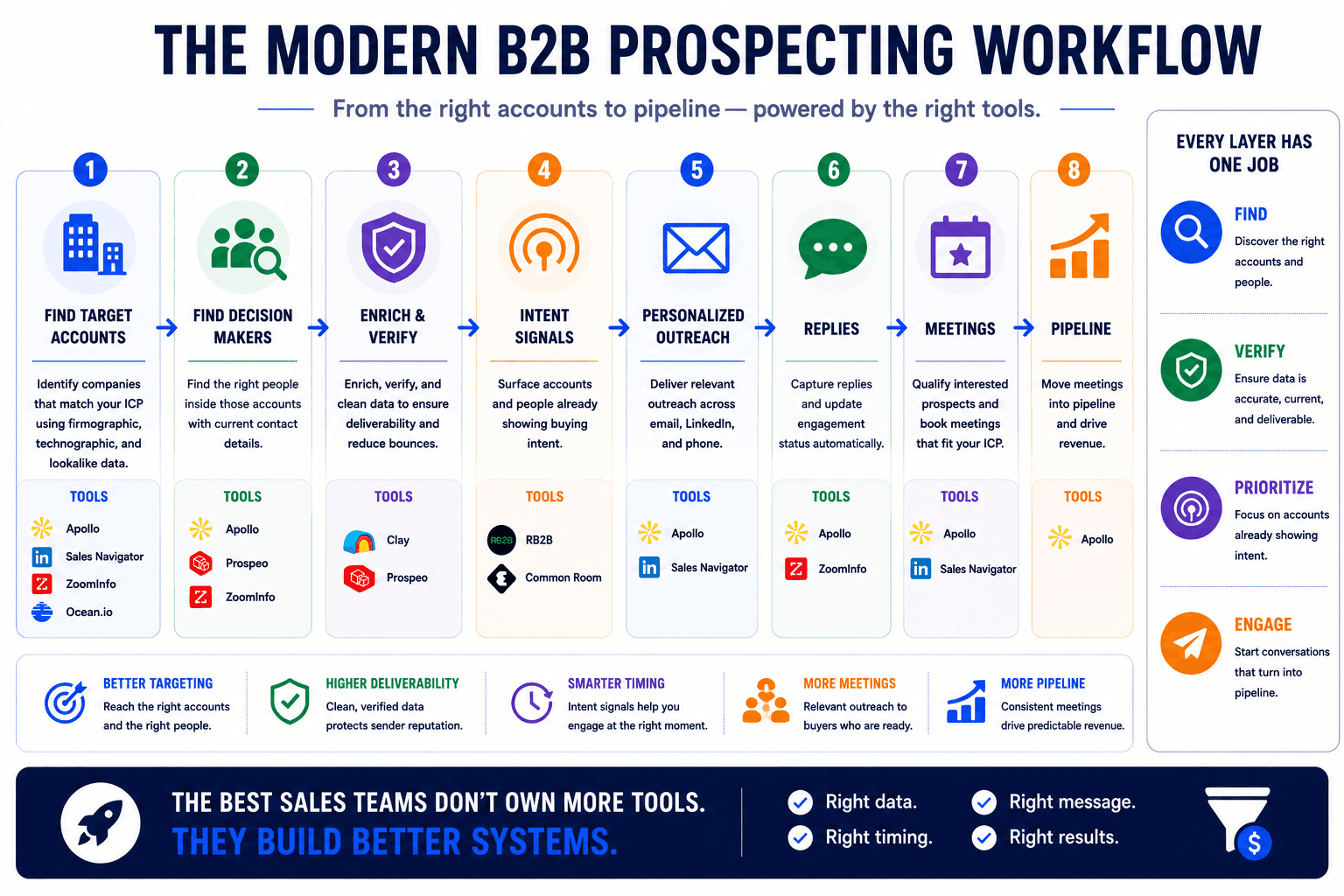
The best prospecting tools for B2B sales teams in 2026 are not ranked on a single leaderboard, because they do different jobs. Apollo, Sales Navigator, ZoomInfo, and Ocean.io help you find the right accounts and people. Clay and Prospeo make that data deliverable. Common Room and RB2B tell you who is already paying attention. The right combination depends on your ICP, your geography, and the tools you already own.
Two takeaways carry most of the value. Match tools to the four jobs rather than buying the longest feature list, and fix the data layer before you scale volume, because accuracy decides whether everything downstream works. Get those right and you stop paying for a stack that keeps reps busy without filling pipeline.

If you want a second set of eyes on which tools your team actually needs and how to wire them into a system that books meetings, book a call with our team and we will map it to your motion.