Article
Sep 11, 2026
How Recruitment Agencies Can Automate Candidate Sourcing and Client Outreach
A practical guide to automating both sides of a recruitment desk from sourcing candidates to winning clients.

Recruiters spend a large share of the week on work that does not move a candidate or a deal forward. Industry research puts the figure at around 14 hours a week lost to admin such as CV reformatting, status updates, scheduling emails, and manual data entry. Automating that layer commonly returns close to 10 of those hours to actual recruiting, and the point of reclaiming them is not a smaller team but more placements and more business development from the recruiters you already have.
A recruitment agency runs two engines that both benefit from automation: sourcing the candidates you place, and winning the clients who give you the job orders. This guide covers a practical, sequenced approach to automating both, along with the parts that should stay human and the order to build things in so you do not simply speed up a broken process.
The principle: automate the repetitive, keep judgment human
Automation earns its keep on high volume, repeatable work, which in recruitment means sourcing, data entry, and follow-up. The parts that actually win placements and clients, meaning judgment, relationships, and negotiation, remain human, and the agencies getting the most from automation use it to free recruiter time for that work rather than to cut recruiters. The gain shows up as capacity, with some agencies reclaiming 5 to 8 hours per recruiter per week, which across a team adds up to the equivalent of one or two extra full-time recruiters without the hiring cost.
Two cautions shape how to approach it. The first is that automating a broken process only makes the mess arrive faster, so the process has to be clean before you automate it. The second is the difference between a simple rule and an agent. A rule executes a fixed instruction, while an agent reads the situation, decides the right action, carries it out, and hands the judgment call back to the recruiter. The second is what makes it possible to automate the reasoning heavy steps in sourcing and outreach rather than only the mechanical ones.
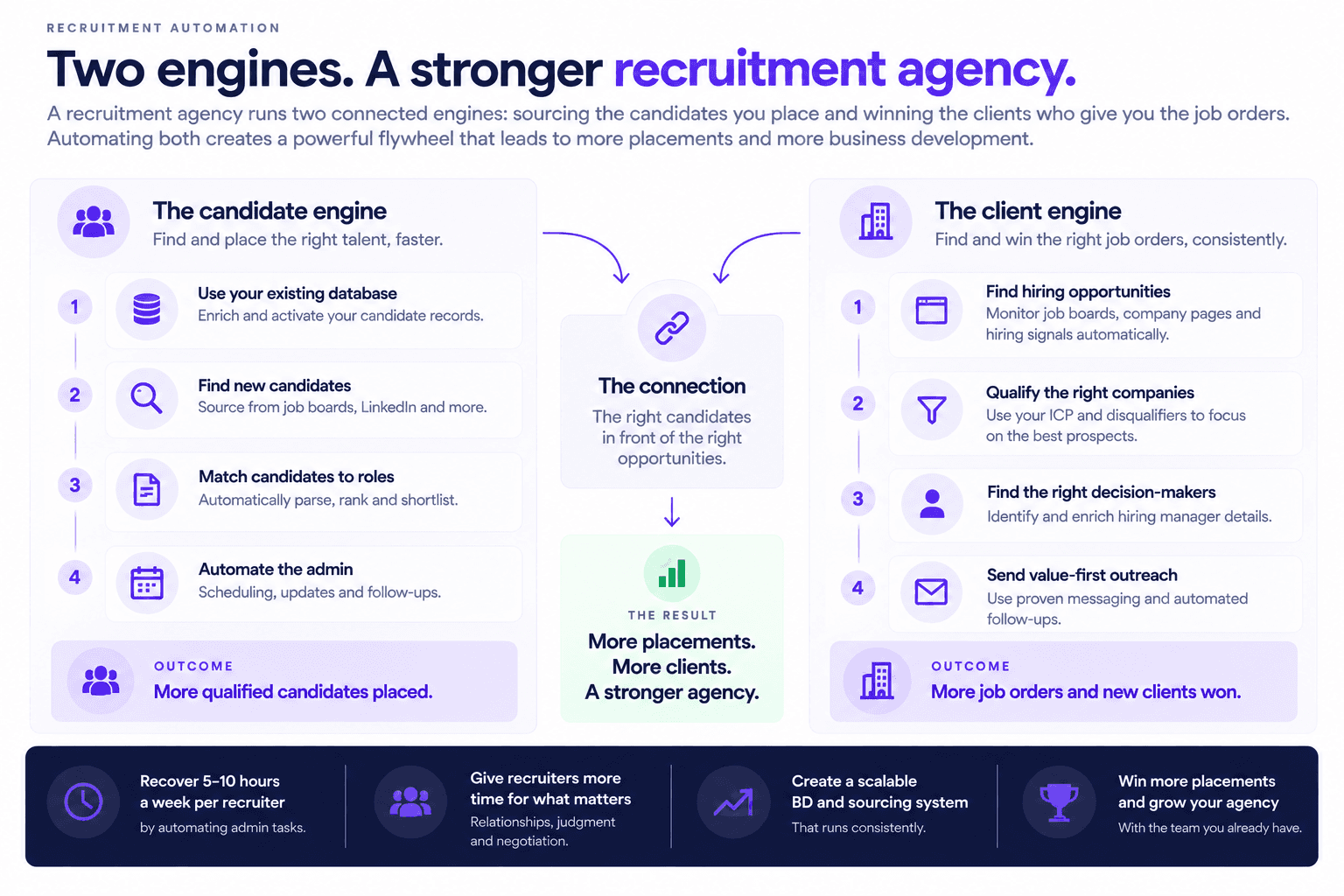
Automating candidate sourcing
Sourcing is the most repetitive part of the desk and the first place most agencies should look, but the order within it matters.
Start with the database you already have
Before spending recruiter hours finding new people, mine the candidates already in your records, since most placements come from people you have already spoken to. This is where automation pays back fastest, because a clean, searchable database turns a pool that usually goes stale into an active source of matches. The prerequisite is clean data, so enriching and tidying your existing records is the groundwork that makes everything downstream sharper. Automated outreach and matching built on a current database are powerful, while the same tools built on a messy one just scale the disorder.

Automate finding and matching new candidates
When the existing pool does not cover a role, the search for new candidates is the next step to automate. Parsing CVs by hand and reading each one against a brief is slow and repeatable, which makes it a strong fit for automation that can read a candidate the way a recruiter does and rank the field against the requirement. Running your pool and new applicants against an open role with a tool such as candidate matching produces a shortlist with reasoning in minutes, so the recruiter reviews the top few rather than the whole stack. A boutique agency that paired sourcing automation with a structured outreach sequence cut its sourcing time by around 60% and filled niche roles faster as a result.
Automate the admin around candidates
The tasks surrounding a candidate are pure overhead and among the easiest wins. Interview scheduling handled automatically across calendars and time zones saves 5 to 10 hours a week per recruiter, and automated status updates and follow-up sequences remove the constant small messages that fragment a recruiter's day. None of this touches the judgment about who to put forward, which is exactly the point, since clearing the admin is what gives recruiters the time to make those calls well.
Automating client outreach
The BD side of the desk follows the same logic, and it is where agencies most often leave money on the table because outreach gets done in bursts rather than as a system.
Find the opportunities automatically
The front of client outreach is knowing which companies to approach, and this can run without a recruiter refreshing a search. A system that monitors job boards, company pages, and hiring signals surfaces new roles and openings as they appear, so you reach a company while its need is live rather than weeks later. Automating this step is what lets an agency watch hundreds of target accounts at once instead of the handful a person can track by hand.
Qualify and find the decision-maker
Not every company that is hiring is worth your time, so the next step to automate is filtering. Scoring each prospect against your criteria for whether a company is worth prospecting removes the accounts that cannot pay or do not need you before any effort goes into them. For the companies that pass, automatically identifying and verifying the hiring manager behind the role means your outreach reaches the person who owns the requisition rather than a generic inbox.
Personalize and sequence the outreach
Outreach is the last thing to automate, because personalization matters most here and it needs a solid foundation underneath it. Once the data is clean and the targeting is sharp, the messages and the follow-up can run at scale, drafting a first touch that leads with a matched candidate and sequencing the follow-up across several touches. The approach that works is to lead with value rather than a meeting request, since a specific candidate or a piece of useful data earns replies that a calendar ask does not. This is the recruitment version of an automated outbound motion, and wiring it together into a signal-based system is what makes it run continuously rather than in fits and starts.
Connect the two engines
Sourcing and outreach are stronger together than apart, and the connection is what makes automation compound for a recruitment agency specifically. When your sourcing engine can produce a matched candidate for an open role, that candidate becomes the strongest possible hook for the outreach engine, because the most compelling first message to a hiring manager is one that names a person who fits their role and is available now. Run in isolation, the two systems each save time, and connected, they feed each other, so a role spotted by the outreach engine triggers a match from the sourcing engine, and the resulting shortlist becomes the reason a hiring manager replies. That loop is a large part of the broader shift in how agencies generate leads with AI.
Sequence your automation rollout
Trying to automate everything at once creates confusion and erodes trust in the systems, so the rollout should follow the same order that makes each step work better. Clean your data first, because sourcing and outreach both depend on it. Automate sourcing from your existing database next, since it pays back fastest. Add the follow-up and scheduling systems after that, so the admin around both candidates and clients is handled. Automate outreach last, once the foundation is solid enough that personalization has good data to draw on.
Two practical points keep the system healthy. Favor connected tools over bolted-on ones, because a stack where sourcing, data capture, scheduling, and outreach talk to each other automatically avoids the fragmentation and broken integrations that come from stitching together separate point tools. And measure the time you reclaim so you actually redeploy it, since the value is not the hours saved on their own but the additional BD and placements those hours make possible. Packaged well, this whole approach can be run as a repeatable system that supports the wider goal of winning more clients.
What should recruitment agencies automate first?
Start with the highest frequency task that eats the most recruiter time, which for most agencies means cleaning the candidate database and then automating sourcing from it, followed by scheduling. These deliver the fastest and clearest return because they are repetitive, high volume, and low risk. Outreach comes later in the sequence, since it depends on clean data and sharp targeting to work well. The general rule is to automate the right tasks in order rather than automating everything at once, because building on a weak foundation just produces a faster version of a process that was not working.
Will automation replace recruiters?
No. Automation is strongest at the repetitive, high volume parts of the job, such as sourcing, data entry, scheduling, and follow-up, while the parts that win placements and clients, meaning judgment, relationships, and negotiation, remain human. The agencies getting real value from automation use it to remove the admin that fills a recruiter's day so they can spend more time on billable work, which increases revenue per recruiter rather than reducing headcount. An agent handles the repeatable work and hands the decision back to a person, which keeps a human on every call that matters.
How much time does recruitment automation actually save?
The consistent pattern across agencies is roughly 5 to 10 hours per recruiter per week returned, depending on how much manual work a firm starts with. Scheduling automation alone accounts for several of those hours, and automating follow-up, data entry, and sourcing adds the rest. Across a team, that reclaimed time can add up to the capacity of one or two additional recruiters without the cost of hiring them, which is why the return is best measured in extra placements and BD rather than in the hours themselves.
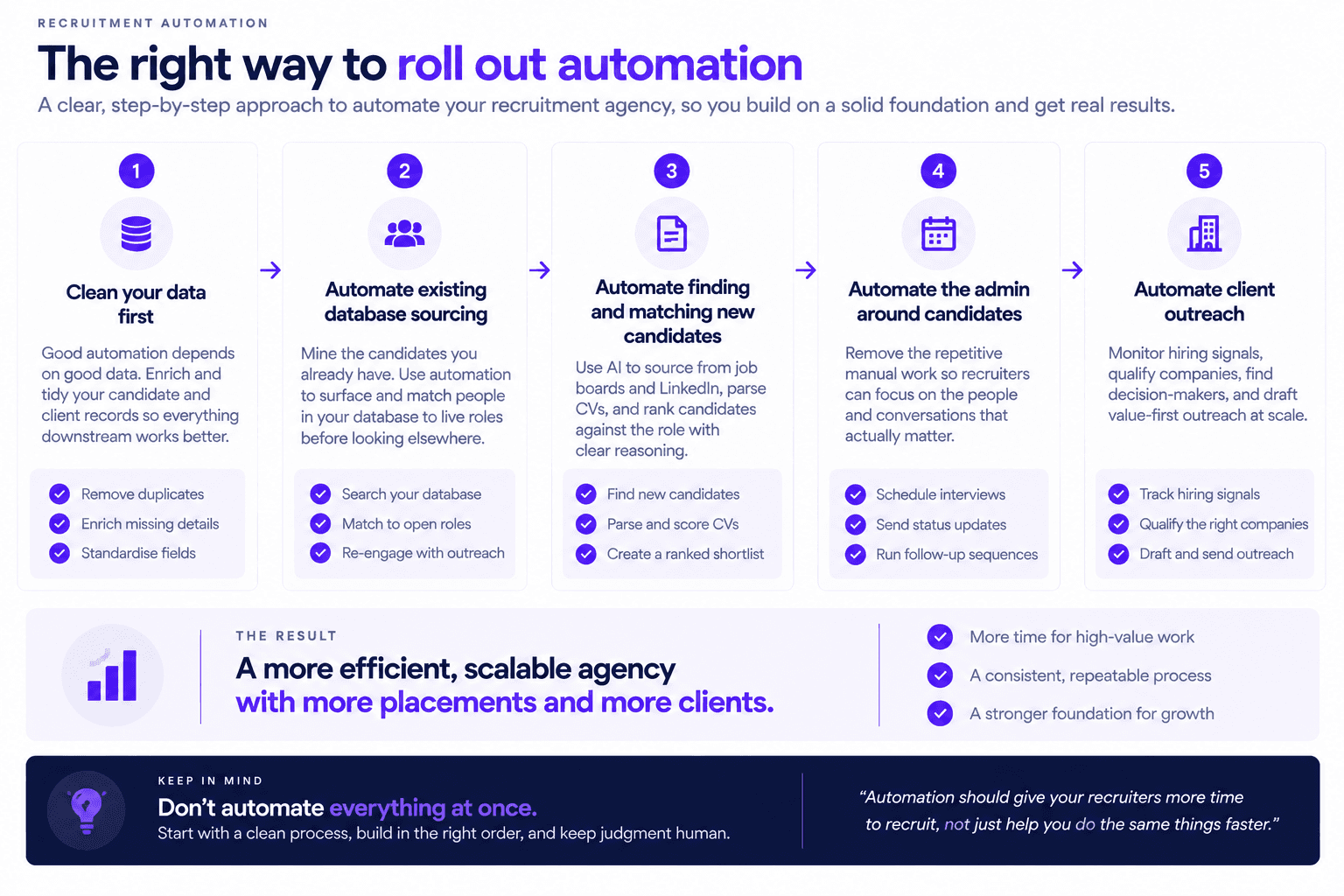
Bringing it together
Automating a recruitment agency comes down to running two engines well and connecting them. On the candidate side, clean your database, automate sourcing and matching, and clear the scheduling and follow-up admin that fragments the day. On the client side, automate finding and qualifying opportunities, reaching the right decision-maker, and sequencing value-first outreach. Build it in the right order so each step strengthens the next, keep a human on the judgment calls, and let the two engines feed each other so a sourced candidate becomes the reason a hiring manager replies. Done this way, automation gives your recruiters their week back and turns it into more placements and more clients.
If you want help building this for your agency, we can design a connected system that sources and matches candidates and runs qualified, value-first client outreach, with your team kept on the decisions that matter. Book a call with the Novoslo team and we will show you exactly how it works.