Article
Jul 17, 2026
How to Find Potential Customers for Your Business (Complete Guide)
A practical guide to finding potential customers: define your ideal buyer, spot buying signals, and build a pipeline that actually repeats.

Most businesses that struggle to grow do not have a shortage of people who could buy from them. They have a targeting problem and a consistency problem. They either chase everyone at once, or they find a few good customers by accident and never work out how to repeat it. Learning how to find potential customers for your business is less about discovering some hidden channel and more about building a process you can run every week without guessing.
This guide walks through that process from start to finish. We cover how to define who your customer actually is, where those people already spend their attention, the main methods for reaching them, and how to turn a list of names into real conversations. The goal is a system you can point at any market and trust to produce a steady flow of prospects, rather than a burst of activity that dries up the moment you get busy with delivery.
Start by Defining Who Your Customer Actually Is
The single biggest reason outreach and marketing underperform is that the message is aimed at a group too broad to mean anything. Before you look for customers, you need a clear picture of who is worth looking for.
Build an ideal customer profile from your best existing accounts
Look at the customers you already have and find the ones you would happily take ten more of. These are usually the accounts that closed quickly, paid without friction, got real results, and referred others. Study what they have in common: company size, industry, the role of the person who signed off, the budget they had available, and the situation they were in when they reached out. That pattern becomes your ideal customer profile. If you are early and do not yet have enough customers to see a pattern, borrow one by looking at who your closest competitors serve and which of those accounts seem happiest.
An ideal customer profile is only useful when it is specific enough to disqualify people. A description like "small businesses that want to grow" fits almost everyone and helps no one. Something like "accounting firms with 15 to 50 staff that have outgrown their spreadsheets" tells you exactly who to add to a list and who to skip. Our guide on B2B lead generation strategies goes deeper on turning a profile into an actual target account list.
Get specific about the problem you solve and when it shows up
People buy when a problem becomes urgent enough to act on, so knowing the problem you solve is not enough on its own. You also need to know the moment it tends to surface, because that timing is what separates a warm prospect from someone who files your email away for later. A payroll product matters most right after a company crosses a headcount threshold. A compliance service matters most after an audit or a new regulation. When you understand the trigger, you can look for the trigger instead of contacting your whole market and hoping a few people happen to be ready.
Figure Out Where Your Potential Customers Already Are
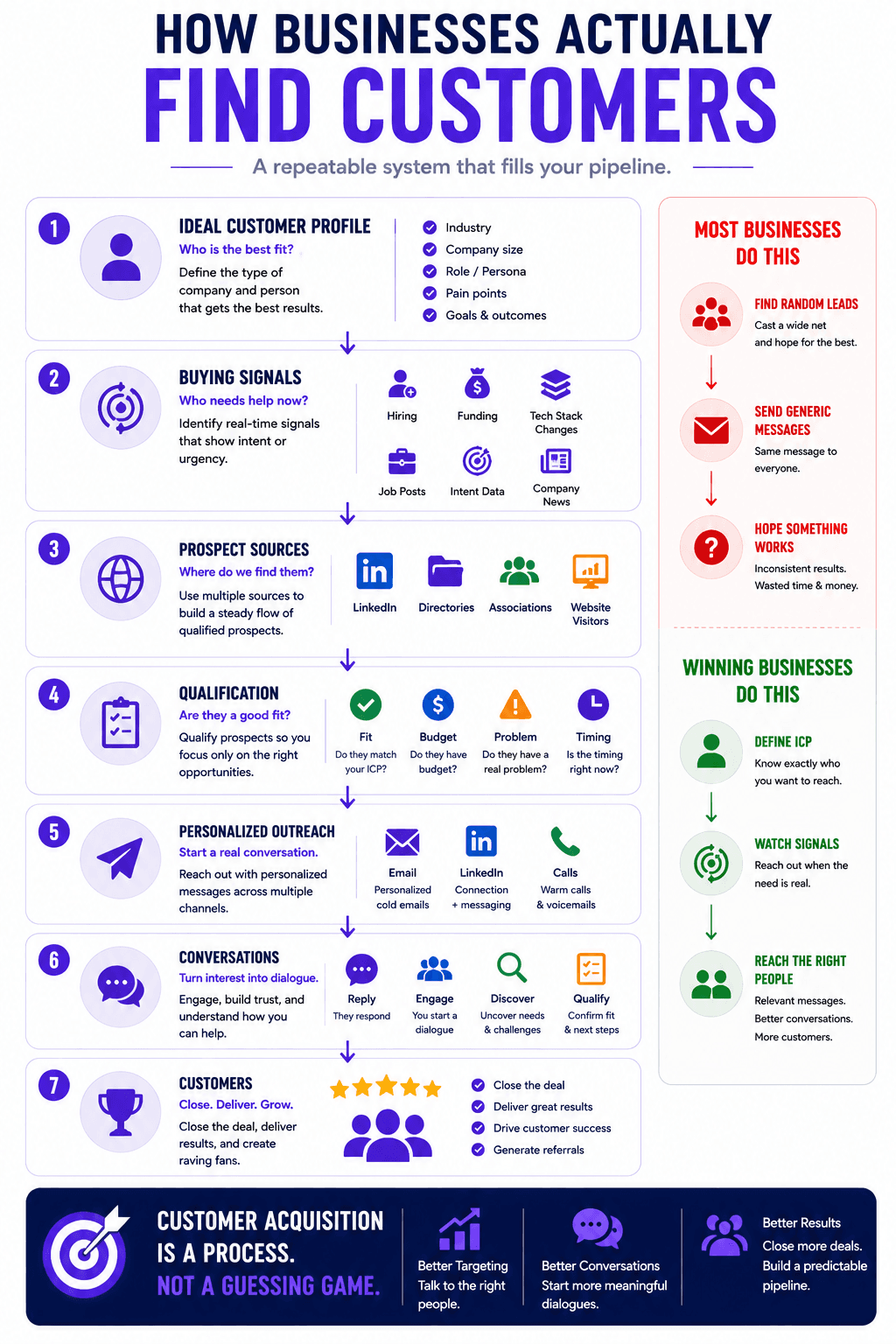
Once you know who you are looking for, the next question is where they already spend their time and leave evidence of what they need.
Follow the signals, not just the demographics
Demographics tell you who might be a fit, while signals tell you who is likely a fit at this moment. A signal is any observable event that suggests a company is moving toward the problem you solve, such as a new hire in a relevant role, fresh funding, a tool they just adopted, a job posting, expansion into a new market, or a public complaint about something you fix. These are called buying signals, and they let you reach people while the problem is still fresh rather than months later. Intent data works the same way at scale, tracking the research behavior that shows a company is actively looking for a solution like yours. Teams that build their prospecting around signals consistently reach better conversations, which we cover in detail in how revenue teams use buying signals to generate pipeline.
Map the channels that fit your buyer, not the trendy ones
Every channel works for someone and wastes money for someone else, so the channel you pick should follow the buyer rather than the other way around. A founder selling to other founders can often reach them directly on LinkedIn or through warm introductions. A company selling to operations leaders at midsized firms will usually get further with targeted cold email and search content than with short form video. Pick the two or three places your ideal customer actually pays attention and go deep there before adding more, because spreading thin across six channels is the quickest way to look busy while producing very little. This is also how strong teams find opportunities before their competitors, by watching the right places closely rather than watching everything loosely.
The Main Ways to Find Potential Customers
There are only a handful of reliable methods for finding potential customers, and most businesses do best with a combination of two or three rather than betting everything on one. The stakes for choosing well have gone up, since the US Chamber of Commerce reports that customer acquisition costs have risen roughly 60 percent over five years.
Inbound
Inbound covers the customers who come to you because they found something useful, including content and SEO, referrals from happy customers, and reviews. It builds slowly and then pays off for a long time. Reviews carry real weight here, since research shows that 93 percent of buyers check reviews before making a decision, so a steady stream of them quietly shortens every future sale. The tradeoff is speed, because inbound rarely delivers customers in your first few weeks and works best as a long term layer underneath faster methods.
Outbound
Outbound is how you find customers on demand instead of waiting for them. You build a list of companies that match your ideal customer profile and reach out directly, usually through cold email or a mix of email and LinkedIn. Done carelessly it becomes spam, but with a tight list and a relevant message it is the most predictable way to start conversations with people who have never heard of you. If you want to go deeper, we have full guides on building a cold email system and the best prospecting tools for sourcing accounts.
Paid and partnerships
Paid ads buy attention quickly and stop the moment you stop paying, which makes them useful for testing offers and filling gaps rather than as a foundation. Partnerships, where another business that serves your customer sends people your way, take longer to set up but tend to produce warmer prospects than any ad. Both are worth adding once your core method is working, not before.
Build a List of Real Prospects
Finding potential customers eventually comes down to a concrete list of companies and people you can contact, and the quality of that list decides most of your results before you send a single message.
Where to source and how to qualify
You can build a prospect list from professional databases, industry directories, association memberships, event attendee lists, and your own website visitors. Tools make this faster, and our comparison of Apollo vs Clay covers two of the common options for pulling and enriching lists. Whatever the source, qualify each account against your ideal customer profile before it goes on the list. A shorter list of accounts that genuinely fit will outperform a longer list padded with names that were easy to grab.
Verify before you reach out
A list is only as good as the contact information behind it. Sending to outdated or wrong addresses damages your ability to reach anyone, because email providers begin treating you as a low quality sender. Running your list through email verification tools before you send protects your deliverability and keeps your real prospects reachable.
Turn Prospects Into Conversations
A list of perfect prospects does nothing until you contact them in a way that earns a reply.
Personalize the first touch
The first message decides whether someone reads the second one. Generic outreach that could have been sent to a thousand companies gets ignored, while a message that shows you understand the specific company and its situation gets read. You do not need to write a great deal, since a single relevant line that references something real about their business is usually enough to signal that a person rather than a machine is on the other end. Our guide on writing personalized first lines breaks down how to do this at scale without spending an hour per prospect.
Follow up without being annoying
Most replies come after the first message, so a single attempt leaves the majority of your pipeline on the table. A good follow up adds something, whether that is a new angle, a relevant example, or a shorter version of your offer, rather than simply asking again whether they saw your last email. Space your follow ups a few days apart and stop after a reasonable number. Outreach often underperforms because people either give up after one try or keep pushing long past the point of welcome, both of which we cover in why most cold outreach fails before it has a chance to work.
Make It a System, Not a Scramble
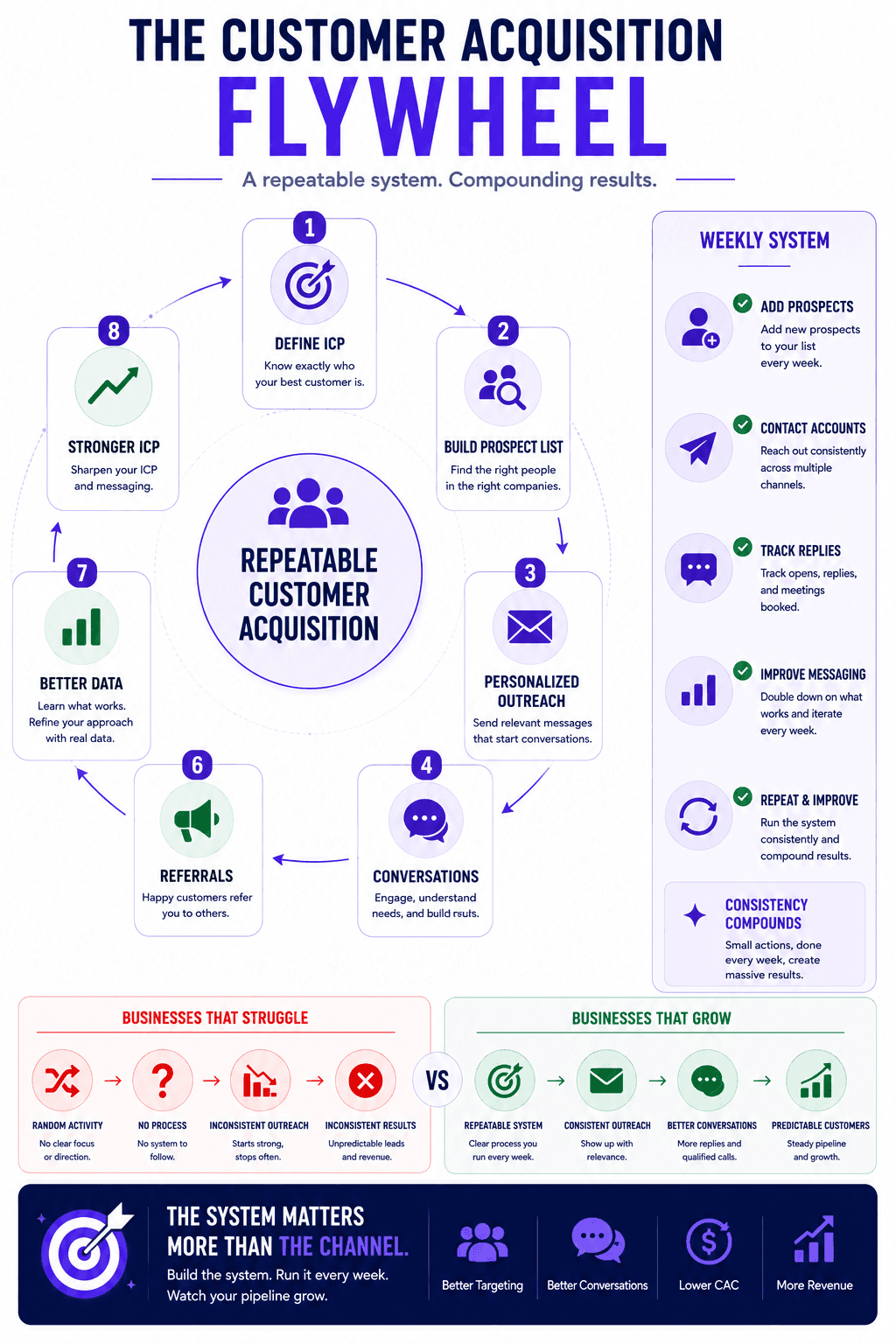
The businesses that always seem to have customers are rarely doing anything exotic. They have turned finding potential customers into a routine that runs whether or not they feel like it that week. That routine usually looks like a fixed number of new prospects added to the list, a fixed number of accounts contacted, and a simple record of what happened. Tracking which industries reply, which messages land, and which sources produce the best customers lets you cut what does not work and put more into what does. If you want to move faster, AI now handles much of the sourcing and personalization work, which we cover in how to generate B2B leads with AI. The system matters more than any single tactic, because a mediocre method run consistently produces more customers than a brilliant one you use twice and abandon.
What is the fastest way to find potential customers?
Outbound is almost always the fastest, because you control when it happens. You build a list of companies that fit your ideal customer profile and contact them directly rather than waiting for them to discover you. Inbound methods like content and referrals produce better long term results but take months to build momentum, so most businesses that need customers soon start with targeted outreach and layer inbound underneath it over time.
How do I find B2B customers specifically?
Finding B2B customers comes down to identifying the right companies, the right person inside each company, and the right moment to reach them. Start with a clear ideal customer profile, use signal based prospecting to find accounts that show they are ready to buy, and reach the decision maker with a relevant, personalized message. Because B2B deals involve fewer buyers and larger contracts than consumer sales, precision matters far more than volume. Our B2B lead generation strategies guide covers the full approach.
How many prospects should I be reaching out to at once?
There is no single number, but the right amount is however many you can contact with a genuinely relevant message and still follow up on properly. For most small teams that lands somewhere between a few dozen and a few hundred new prospects a week. Going higher only helps if your list quality and personalization hold up, since a large volume of generic outreach produces worse results and more deliverability damage than a smaller, sharper effort.
Bringing It Together
Finding potential customers for your business becomes far more manageable once you stop treating it as a search for a magic channel and start treating it as a process. Define who your customer actually is with enough specificity to disqualify the wrong people, look for the signals that show who is ready now, and pick the two or three methods that fit your buyer. From there it is a matter of building a clean list, reaching out with something relevant, following up with intent, and keeping the whole thing running week after week. Businesses that grow steadily are usually the ones that made this repeatable rather than the ones that got lucky once.

If you would rather have this system built and run for you than assemble it yourself, book a call with our team and we will map out what finding your next set of customers would look like.