Article
Aug 25, 2026
Outbound Lead Scoring: How to Prioritize the Prospects Most Likely to Buy
Outbound lead scoring ranks cold prospects by fit and buying signals so your team works the accounts most likely to buy first. A practical 2026 guide.

Most outbound teams run the same workflow without ever calling it a workflow. A rep pulls a list, skims job titles, makes a few gut calls on who looks close enough to the ideal customer, and starts emailing. It feels productive because emails go out and the sequence fills up. The problem is that this creates activity, not pipeline. Every prospect on that list got the same treatment, which means the accounts most likely to buy got no more attention than the ones that were never going to reply.
Outbound lead scoring is how you fix that. It gives your team a repeatable way to decide who to reach first, who goes into a lighter sequence, and who should stay out of the workflow until something changes. This guide covers what outbound lead scoring actually is, why it matters more in outbound than anywhere else, the two things a good score measures, and how to build a model you can launch this week. Most of the reason cold outreach fails before the first email is sent comes down to working the wrong accounts in the wrong order, and scoring is the direct fix.
What Outbound Lead Scoring Actually Is (and How It Differs From Inbound)
Lead scoring assigns a value to each prospect based on how likely they are to buy, so your team can prioritize the ones worth working first. That definition holds for inbound and outbound, but the two situations are not the same, and treating them the same is where most models break.
Inbound scoring ranks people who already raised their hand. Someone visited a pricing page, downloaded a guide, or requested a demo, and you score them on that behavior. Outbound is the opposite. You are ranking people who have not raised their hand and may not know you exist yet. There is no engagement history to score because no engagement has happened. This is the part teams miss when they copy an inbound model onto a cold list: the behavioral data the model depends on simply is not there.
Because of that gap, the weighting shifts. In outbound, fit becomes the main axis of the score, and buying signals become the timing layer on top. When engagement data is limited, deep firmographic and contact-level fit data has to carry the weight that behavior would carry inbound, which is why outbound teams maximize fit-scoring precision and enrich their data to capture every firmographic detail they can. Inbound ranks the hands that went up. Outbound decides whose hand to go looking for.

Why Prioritization Matters More in Outbound
The case for scoring is simple once you look at what outbound actually costs. Every prospect you put into a campaign has to be sourced, enriched, verified, assigned, sequenced, and personalized. That is real money and real time spent per contact before a single reply comes back. When you spread rep hours evenly across a list, you are paying the same cost for your best-fit accounts and your worst-fit accounts, and getting wildly different returns.
Rep hours are the scarcest input in outbound, and spreading them evenly across a list guarantees the best opportunities get the same attention as the worst. Prioritization is how you concentrate those hours where the probability of a meeting actually sits.
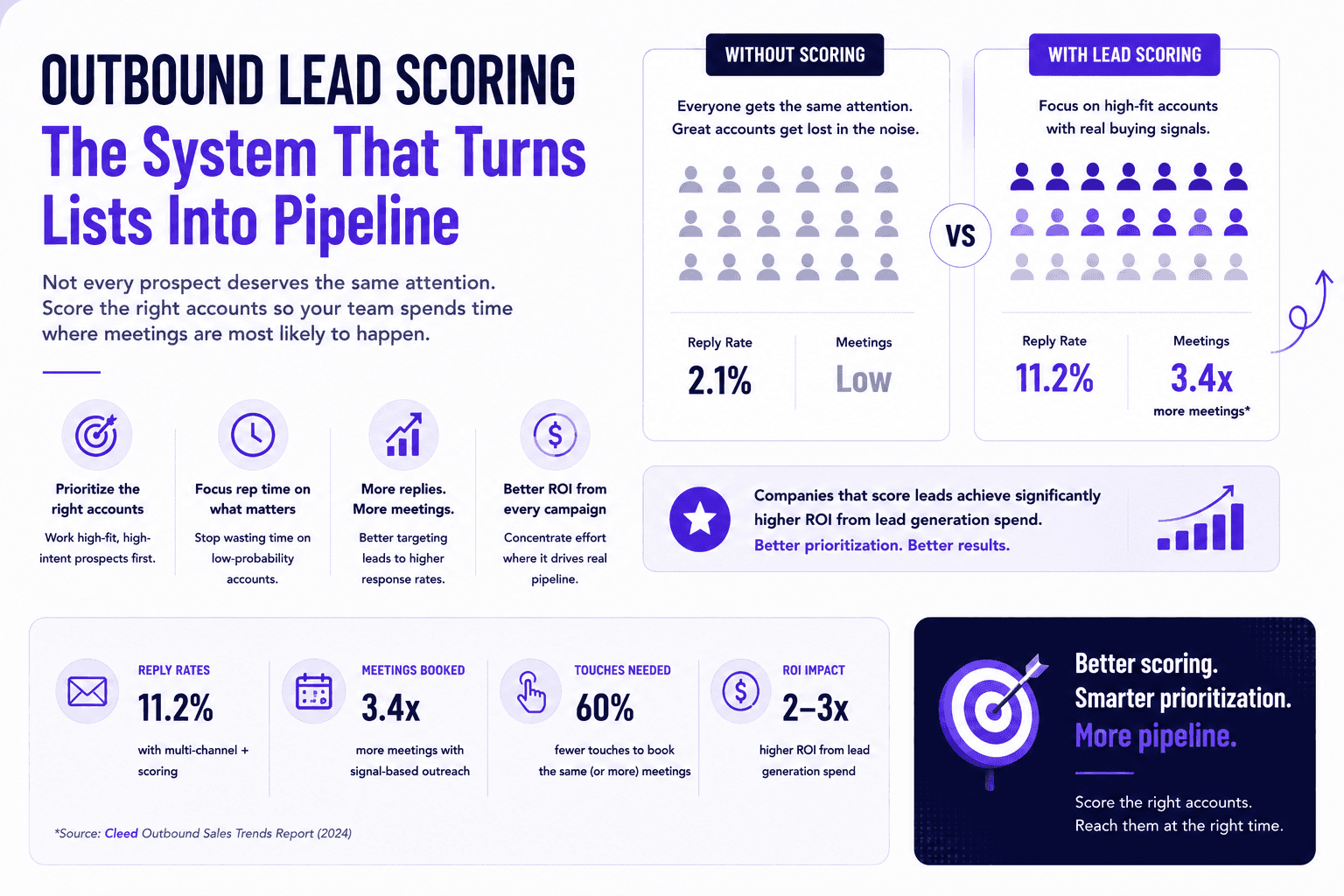
The numbers back this up. One mid-market SDR team ran a controlled test where half kept their existing high-volume playbook and half cut daily volume by 60 percent to focus only on accounts showing active buying signals. The signal-based group booked 3.4 times more meetings with 60 percent fewer touches, and their reply rate hit 11.2 percent against the volume group's 2.1 percent. Across the wider market, companies that score leads see meaningfully higher return on their lead generation spend than companies that do not, and the difference comes almost entirely from better prioritization rather than better tools. One enterprise team we worked with doubled its sales efficiency by engaging accounts at the right time using data-backed decisions rather than working the list in whatever order it arrived.
The Two Axes of an Outbound Score: Fit and Signal
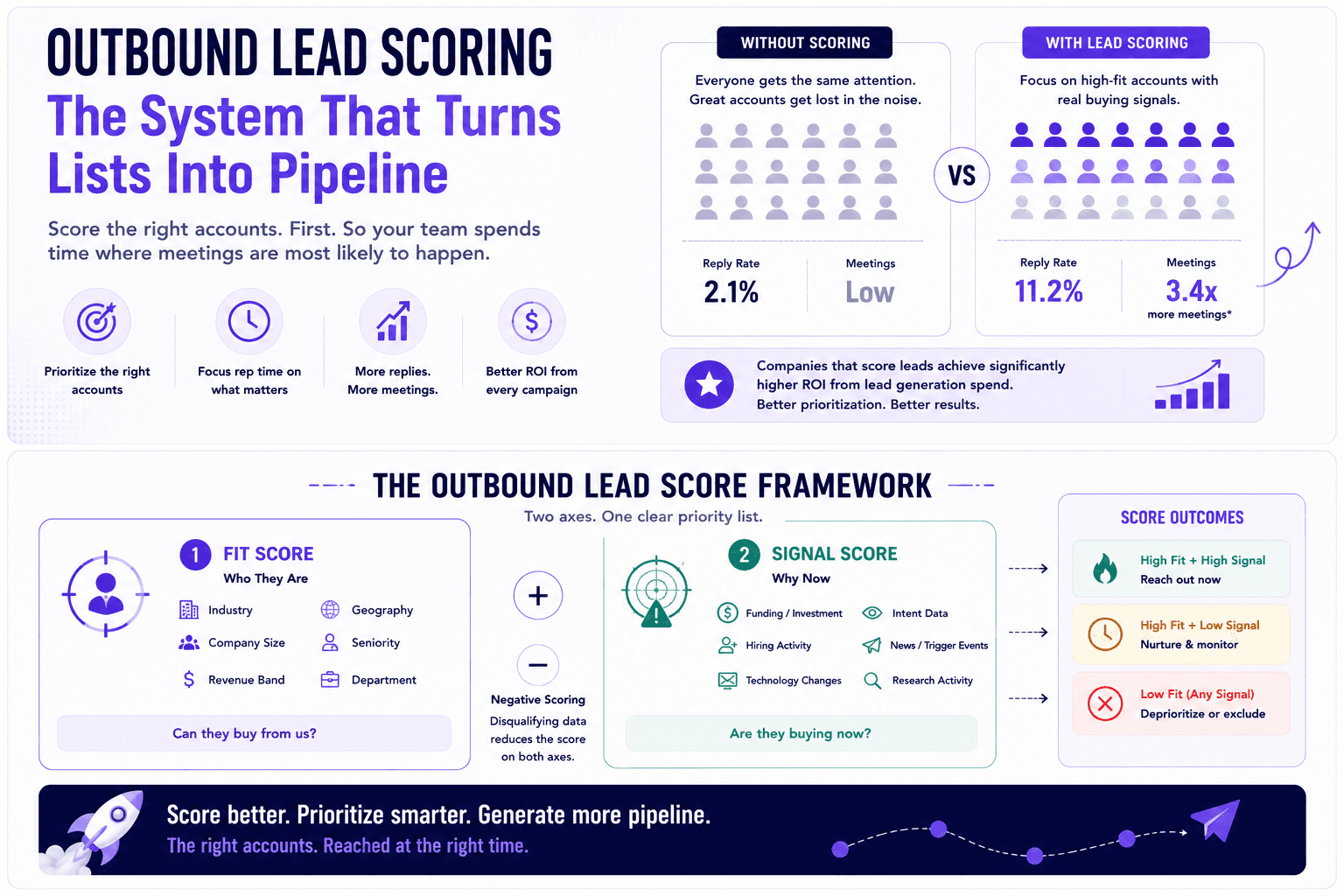
The dominant working model in 2026 uses two dimensions rather than one blended number. One axis measures fit, the other measures intent, and negative scoring applies across both. Two dimensions matter because a single combined score hides the distinctions your team needs to make. High fit with low intent is a nurture. High intent with low fit is usually a pass. High fit with a live signal is an immediate priority. Collapse those into one number and you lose the ability to tell them apart.
Fit Scoring: Who They Are
Fit answers a basic question. Could this account and this person actually buy from us? You score it using firmographic data like industry, company size, revenue band, and geography, alongside contact-level data like seniority and department. The weights should come from your own closed-won patterns, not from opinions in a planning meeting. Look at the accounts you actually closed and let the shared characteristics set the weighting.
One caution here. Do not let a single criterion dominate unless you are certain it predicts conversion. A company can sit in the right size band and still be a poor prospect if the contact is in the wrong function, and a VP title at a five-person company means something different than the same title at a 500-person firm. Building fit scoring well is the same discipline as knowing how modern revenue teams find their best customers: start from real customer patterns, then score against them. If you want to sharpen fit before scoring even begins, tightening how you enrich your lead list gives the model cleaner inputs to work with.
Signal Scoring: What Changed
Fit tells you who is worth pursuing. Signals tell you when. This is where intent data and trigger events come in. Certain events make a lead's static fit score temporarily beside the point. A company that just raised a funding round, hired a new VP of Sales, posted a surge of relevant roles, or changed a key part of its tech stack is in an active buying window regardless of what its baseline score says. When a high-fit account hits a trigger like that, its priority should jump even if nothing else about it moved.
Triggers are the earliest signal available in outbound, which is why they carry so much weight. Acting on them is how GTM teams find opportunities before competitors do, reaching an account in the weeks after a funding announcement instead of the month after everyone else notices. Signals also decay. An account that looked hot last month and has done nothing since is not hot today, so build recency into the model rather than letting old signals sit at full value.
Negative Scoring: What to Subtract
Positive points alone inflate every score over time until the tiers stop meaning anything. Negative scoring is the fix, and it is the layer teams most often skip. Subtract points for clear disqualifiers: company size below your minimum viable customer, a contact in a function that never buys, a free-email domain, or a region you cannot serve. Negative scoring keeps your Hot tier honest by pushing the accounts that look qualified on paper but are not out of the priority lane.
How to Build Your Outbound Scoring Model in Five Steps
You do not need a hundred-point system or an expensive platform to start. A clear set of criteria your team agrees on is enough to launch.
Define fit criteria from closed-won. Pull your last set of customers and list the firmographic and contact traits they shared. Those become your positive fit criteria.
Assign weights that reflect real patterns. Give more weight to the traits that show up most consistently in accounts you closed, and resist the urge to weight by intuition.
Layer in signals. Decide which trigger events matter for your offer and how many points each adds. Fund the ones tied to an active buying window most heavily.
Set negative rules. Write down the disqualifiers that should subtract points or cap a score, so poor-fit accounts cannot climb into your top tier on one strong trait.
Map scores to tiers. Translate the number into a small set of buckets your team can act on without thinking. This is the step that turns a score into a decision.
Your first model will be directionally right, not perfect, and that is normal. The point is to launch something workable, then compare your score bands against actual outcomes and recalibrate. If company size barely affects conversion but department fit strongly predicts meetings, shift the weighting toward department fit. A scoring model is a living system, not a monument, and it loses accuracy the moment markets and buyers move if you never revisit it.
Turning Scores Into Tiers and Actions: Hot, Warm, and Cold
A score only matters if it changes what a rep does next. The right question is not whether you can calculate a number, it is what operational decision that number triggers. Three clear buckets usually work better than nine categories nobody remembers.
Hot accounts have strong fit and a live signal. Route these to your best reps for immediate, personalized outreach, and have a person review the personalization before launch so quality stays high. This is the tier where a tailored, account-based motion earns its cost.
Warm accounts have strong fit but no active signal yet. Enroll them in a solid baseline sequence and keep watching for a trigger that would bump them up. This is the natural home for micro-segmented campaigns, where messaging is grouped by shared context rather than blasted at everyone equally.
Cold accounts have weak fit or clear disqualifiers. Keep them out of high-cost outbound steps unless they gain a new qualifying signal. Suppression is a decision too, and it is often the most valuable one because it protects rep hours and deliverability.
The tier-to-action map is the whole point of scoring. When a prospect's score climbs because a new signal appeared, they move into a higher-priority motion, which is exactly how revenue teams act on buying signals before the window closes.
Common Questions About Outbound Lead Scoring
What Is the Difference Between Lead Scoring and Lead Qualification?
Qualification is a yes or no decision: does this lead meet the basic criteria to be worth any effort at all. Scoring goes further and ranks the leads that pass, telling you which qualified accounts deserve attention first and in what order. Qualification gets a prospect into the workflow. Scoring decides where they sit in the queue once they are in it. Frameworks like BANT are qualification checklists a rep runs during a conversation, while a scoring model answers many of those same questions automatically from fit and signal data before the conversation ever starts.
Do I Need a Tool to Score Outbound Leads?
No, not to begin. You can build a working model as fields in your CRM: store the fit score, the signal score, and the resulting tier, then let reps and automation read them. A simple rule-based model that scores fit, applies negative rules, and layers in a few trigger signals will already improve how your team prioritizes. Tools help most once your list volume and data get large enough that manual scoring cannot keep up, or when you want the model to learn from closed-won patterns automatically. Some teams also lean on AI SDRs to act on scored tiers at scale, but the scoring logic underneath matters more than the tool that runs it.
How Is Account Scoring Different From Lead Scoring in Outbound?
Lead scoring evaluates an individual contact. Account scoring evaluates the whole company on firmographic fit, technographic signals, and buying readiness. For most outbound and account-based motions you want both. Account scoring tells you which companies belong on the target list and which twenty of your two hundred open accounts to focus on this week. Lead scoring then tells you which specific contacts inside those accounts to engage first. Account scoring sets priority, contact scoring handles routing.
How Often Should I Update My Outbound Scoring Model?
Treat it as a system that needs scheduled maintenance rather than a one-time build. At minimum, review it quarterly against real outcomes: check whether your Hot tier is actually converting better than Warm, and adjust weights where the data disagrees with your assumptions. Signals should update far more often than that, close to real time, because a trigger that fired six weeks ago no longer means what it did the day it happened. The model should also shift when your product, pricing, or target market changes, since those change what a good lead looks like.
Prioritize the List You Already Have
Outbound lead scoring is not a new tool to buy or a complicated system to install. It is a decision about where your team spends its scarcest resource, which is rep attention. Score fit from your real closed-won patterns, layer buying signals on top to get the timing right, subtract points for clear disqualifiers, and map the result to three tiers that each trigger a specific action. Launch it simple, then let real outcomes recalibrate the weights.
Done this way, scoring turns a flat list into a prioritized queue, and a prioritized queue is what lets a small team book more sales meetings without sending more email. If you want help building a scoring model and the outbound system around it, book a call with our team and we will map it to your pipeline.