Article
Aug 28, 2026
How to Build a Signal-Based Outbound Engine That Finds Buyers Before Competitors
Build a signal-based outbound engine that spots in-market buyers early and reaches them before competitors. A practical, layer-by-layer 2026 guide.

At any given moment, only about 5% of your market is actively looking to buy. The other 95% are content with what they already have, and no amount of clever copywriting changes that. Most outbound teams still work the entire list the same way, which means the majority of their effort lands on accounts that were never going to respond. A signal-based outbound engine fixes this by watching for the events that tell you an account has entered a buying window, then reaching those accounts while the window is still open. This guide walks through how to build that engine one layer at a time, from detecting the right signals to acting on them before your competitors notice the same opening.
What a Signal-Based Outbound Engine Actually Is
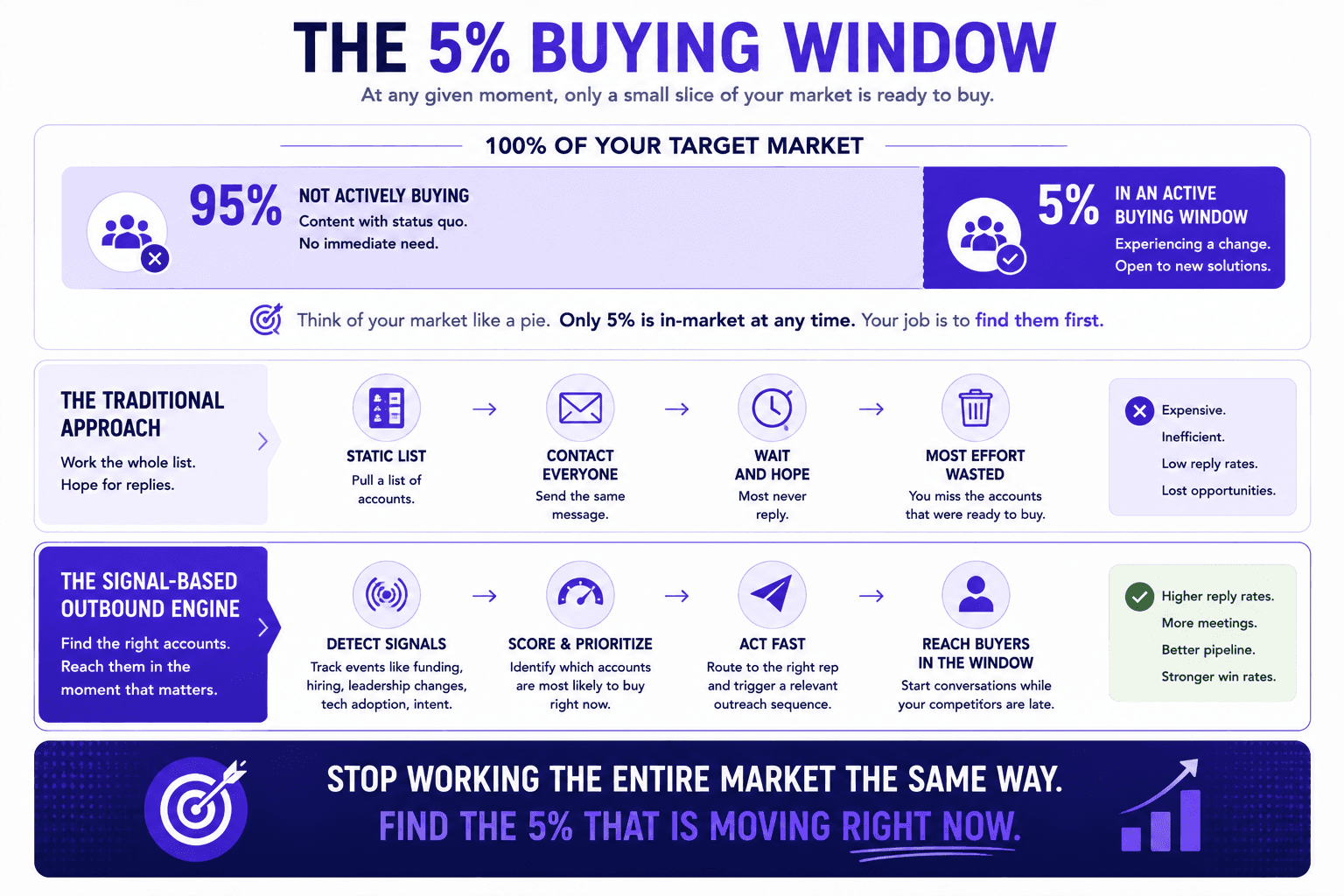
A signal-based outbound engine is a system that reacts to observable events instead of working through a static list in order. The list is still there, but it stops being the trigger. The trigger becomes something the account did or something that happened to it: a funding round, a leadership change, a hiring surge, or a visit to your pricing page. When one of those events fires, the engine flags the account, scores it, and routes it to the right sequence quickly enough to matter.
The reason this approach works comes down to how buying happens now. Gartner research indicates that 99% of B2B purchases are triggered by a specific organizational change, which means almost every deal starts with an event you could have detected. By the time a buyer talks to a vendor, they have usually completed 70 to 80 percent of their research on their own. That research phase is where the shortlist forms, and roughly 85% of purchases go to a vendor that was already on the buyer's shortlist before formal evaluation began. If you wait for a hand to go up, the shortlist has usually closed without you.
This is the same shift we cover in more detail in our breakdown of how modern GTM teams find opportunities before competitors. The teams pulling ahead are reaching accounts during the research phase, when they can still shape the criteria the buyer uses to decide.
The Signals Worth Building the Engine Around
Before you build anything, you need to know which events are worth reacting to. A useful starting frame is to group signals into families, then decide how strongly each one predicts a purchase. Our guide to what buying signals are goes deeper on the categories, but here is the working version.

The signal families that matter
There are four families most teams should track. People signals cover leadership changes, new executive hires, and champion job moves. Growth and investment signals cover funding rounds, headcount expansion, and new office openings. Technology signals cover tools being added or removed from an account's stack. Behavioral and intent signals cover research activity, pricing-page visits, and content engagement, which you can read more about in our guide to what intent data is.
Each family answers a different question. People signals tell you the decision maker changed. Growth signals tell you budget just appeared. Technology signals tell you a related priority is in motion. Intent signals tell you someone is researching your category right now. Our piece on how revenue teams use buying signals to generate pipeline shows how these families feed a working pipeline once you start combining them.
Ranking signals by strength
Not every signal deserves the same weight, and treating them equally is one of the most common ways teams waste their budget. An analysis of a million B2B software purchases found that AI tool adoption correlated with buying behavior at 46 percent, headcount growth at 38 percent, and recent purchases at 38 percent, while job postings on their own scored only 7 percent. Teams that build their engine around job postings alone are chasing noise and wondering why reply rates stay flat. Weight your strongest signals accordingly, and treat weak ones as supporting evidence rather than a reason to reach out.
Why freshness decides everything
A signal is only useful inside a specific window, and that window is shorter than most people expect. Funding rounds are strongest two to four weeks after the announcement, a new VP hire stays relevant for 30 to 90 days, and a pricing-page visit decays within five to ten days. This matters for how you build the engine, because it means detection frequency is a design decision. A monthly data refresh will miss most of your best openings. Weekly scanning, at a minimum, is what keeps the engine pointed at accounts that are still in motion.
How to Build the Engine, Layer by Layer
The engine is easier to build when you treat it as four connected layers rather than one large project. Each layer has a clear job, and each one hands off to the next. This is also the structure we use when we build an AI outbound agent for prospecting and personalization, so the layers below map directly to a system you can actually run.
Layer 1: Detection
Detection is where the engine watches for events. You need at least one source per signal family: a job-change and leadership source, a funding and hiring source, a technographic source, and an intent source. Some teams stitch these together from separate providers, and others start with a smaller stack and expand once the workflow is proven. Our overview of the best prospecting tools for B2B teams breaks down which source does which job. The point of this layer is coverage and freshness, so set your scan frequency to match the fastest-decaying signal you care about. If you track pricing-page visits, weekly is already too slow for that specific signal, so plan for near-daily checks on the ones that expire quickly.
We wrote about how this looks in practice in our post on how we built an AI lead generation engine with Claude Code, where detection runs continuously instead of in monthly batches.
Layer 2: Scoring and stacking
Once signals are flowing in, the engine needs to decide which accounts deserve attention first. A single signal is usually weak evidence, so the real lift comes from stacking. When two or more signals appear on the same account inside a short window, the account moves up your priority list. The combination of a new VP and recent funding at the same account produces reply rates four to six times the cold baseline, because both the authority to change and the budget to act arrived together.
A simple scoring model works well here. One signal places an account in your lowest tier for nurture, two signals move it to a middle tier for an automated sequence, and three or more move it to a top tier that earns immediate, personalized outreach. Our guide to outbound lead scoring covers how to build this ranking so your team works the accounts most likely to buy before anything else.
Layer 3: Routing and speed
Speed is the layer most teams underestimate, and it is often where the whole advantage is won or lost. A benchmark study of 939 companies found that the average business takes 47 hours to respond to a lead. A signal decays across that same window, so a good message sent within a day of a signal firing usually beats a perfect message sent five days later. The practical standard to build toward is first outreach within 72 hours of detection, and faster for signals that expire quickly.
This is why routing matters. The engine should send top-tier accounts straight to a person for same-day outreach, while middle-tier accounts drop into an automated sequence. Handling replies quickly is just as important as the first send, which we cover in our guide to speed-to-lead for outbound, where after-hours coverage turns positive replies into booked meetings that would otherwise go cold.
Layer 4: Message and execution
The final layer is where the signal becomes a reason to reach out. The message should name the trigger directly, so the account understands why you are contacting them now rather than at random. Referencing a specific, recent event is what separates signal-based reply rates of 15 to 25 percent from the 3.43 percent average that generic cold outreach produces in 2026. Because each tier and signal type calls for a different angle, this layer works best when you build small, tightly targeted campaigns rather than one broad send, which is the logic behind micro-segmented outbound campaigns.
None of the message work matters if the email does not land, so execution also depends on the plumbing underneath it. Deliverability, domain health, and sending limits are what let a good message reach the inbox at all, and our guide to the best cold email infrastructure setup for B2B companies covers the setup that keeps a signal-based engine out of the spam folder.
Frequently Asked Questions
How is signal-based outbound different from buying an intent data list?
A purchased intent list is a snapshot, and a signal-based outbound engine is a live system. When you buy a list, you get accounts that showed intent at some point, with no built-in way to act while the signal is still fresh or to combine it with other evidence. An engine detects signals continuously, scores accounts by how many signals stack up, and routes them to outreach inside the window when they still matter. The data provider gives you raw material, and the engine is what turns that material into timed, prioritized outreach. Most teams that only buy lists end up reaching accounts weeks after the signal has already decayed.
How fast do you need to act on a buying signal?
Fast enough to beat the decay window for that specific signal, which usually means days rather than weeks. Pricing-page visits fade within five to ten days, funding signals stay strong for two to four weeks, and new-executive signals hold for 30 to 90 days. A workable rule is to aim for first outreach within 72 hours of detecting a signal, and to move faster on the ones that expire quickly. Given that the average company takes nearly two full days just to respond to an inbound lead, a team that reliably acts inside a day already has a structural advantage over most of its competitors.
What tools do you need to run a signal-based outbound engine?
You need one tool for each of the four jobs: a detection source for signals, an orchestration layer to score and stack them, a sequencing tool to run the outreach, and a CRM to track which signal drove which conversation. Many teams start with a smaller stack and add sources as the workflow proves out, since the most expensive part is rarely the software. The real cost is the person who reviews the signals and makes the routing calls each week. Our guide to the best prospecting tools breaks down the options by the job each one does, so you can assemble a stack that fits your motion instead of paying for overlap.
How do you actually find buyers before competitors do?
You detect the trigger before the buyer starts formal evaluation, then reach out while they are still forming their shortlist. Since almost every purchase begins with an organizational change and the shortlist usually closes before a rep is ever contacted, the accounts you want are visible through their signals well before they raise a hand. Building an engine that watches for those signals, ranks them, and acts within the decay window is what puts you in front of the buyer during the research phase. That is the phase where the shortlist is decided, and being early there is worth more than any subject line.

Building the Engine Is the Real Advantage
Signal-based outbound comes down to three things working together. You have to detect the right signals while they are fresh, score and stack them so your team works the strongest accounts first, and act inside the window before the opening closes. Teams that get all three right stop spending effort on accounts that were never going to buy and start showing up for the small share of the market that is ready right now. The engine is what makes that repeatable, so it keeps finding buyers week after week instead of depending on a single good list.
If you want help designing an engine like this for your own pipeline, book a call with the Novoslo team and we will walk through what it would take to build one around your market.