Article
Aug 17, 2026
LinkedIn DMs vs Cold Email: Which Outbound Channel Works Better in 2026?
LinkedIn DMs vs cold email in 2026: how reply rates, cost, scale, and effort compare, plus which outbound channel to pick for your team.

Most outbound teams are asking the same question this year: should they keep pouring budget into cold email, or move attention to LinkedIn DMs. The honest answer is that LinkedIn DMs vs cold email is not a fight one channel wins outright. It is a decision about where buyer attention is less crowded, what your offer can carry, and how much volume you actually need to hit pipeline.
Cold email has gotten easier to launch and harder to stand out in. More teams are sending, filters are stricter, and the average reply rate has been sliding for years. LinkedIn DMs are pulling attention because the channel is quieter, so the same message often lands better. Both can work in 2026, and plenty of teams run them together. This guide compares the two on reply rates, cost, scale, and effort, then gives a clear recommendation on which channel to start with based on your situation.
Where Each Channel Stands in 2026
The starting point for any LinkedIn DMs vs cold email comparison is understanding how each channel has changed, because both look different than they did even two years ago.
What changed with cold email
Cold email is still a real channel, and it still books meetings at scale. What changed is the level of competition inside the inbox. Since it is cheaper and faster than ever to spin up domains and start sending, the channel filled up, and reply rates have drifted down across the board. Platform wide benchmarks now sit in low single digits, and tightly targeted lists consistently outperform large blasts.
That decline is not a signal to abandon email. It is a signal that the old playbook of pulling a huge list and running volume with a generic offer no longer carries a campaign. We cover the full picture of why most cold email campaigns are struggling in 2026, and most of the drop traces back to a handful of fixable mistakes that quietly kill reply rates. Teams that segment tightly, personalize with a real reason, and protect deliverability still do well.
Why LinkedIn DMs are getting attention
LinkedIn DMs work for a simple reason. A buyer might receive a dozen cold emails on a normal day and only one or two LinkedIn messages. Less competition for attention means a message with the same offer often gets read and answered. Published benchmarks show InMail reply rates well above what email produces, especially when the message is personalized rather than blasted.
The other advantage is context. On LinkedIn you can see recent activity, role changes, and posts before you reach out, which makes timing easier. Outreach tied to a recent trigger tends to perform better, and the platform makes those triggers visible. The result is that a plain offer that struggles in email can still find traction in DMs, which is why teams in commoditized or competitive spaces are testing the channel first.
LinkedIn DMs vs Cold Email: The Honest Comparison
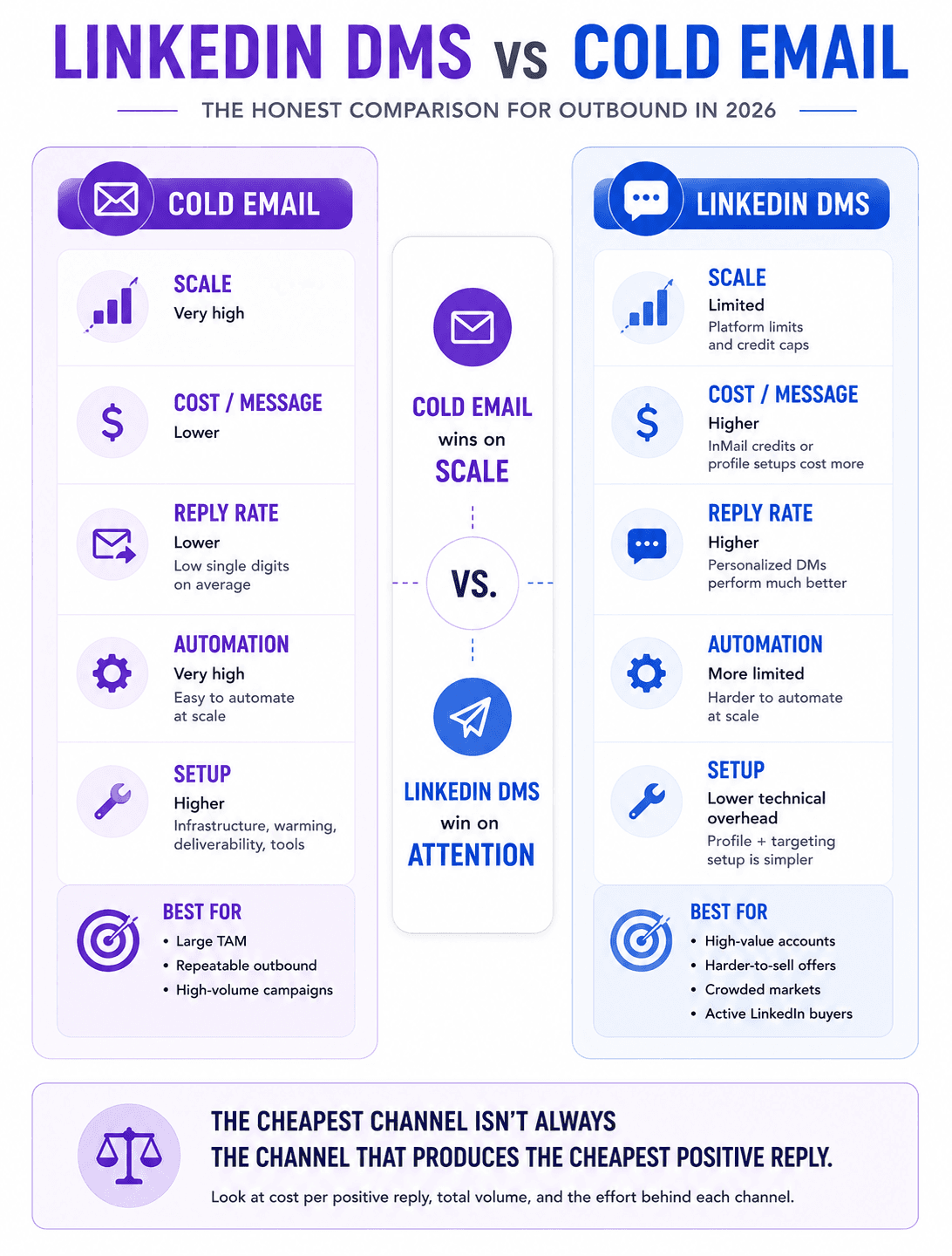
Reply rate is where most people start, but it is only one part of the decision. Cost per positive reply, total volume, and setup effort all shape which channel actually produces pipeline for your team.
Reply rates and response quality
On raw reply rate, LinkedIn DMs generally come out ahead. The channel is less saturated, so personalized messages tend to get answered at a higher rate than the same message sent by email. Cold email reply rates now sit in low single digits at the platform level, while LinkedIn messages, particularly personalized ones, land in a much higher range.
The number that matters more than total replies is the positive reply rate, meaning the share of responses that show real interest. Both channels benefit from tracking this instead of raw replies, because a channel with fewer total answers can still produce more booked calls if those answers are warmer.
Volume and scale
This is where cold email holds a clear edge. Email lets you reach far more people per day, and the whole process automates cleanly once your infrastructure is in place. If you need to cover a large total addressable market quickly, email scales in a way LinkedIn does not.
LinkedIn caps volume by design. Sales Navigator hands out a limited number of InMail credits, and the platform has tightened the limits on open profile messaging that teams relied on to send at scale. Connection requests carry weekly limits tied to account health. You can stack profiles and licenses to push more volume, but that adds operational overhead and account risk, and the ceiling stays lower than email. For teams that need thousands of touches a week from a small operation, that constraint is the deciding factor.
Cost per message versus cost per positive reply
Per message, LinkedIn costs more than email. A single InMail or a managed profile setup runs higher than the cost of an email send. Looked at that way, email wins on unit economics.
The more useful comparison is cost per positive reply. Because LinkedIn produces a higher share of interested responses, the cost per meaningful conversation can come out lower even though each message costs more to send. The right way to judge either channel is to track spend against booked calls, not against messages sent. That framing changes the answer for a lot of teams, and it is the same discipline behind getting more sales meetings without adding headcount.
Effort and setup
Cold email carries most of its work up front and in maintenance. You need domains, authentication, warmup, verified lists, and ongoing monitoring so campaigns keep landing in the inbox. Getting this right is a project on its own, and we walk through the full cold email infrastructure setup B2B companies need in 2026. List hygiene matters just as much, since verified lists produce far better response than unverified ones and B2B data decays quickly.
LinkedIn shifts the effort elsewhere. There is no spam folder to fight in the same way, and you can often include a link in the first message, which shortens the path to a booked call. The cost shows up in account management, license limits, and the risk of restriction if you push volume too hard. Neither channel is set and forget. Email demands technical upkeep, and LinkedIn demands account discipline.
Which Channel Fits Your Offer and ICP?
The channel decision comes down to your offer, your buyer, and how much pipeline you need. Both channels reward good targeting, and both suffer when the offer is weak.
When cold email is the stronger bet
Cold email fits teams that need to reach a large market fast and have an offer that reads well in writing. If your buyer lives in their inbox, if you need thousands of touches a week, or if you are running a repeatable motion across a wide segment, email is the base channel. It also pairs naturally with structured systems, and the teams getting results tend to run one of a few proven cold email frameworks rather than improvising each campaign.
When LinkedIn DMs pull ahead
LinkedIn DMs earn their place when your offer is harder to sell cold, when your space is crowded, or when your buyers are active on the platform. A message that would get lost in a busy inbox can stand out in a quieter DM thread. The channel also suits high value accounts where personalization justifies the extra cost per touch, which lines up closely with an account based marketing approach. Before committing either way, it helps to understand why most cold outreach fails before the first message is sent, because a weak offer sinks both channels equally.
The role of buying signals and timing
Targeting and timing lift results on both channels, and this is where a lot of teams leave pipeline on the table. Reaching out when an account shows real interest beats reaching out on a schedule. Learning to read buying signals and to act on intent data turns either channel from a volume game into a timing game. The same signal that makes a LinkedIn DM land also makes a cold email land, which is one more reason the channels work well together.
Frequently Asked Questions
Are LinkedIn DMs replacing cold email in 2026?
No. LinkedIn DMs are gaining ground because the channel is less crowded and reply rates are higher, but they cannot match the volume email produces. Most teams that adopt LinkedIn keep email running as the scalable base and use DMs where the offer or the buyer suits the channel better. The trend is toward running both, not swapping one for the other.
Is cold email dead?
Cold email is not dead. Reply rates have fallen and the channel is more competitive, but it still books meetings at scale for teams that target tightly, personalize with a real reason, and maintain deliverability. What has died is the lazy version of cold email built on huge generic lists and no infrastructure. The disciplined version still works.
Can you run both channels at once?
Yes, and for many teams that is the strongest setup. Running email and LinkedIn together, tracked in one system, lets you reach a buyer through whichever channel they respond to. Multichannel outbound tends to produce the highest overall response because it meets people where they already pay attention. The catch is operational: you need clean tracking so the two channels coordinate instead of double touching the same person.
Which is cheaper, LinkedIn or cold email?
Per message, cold email is cheaper. Per positive reply, the answer depends on your offer and market, and LinkedIn can come out lower because a bigger share of its replies show real interest. Judge cost by spend per booked call rather than spend per message, since that is the number tied to revenue.
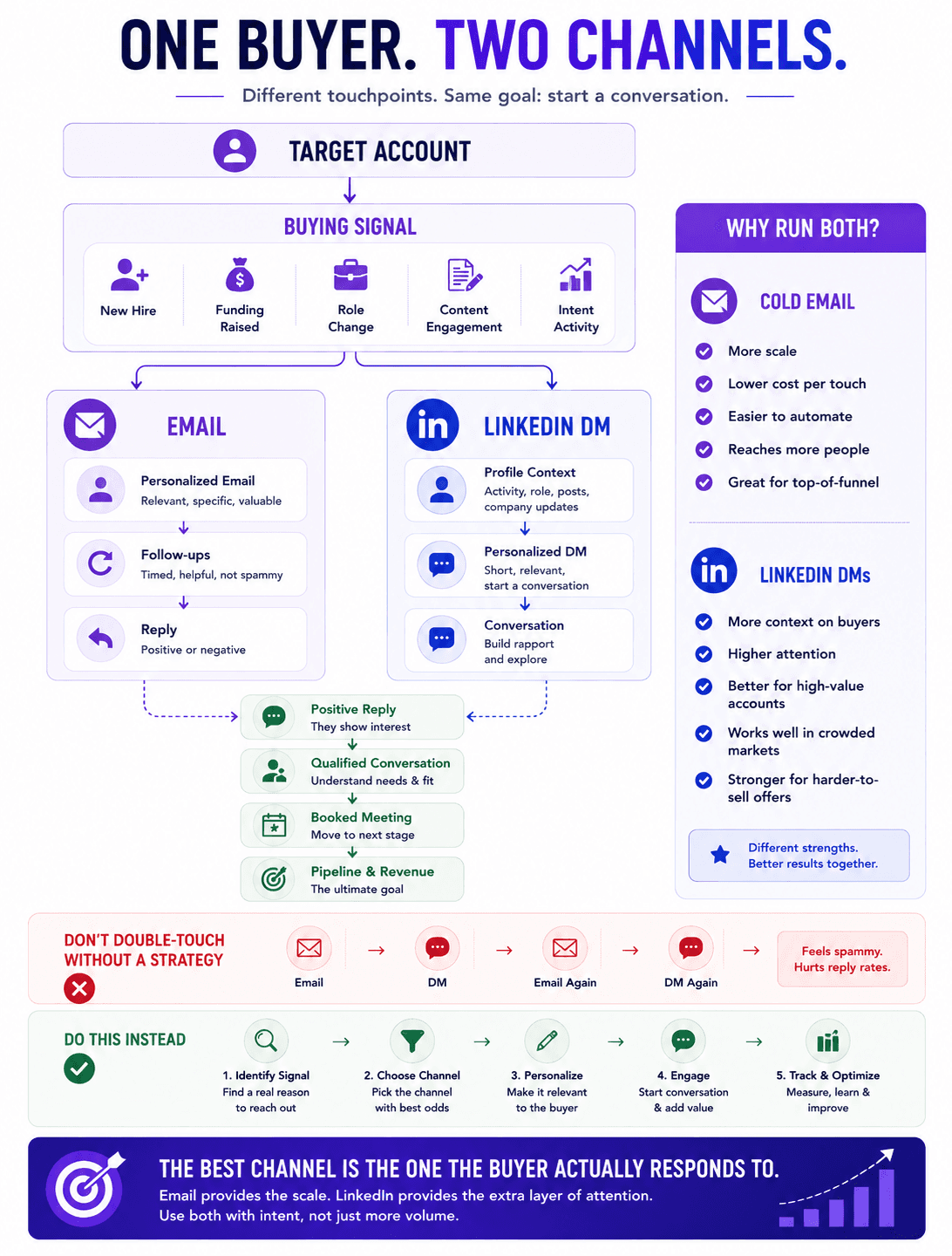
The Verdict: Which Outbound Channel to Choose
For most B2B teams in 2026, cold email should be the base channel and LinkedIn DMs the second layer. Email gives you the volume and automation to cover a large market, and it remains the most efficient way to reach a lot of buyers when your infrastructure and targeting are solid. That is the channel to build first if you need predictable, repeatable pipeline.
Add LinkedIn DMs when your offer is harder to sell in writing, when your space is saturated, or when your buyers clearly spend time on the platform. In those cases the higher reply rate and the context LinkedIn provides often justify the extra cost per touch. Teams with the operational capacity to run both, tracked in one place, tend to see the best results because they reach each buyer through the channel that fits them. Whichever you start with, the fundamentals decide the outcome: a clear offer, tight targeting, good timing on buying signals, and a system that turns replies into booked calls rather than letting them sit. Growing teams that want to scale this without adding headcount are increasingly leaning on AI to handle the manual work of prospecting, and it also helps to weigh outbound against inbound as part of the wider mix and a broader set of B2B lead generation strategies.
If you want a straight read on which channel fits your offer, market, and stage, and a system built to run it, book a call with our team. We will map your situation and show you where the pipeline is likely to come from.