Article
Jul 29, 2026
What Is Account-Based Marketing (ABM)?
Account-based marketing (ABM) targets your highest-value accounts with personalized outreach. Learn how it works and when to use it.

Most B2B teams still run marketing the same way. They build a wide list, push content and outreach to everyone who vaguely fits, and hope enough of the right people raise their hand. The result is usually a lot of activity and a pipeline that is hard to read. You get leads, but you cannot always tell which ones matter, and your sales team spends real time chasing accounts that were never going to buy.
Account-based marketing takes the opposite approach. Instead of starting with volume, you start with a short list of the accounts most likely to become good customers, and you concentrate your effort there. It has moved from a niche enterprise tactic to something close to standard practice, with roughly 70% of marketers now running an active ABM program. This guide covers what account-based marketing actually is, how it differs from the way most teams already work, when it fits your business, and how to build a program without overcomplicating it.
What is account-based marketing (ABM)?
Account-based marketing is a B2B strategy that treats each high-value account as its own market. Rather than marketing to a broad audience and filtering for interest later, you decide which specific companies you want as customers, then build personalized outreach around the people inside those companies who influence the buying decision.
The core idea is focus. A traditional funnel pulls in a large number of contacts and narrows them down over time. ABM works in the other direction. You identify the accounts worth winning first, then design campaigns and messaging for each account or tight segment of accounts. Everything you do is aimed at a defined list rather than an open audience.
One point worth being clear on is that ABM supports your existing lead generation, it does not replace it. Most companies run both. Broad-reach programs keep the top of your funnel full and build awareness, while ABM concentrates budget and attention on the accounts that justify a more tailored effort. If you already run outbound and inbound marketing, ABM sits alongside them as a way to prioritize where your best resources go.
How ABM flips the traditional funnel
In a standard demand model, marketing generates a large pool of leads, qualifies them, and passes the survivors to sales. In ABM, sales and marketing agree on the target accounts before any campaign runs, and both teams work the same list from the start. The account is the unit of focus, not the individual lead, which changes how you plan, measure, and report. This matters more than it used to because buying decisions rarely rest with one person. Research now puts the average B2B buying committee at more than 11 stakeholders for larger deals, so reaching a single contact is rarely enough to move an account forward.
How ABM differs from traditional lead generation and demand generation
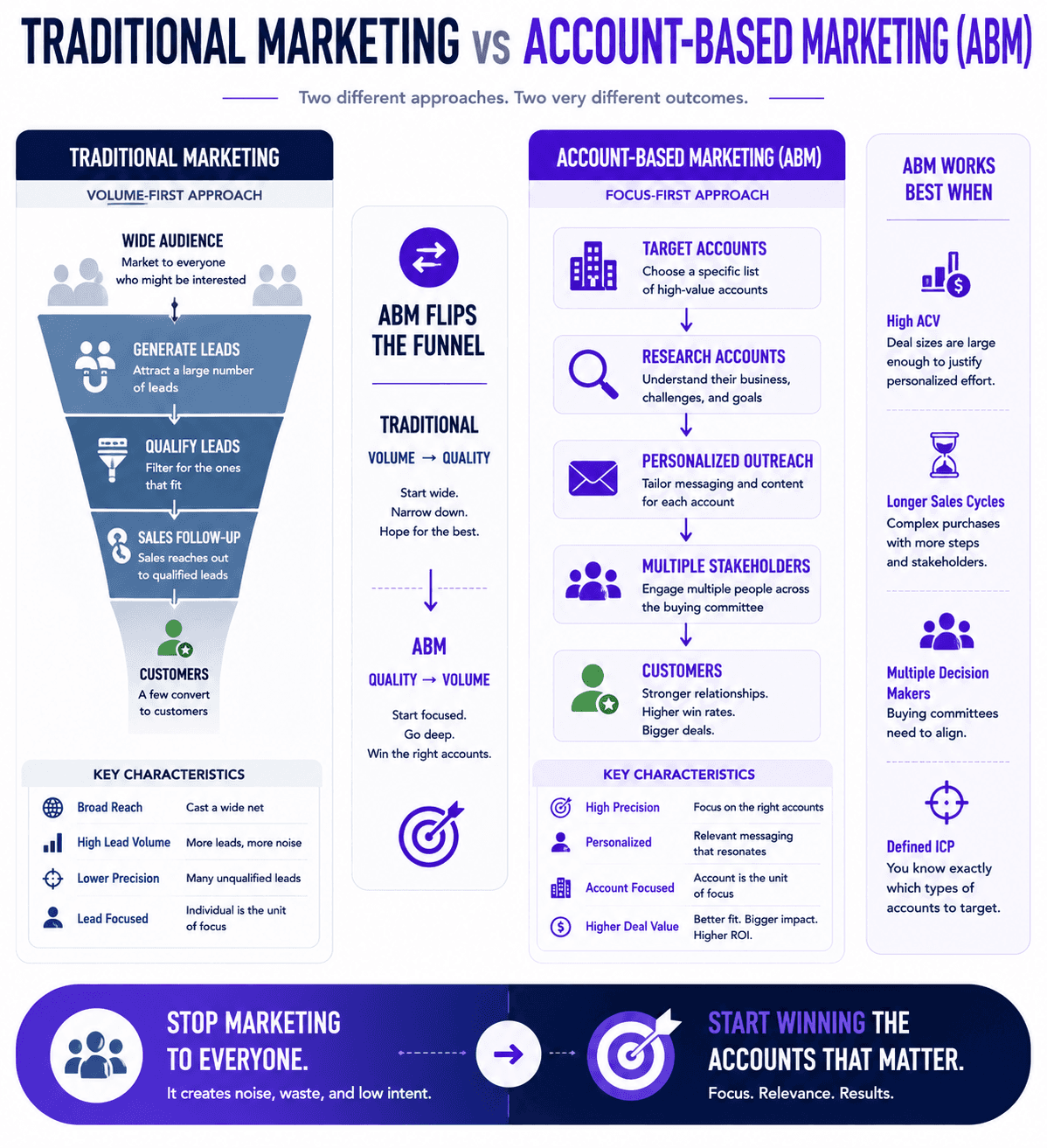
The simplest way to picture the difference is spearfishing versus casting a wide net. Traditional lead generation reaches a large group of potential buyers and accepts that most of them will not be a fit, which keeps volume high and focus low. ABM decides what it wants to catch, prepares for that specific target, and commits real effort to a smaller number of accounts.
That focus changes the economics. Because your spend is concentrated on accounts with genuine revenue potential, you waste less on people who were never going to convert, and your reporting becomes cleaner because you are tracking a defined list rather than a moving pool.
It also helps to separate ABM from demand generation, since the two get confused. Demand generation is about creating and capturing interest across a broad market, while ABM is about converting and expanding a specific set of accounts you have already chosen. If you want the full breakdown, our guide on demand generation vs lead generation covers how the goals and metrics differ, and ABM layers on top of both as a targeting decision rather than a separate channel.
When ABM is the wrong choice
ABM is not right for every business. It works best when you sell into a defined set of high-value accounts with deal sizes large enough to justify personalized effort, and when your buying process involves several decision makers over a longer cycle. If your product is low priced, sold at high volume, or bought quickly by a single person, the extra coordination ABM requires will cost more than it returns. The honest test is whether you have enough high-value accounts in your addressable market to make a targeted program worth the work. If you do not, broad-reach B2B lead generation strategies will serve you better for now, and you can revisit ABM as you move upmarket.
Why B2B teams use ABM
The most consistent benefit teams report is alignment between sales and marketing. Because both functions commit to the same account list and share the same definition of success, the usual friction over lead quality tends to fade. The 2026 ABM benchmark data shows new account acquisition is the primary goal for most programs, which gives both teams a clear shared target to work toward rather than a vague volume number.
The business case shows up in deal quality. Concentrating effort on accounts that fit your profile tends to produce larger deals and shorter cycles, because you are engaging the right stakeholders earlier and with more relevant messaging. Industry data points to ABM programs generating meaningfully more pipeline per marketing dollar than broad-reach demand generation, along with higher win rates and larger average deal sizes once an account converts.
There is also a budget argument. Companies now dedicate a significant share of their marketing spend to ABM, with surveys placing it around 29% of the marketing budget on average. That level of investment reflects a simple reality. When you know exactly which accounts you are pursuing, you can measure return against real pipeline instead of tracking impressions and hoping they add up to revenue.
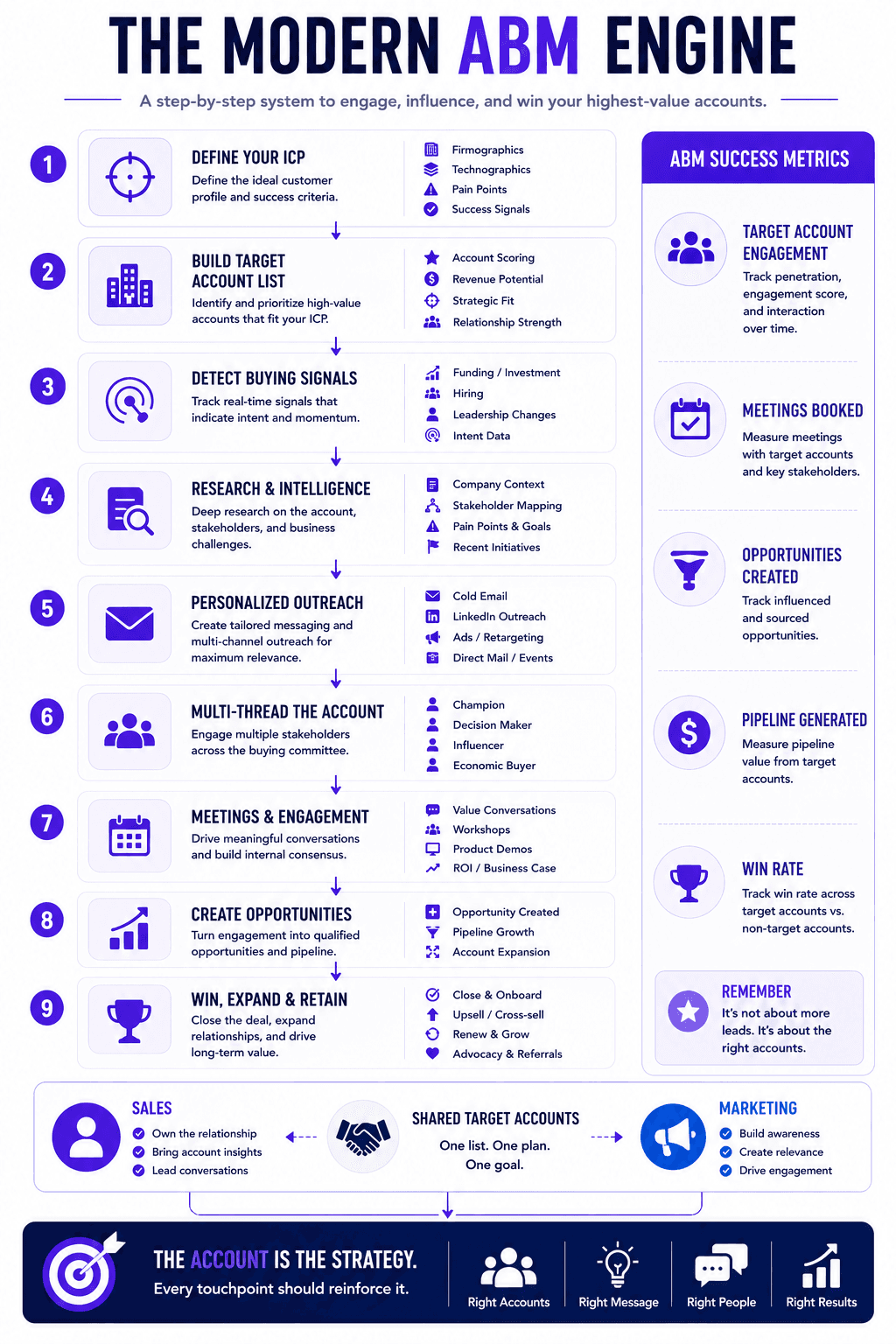
How to build an ABM strategy in five steps
You do not need a large team or expensive software to start. A workable program comes down to five steps done in order.
Identify high-value target accounts
Start by defining your ideal customer profile, then build a list of the specific companies that match it and have the potential to contribute the most revenue. Base this on firmographic fit and on real evidence of readiness rather than gut feel. This is where buying signals become useful, because signals like hiring for relevant roles, funding events, or leadership changes tell you which accounts are worth prioritizing now. If you are building your first list, our guide on how to identify high-value target accounts walks through the sourcing process.
Research and segment the list
Firmographic data tells you who an account is, but not how to reach them. Research each account for its current situation, its pain points, and what it has already tried, then group similar accounts into segments so your outreach stays efficient. Pure one-to-one personalization rarely scales, so most teams segment by company size, industry, or a triggering event and tailor messaging to the segment. Good prospecting tools handle the enrichment and data collection so your team spends its time on judgment rather than manual lookup.
Build personalized campaigns and pick channels
Use what you learned in research to create messaging that speaks to each segment's actual problems. Personalization here means more than inserting a company name. It means reflecting the account's situation back to them in a way that shows you understand it. Choose the channels where your target accounts actually engage, which for most B2B teams is some mix of email, direct outreach, targeted advertising, and events. If email is central to your program, proven cold email frameworks give you a structure that holds up across accounts.
Engage across sales and marketing together
ABM breaks down when sales and marketing work in silos. Both teams need access to the same account list and the same insights, and they need to coordinate their touches so an account gets a consistent experience regardless of who reaches out. The teams that do this well tend to find opportunities before their competitors because they are acting on the same signals at the same time rather than passing accounts back and forth.
Measure against pipeline, not vanity metrics
Because ABM targets a defined list, results are easier to measure than broad campaigns. Track account engagement, opportunities created, deal size, and sales cycle length rather than impressions and open rates alone. The goal is to tie your marketing effort directly to pipeline and revenue, which is also the clearest way to prove the program is working and decide where to expand it. If your aim is more meetings on the calendar, our guide on how to book more sales meetings covers the levers that move held meetings up.
Where AI and intent data fit into modern ABM
The hardest part of ABM has always been knowing which accounts to prioritize and when to reach them. This is where data has changed the game. At any given moment, only a small share of your market is actually ready to buy. The often-cited 95-5 rule suggests roughly 5% of B2B buyers are in-market at a time, which means most of your target list is not ready today. The value of good targeting is finding that 5% before your competitors do.
Intent data helps here by showing which accounts are researching topics related to what you sell, so you can focus effort on accounts showing real interest rather than treating the whole list the same. AI has made this practical to run at scale. A large majority of marketers now use AI to support ABM personalization and account scoring, which lets a small team maintain personalized outreach across a bigger list than they could manage manually. Used well, these tools do not replace judgment. They surface the accounts worth your attention so your team spends its time on the ones most likely to convert.
Is ABM only for enterprise companies?
No. ABM started in enterprise sales, but the approach works for any company selling into a defined set of high-value accounts with longer buying cycles. Mid-market adoption has grown quickly, and smaller teams can run effective programs by keeping their target list tight and their tooling simple. The deciding factor is not company size, it is whether you have enough high-value accounts and long enough sales cycles to justify a focused effort.
How is ABM different from cold outbound?
Cold outbound and ABM overlap but are not the same. Cold outbound is a channel, a way of reaching prospects who have not engaged with you yet. ABM is a strategy that decides which accounts you pursue and how you coordinate across teams. You can run cold outbound as part of an ABM program, sending targeted, personalized outreach to the specific accounts on your list. The difference is that ABM adds account selection, cross-team alignment, and account-level measurement around that outreach, rather than treating each contact as an isolated lead.
How many accounts should an ABM program target?
There is no single right number, and it depends on how personalized your approach is. Highly tailored one-to-one programs work with a small number of strategic accounts, often a few dozen, because each one receives significant custom effort. Broader one-to-many programs can target hundreds of accounts grouped into segments that share similar needs. The practical guidance is to start small with a pilot list you can genuinely personalize, learn what works, then expand as your process and data improve.
Getting started with ABM
Account-based marketing is not a new channel to bolt on. It is a decision to concentrate your best effort on the accounts most likely to become good customers, and to get sales and marketing working the same list toward the same goal. The teams that benefit most start with a focused pilot, use real signals to choose accounts, and measure against pipeline rather than activity.

If you want to move faster, the fastest path is usually to fix your targeting and outreach at the same time. That means a clean list of accounts that fit, timely signals that tell you when to reach out, and personalized messaging that lands. If you would rather have that system built and run for you than assemble it piece by piece, book a call with our team and we will walk through what a focused outbound program would look like for your accounts.