Article
Jul 15, 2026
17 B2B Lead Generation Strategies That Actually Work in 2026
17 B2B lead generation strategies that actually work in 2026. Signal-based targeting, cold email, LinkedIn, referrals, and nurture that books calls.

Most B2B lead generation advice repeats the same list every year. Send cold email, run some ads, post more often. The list is not wrong, but it skips the part that actually decides whether any of it works in 2026. The buyer makes up their mind earlier than your funnel assumes. Research from Forrester shows that most B2B buyers already have a vendor in mind before they start a formal evaluation, and a large share have a clear favorite picked before they ever speak to sales. By the time a lead fills out your form, the real competition has already happened.
That changes what a good strategy looks like. The teams growing pipeline in 2026 are not sending more messages to more people. They are getting in front of buyers who are already moving, and they are following up in a way that keeps those buyers warm. What follows are 17 strategies that hold up under that reality, ordered by the job each one does. Some cost money. Most cost time and attention. All of them work better together than alone.
What changed in B2B lead generation for 2026
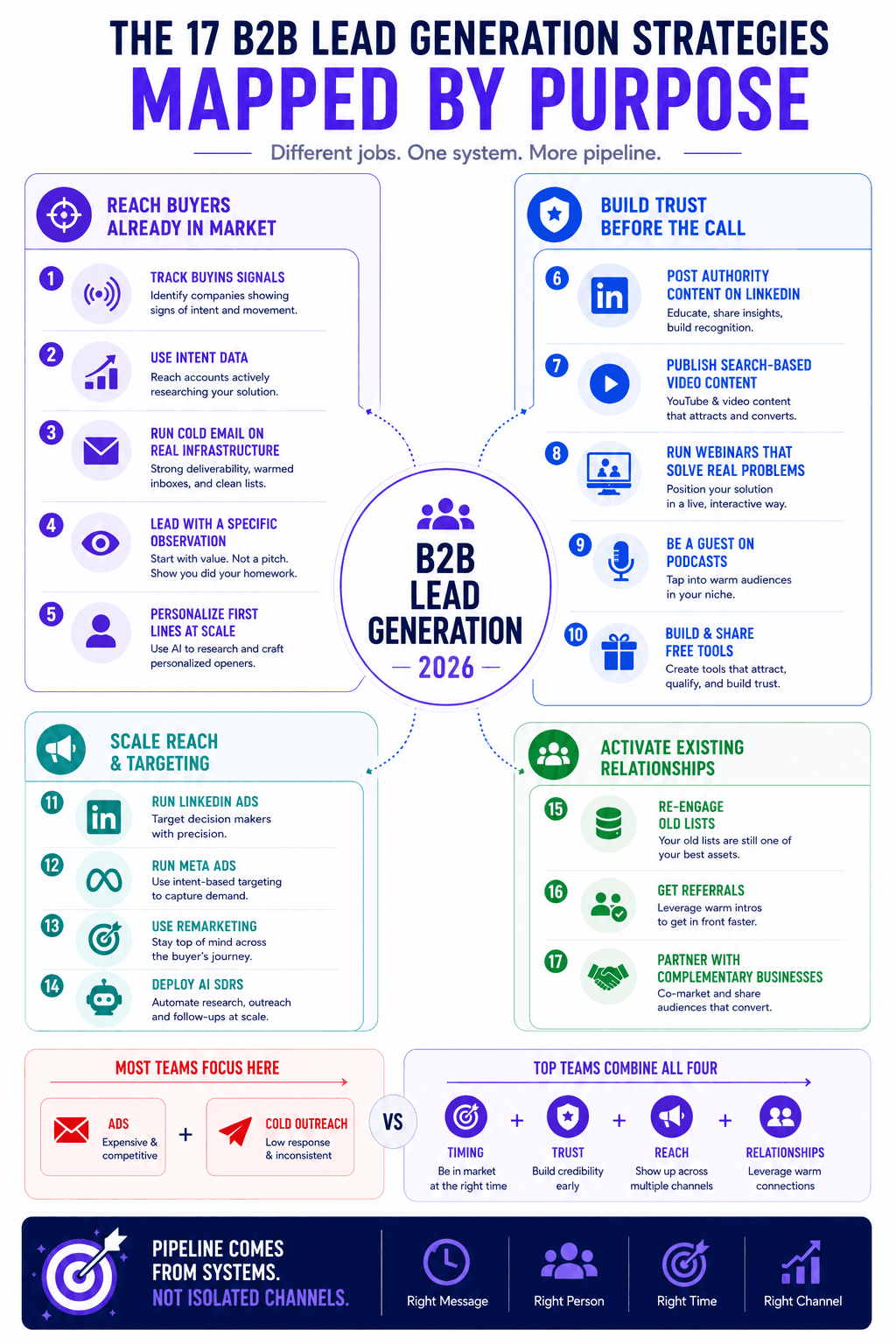
The shift is simple to describe and easy to underestimate. Buyers do most of their research before they talk to anyone, so the shortlist forms in channels your analytics barely track. Around 95% of deals go to a vendor that was on the buyer's initial shortlist, which means visibility and proof early in the journey matter more than a clever closing sequence. Cost per lead has climbed at the same time, with the median B2B figure now sitting above $200 and the gap between the best and worst programs widening to nearly five times. The lesson inside those numbers is that quality now beats volume at every stage, and the strategies below are ordered to reflect that.
Strategies that put you in front of buyers already in the market
1. Track buying signals before you reach out
The most reliable way to reach someone who is ready to buy is to watch for the behavior that indicates it. Buying signals include things like a company hiring for a role your product supports, a funding announcement, a leadership change, or a spike in research activity around your category. When you reach out inside that window, your message lands as relevant rather than random. One enterprise client we worked with doubled its sales efficiency simply by engaging leads at the moment the data said they were active, rather than working a static list from top to bottom. Start by defining the two or three signals that reliably precede a purchase in your market, then build your outreach around them.
2. Use intent data to time your outreach
Intent data tells you which accounts are researching a solution like yours right now, before they raise a hand. It works upstream of everything else, because timing is often the difference between a reply and silence. Adoption of intent signals nearly doubled year over year for a reason: the accounts showing intent convert at a much higher rate than a cold list. Layer intent on top of your ideal customer profile so you are not just reaching the right companies, but reaching them while the topic is live. This is the mechanism behind how revenue teams turn signals into pipeline instead of guessing.
3. Run cold email on real infrastructure
Cold email still works in 2026, but only when the plumbing underneath it is sound. Reply rates have fallen to around 3 to 5% on average, and most of that decline comes from deliverability problems rather than bad copy. Before you write a single line, get your cold email infrastructure right: separate sending domains, proper authentication, warmed inboxes, and a verified list. It helps to understand why most cold email campaigns are failing now, because the common failure points are almost all technical. Clean sending and a verified list will do more for your results than any subject line trick.
4. Lead with a specific observation, not a pitch
The outbound messages that get replies in 2026 give something before they ask for anything. Instead of opening with who you are and what you sell, open with a specific observation about the prospect's business and an offer to help. A short note that says you looked at their site, noticed three things worth fixing, and can send a quick breakdown will outperform a standard pitch by a wide margin. Keep it plain, short, and human, and stop after three attempts, because response rates fall sharply past that point. Most of the mistakes that kill reply rates come down to making the message about you instead of them.
5. Personalize first lines at scale
Personalization used to mean choosing between quality and volume. That tradeoff is mostly gone. You can now research a prospect, pull the relevant detail, and write a personalized first line for every contact on your list without doing it by hand. The workflow that makes this practical is the same one you use to enrich your lead list: gather company context, score fit, and generate the opening line in one pass. Done well, the prospect cannot tell the message was one of hundreds, which is the whole point.
Strategies that build trust before the call
6. Post authority content on LinkedIn
LinkedIn remains the center of B2B attention, generating roughly 80% of all B2B leads that come from social platforms. The content that works is not promotional. It educates, shares what you have seen work, and takes a clear position on topics your buyers care about. Posting three to five times a week builds recognition over time, so that when you do reach out, the message feels familiar rather than cold. Deals close from this channel precisely because the buyer has already watched you think in public.
7. Publish search-based video and YouTube content
YouTube is the second largest search engine, and in most B2B niches the competition for useful content is thin. Videos that answer specific questions, such as how to set up a particular tool or solve a common problem, pull in the exact people looking for what you do. The format does not need production polish. A clear screen recording that teaches something real will build trust faster than a glossy brand video, because the viewer leaves having learned something. Point each video toward one core explainer of how your service works, so every topic you cover feeds the same destination.
8. Run webinars structured as case studies
Webinars produce some of the highest quality leads of any channel, often at a lower cost per lead than paid search, because the people who spend an hour with you have already qualified themselves. The topic decides whether anyone shows up. A session built around a named outcome, such as how a specific company reached a result using a specific method, will draw a far more serious audience than a generic overview. Structure the session as a walkthrough of what happened and how the viewer can do something similar, then follow up afterward with the replay and a clear next step, because that follow-up is where the pipeline actually forms.
9. Start a podcast to reach decision makers
A podcast is one of the few formats that gives you a reason to talk directly to the people you most want as clients. Instead of chasing a prospect for a sales call, you can invite them onto your show as a guest, which is a far easier conversation to start. The recording builds a relationship, produces content you can cut into clips across other channels, and associates your brand with the guest's credibility. For high value deals in particular, this opens doors that direct outreach rarely can.
10. Build a free tool or lead magnet worth the email
A free tool that solves a real problem is one of the most durable lead sources available, because it gives value before it asks for anything. The tool has to be genuinely useful on its own, not a thin teaser. Our own ROI calculator works this way: it answers a question the buyer already has, and the conversation starts from there. Whatever form yours takes, a calculator, an audit, or a template, make it something the prospect would happily use even if they never bought from you.
Strategies that scale reach and targeting
11. Run LinkedIn ads to target by title and company
No other ad platform lets you target by job title, seniority, company size, and industry with the precision LinkedIn offers. The cost per impression is higher than Meta or Google, and that puts a lot of people off. The number that matters is cost per closed deal, and on that measure LinkedIn often wins because the leads are better qualified. It is not plug and play. You need to test several angles and a couple of offers before a campaign works, which is exactly where most advertisers give up too early.
12. Train Meta ads with qualified data only
Meta can work well for B2B, but only if you control what you feed the algorithm. The system optimizes toward whatever you tell it a good lead looks like, so if you send it unqualified form fills, it finds you more of the same. Two controls fix this. Use lead forms with qualifying questions that block unqualified submissions, and only fire a conversion event back to Meta once a lead passes your qualification survey. Clean data going in means the algorithm learns to find your actual buyer, and the results compound from there.
13. Build a remarketing stack that answers buyer hesitation
Most people do not buy the first time they encounter you, and most companies waste that first touch by never following up. A remarketing stack fixes the leak cheaply. Place tracking across your site, funnels, and content so anyone who engages gets bucketed, then serve those audiences a sequence of ads that each address a different reason a buyer hesitates. One ad shows how the service works, another shows the result, another compares your approach to the alternative. Trust builds passively across those touches, and the spend required is small relative to the deals it closes.
14. Use AI SDRs and sales agents to expand coverage
AI SDRs now handle the repetitive parts of prospecting, from research to first outreach, without adding headcount. Used well, they let a small team cover far more accounts than it could by hand, while the humans focus on the conversations that need judgment. The category has matured quickly, and there are now several capable AI sales agents worth evaluating depending on your motion. Treat them as a way to scale the work you already know converts, not as a replacement for a strategy you have not figured out yet.
Strategies that pull from people who already trust you
15. Reactivate your old list and network
The fastest lead source most companies own is the list they already have and forgot about. Old leads, past conversations, and dormant contacts represent people who once showed interest. A short campaign with a real offer and a genuine deadline can pull calls out of that list within days. The move that makes it work is to ask contacts whether they know anyone who would benefit, rather than pitching them directly, which removes the sales pressure and gets them thinking anyway. Run this once a quarter and it reliably produces pipeline at no media cost.
16. Build a referral program you actually reinforce
Referrals convert faster and cost far less than paid leads, yet most companies never ask for them consistently. The fix is to make the referral a standing part of how you operate rather than a one time request. Set a clear reward, mention it during onboarding, and keep it visible in ordinary touchpoints like your email signature. The point is repetition. A referral program only works when the people who could refer you are reminded often enough to act.
17. Sell through partners
Selling to a cold prospect is hard. Selling through someone the prospect already trusts is much easier. Partner or joint venture selling means going one level up from the end buyer to a company that already serves your target audience, then offering your product as something they can bundle or recommend. You are not asking them for a favor, you are offering their clients more value and often a new revenue stream. For products that plug into someone else's offer, this is one of the fastest ways to reach a whole market without pitching each buyer individually.
Frequently asked questions
Which B2B lead generation strategy works best in 2026?
There is no single best channel, and the surveys that claim one usually reflect the bias of whoever ran them. What holds up across the data is that timing and quality beat volume. The strategies that reach buyers who are already in the market, signal tracking, intent data, and well timed outreach, tend to produce the highest return because they meet the buyer during the window when a decision is actually forming. If you are starting from zero, pick one channel you can execute consistently and build from there rather than spreading thin across all seventeen.
How many strategies should I run at once?
Fewer than you think, especially early. Running three strategies well will beat running ten poorly. The reason most teams stall is that they pick plays off the shelf, run them in isolation, and never give any of them enough time to compound. Choose a small set that fits your market and your capacity, run each long enough to judge it fairly, and add more only once the first ones are stable.
Why do most B2B lead generation strategies fail?
Most fail for reasons that have nothing to do with the channel. The common causes are a leaky funnel that loses leads a better form would have captured, weak follow-up, and chasing volume without qualification. Around 79% of leads never convert, and poor nurturing is the usual reason. Fixing the process underneath your traffic, the forms, the follow-up, and the qualification, will usually do more than switching channels.
How fast should I follow up with a new lead?
As fast as you can. Response speed is one of the most reliable predictors of whether a lead converts, and reaching out within the first few minutes dramatically increases your odds compared to waiting even half an hour. Build a follow-up sequence that fires the moment a lead comes in, across email and, where you have it, phone or LinkedIn. The booking is the moment of peak interest, and every hour you wait after that lets it cool.
The takeaway
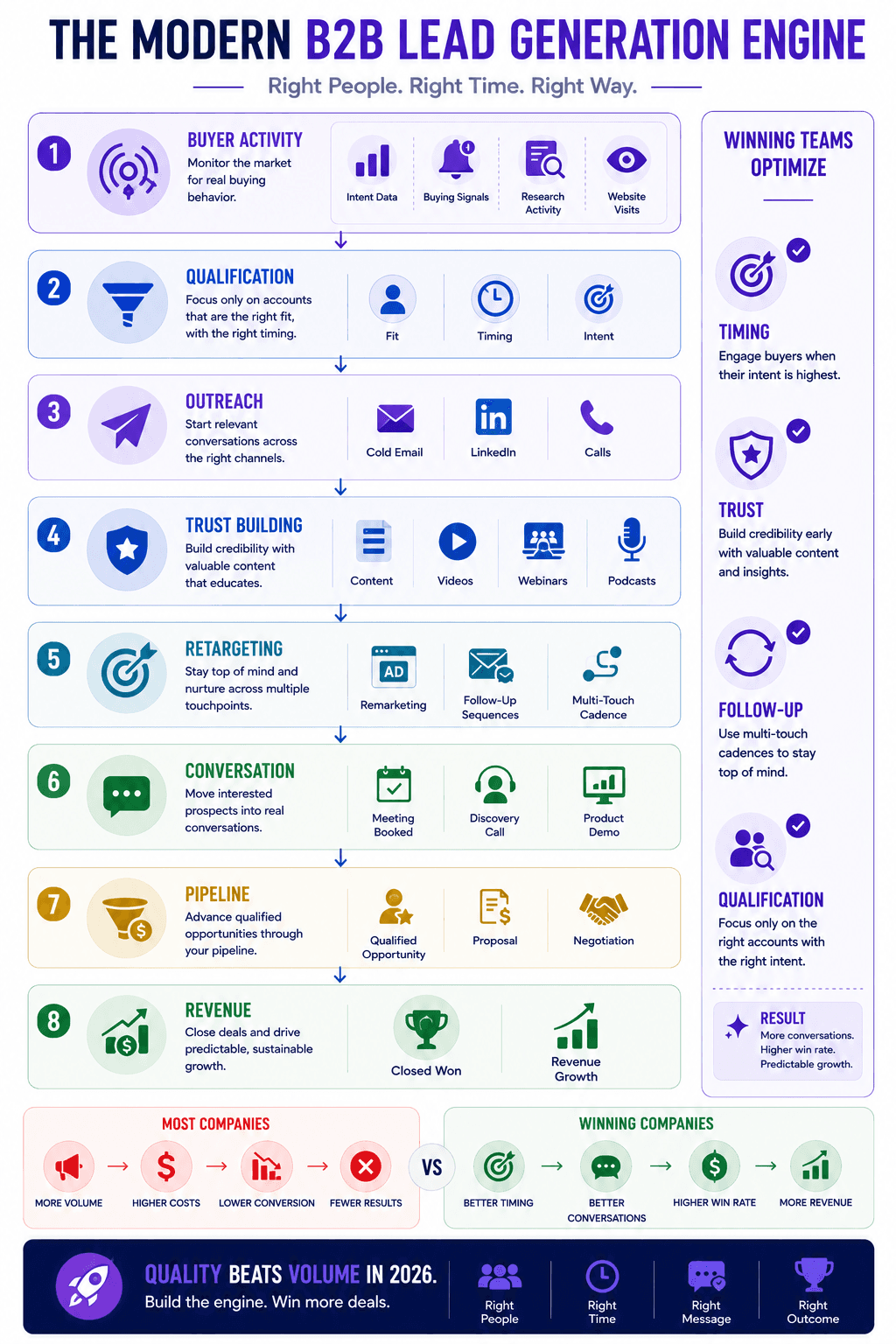
The strategies that work in 2026 share a logic. Reach buyers while they are actually in the market rather than interrupting them at random, qualify hard so you spend your effort on people who can buy, and follow up in a way that keeps interest from cooling. Volume for its own sake is the expensive way to grow, and the data on rising cost per lead makes that clearer every year. You do not need all seventeen of these running at once. You need a few that fit your market, executed consistently, with a clean process underneath them. Much of this now runs faster with AI, and we go deeper on how to generate B2B leads with AI if that is where you want to start.

If you want help building that system for your company, book a call with our team and we will map the fastest path to booked calls for your specific offer.