Article
Jul 27, 2026
Outbound vs Inbound Marketing: Which Is Better for B2B Companies?
Outbound vs inbound marketing for B2B: which drives pipeline faster, which costs less, and why the best companies run both. A practical guide.
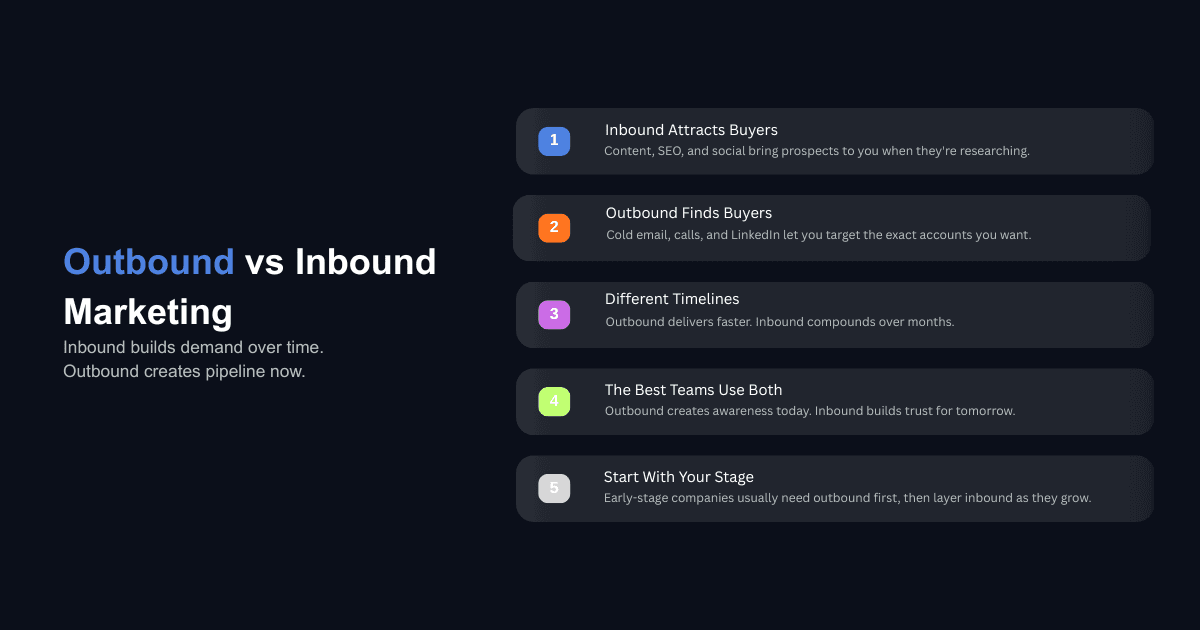
If you run growth at a B2B company, you have probably sat in a meeting where this exact argument played out. One person wants to pour the budget into content and SEO because the cost per lead is lower. Another wants to hire an SDR and start cold outreach because the pipeline is empty and the quarter is half over. Both sides bring numbers, and both sets of numbers are real.
The reason the debate never settles is that most of what gets written about outbound vs inbound marketing is sales collateral wearing a blog post costume. Inbound agencies publish data proving inbound wins. Outbound shops publish data proving the opposite. We build outbound systems for a living, so you know where we sit, but we also watch inbound quietly outperform us in certain markets, and pretending otherwise would waste your time. This guide gives you a way to decide based on your stage, your runway, and how much control you need over who shows up, rather than on whoever argued loudest in your last planning call.
What outbound and inbound actually solve
The cleanest way to tell these apart is to ask who starts the conversation.
Inbound: buyers come to you
Inbound marketing creates content and search visibility so that a prospect finds you on their own and reaches out first, usually through a demo request, a form fill, or a content download. Blog posts, SEO, webinars, email newsletters, and social all fall under this. The prospect arrives already partway through their research, which is why inbound leads tend to be warmer. The tradeoff is that you do not choose who arrives, and you have limited say over when they do. If you want the full picture of how these motions fit together, our guide to B2B lead generation strategies covers where each one earns its place.
Outbound: you choose who you talk to
Outbound marketing means you reach out to a prospect who has not signaled interest yet, through cold email, cold calls, or LinkedIn. The defining advantage is control. You pick the exact accounts and titles you want in your pipeline instead of waiting to see who a piece of content happens to attract. That control is also the cost, because you carry the full weight of getting attention from someone who did not ask to hear from you.
People often confuse these categories with demand generation, and the lines do blur. If that distinction matters for how you plan budget, we broke it down in demand generation vs lead generation, and the underlying mechanics of turning attention into pipeline are covered in what is lead generation.
The numbers behind the debate in 2026

The data tells a consistent story once you stop reading it as a scoreboard and start reading it as a description of two different jobs.
On cost and volume, inbound has a clear edge over time. Content and SEO produce leads at roughly 62% lower cost per lead than outbound and generate close to three times as many leads per dollar once the engine is running. That efficiency is real, but it is an average measured across a mature program, not a promise about your first quarter.
On conversion, the two motions behave differently in a way that is easy to misread. Inbound leads convert at about 5 to 10%, while cold outbound converts closer to 1 to 3%. The gap looks damning for outbound until you remember that outbound reaches buyers who have not found you and never would have. A lower conversion rate on an audience you can define and expand is a different kind of number than a higher rate on whoever happened to show up. Landbase's 2026 analysis puts inbound close rates far above cold outbound but notes that outbound delivers meaningfully larger average deal sizes for smaller companies, which is why deal size and account fit matter as much as the raw conversion percentage.
The number that decides most real cases is timeline. Inbound compounds into the cheapest pipeline you can own, but it takes six to eighteen months to mature because SEO builds slowly and content requires consistency before it pays. Outbound produces conversations in weeks. If your board wants pipeline this quarter, the lower cost per lead of inbound is not available to you yet, and building a program around it now means going hungry in the meantime.
When outbound is the better choice for B2B companies
Outbound is the right first move when time and control matter more than long term efficiency. That describes more early stage B2B companies than most inbound advocates will admit.
Choose outbound when you need pipeline inside the current quarter, when your total addressable market is narrow enough to name the accounts you want, when your average contract value is high enough to justify the cost of reaching each buyer directly, or when you are entering a new market where nobody is searching for you yet. In all of these, waiting for buyers to find you is not a strategy, it is a stall.
The important caveat is that the outbound that works in 2026 is not volume for its own sake. Cold outbound at scale has become steadily less effective, while triggered, signal based outbound is stronger than ever. The failure everyone points to when they say outbound is dead is really the failure of generic blasts to cold lists. Reaching the right account at the moment something changes inside it is a different activity with different results. This is where buying signals earn their keep, because a new executive hire, a funding round, or a technology change tells you when a company is actually in motion rather than guessing.
Two things determine whether outbound produces meetings or just noise. The first is timing, which is why intent data has moved from a nice to have into the core of good targeting. The second is infrastructure, because deliverability quietly decides whether your emails ever reach an inbox at all. Getting the domains, DNS, and warmup right is unglamorous and non negotiable, and we walk through the full setup in our cold email infrastructure guide. Teams that skip that step are the ones who conclude outbound does not work, when the truth is closer to what we covered in why most cold email campaigns are dying in 2026. One enterprise client of ours doubled its sales efficiency simply by engaging leads at the right moment using signal based timing rather than working a static list, which is the whole point of doing outbound well instead of loudly. If you want to see how the AI side of this fits together, we laid it out in how to generate B2B leads with AI.
When inbound is the better choice
Inbound is the right investment when you have runway and a reason to compound. Choose it when you already have some brand recognition, when your buyers educate themselves before they ever talk to sales, when there is real search demand in your category, and when you can afford to wait two or three quarters for the payoff.
The case for inbound rests on how B2B buying actually happens now. Around 67% of the buying journey is self directed, with buyers consuming more than a dozen pieces of content before they contact a vendor. Worse for anyone who ignores inbound, the shortlist tends to form during that anonymous research phase, and the vendor a buyer ranked first before ever speaking to sales wins the deal about 80% of the time. If you are not present in that research phase, you are not losing at the negotiation table, you never made it into the room.
Committees make this harder and more important at the same time. The median B2B buying group now runs above eleven stakeholders on larger deals, which stretches mid market cycles past four months and enterprise cycles past seven. More people means more independent research, and content is how you reach the four or five stakeholders your SDR will never get on a call. Inbound is the only economical way to stay in front of a committee for that long.
Why the best B2B companies run both
The framing of outbound vs inbound marketing falls apart once you look at how high growth companies actually operate, because they refuse to pick. They sequence the two so each does the job it is built for.
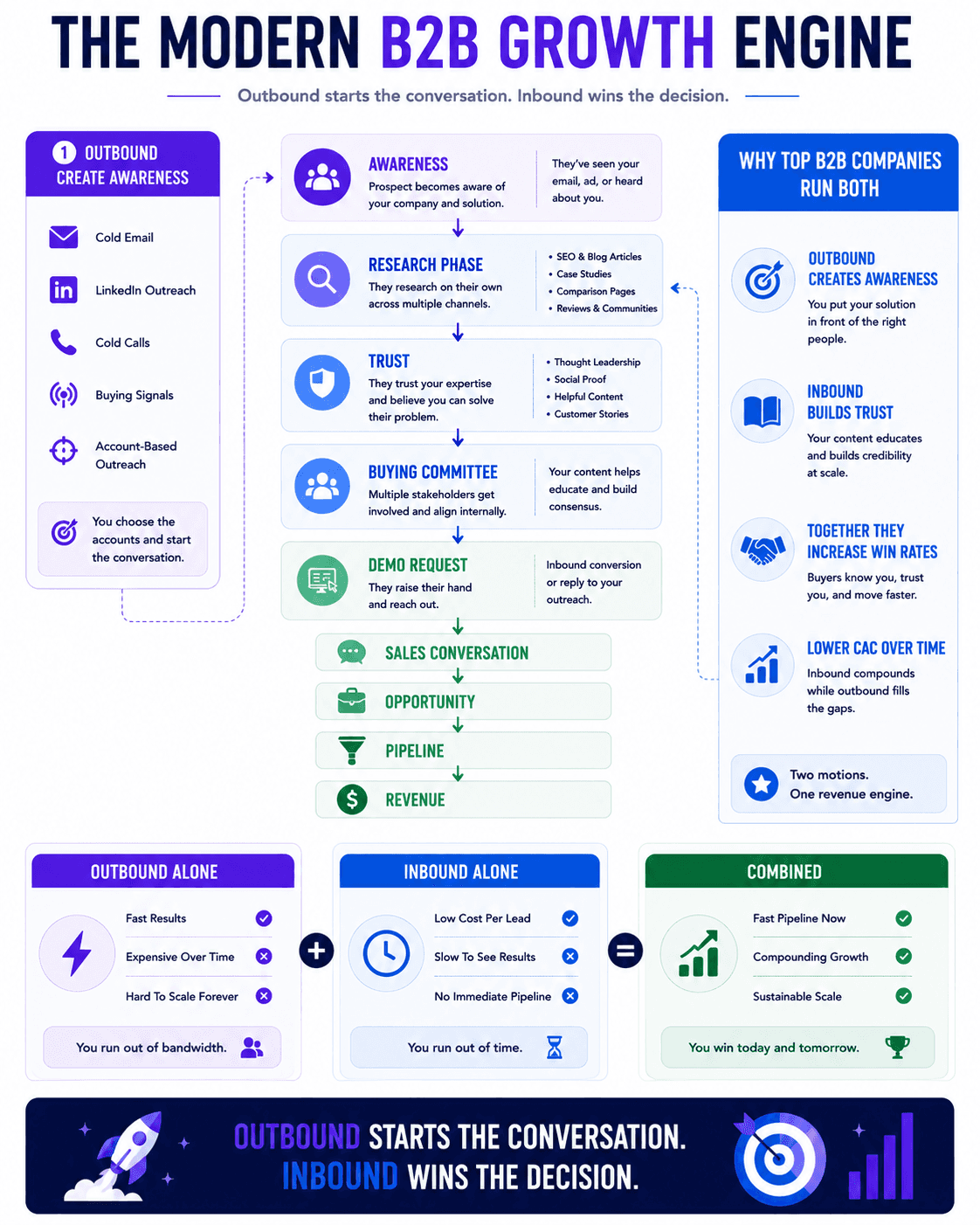
The pattern is straightforward. Outbound creates the spark. You run targeted campaigns to your top few hundred or few thousand accounts to introduce your category and get onto the consideration list, with no expectation of closing on the first touch. Once an account knows you exist, they research, and that is where inbound does the heavy lifting. Case studies, comparison pages, and product proof close the gap between awareness and decision. Outbound buys you time and attention now, inbound compounds into cheap pipeline later, and the handoff between them is where most pipeline is won or lost.
Two disciplines make the sequence work. The first is multi threading, since a single reply from one champion cannot carry an eleven person committee, and you need content and outreach reaching the other stakeholders in parallel. The second is speed, because when an inbound lead does raise a hand, the response window is brutal and the companies that reply first win a disproportionate share. Teams that get ahead of competitors do it by combining signal based outbound with a content engine that is already ranking, an approach we detailed in how modern GTM teams find opportunities before competitors. The execution layer for the outbound half of that system is covered in our cold email stack for B2B companies.
Is outbound marketing dead in B2B?
No, though a specific version of it is fading. Generic cold outreach sent to large unvetted lists produces almost nothing in 2026, and that is the outbound people mean when they call it dead. Targeted outbound tied to real signals, sent through properly configured infrastructure, still books meetings reliably. The distinction is between spraying volume and reaching the right account at the right moment. One is dying and the other is quietly getting better as AI makes personalization and timing easier to execute at scale.
Which is cheaper, inbound or outbound?
Inbound is cheaper per lead once it matures, at roughly 62% below outbound cost per lead with far more leads per dollar over time. That comparison hides the timeline. Inbound is expensive at the start because you are paying for content and SEO for many months before it produces meaningful pipeline, so the low cost per lead only shows up after the engine has been running. Outbound costs more per lead but the cost is linear and the pipeline arrives in weeks. The cheaper option depends entirely on whether you are measuring the first quarter or the third year.
How long before inbound marketing produces pipeline?
Plan for six to eighteen months before inbound delivers pipeline you can count on. SEO compounds slowly and content marketing rewards consistency, which means the payoff is real but delayed. If you need pipeline sooner than that, inbound will not rescue the quarter, and trying to force it to move faster usually just means spending on content that has not had time to rank. This is the single most common reason companies abandon inbound too early, right before it would have started working.
Should a small B2B company start with inbound or outbound?
Most small B2B companies should start with outbound and layer inbound in as they grow. Early on you have no brand, no search authority, and no time to wait, and outbound is the only motion that lets you generate pipeline this month while choosing exactly who you sell to. As revenue stabilizes, begin building the content and SEO that will compound into cheaper pipeline later, so that by the time outbound alone stops scaling, inbound is ready to carry more of the load. If your immediate problem is an empty calendar, our guide to getting more sales meetings without adding headcount is the more useful starting point than any content plan.
The bottom line
Outbound vs inbound marketing is the wrong question for most B2B companies, because the two solve different problems on different timelines. Outbound gives you speed and control and produces pipeline in weeks, which is why it usually belongs first. Inbound gives you the cheapest pipeline you can own but takes the better part of a year to mature, which is why it belongs as the compounding layer underneath. The companies growing fastest in 2026 sequence them so outbound creates the spark and inbound does the heavy lifting, and they multi thread across a buying committee that now averages more than eleven people.

If you want a straight read on which motion your company should lead with given your stage and runway, book a call with our team and we will map it against your numbers rather than a generic playbook.