Article
Jul 13, 2026
How to Generate B2B Leads with AI in 2026
How to generate B2B leads with AI in 2026: waterfall sourcing, signal-based timing, and agentic outreach you can actually run.

Lead generation in 2026 works differently than it did even a few months ago. The change is not that AI can write your emails now. The change is that the parts of the job that used to take entire afternoons, finding the right companies, locating the right people, and reaching them at the right moment, can now run as a system with very little manual work. We use this approach to produce a few hundred positive replies a day for clients through cold email alone.
Most teams are still clicking around inside one tool, building lists by hand, and hoping the timing works out. There is a better way to do it, and it is not complicated once you see how the pieces fit. This guide covers how to generate B2B leads with AI using the six shifts that made the biggest difference for us, so you can build the same setup inside your own business.
What actually changed in B2B lead generation
Buyers now finish most of their research before they ever talk to sales, and a large part of that happens without filling out a form or raising a hand. That single fact reshapes how lead generation has to work. If you wait for someone to declare intent, you are already late.
The numbers show where this is heading. Median MQL to SQL conversion has compressed over the past two years, mostly because teams keep passing marketing contacts to sales without checking whether those contacts show real buying behavior. Programs that add behavioral or third party signals to their qualification see much higher conversion, and leads sourced from intent data close several times more often than cold outreach to accounts that merely match your profile. The lesson is consistent across the data: timing and fit beat volume.
This is why intent data and buying signals have moved from a nice edge to the center of how good teams operate. The goal for 2026 is a narrow, well timed motion rather than a wide manual one, and AI is what makes narrow and well timed possible at scale.
Start with waterfall company sourcing
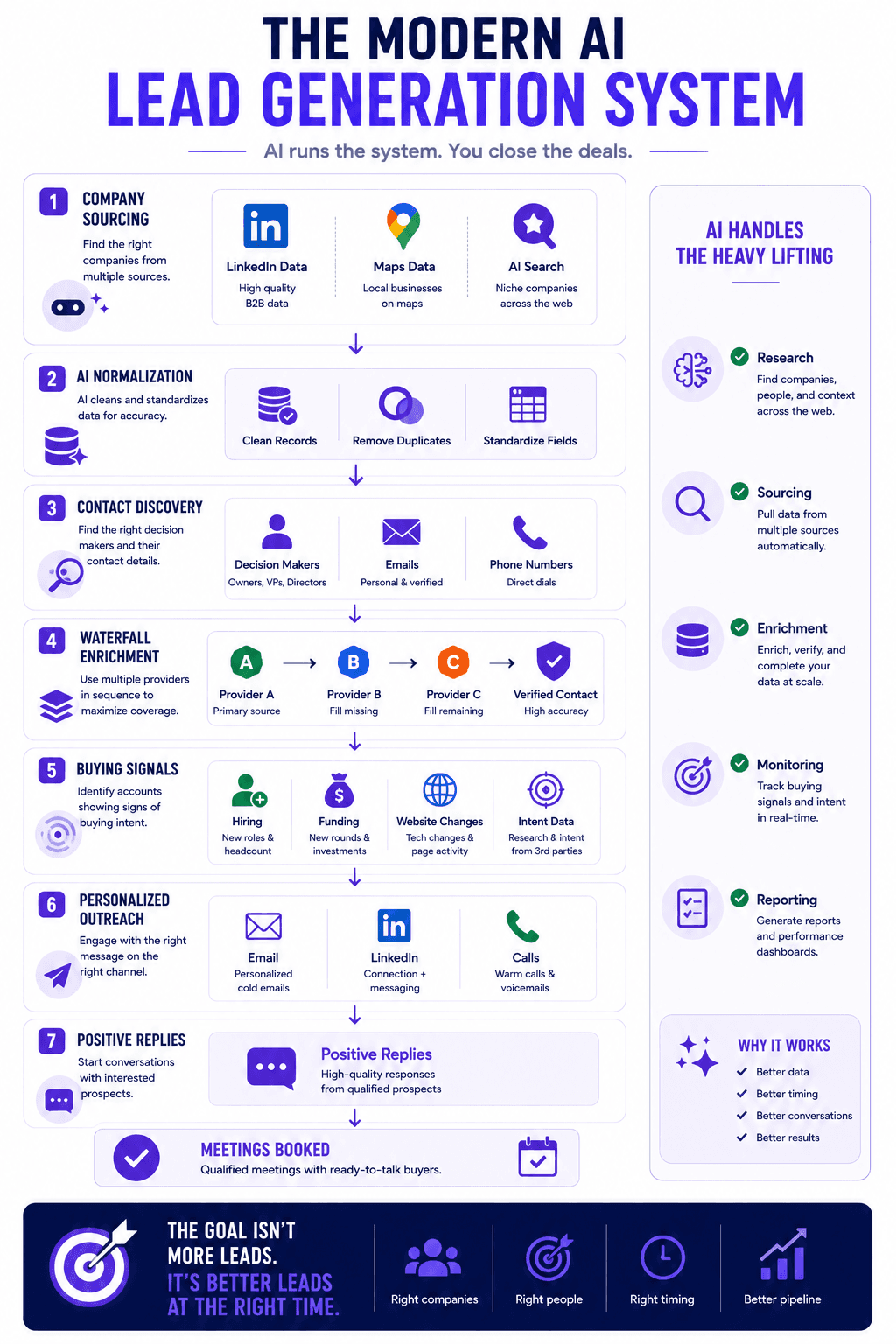
The first shift is how you build a list of companies. There are three kinds of sources, and each is strong in a different situation.
The first is data built on LinkedIn, which powers tools like Clay and most contact databases. It is high quality and works well for most B2B lists. The second is data built on Google Maps, which is what you want for local businesses that live on maps rather than on LinkedIn. The third is AI search tools that have indexed most of the public internet and can find niche companies that have a website but little presence anywhere else. These AI tools are the most expensive of the three, so using them for your entire list burns budget fast.
The method that works is to layer them. Start with the highest quality source for the list you are building, clean the results with AI, then use the AI search tools only to fill the gaps the first source missed. If you want marketing agencies with 10 to 200 employees, that is a LinkedIn list. If you want HVAC companies with more than 200 reviews, that is a Maps list. Because people describe their own industry inconsistently on LinkedIn and not every company has a Maps listing, the AI search tools close whatever the primary source leaves open. You end up with a complete list in close to one pass, and you paid full price only for the records you actually needed.
If you run this through Claude Code, you can hand it the criteria and let it check every database, normalize the columns, and produce a clean CSV. We walk through the enrichment side of this in enriching a lead list with Claude Code, and if you are choosing between the common sourcing platforms, Apollo versus Clay and our breakdown of prospecting tools cover the tradeoffs.
Find the contacts you could not reach before
The second shift is contact finding. For a long time you had two options and nothing in between. You could find someone on LinkedIn and reach out there, which everyone else is also doing, or you could pull a generic email off a website and use AI to guess the name behind it. Anyone without a clear LinkedIn profile and without a listed email simply fell out of your reach.
That gap is now closable. AI search tools are as useful for finding people as they are for finding companies, and open web search tools can surface an owner or decision maker who never appears cleanly in a standard database. As a simple test, searching the public web for the owner of a specific business will often return the name directly, and running the same search through an AI enabled tool returns the same answer in a structured form you can drop straight into a list. You are no longer limited to people who happen to keep an active LinkedIn presence. For the research layer that sits around this, using Claude to research leads before outreach shows how we gather context before a single email goes out.
How do you keep contact data accurate at scale?
Coverage without accuracy just means more bounces, so verification has to be part of the process rather than a step you add later. Waterfall enrichment helps here for the same reason it helps with sourcing. Instead of trusting one provider, you chain several and take the first verified result, which lifts coverage from around 20 percent to 80 percent on the same list. Run every address through verification before it enters a campaign, and treat catch all domains and role based inboxes with more caution than named personal addresses. Our guide to the best email verification tools for cold email covers how to set that check up so it runs on its own.
Let agents handle the repetitive work
The third and fourth shifts are about handing routine work to agents that can adjust when something unexpected happens.
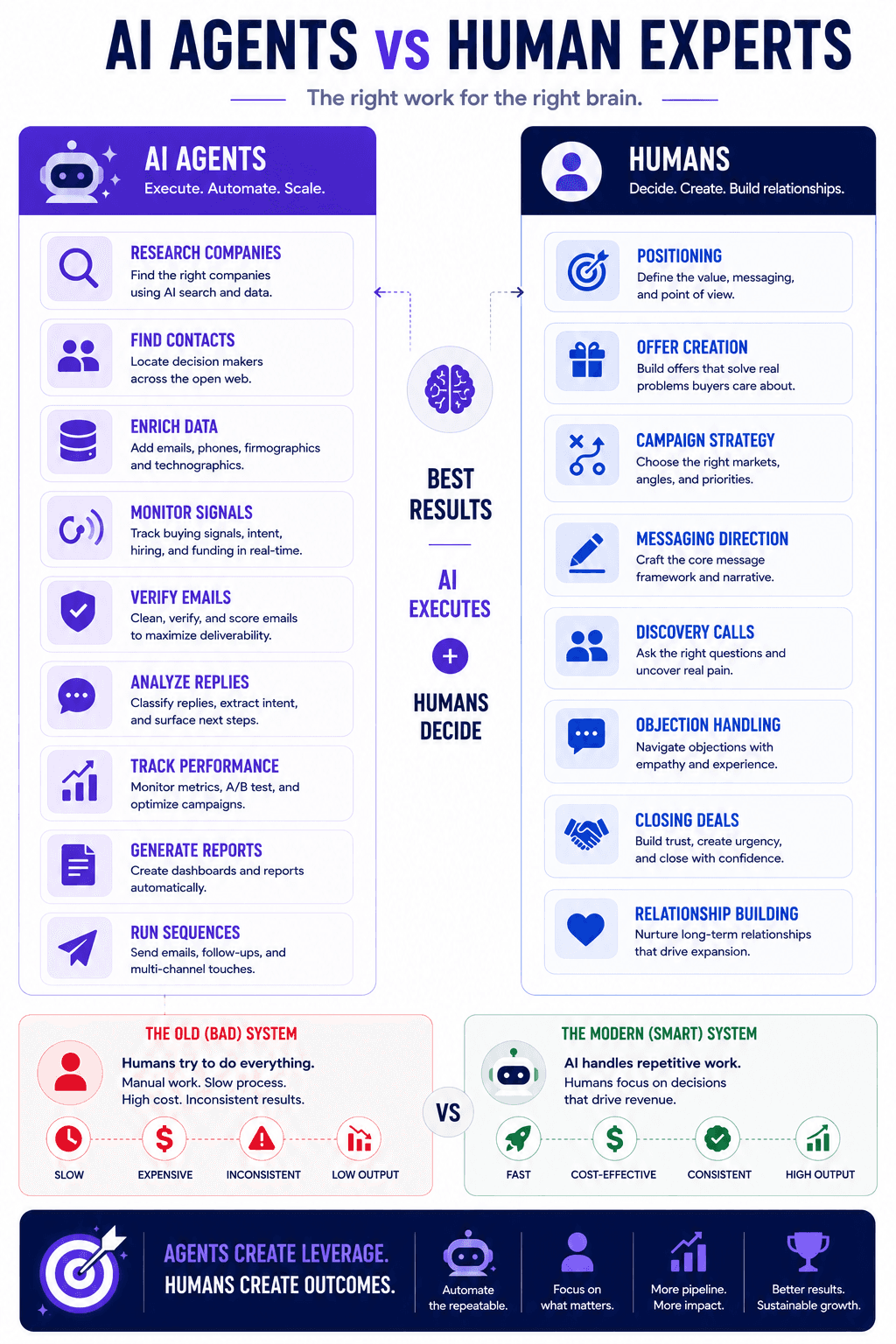
A scheduled task used to mean building a rigid workflow, wiring it to prompts you wrote in advance, and then fixing it every time an edge case broke the flow. Agentic scheduled jobs remove most of that maintenance. You can ask an agent to find five companies every morning that are hiring their first go to market engineer, pull the information from whichever source has it, and hand you the list. When it hits a case you did not anticipate, it works around the problem instead of stopping with an error. We use these same jobs to run daily reply rate analysis and bounce rate checks, the routine health checks that used to sit on someone's task list, and the results arrive as a Slack message on whatever schedule we set.
The related shift is goal mode, which is useful for anything with a clear definition of done. For list building, you describe the databases the agent must check, tell it to compile and normalize everything, and let it keep working until the list is complete. For campaign setup, you give it the inboxes, the messaging, the list, and the custom variables, then have it audit and verify each one. A pattern that works well is to dump your contacts in, ask the agent for ten to fifteen clarifying questions so the details are right, set the plan, and then define a pass or fail check for the goal so you know when it is genuinely finished. The GTM prospecting workflow with Claude Code shows this running end to end, and how AI SDRs are replacing manual prospecting covers where this fits in a wider team.
The fifth shift belongs here too. You can run an ongoing research loop on your campaigns so the insight comes to you. Instead of reading through response data yourself, an agent reviews which prospects reply, what titles and industries they hold, and which messages earn answers, then sends you a summary you can spot check. Timing matters more than wording in this world, since a fair message sent at the right moment tends to beat a polished one sent at random, so knowing who is responding and why is what you tune against.
What should you automate and what should stay human?
Agents are good at the structured, repeatable parts of the job: research, enrichment, sequencing, and the routine checks. They are not the right tool for positioning, for deciding what your offer actually is, or for the live conversation once a prospect replies. The strongest setups use agents to clear the administrative load so your team spends its attention on messaging strategy and the conversations that require judgment. Keeping that line clear is what stops automation from producing volume without results.
Build on open tools instead of paying for everything
The sixth shift is the growing amount of capable open source technology you can use for free. Browser automation lets an agent move through a site, read what is there, and complete a task. We once used it to take a product all the way to checkout to confirm whether a company was collecting sales tax correctly, which became a genuine reason to reach out. Open models have improved enough to write custom campaign variables locally after a little tuning. For pulling plain text off a homepage, an open HTML to text library does the job that used to cost hundreds of dollars a month through a paid scraper. Even technology detection, which sounds advanced, is often just checking a page's code for a signature that a given tool is installed, so you rarely need to pay for it.
The wider point is that the cost of data keeps falling, and a lot of what required an expensive subscription a year ago is now a short script. For the models and connectors worth building on, the best Claude MCPs for lead generation is a good place to start.
Putting the system together
Each shift is useful on its own, but the value shows up when they run as one motion. In practice the sequence looks like this. You source a list by layering LinkedIn or Maps data with AI search to fill the gaps. You enrich and verify the contacts through a waterfall so the addresses are accurate. You watch for a signal that indicates timing, such as a relevant hire or a change on the company's site. You personalize the opening line around what you found, send across your inboxes at a pace that protects deliverability, and let an agent report back on who responded. Then you repeat, using what you learned to tighten the next round.
You can wire this whole path through Claude Code, from lead list to sent campaign, and the personalization step in particular benefits from a focused approach, which we cover in writing personalized first lines for cold email.
How fast should you follow up on a lead?
Faster than most teams manage, because speed to lead remains one of the largest and most preventable leaks in the funnel. Leads contacted within an hour are far more likely to qualify than leads contacted a day later, yet a majority of qualified leads still sit untouched past the first 24 hours. This is exactly the kind of work agents handle well, since an agent can watch for a reply or a signal and route it the moment it appears, which closes the gap where interest usually goes cold.
Where to start
If you take three things from this, make them these. Build lists by layering your data sources rather than relying on one, so you get full coverage without overpaying. Organize your outreach around timing and signals instead of raw volume, because that is what the current conversion data rewards. And hand the repetitive research, enrichment, and monitoring to agents so your team can spend its time on messaging and real conversations.
Most of what this guide describes was difficult or impossible a year ago, and the tools keep getting cheaper and more capable. The teams that build this system now will have a real head start on the ones still doing it by hand.

If you want a done for you version of this running for your business, book a call with our team and we will map out what it would look like for your market.