Article
Jul 8, 2026
How Modern GTM Teams Find Opportunities Before Competitors
How modern GTM teams find opportunities before competitors using buying signals, intent data, and speed. A practical guide for 2026.

Most go-to-market teams are not losing because they send too few emails or work too small a list. They lose because they reach the same accounts at the same time as everyone else. When you build a campaign from a static list of companies that fit your profile, you are working from a snapshot that says nothing about whether those companies are ready to buy. Everyone with a similar list is looking at the same names, so the moment a company enters a buying cycle, a dozen vendors show up at once.
The teams that find opportunities before competitors have changed what they pay attention to. Instead of asking who fits the profile, they ask which accounts are showing signs of movement right now, and they reach those accounts while the window is still open. This guide breaks down how that works: the signals worth watching, how to read fit and timing together, why speed decides who gets the conversation, and how to build the system so it repeats instead of depending on one good week.
Why finding opportunities first became the whole game
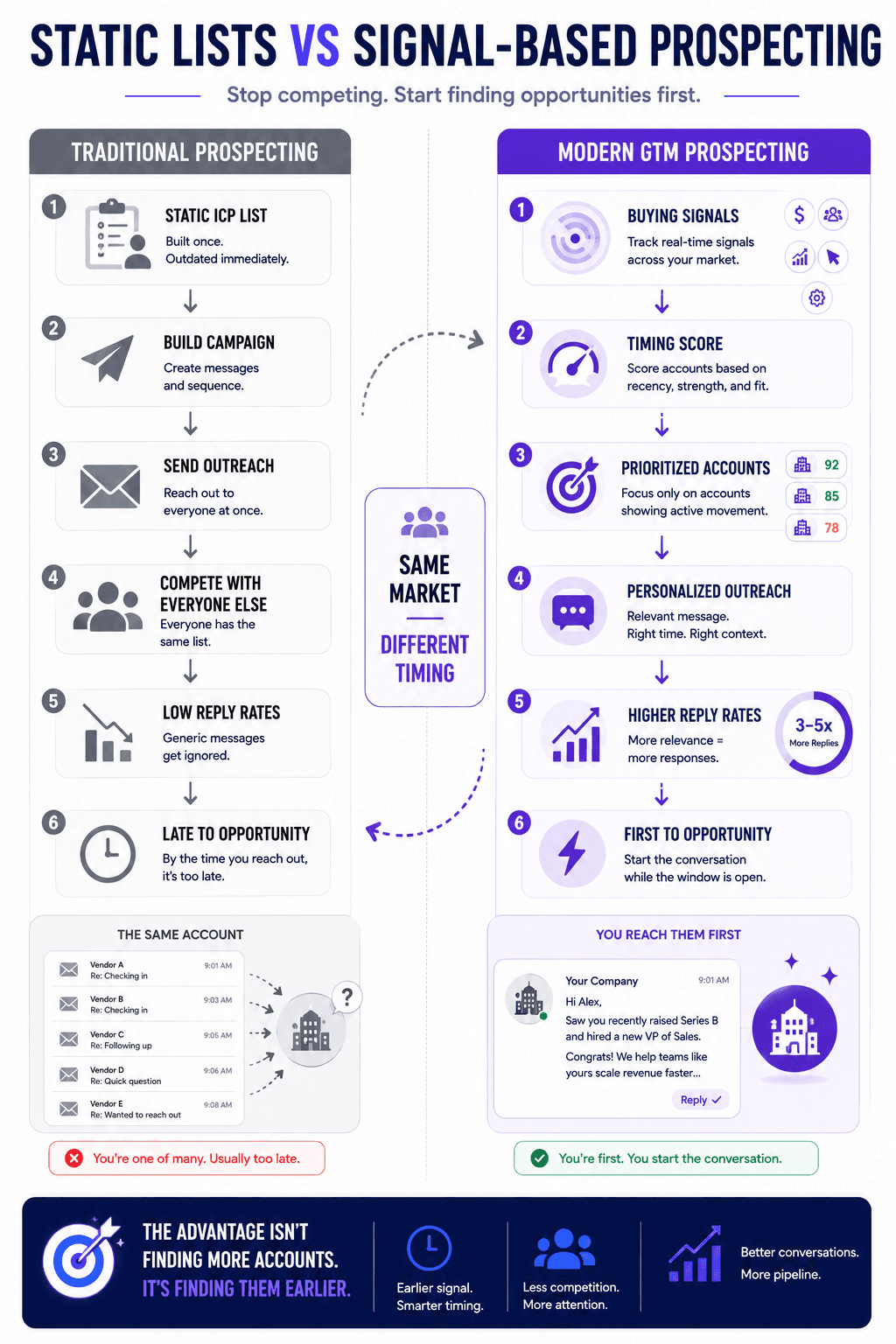
Buyers changed how they buy, and most outbound never adjusted. According to research cited in modern SaaS GTM strategy breakdowns, 81% of B2B buyers finish most of their research before they ever speak to a sales rep. By the time a company raises its hand, it has already formed opinions, shortlisted vendors, and in many cases made a soft decision. If your first contact happens after that, you are competing to change a mind rather than shape one.
A static list keeps you in that late window by design. It tells you a company matches your ideal customer profile, but fit alone does not tell you when to reach out. A company can be a perfect match and still be eighteen months from buying anything. The teams pulling ahead treat fit as the starting filter and timing as the thing that actually decides where effort goes. That shift is the core of modern prospecting, and it is why understanding what buying signals are has become a basic skill rather than an advanced one.
What a buying signal actually is, and which ones matter
A buying signal is any observable change inside an account that suggests it may be entering an active buying cycle. The value of a signal is not that it proves intent. It is that it reveals an opportunity earlier than you would have found it on your own.
Company events that create a reason to act
Some of the most reliable signals are public company events. Funding rounds, senior hires, leadership changes, acquisitions, and expansions all tend to create new budget or new pressure. A company that just raised a Series B and hired a new VP in your target function is a different prospect than the same company was three months earlier. As one 2026 lead scoring breakdown explains, a perfect-fit account with steady engagement might not buy for six months, while a perfect-fit account that just raised money and staffed up is a now opportunity.
Behavioral signals that show research in progress
Behavioral signals come from what people do rather than what a company announces. Repeat visits to a pricing page, downloads of comparison content, time spent on documentation, and engagement with your category all point to active evaluation. These signals are useful because they catch a buyer mid-research, which is the window where relevance is highest and generic outreach still gets ignored.
Technographic and displacement signals
The tools a company uses, and the ones it drops, say a lot about timing. Adopting a complementary platform, removing an existing tool, or approaching a contract renewal all open a window where switching is on the table. Competitor displacement signals are among the strongest because they point to a specific decision the account is already weighing.
The question every signal has to answer
A signal is only worth acting on if it answers whether this is the right moment. Fit tells you an account belongs in your universe, while a signal tells you the account is actually moving, and you need both to prioritize without guessing.
How modern GTM teams read signals before competitors do
Collecting signals is the easy part, and reading them well is where most teams fall down, usually because the signals sit in a dashboard that nobody connects to action.
Combining first-party and third-party data
First-party data is often the most underused source of signal. Product usage patterns, trial behavior, support themes, and website activity frequently show readiness earlier than anything you can buy. Third-party sources add reach by showing category research happening across the wider market. The teams that read timing well combine both, so an account showing external research and internal engagement rises to the top on its own. Pulling those sources together is a big part of what a GTM engineer actually does, and it is closely tied to the broader practice of revenue intelligence.
Scoring fit and timing together
A common mistake is to score fit once and stop there. Fit is stable, but timing changes weekly, so high-performing teams keep a fit score and a timing score and let the combination decide priority. That way an account that becomes active this week moves up without anyone rebuilding the list. This is where enriching your lead list with live data pays off, and where the right prospecting tools earn their place in the stack.
Where intent data fits, and where it misleads
Intent data shows which accounts are researching your category, sometimes before they contact any vendor. It is useful, though it carries a noise problem that G2's analysis of signal tools documents clearly. Reps stop trusting intent data the moment it feels inaccurate or hard to validate, and once that trust is gone they go back to manual research. The fix is to filter intent against a precise profile so you act on genuine matches instead of background activity.
Speed is the second half of the advantage
Seeing an opportunity early only helps if you act while the window is open, and this is where most teams quietly lose. A 2026 speed-to-lead benchmark of more than 250,000 B2B leads found the median response time was 42 hours, and that companies responding within five minutes converted at around 21% compared to 2.3% for those who waited a day or more. The same research found only about 7% of teams hit the fast window at all, which makes speed one of the cheaper advantages still available.
The pattern holds for signal-based outreach too. Analysis of GTM automation with intent data shows the window of receptivity around a buying signal is short, and reaching an account within a day of a meaningful signal produces a different result than reaching it a week later. The older Harvard Business Review audit, revisited in a 2026 review of every major response-time study, found firms that responded within an hour were roughly seven times more likely to qualify a lead than those who waited longer.
This is why timing beats polish more often than people expect. One enterprise team we worked with doubled its sales efficiency by engaging leads at the right moment with data-backed decisions rather than working accounts in list order. The improvement came from better timing, not from cleverer copy. If your current process reaches accounts days after a signal fires, that gap is where deals are leaking, and it is worth reading through why most cold outreach fails before the first email is sent to see how much of it traces back to timing and data rather than words.
Building the system so this repeats
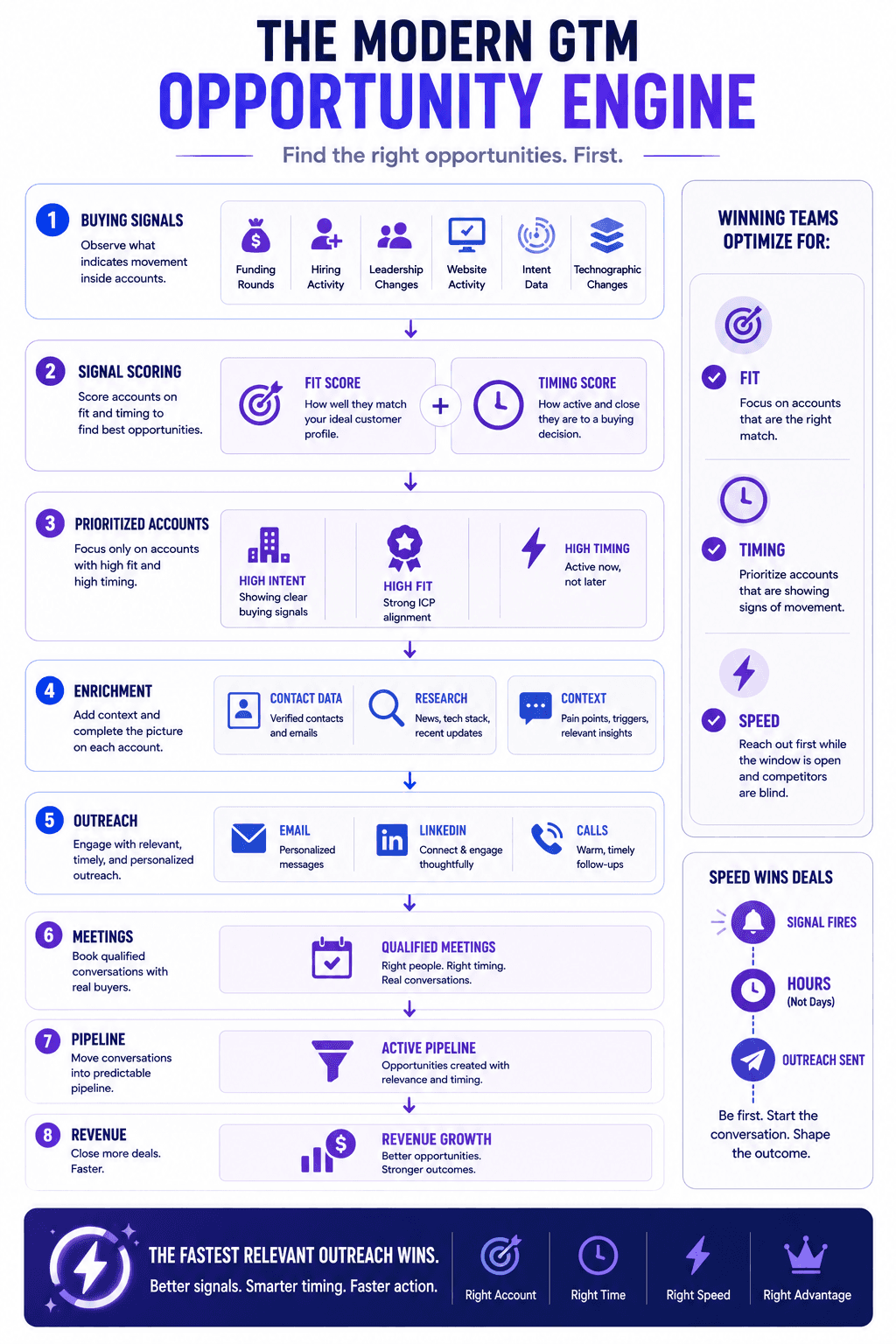
Catching one opportunity early can happen by chance, but catching them consistently requires a system. The difference is whether signals flow into action automatically or sit until someone notices them.
The loop that turns signals into conversations
A working system moves in a loop: gather signals, match them against your profile, enrich the account with the context a rep needs, route it to outreach fast, and record what happened. When that loop runs on its own, an account showing intent this morning can be in a personalized sequence this afternoon instead of next week. Teams building this often start with Claude Code for prospecting and wire in data sources through Claude MCPs for lead generation so the whole path from signal to send lives in one place.
The feedback loop that improves signal quality
The teams that get better over time watch which signals produce real conversations and which produce noise, then feed that back into their thresholds and routing. Over a few months this turns a generic signal feed into a tuned one that reflects how your specific market actually buys. The cold email frameworks high-performing teams use all include this feedback step for the same reason.
Why this is engineering, not more headcount
None of this requires a bigger team. It requires the plumbing that lets a small team act on more signals without dropping any. That is the shift behind AI SDRs replacing manual prospecting, where the goal is not to remove people but to remove the delay between a signal appearing and a person acting on it.
Frequently asked questions
What is the difference between intent data and buying signals?
Buying signals are the broad category of observable changes that suggest an account may be moving toward a purchase, including funding, hiring, tool changes, and research behavior. Intent data is one type of signal, specifically the research activity that shows an account is looking into your category. Intent data tells you someone is researching, while the wider set of buying signals tells you why the timing might be right and what to say.
How fast do you need to act on a signal?
Faster than most competitors manage. With a median B2B response time around 42 hours, even reaching an account within a few hours puts you ahead of most of the field. For behavioral and intent signals the window of peak receptivity is short, so the practical target is same-day contact whenever the signal is strong.
Do you need expensive tools to do this?
No. The tools matter less than the workflow underneath them. Plenty of teams overspend on data and still act slowly because nothing connects the signal to the outreach. A modest stack with a tight loop from signal to send will outperform an expensive stack that dumps signals into a dashboard nobody checks. Choosing tools by the job they do, rather than by the feature list, is the more useful way to build the stack.
How is this different from just buying a bigger list?
A bigger list gives you more names in the same late window everyone else is working. Signal-based prospecting gives you the same market seen earlier, so you reach accounts while they are still deciding rather than after they have shortlisted vendors. The advantage comes from timing and relevance rather than scale, which is what actually separates the teams booking meetings from the ones adding volume.
Bringing it together
Finding opportunities before competitors comes down to three habits that reinforce each other. You watch for signals that reveal movement instead of working a static list, you read fit and timing together so effort goes where the window is open, and you act fast enough that the window is still open when you arrive. None of these is complicated on its own. The advantage comes from running all three as a system that repeats, which is where most teams still have room to gain.

If you want a system that surfaces the right accounts at the right moment and gets outreach out before the window closes, book a call with our team and we will map it to how your pipeline works today.