Article
Jul 10, 2026
How Revenue Teams Use Buying Signals to Generate Pipeline
How revenue teams use buying signals to generate pipeline: which signals matter, how to stack them, and how to act before the window closes.

When pipeline gets thin, most teams reach for volume. More dials, more sequences, more contacts per account. The activity goes up and the meetings do not, and the diagnosis usually lands on the reps.
The problem is rarely effort. It is timing. Forrester's research shows B2B buyers now complete most of the buying journey before contacting a vendor, moving through roughly 27 interactions with six to ten stakeholders before a seller hears from them. By the time a form gets filled out, the shortlist already exists. Corporate Visions found that 85% of B2B purchases go to a vendor already on the buyer's day-one shortlist, which means the outcome of most deals is decided in a window sellers never see.
Buying signals are how revenue teams get into that window. If you are still working from a static list of accounts that match your ICP, the list tells you who could buy and nothing about who is buying. This is one of the reasons most SDR teams struggle to generate pipeline even when their activity metrics look healthy.
This guide covers what the signals actually are, how to rank them, how to act on them fast enough for them to matter, and how to run the whole thing as a weekly operating motion instead of a one-time exercise.
What Buying Signals Actually Tell a Revenue Team
A buying signal is any observable event that suggests an account is moving toward a purchase. That definition is broad on purpose, because the useful work happens when you sort signals by where they come from and what they mean. If you want the foundational breakdown, we covered what buying signals are and where they come from in more depth separately.
First-party, third-party, and internal change signals
First-party signals happen on property you own. Website visits, page depth, time on page, document opens, email replies, demo requests. You see these directly and you see them immediately, which makes them the most actionable category you have.
Third-party signals happen everywhere else. Someone at a target account searches a topic, reads a comparison article, or lands on a review site to look at your product next to a competitor's. Aggregators pick this activity up and attribute it to the company. This is what third-party intent data is measuring.
Internal change signals are events at the company itself. Funding rounds, hiring surges, leadership appointments, product launches, earnings call language. These do not indicate that someone is researching you. They indicate that a budget or a mandate just appeared.
The difference between a signal and an intent signal
A website visit tells you an account is aware of you. A pricing page visit tells you someone has thought about your product seriously enough to ask what it would cost. Those are different events and they deserve different responses.
The distinction is depth, not category. A prospect who spends five seconds on your homepage and leaves has produced noise. A prospect who spends three and a half minutes moving through a product page, then a pricing page, has produced something worth interrupting your day for. Most signal platforms let you filter on dwell time and page depth for exactly this reason, and teams that skip that filter end up chasing bounce traffic.
Why signal quality is the constraint, not signal volume
The temptation with signals is to collect more of them. That instinct produces the opposite of clarity. DemandScience found that 87% of organizations say their marketing investments produce signals that look like buying intent but do not reflect it, and only around a quarter of those signals convert into qualified opportunities.
We see this constantly. A team turns on intent monitoring, gets a firehose of accounts flagged as in-market, works them the same way they worked the old list, and concludes that signals do not work. What actually happened is that they never built a rule for which signals earn a response.
How Do You Rank Buying Signals by Strength?
Rank them by how close the behavior sits to a purchase decision, and by how much of the company is involved.
Tier 1: pricing pages, product pages, and review site comparisons
These are the signals that should reorder your day. If someone has gone looking for your pricing, they have already decided your product is worth evaluating and are now working out what it costs to say yes. A comparison view on a review site carries similar weight, because the buyer has narrowed the field to a shortlist and is doing the final read on tradeoffs.
Review site activity also carries a second meaning that teams miss. If the account is already a customer and someone there is comparing you against an alternative, that is a churn signal, and the right response is a retention conversation rather than a prospecting sequence.
Tier 2: third-party research spikes
Third-party research is a layer earlier in the process. Someone is reading about the category, not about you. That is still valuable, because whoever shapes the buyer's requirements early tends to win the evaluation. A vendor who arrives after the requirements are set is arguing against a spec someone else wrote.
Tier 3: funding, hiring, and leadership change
Funding, hiring, and executive appointments do not mean anyone is thinking about you. They mean money and mandate exist. Cognism's data shows that champion migration signals, where a former buyer takes a role at a new company, produce opportunities with 114% higher win rates and 54% larger deal sizes, and that incoming executives deploy roughly three quarters of their budget within their first two quarters.
The mistake with funding signals is treating the funding as the reason to call. Nobody raises a round in order to buy your software. They raised it to accomplish something specific, and funding announcements usually state what that something is. Your job is to read the article, work out whether your value proposition connects to the stated goal, and open the conversation there.
The consumption and headcount test
Two filters separate a real research spike from background noise.
The first is consumption relative to baseline. Most intent platforms score topic research against an account's own historical activity. An account researching a topic more heavily than it ever has before is behaving differently, and different behavior is the whole point.
The second is how many people are doing it. One person researching a topic tells you about that person. Five or ten people at the same company researching the same topic within the same window tells you a meeting happened, a problem was named, and everyone went off to look for options. That second pattern converts. The first usually does not.
Signal Stacking: Why Two Signals Beat One
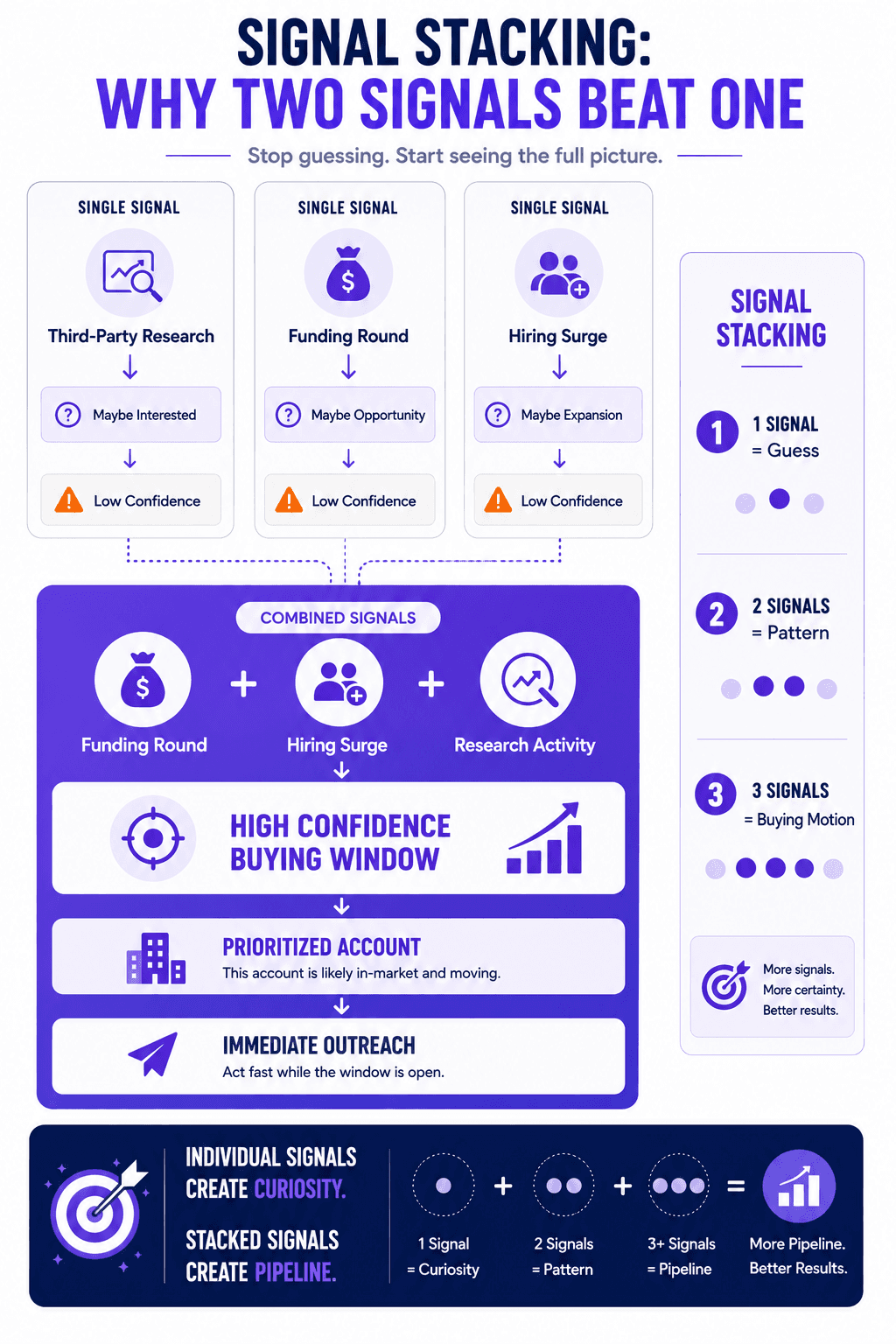
Signal stacking is the practice of requiring more than one signal before an account gets elevated to active outreach.
The logic is simple. An account doing third-party research on your category is interesting. An account doing third-party research on your category that then shows up on your pricing page is in a buying process. Each signal is a partial view. Together they describe a sequence of behavior that is hard to explain any other way.
The numbers support the approach. ABM Leadership Alliance and Demandbase data show that programs combining multiple account signals generate 2.6x more pipeline per marketing dollar than broad-reach demand generation, and that gap has widened every year since 2022.
In practice, a stack might look like a funding announcement plus a hiring surge for the exact function you sell into, plus a spike in third-party research on a related topic. Any one of those would be a maybe. All three together describe a company that got money, decided to build a team, and is now shopping for tools to give that team. This is the mechanic behind how modern GTM teams find opportunities before competitors do: they are not seeing different data, they are requiring a higher bar before they act and then acting harder on fewer accounts.
Set the rule explicitly. Decide how many signals, from which tiers, within what time window, qualify an account for outreach. Write it down. Otherwise every rep invents their own threshold and you lose the ability to learn anything from the results.
How Do You Turn a Buying Signal Into a Booked Meeting?
The signal is worthless if the response is slow, generic, or aimed at one person.
Speed is the whole game
Buying signals decay. The MIT and InsideSales lead response research found that the odds of qualifying a lead drop roughly 21 times when the first contact attempt moves from five minutes to thirty, and the odds of making contact at all drop by around 100 times across the same window. The Harvard Business Review audit of 2,241 companies found an average response time of 42 hours.
That gap is the opportunity. Most competitors watching the same signal will take two days to act on it. A response measured in minutes is not a marginal advantage over a response measured in days.
Operationally this means signals need to route themselves. If a Tier 1 signal fires and the rep finds out during their next CRM check, the window has already closed. The signal has to reach a person, with context attached, without anyone remembering to look.
Message the action, not the product
Relevance is now a filter, not a nice-to-have. Gartner data shared in Saleshood's buyer engagement research found that 76% of buyers avoid sellers who send irrelevant messages and 58% avoid suppliers who send too many.
The messaging pattern that works references the behavior and then asks a question about the buyer's goal. A prospect who landed on your marketing page has a marketing problem, and the email should name the two or three problems companies like theirs usually arrive with and ask which one is theirs. A prospect whose company just closed a round to expand its sales organization should get a message about how they plan to expand it.
Note the framing. "I would like to learn more about how you plan to get there" earns replies at a materially different rate than "I would like to show you something," because the second one is transparently a pitch wearing a question mark. Doing this well requires actual context on the account, which is why teams increasingly research leads before outreach using AI rather than skipping the step. Skipping it is a large part of why most cold outreach fails before the first email is sent.
One enterprise client we work with doubled their sales efficiency after moving to signal-based prioritization, largely because reps stopped spending their mornings deciding who to call.
Phone first, email second
When a Tier 1 signal fires, the phone compresses the path. A call can produce a booked meeting in one interaction. An email thread often needs five or six exchanges to reach the same outcome. Use the call for the highest tier signals and let email carry the rest.
Multi-thread from the start
Buying groups now average around eleven stakeholders for deals above 50,000 dollars. Prospecting one contact at an account with eleven decision makers is a coverage problem no message quality can solve.
The practical approach when a signal fires at a large account is to identify the executive who owns the outcome, then work one layer below them. Directors and managers do the research and bring options upward. Reach both layers, vary the message between them, and you have created the internal conversation that produces a meeting.
What Signals Matter After the First Meeting?
Buying signals are usually discussed as a top-of-funnel tool. The more interesting use is inside open deals, where engagement data becomes a read on whether the deal is real.
Saleshood analyzed buyer engagement across roughly 50,000 digital sales rooms spanning 150 companies and about a billion dollars in pipeline. Four findings stand out.
Repeat visits predict progression. High-performing deal rooms averaged around 16 repeat buyer visits across the sales cycle. A single visit indicates awareness. Sustained return visits indicate a buying committee doing work.
Contact count drives engagement. Deals with seven or more contacts in the room generated roughly seven times the engagement of single-threaded deals. In the same dataset, 69% of rooms had three or fewer contacts, which is a good measure of how normal single-threading still is.
Mutual action plans double engagement. Deals with an active mutual plan, mapped to the buyer's real decision criteria, saw about twice the engagement and larger average deal sizes. Teams that introduce the plan on the first or second call also learn something immediately: a buyer who will not map out their own process with you is either not the decision maker or not in a process at all.
Late-stage content outperforms everything else. Buyers spent roughly 20 times more time with ROI calculators, business case material, and pricing models than with case studies, testimonial videos, and product decks. By the time they are in the room, they have read your marketing site. What they need is help building internal consensus and justifying a decision.
This is where revenue intelligence earns its place in a pipeline review. Instead of asking a rep how they feel about a deal, you can ask how many stakeholders have engaged, what content they opened, and whether the mutual plan has moved. Call recordings answer the rest, and you can pull signals out of recorded calls at scale rather than relying on what a rep remembers.

Building the Signal Motion Into Weekly Operations
None of this works as a project. It works as a routine.
The daily start-of-day routine
Reps should begin the day with first-party signals, because those accounts have already come to you. Work down through review site activity, then third-party research spikes, then company change events. Anything below the threshold you set for signal stacking stays in nurture and does not consume selling time.
The weekly pipeline review question set
Change the questions leaders ask. How many stakeholders are engaged on this deal, and which functions do they represent. What content have they opened. Has the mutual plan advanced since last week. What signal originally brought this account into pipeline, and is it still firing.
These questions are answerable from data rather than from memory, which is what makes them useful.
Kill the signals that do not convert
Track reply rate, meeting rate, and closed pipeline by signal type. Some signals will earn their place and some will not, and the answer will differ by company. Webinar attendance is a strong signal in some businesses and background noise in others. You only find out by measuring, and you can only measure if reps are following a written rule about which signals trigger which action.
Where AI removes the research bottleneck
The reason most teams never operate this way is the research load. Doing signal-based outreach properly means reading a funding announcement, understanding what the company said it would do with the money, checking who they are hiring, and writing a message that connects all of it to a problem you solve. That is fifteen to twenty minutes per account done by hand, which does not survive contact with a quota.
This is the work AI is genuinely good at. AI sales agents can monitor a defined account list continuously and surface only the accounts that clear your stacking threshold. Claude MCPs for lead generation connect signal sources, enrichment, and sequencing into one pipeline so that context arrives with the alert rather than being assembled afterward. Your existing prospecting tools already produce most of the raw data, and the work of wiring detection to action is increasingly what a GTM engineer is hired to do.
The payoff shows up in cycle length. Signal-driven programs are running average sales cycles around 54 days against 88 days for volume-driven outbound, because the conversation starts while the buyer is already in motion.
Where to Start
Three things carry most of the result.
Set a written rule for which signals qualify an account for outreach, and require more than one before a rep spends time. Build routing so that a Tier 1 signal reaches a person in minutes rather than at the next CRM check. Change what you inspect in pipeline reviews from rep sentiment to buyer behavior.
The teams generating pipeline right now are not sending more email. They are watching a smaller set of accounts more closely, acting inside the window while it is open, and reaching the whole buying committee instead of one champion who cannot get budget on their own. Everything else follows from that.

If you want to look at how this would work against your current outbound motion and account list, book a 45 minute call with our team. We will walk through which signals your stack can already detect, what you are missing, and what it would take to run this weekly