Article
Jul 31, 2026
How Modern Revenue Teams Find Their Best Customers
How modern revenue teams find their best customers by combining ideal customer profile fit, buying signals, and a repeatable system.

Every company selling into the same market usually works from the same toolbox. The enrichment platforms, the intent providers, the sequencers, and the data vendors are available to you and to every competitor you have. When a founder tells us their tooling is their advantage, we point out that the same fishing rods are sitting in everyone else's boat, and everyone is casting into the same pond. The teams that consistently land their best customers are not the ones with better tools. They are the ones who know exactly who they serve, can tell when those buyers are ready, and have built a system that repeats.
Most teams still try to solve slow pipeline by adding more names to the top of the funnel. That approach made sense when attention was cheaper. Today it fills your pipeline with accounts that will never close and buries the few that would. This guide walks through how modern revenue teams find their best customers by combining a clear definition of fit, real buying signals, and a process that holds up as you scale.
Why more leads stopped being the answer
Volume used to be a reasonable proxy for pipeline. If you contacted enough people, some would convert. That math has quietly broken. Buyers have grown immune to generic outreach, and they now do most of their research before they ever speak to a seller. Gartner's data shows buyers complete the majority of their evaluation on their own, which means the quality and timing of your outreach matters far more than the number of messages you send.
The noise problem is easy to feel firsthand. One revenue leader we follow counted 22 people who messaged him on LinkedIn during a single stretch of leave, every one of them selling, none of them personalized, and most using a single channel while clearly rushing. Only one referenced an actual reason for reaching out, and that was the only message he answered. Your buyers are running the same filter every day.
Your team's time is also the scarcest resource you have. Reps spend only about 40 percent of their week actually selling, with the rest lost to admin, research, and data entry. Pointing that limited selling time at poorly matched accounts is one of the most expensive mistakes a revenue team can make. This is the same reason most cold outreach fails before the first email is sent, and it is why modern GTM teams focus on finding opportunities before competitors rather than competing on sending volume.
Start with who, not how many
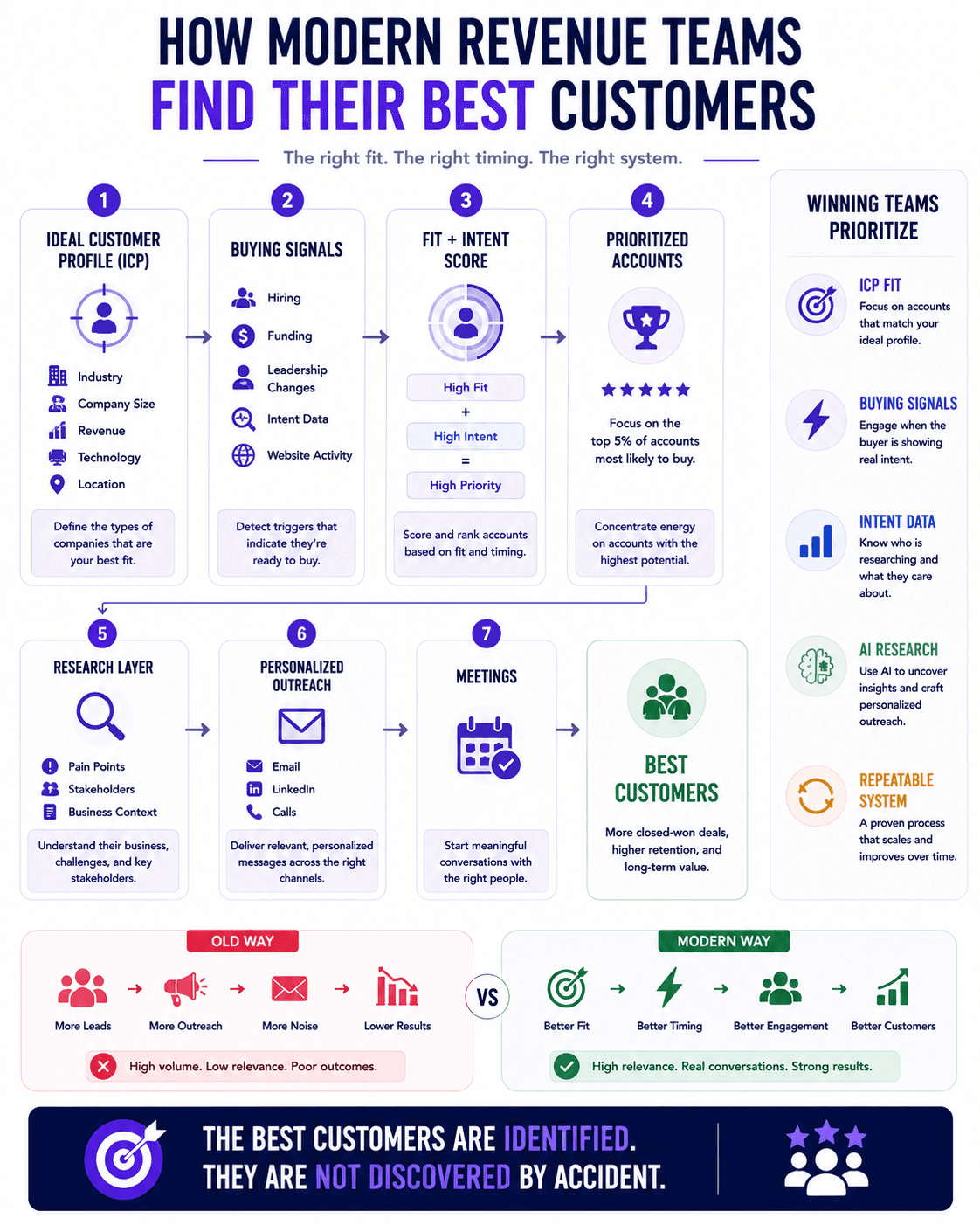
Finding your best customers begins with defining them precisely. An ideal customer profile is a data backed description of the accounts most likely to buy, stay, and generate real value over time. It is not the same as a buyer persona, which describes the individual person you sell to. The profile describes the company you should be pursuing in the first place.
The teams that do this well see measurable returns. Research links a strong ideal customer profile to roughly 68 percent higher account win rates, largely because reps stop spending cycles on accounts that were never going to close. The downside of getting it wrong is just as concrete. Companies where less than 10 percent of the customer base fits the profile are significantly less likely to survive over five years, because a business built on mismatched customers carries higher churn and produces weaker referrals.
The practical move is to narrow from your total addressable market down to the serviceable slice you can genuinely serve well. One team we studied stopped looking at the whole market and asked instead which companies inside it had a clear fit with their product, because a tight fit produces faster sales velocity and lets them concentrate on the accounts that matter. You can start that work with our guide to finding potential customers for your business, and if you sell into a defined set of high value accounts, account based marketing gives you a structure for it.
Go past the playbook page
A profile that lives as a tidy page in a playbook is close to useless. The value comes from understanding what is actually happening inside your customer's world. One operator described going on ride alongs with real clients and finding a clear gap between what their systems reported and what was happening in the field. Leaders read the CRM and make decisions from it, but people enter that data selectively, so the record and the reality drift apart. Time spent watching how your best customers actually work will teach you more about fit than any amount of dashboard analysis.
The signals that tell you a best customer is ready
Knowing who fits is half the picture. The other half is timing. A perfect fit account is worth very little to you in a quarter when nothing is changing in their business. What creates an opening is a trigger, some change that makes them start looking for what you sell. Triggers matter for inbound and outbound alike, and outreach that ignores them reads as noise no matter how good the copy is.
This is where buying signals and intent data earn their place. They tell you which accounts are researching now, which have hired for a relevant role, which are expanding, and which are showing behavior that tends to precede a purchase. A large share of that activity happens well outside your CRM. Common Room's research found that close to 30 percent of opportunities show up in communities and other channels before they ever appear in your system, and that acting on those signals helped teams close deals around 20 percent faster. Your sellers only get a sliver of a buyer's attention, so the earlier you spot movement, the more of that journey you can actually influence. Our breakdown of how revenue teams use buying signals to generate pipeline covers which signals to track and how to stack them.
Fit and intent belong together
Fit and intent are only useful in combination. A high intent account that does not match your profile will drain time and often churn out. A perfect fit account with no active intent is worth watching but not worth a full outreach push yet. The accounts that deserve your team's attention today are the ones that score well on both. One enterprise sales team we worked with doubled its selling efficiency after it started engaging leads at the right moment with data backed decisions rather than working a static list. Layering AI into this scoring, which we cover in how to generate B2B leads with AI, lets you rank accounts by fit and timing together instead of guessing.
Why your CRM will not find your best customers for you
A common and expensive assumption is that buying a CRM installs a sales system. Teams spend heavily on implementation and expect process to arrive with the software. What they get is a place of record. The CRM stores what happened, but it does not define how you engage a customer, what you do when a deal moves from one stage to the next, or which accounts deserve priority. Those decisions have to be designed by you first and then embedded into the tool.
The order matters. Documenting the buyer's journey and your own sales journey has to come before the technology, because the system is what produces consistency once more people and more markets are involved. When that groundwork is skipped, sales performance stays inconsistent and no one can diagnose why deals stall. A revenue intelligence layer helps here by unifying your sales data and surfacing where deals are slipping, but it only works on top of a defined process. If you want to build that foundation deliberately, our walkthrough on building an AI operating system for your business lays out the layers in order.
Turn it into a repeatable system
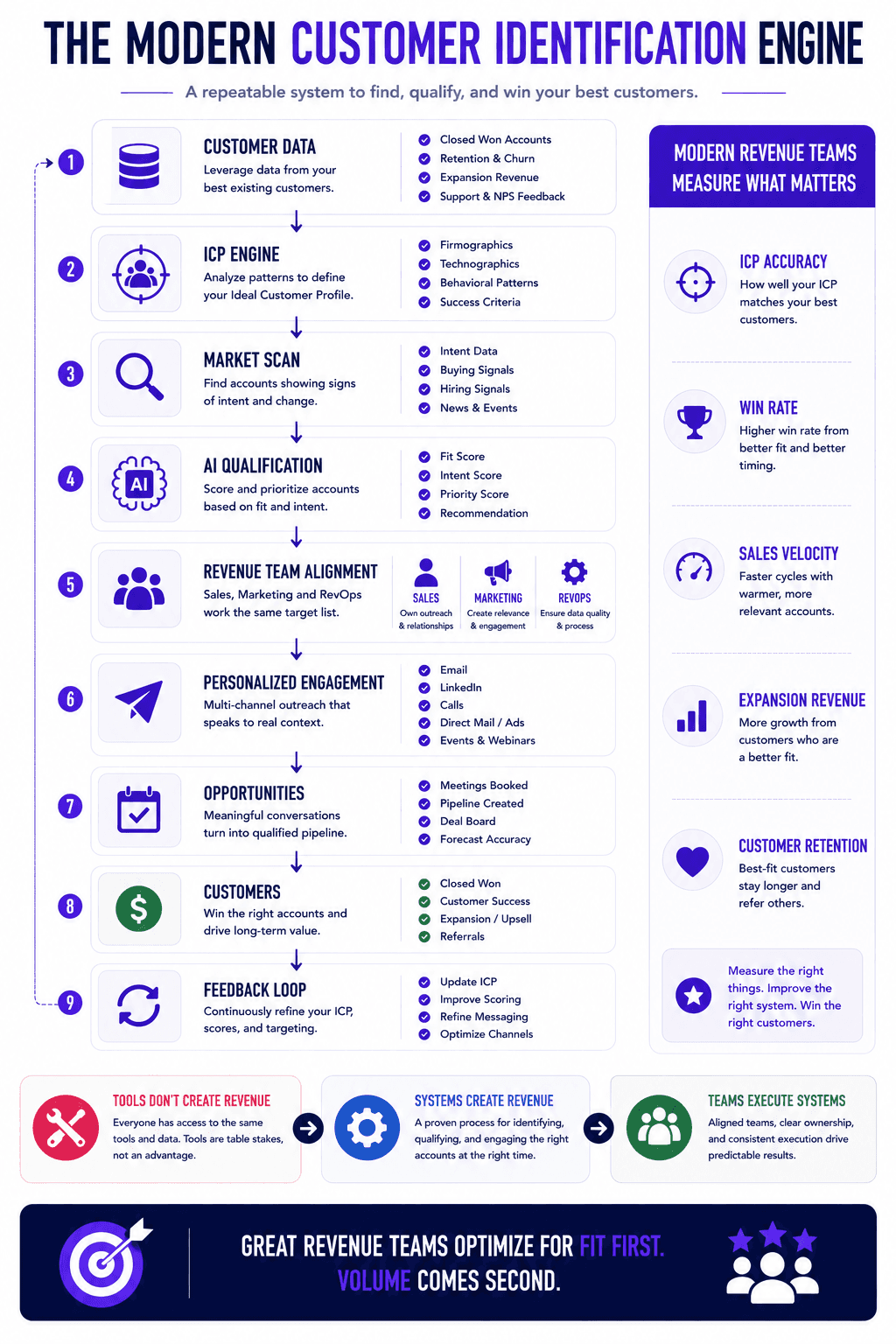
Finding your best customers once is a result. Finding them predictably is a system. The revenue leaders whose approach informed this guide summarized the build in a sequence that holds up well. Define who you target, map the path a deal takes from first conversation to decision and beyond, pressure test that path against reality, and then systemize what works. Only after that do refinement, coaching, and automation earn their place, because automating a broken process just produces bad outcomes faster.
The gap between having a process and running one is where most teams lose the plot. Recent research found that while roughly 89 percent of teams have documented their sales process, only about 36 percent of reps consistently follow it, and the teams whose reps do adhere hit quota at several times the rate of those who do not. A system only pays off when your people actually run it, which is why documentation, practice, and reinforcement matter as much as the design. Getting this right is what lets you book more sales meetings without adding headcount, and it underpins nearly all of the B2B lead generation strategies that actually work in 2026.
Your best customers change, so keep the profile alive
An ideal customer profile is not a one time exercise. Markets shift, your product evolves, and the accounts that fit perfectly a year ago may look different now. Growth stage companies can see meaningful drift inside 90 days. The most reliable way to keep the profile honest is to weight your refresh toward retention data rather than your most recent wins, since recent closes are biased by whatever campaign happened to run, while long term retention shows which customers actually stay and grow.
That same logic points at an underused source of best customers, the ones you already have. Expanding an existing account costs far less than winning a new one. Gainsight's benchmark data put the cost of expansion revenue at roughly half the cost of acquiring a new customer, which makes your current base one of the highest return places to look for growth. Reviewing who among your customers fits best, and why, sharpens both your expansion motion and your outbound targeting at the same time.
What is the difference between a lead and a best fit customer?
A lead is anyone who has entered your pipeline, often just a name and an email with little indication of fit or intent. A best fit customer is an account that matches your ideal customer profile, meaning it is structurally likely to buy, to stay, and to generate strong value over time. The distinction matters because a funnel full of leads with no fit produces motion without results, while a smaller set of best fit accounts produces durable revenue. The job of a modern revenue team is to filter the first group down to the second before spending real effort.
How do you find your best customers with limited data?
Start with the customers you already have and look for patterns. Identify your happiest, longest tenured, and highest value accounts, then note what they share in industry, size, structure, and the problem that brought them to you. That pattern becomes the first version of your profile. From there you can layer in buying signals and light enrichment to spot similar accounts showing relevant activity. You do not need an expensive stack to begin, because a clear definition applied by hand will outperform a large budget aimed at the wrong accounts.
How often should you update your ideal customer profile?
Treat it as a living document rather than an annual ritual. Growth stage companies should review quarterly, since their product and market are still settling and the profile can drift within a single quarter. More established companies can review less often but should still check any segment that carries a large share of revenue at least twice a year. Weight each refresh toward retention data so that you are optimizing for customers who stay, not just for whoever responded to your last campaign.
Do you need expensive tools to find your best customers?
No. Every competitor has access to the same enrichment and intent tools, so the tooling itself is never the advantage. What separates the teams that win is clarity on who they serve, the discipline to act on fit and timing together, and a documented process their reps actually follow. Tools help you execute faster once the thinking is in place, but they cannot substitute for it.
Bringing it together
Finding your best customers comes down to three things that reinforce each other. Know precisely who you serve and narrow to the accounts you can genuinely help. Act on fit and timing together, using real signals rather than a static list. Build the whole thing into a system your team runs consistently, then refine and automate once it works. Teams that operate this way stop competing on volume and start winning on precision, which is what actually moves win rates and sales velocity.
If you want help turning this into a working system for your own revenue team, book a call with Novoslo and we will map it to your market.