Article
Aug 18, 2026
Cold Email Is Becoming One-to-One Advertising: The Future of AI-Personalized Outbound
Cold email is becoming one-to-one advertising. How AI-personalized outbound works, why it beats batch-and-blast, and which tool to use.

Most inboxes now filter cold email the way people scroll past a banner ad. The message arrives, the eye moves on, and the reply never happens. Reply rates across the channel have fallen far enough that operators who once ran high volume with a single template are quietly rebuilding how they send.
The teams still booking meetings have landed on a different idea. They treat each cold email as an advertisement written for one specific business, not a template dropped into a list. The offer stays the same, but the framing, the reference point, and the reason to care are assembled per prospect. This is what AI-personalized outbound actually means in 2026, and it changes how you think about cold email from the ground up.
This guide covers why the shift is happening, how the workflow runs in practice, the infrastructure it depends on, and a neutral read on which tool to reach for.
Why cold email is turning into a one-to-one advertising channel
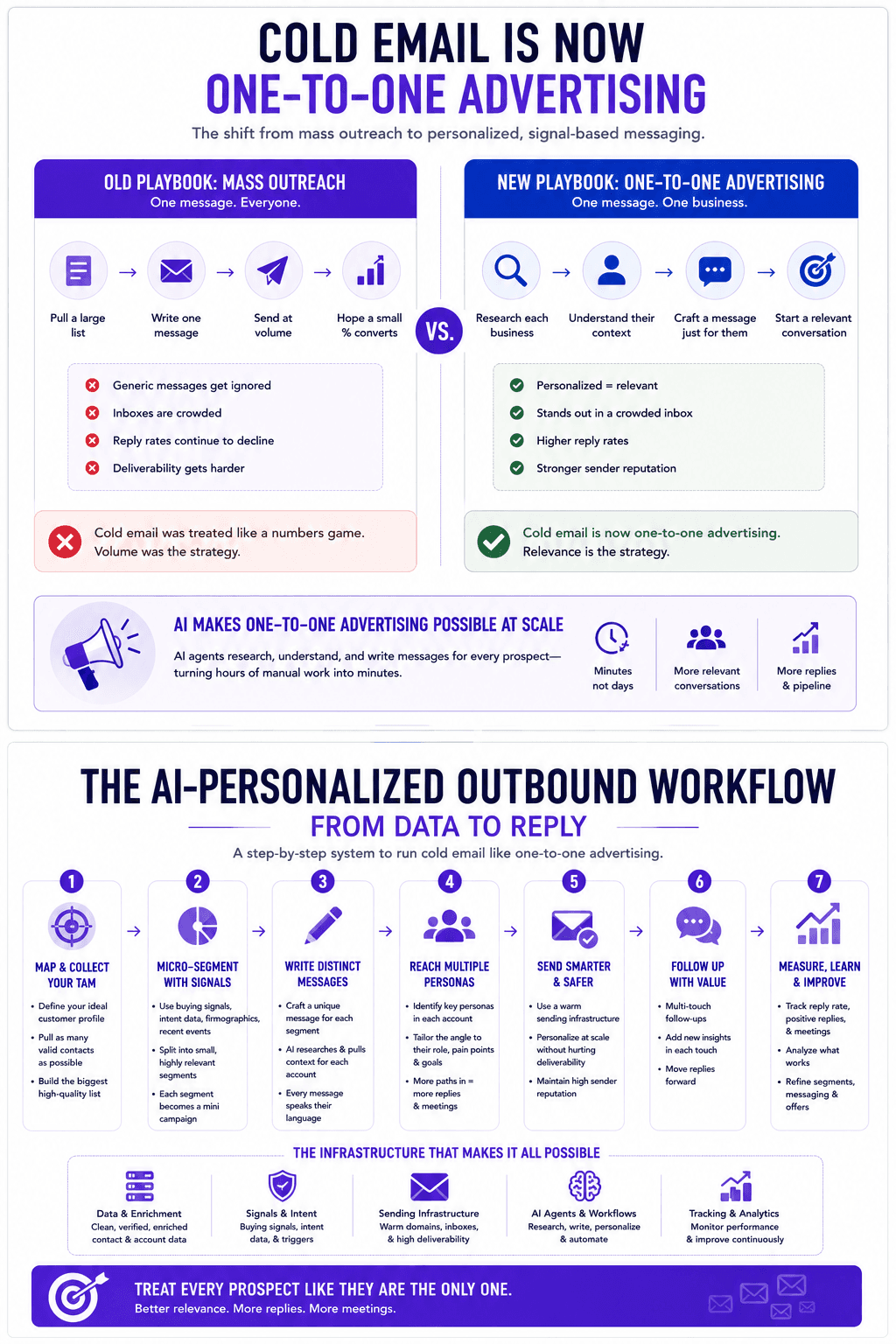
The older playbook was straightforward. You pulled a large list, wrote one direct offer, added a soft call to action, and sent at volume. A small share of recipients converted, and if the math held, the channel paid for itself. Operators started describing this in advertising terms, measuring cost per send the way a media buyer measures cost per impression. Cold email became cheap enough that volume alone produced pipeline.
That model still runs, but it works mainly for offers that are genuinely hard to ignore. Once sending became cheap and easy for everyone, the channel crowded, and generic messages stopped clearing the bar. Industry write-ups now describe cold email as a channel to manage like paid advertising or SEO, with sender reputation and relevance mattering as much as the copy itself.
The advertising comparison is more literal than it first sounds. A media buyer would love to serve every prospect a unique ad built around that person's exact situation, but no team could produce that by hand at scale. AI removes that constraint. An agent can read a company's website, understand what the business does, and draft a message that speaks to that specific context. Every recipient effectively gets their own ad, and the work that used to require a full day per campaign now happens in minutes. That is the core of the shift, and it is why the channel is starting to behave like one-to-one advertising rather than mass outreach.
What AI-personalized outbound actually means in practice
The phrase gets used loosely, so it helps to separate the marketing language from the actual workflow. AI-personalized outbound is a sequence of concrete steps, and each one is doing real work.
Map the full market, then split it into micro-segments
The process starts by mapping your total addressable market and pulling as many valid contacts inside it as possible. From there, the list gets sliced into small segments based on signals that predict relevance. You might separate accounts by the service they sell, the role of the contact, the tools they already use, or a recent trigger event. Each slice becomes its own mini-campaign with messaging built for that group. Teams that lean on buying signals and intent data to define these slices consistently see stronger relevance, because the message references something the prospect actually cares about right now. Signal-based sends outperform generic ones by a wide margin for exactly this reason.
Write a distinct message per segment, not per template
Once the list is segmented, the copy changes to match each group. A message aimed at a cold-call agency reads differently from one aimed at a company running paid ads, even when the underlying offer is identical. The point is that the framing lands inside the prospect's world instead of asking them to translate a generic pitch. This is where an AI research step earns its place, pulling context from each account and shaping a first line and angle that fit. If you want the mechanics of that step, our guide on writing personalized first lines walks through how to research and draft at scale, and building a Claude skill for cold email personalization shows how to encode your rules so the output stays consistent.
Reach more than one persona inside the same account
The advertising mindset opens up a move that generic outbound usually skips. Instead of contacting only the obvious buyer, you can reach several people inside the same account with a message tailored to each of their concerns. A finance contact might respond to a line about a specific cost on their profit and loss, while an operations contact responds to a workflow problem. This is the same instinct behind account-based marketing, applied at the message level rather than the campaign level. When the personalization is real, hitting a second or third persona inside an account stops feeling like spray and starts feeling like coverage.
The infrastructure that makes personalized outbound deliver
Better copy means nothing if the message lands in spam. Personalization and deliverability are two halves of the same system, and the teams doing this well treat infrastructure as part of the campaign design, not an afterthought.
Deliverability as a routing problem
The reliable approach keeps a healthy spread across the major inbox providers, so that a shift in one provider's filtering does not sink the whole campaign. Recipients running strict security gateways get handled separately or removed, since those addresses tend to spike bounce rates and rarely deliver well. Structuring campaigns this way, by segment and by the recipient's mail environment, lets you pause one problem group without touching the rest. The full breakdown of domains, DNS, warmup, and monitoring lives in our guide to cold email infrastructure setup. The short version is that deliverability is mostly a routing and hygiene problem once the offer and copy are relevant.
Scoring leads from your own reply history
The most underused asset in outbound is the data a team already owns. Every prospect who has ever replied with interest is a signal, and that history can be turned into a scoring layer for future lists. Contacts who engaged positively before tend to do so again, and campaigns aimed at those responders reach reply rates that generic lists never approach. Storing and scoring reply data compounds over time, which is a large part of why established senders keep pulling ahead of newer ones.
Speed to lead is where most of the pipeline is won or lost
Launching campaigns is the easy part now. A single voice note into an AI agent can produce a segmented, personalized campaign in minutes. The hard part is what happens after a positive reply, and that is where most teams quietly lose pipeline.
A prospect who raises their hand and then waits hours for a response cools off fast. The teams converting well move on that reply immediately, often with an AI inbox agent that answers within seconds and a follow-up path that adjusts based on whether the lead progresses. After hours, some teams route replies to an AI voice agent to keep speed to lead alive around the clock. Whether or not you go that far, the principle holds: the gap between a positive reply and a booked meeting is the real bottleneck, and closing it does more for pipeline than sending more volume. Our guide on getting more sales meetings covers the levers that lift booked and held calls, and much of the lift comes from this handoff being fast and automatic. This is also where AI SDRs are absorbing work that manual reps used to drop.
Which tool should you actually use?
The workflow above depends on a data layer that an AI agent can query directly, plus a way to research and personalize at scale. Several tools can fill that role, and the right one depends on how you want to run outbound rather than on any single feature.
Do you need an unlimited data layer with API and MCP access?
If your model is high volume with heavy segmentation, a flat-rate data source that you can call through an API or an MCP connection is the cleanest fit. Predictable cost matters here, because an AI agent querying data in a loop can burn through per-record credits quickly. Providers built for agent access, with per-request or unlimited pricing rather than seat licenses, suit this pattern best. Our comparison of unlimited B2B data enrichment tools covers the tradeoffs between these options in detail.
When an orchestration layer fits better
If your priority is match rate rather than raw volume, an orchestration layer that waterfalls across many providers can be the stronger choice. Independent testing consistently shows that stitching several data sources together lifts match rates above any single provider. Tools in this category cost more per record and carry a steeper learning curve, but they earn it when data coverage is the constraint you keep hitting.
When you should build it with a coding agent
Teams with some technical capacity can assemble the whole pipeline themselves using a coding agent to wire data sources, research steps, and sequencing into one workflow. This gives the most control and the lowest long-term cost, and it removes the dependence on any one vendor. It also demands ongoing maintenance and someone who enjoys owning the system.
The honest recommendation. For most B2B teams, the deciding factor is not which tool has the best database. It is whether you have the people to run the workflow well every week. A flat-rate data layer with API or MCP access is the best starting point if you want predictable cost and volume, an orchestration layer wins when coverage is your bottleneck, and building it yourself makes sense only if you have the technical bandwidth to maintain it. If none of that is a fit, the practical move is to run this as a managed system rather than a tool you babysit. That is the model we operate at Novoslo, where the segmentation, personalization, infrastructure, and speed-to-lead handoff are built and run for you, so the output is booked calls rather than another platform to learn.
Frequently asked questions
Is cold email dead in 2026?
No, but the version that worked a few years ago is fading. Batch-and-blast with a generic offer struggles now because inboxes are crowded and buyers delete anything that reads as automated. The channel is maturing into something closer to a managed advertising channel, where relevance, deliverability, and speed to lead decide the outcome. Teams treating it that way still book meetings at strong rates, which is why the "cold email is dead" claim keeps getting disproven. For a channel-by-channel view, our breakdown of why most cold email campaigns are dying covers what specifically changed.
How is one-to-one advertising different from normal personalization?
Normal personalization usually means swapping a first name or a company name into a fixed template. One-to-one advertising means the message itself is assembled around each prospect's situation, so the reference point, the framing, and the reason to reply are specific to that business. The difference shows up in how the copy reads. A personalized template still feels like a template with the blanks filled in, while a one-to-one message reads like someone did real homework. AI is what makes the second version possible at volume, since the research and drafting that used to take a human all day now runs in the background.
Does this only work for cold email, or other channels too?
The same logic applies wherever you can reach a prospect with a tailored message. Many teams run this across email and LinkedIn together, tracking both in one system so a reply on either channel triggers the same fast follow-up. The channel matters less than the discipline of matching the message to the person and moving quickly once they engage.

The takeaway
Cold email is not going away, it is turning into a channel you manage like advertising, where every send is a small ad built for one specific business. The teams pulling ahead do three things well. They segment lists tightly and personalize each message around real context, they treat deliverability as part of the campaign rather than a technical chore, and they close the gap between a positive reply and a booked meeting as fast as possible. The tooling to do this is more accessible than it has ever been, whether you buy a data layer, orchestrate several, or build the workflow yourself.
If you would rather have the whole system built and run for you, so the result is meetings on your calendar instead of another platform to manage, book a call with our team and we will map it to your market.