Article
Aug 5, 2026
The Best Unlimited B2B Data Enrichment Tool in 2026
Blitz API vs QuickEnrich vs GetLeads: we compare the best unlimited B2B data enrichment tool in 2026 and tell you which one to pick.

The subscription is never the real cost of bad data. The real cost shows up later, when a list full of stale contacts burns your sending domains, fills your inbox with angry replies, and leaves your pipeline flat after a week of sending. Teams feel that cost long before they trace it back to the vendor that sold them the list.
That is why the shift toward unlimited, API-first data vendors matters. Instead of paying per record and rationing every enrichment, you pay a flat monthly fee and pull as much data as your rate limit allows. Three tools now lead this category, and they are the ones most teams are comparing when they look for the best unlimited B2B data enrichment tool: Blitz API, QuickEnrich, and GetLeads. We ran all three through the same benchmarks on thousands of real companies, and this guide walks through what we found and which one we think most teams should buy.
What "unlimited" actually means for B2B data enrichment
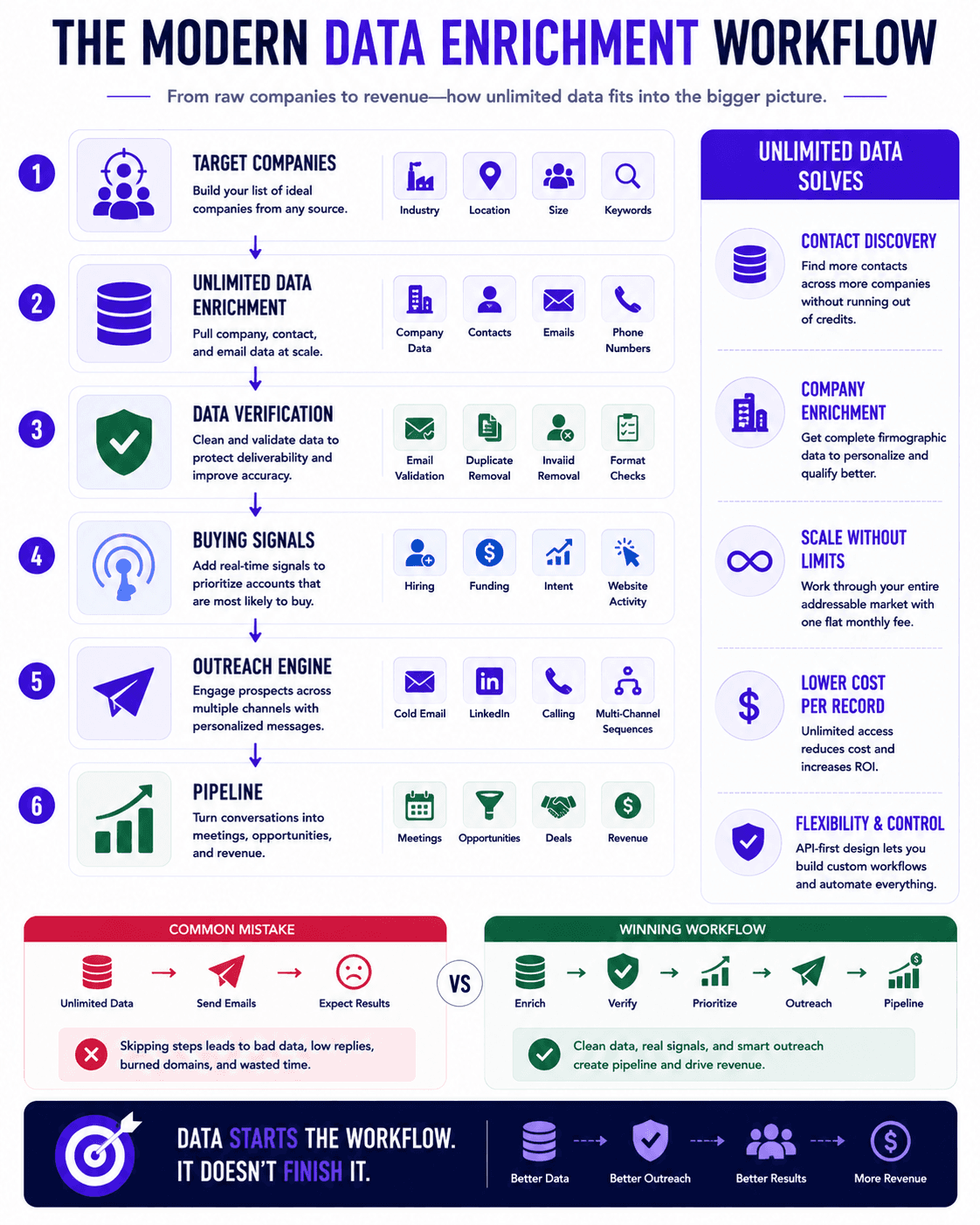
Unlimited does not mean infinite. Every one of these vendors puts a rate limit on how fast you can pull, and that limit is the real ceiling on your daily volume. The practical difference from older tools is that you are no longer capped by a credit balance. If you have a large addressable market, you can work through it over hours or days instead of hitting a wall a few thousand records in.
All three are built API-first, which in 2026 increasingly means agent-first. They are designed to be queried by scripts, automations, and AI agents rather than clicked through in a dashboard. That fits how modern teams operate, since most enrichment now runs inside a pipeline rather than a spreadsheet. If you want a fuller picture of how data sits inside an outbound system, our guide on how to generate B2B leads with AI covers the sourcing and timing layers that these tools feed into.
One thing worth setting straight early: an unlimited data vendor is the first step in your workflow, not the whole thing. It gets you broad coverage at a low cost per record. Filling the gaps, verifying emails, and adding signals still happens downstream. Most teams that treat a single vendor as their entire data strategy end up disappointed, which is a pattern we cover in why most cold outreach fails before the first email is sent.
How we compared the three tools
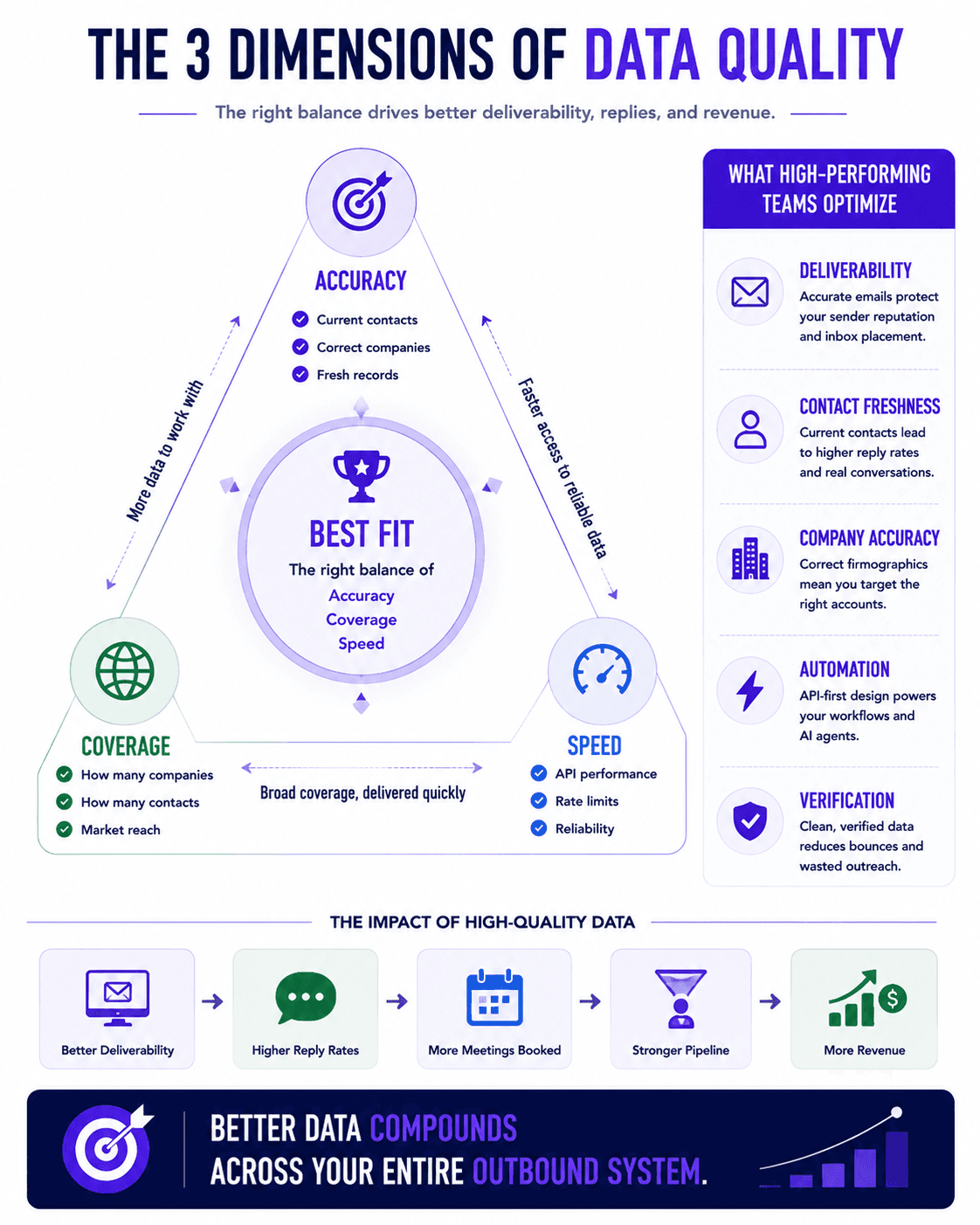
We built one benchmark and ran all three vendors through it on the same list of companies, so the comparison holds up. The benchmark covered six priorities that decide whether a data tool is worth paying for: coverage, email deliverability, contact accuracy, speed and reliability, data cleanliness, and price. We also tracked a seventh, softer factor, which is how each tool actually felt to set up and use day to day.
For coverage, we measured what share of companies we could find at least one usable contact at. For accuracy, we did something most buyers skip: we checked each contact against LinkedIn to confirm the person still worked where the vendor claimed. That last check matters because contact data goes stale quickly, and a large slice of records from older databases point to people who have already moved on. Industry benchmarks make the same point, with single-source databases often landing well short of full coverage and waterfall setups filling the gaps that any one source misses.
We have kept the figures in this guide general on purpose. Exact percentages shift with every data refresh, and one of the vendors updated its dataset shortly after our test, which moved its numbers. The relative picture is what holds, so that is what we report.
Blitz API: the firmographic and API-surface pick
Blitz API was the first vendor in this category, and it shows in the depth of its company data. Its firmographic coverage was the strongest of the three, and it held up well on funded companies and on the smallest micro businesses. If you care about accurate headcount, funding, and company-level attributes, this is where Blitz stands out.
The API surface is the other real advantage. Beyond contacts and emails, Blitz exposes useful endpoints like headcount broken out by department and by country, which lets you see where a company runs remote teams, plus convenience enrichments such as turning a domain into a LinkedIn URL and back. It also ships native skills for Claude Code, so getting it running inside an agentic workflow takes less effort than most vendors. If you are building that kind of setup, our walkthrough on enriching a lead list using Claude Code pairs well with it.
The trade-offs are speed and cleanliness. Blitz was the slowest of the three in our test, showed the most errors, and carried the lowest rate limit, which caps how fast you can move through a large list. It also shipped more stale company domains and duplicate rows than the others, so you will want a cleanup and verification step downstream. That is standard practice anyway, and our list of email verification tools for cold email covers the options.
QuickEnrich: the freshest, cleanest contact data
QuickEnrich surprised us, and we came into the test as heavy users of a different vendor. On the metrics that decide whether outreach lands, it led the group. It produced the highest breadth of usable emails and the freshest contact data, and when we verified contacts against LinkedIn, it had the strongest share of people who still worked where the record said they did. For intent-driven and account-based campaigns, that accuracy is the difference between reaching a real buyer and paying to email someone who left months ago.
It also handles cost sensitivity well. QuickEnrich lets you pull only the contacts it already has emails for, which means you spend your pulls on records that are actually usable rather than paying to discover empty rows. Its industry data was the cleanest for the segments it could cover, and it performed best on mid-market and enterprise accounts. On top of that, it offers an interface you can pull from directly, so you can see what your filters are doing before you commit to a large export. We favor tools that are agent-ready but still human-usable, and this is a good example of that balance.
Two trade-offs are worth naming. QuickEnrich took the most effort to set up of the three, so budget time for the initial configuration. And because it returns data with such breadth, a portion of what you get out of the box will be catch-all or invalid emails. The upside is that you are validating rather than hunting, so you avoid running contacts through a second waterfall of email finders and save money in the process.
GetLeads: the widest reach and best MCP experience
GetLeads is the newest of the three, and its headline strength is reach. It found at least one usable contact at the highest share of companies in our test, which is exactly what you want if your addressable market is large and you cannot afford to leave whole accounts unreachable. It was also the strongest on small-business coverage, and it includes phone numbers at its base tier rather than gating them behind an upgrade.
The other thing GetLeads does well is the agent experience. It ships a clean MCP, and it connects an AI agent to a large pool of verified contacts that you can search and filter in plain language without exports or dashboards. It carries a deep field catalog, well over a hundred and eighty attributes, which gives you room to enrich beyond the basics. If you are wiring data into an agentic stack, our roundup of the best Claude MCPs for lead generation puts this in context.
The trade-offs are practical. The command-line tooling was rough to work with, and the bulk export path showed only a fraction of the depth that the MCP exposed, so plan to use the MCP rather than the CLI. GetLeads was also weaker at indexing newly formed companies, likely a function of how it scrapes on the back end. For most teams that is a minor gap, but if your targets skew toward brand-new businesses, test it against your list before committing.
Which unlimited B2B data enrichment tool should you buy?
Which one is best overall?
For most teams, QuickEnrich is the pick. It delivers the freshest contacts, the strongest usable email breadth, and the cleanest industry data, and it does it at the most accessible price point of the three while still giving you an interface you can actually work from. The accuracy advantage is the deciding factor, since fresher contact data means more of your sends reach real people and less of your budget goes to chasing down whether a lead is still valid. Choose Blitz API instead if firmographic depth and rich company-level endpoints are central to how you target, and choose GetLeads if raw reach across the most companies is your first priority.
Should you run two tools at once?
Running two vendors makes sense when coverage is your bottleneck and no single source reaches enough of your market. The strongest pairing from our test is QuickEnrich for freshness and quality plus GetLeads for reach, which together push your combined coverage close to three-quarters of a typical list. That is meaningfully higher than any one tool alone. If your market is smaller or your budget is tight, a single vendor is usually enough, and QuickEnrich is the one we would start with.
How do you push coverage beyond any single vendor?
No unlimited vendor covers everything, so the teams with the highest coverage treat these tools as the first layer and add fallbacks behind them. A neural search API can find current company and contact information that traditional databases miss, and scraping the domains of accounts you cannot find elsewhere recovers another slice. From there, some teams build a simple email-guessing and verification step to close the last gaps. This is the same layered approach we used when we built our own AI lead generation engine with Claude Code.
Is unlimited data enough on its own?
Data is the input, not the outcome. Even the best list still needs verification, sensible targeting, and healthy sending infrastructure to turn into booked meetings. Contact records also tell you who exists, not who is ready to buy, which is where buying signals and intent data come in. And all of it sits on top of the rest of your outbound stack, which our guide to the best cold email stack for B2B companies breaks down layer by layer.
The takeaway
Three points are worth holding onto. The best unlimited B2B data enrichment tool for most teams in 2026 is QuickEnrich, on the strength of fresher, cleaner contact data at an accessible price. If coverage is your constraint, pairing it with GetLeads gets you close to full reach, while Blitz API earns its place for teams that lean on firmographic depth and API endpoints. And whichever you choose, remember that an unlimited vendor is the front of your workflow, not the entire system. The teams that get results build verification, signals, and sending infrastructure around the data rather than expecting the data to do the work alone. If you want a look at the full stack, our breakdown of the best prospecting tools for B2B sales teams and the best cold email infrastructure setup are good next reads.

Picking the tool is the easy part. Building the system around it is where most teams get stuck. If you want a second set of eyes on your data and outreach setup, book a call with our team and we will walk through what would actually move your pipeline.