Article
Sep 28, 2026
How to Build a B2B Outbound Lead Generation System
How to build a B2B outbound lead generation system in 2026: targeting, data, deliverability, messaging, channels, sequencing, and measurement.

Most outbound underperforms because it is run as a series of disconnected activities rather than a system. A list gets scraped, a sequence gets written, a few emails go out, and when replies do not come the team blames the channel. The teams that generate pipeline reliably treat outbound as an architecture with defined components, each feeding the next, which is what turns outreach from random activity into a predictable revenue lever.
This guide covers how to build that system component by component: how to define who you target, how to build and clean the data, how to make sure your messages land, what to say, how to run it across channels and touches, and how to measure it. The individual pieces matter less than the fact that they connect, since a weak link anywhere caps everything downstream.
Start with targeting, because everything compounds from it
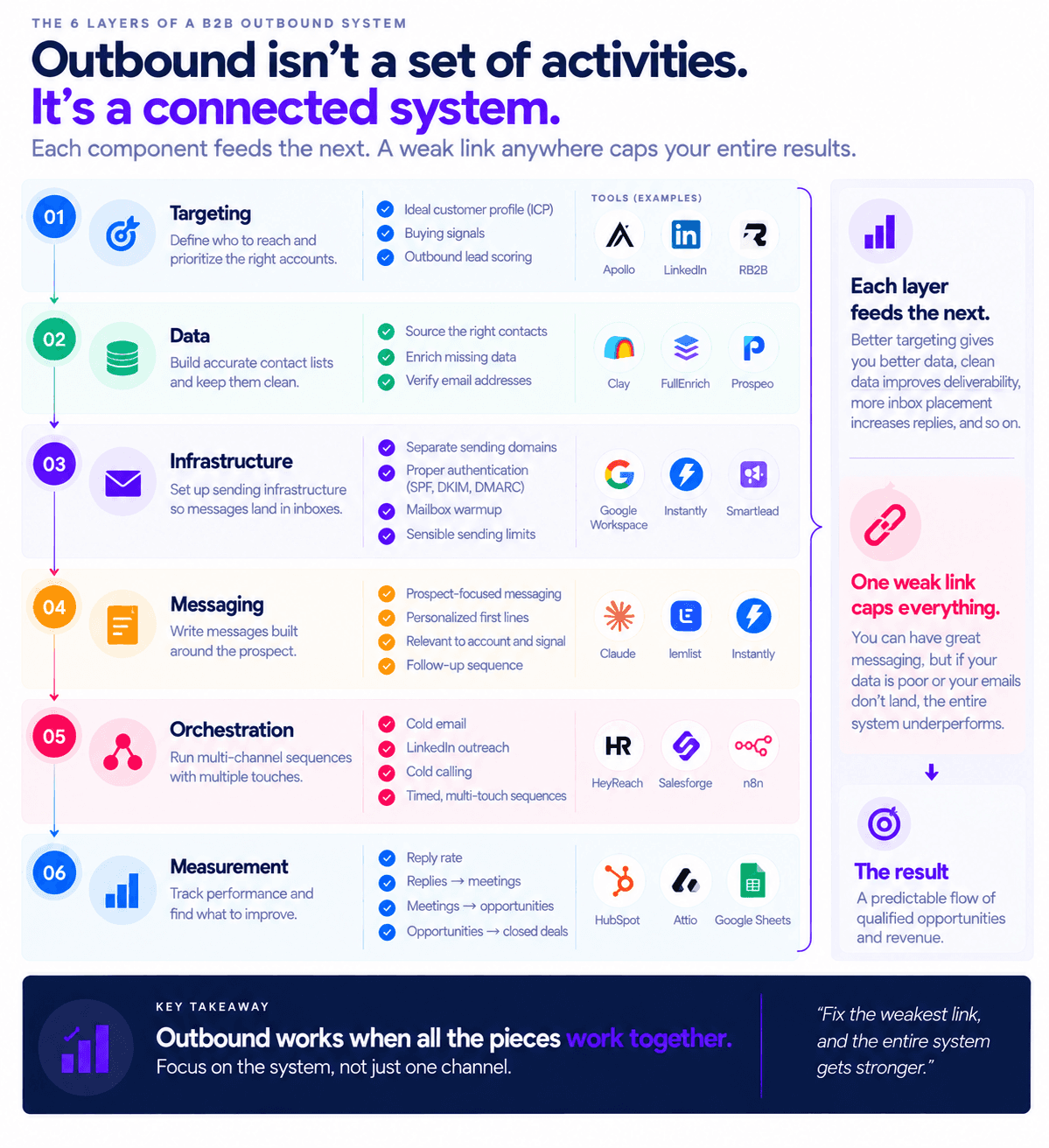
The first component is a precise definition of who you are reaching, because a perfect message sent to the wrong company still fails. A strong ideal customer profile is built from the accounts you already win, meaning the ones that closed quickly, paid well, and stayed, and it combines firmographic traits with the behavioral signals that indicate a company is in the market now. Getting this right is the highest-leverage decision in the whole system, and it is the foundation of knowing how to find the right potential customers.
Timing sharpens targeting further. Layering in buying signals such as a funding round, a leadership change, or a relevant hiring pattern tells you which accounts to reach first, since a company showing intent now converts far better than one contacted at random. Prioritizing the list with outbound lead scoring means your team works the accounts most likely to buy rather than treating every name equally.

Build the data layer, then keep it clean
The second component is the data itself, and it is where many systems quietly fail. A list is only as good as its accuracy, so building it means sourcing the right contacts at your target accounts and verifying them before anyone sends. Assembling this reliably is a matter of connecting the right prospecting tools into one flow, and keeping the records usable depends on enriching and cleaning the data so your messages reach real people at real companies.
Verification is not optional, because a high bounce rate damages the sender reputation the whole system depends on. Running every address through a verification step before it enters a sequence, using one of the email verification tools built for the job, protects the infrastructure you are about to rely on. Clean data is the unglamorous component that determines whether everything above it works.
Get the infrastructure right so messages land
The third component is deliverability, which decides roughly half of your results before a single message is read. A message that lands in spam was never going to convert, and the major providers now enforce sender requirements strictly, so getting this wrong quietly caps the entire system. The foundation is separate sending domains, correct authentication, gradual mailbox warmup, and sensible volume per inbox, which is the whole purpose of a sound cold email infrastructure setup.
This component is invisible when it works and catastrophic when it does not. A team can have perfect targeting, clean data, and strong copy, and still get nothing if the emails never reach a human inbox. Building the infrastructure before scaling volume is what separates a system that grows from one that burns its domains and stalls.
Write messages built around the prospect
The fourth component is the message, and the principle that governs it is simple: it should be about the prospect, not about you. Outreach that opens with what your company does gets ignored, while a message that shows you understand the reader's situation and offers something relevant earns a reply. The opening line carries most of the weight, which is why a genuinely personalized first line matters more than any subject-line trick, and personalized campaigns see materially higher response rates as a result.
Personalization at scale is the hard part, and it is where the system earns its name. Rather than writing every message by hand or blasting an identical template, the goal is relevance produced repeatably, so each message reflects the specific account and signal that put it on the list. That combination of scale and relevance is what makes outbound a system rather than a grind.
Run it across channels and touches
The fifth component is orchestration, meaning how the messages are delivered across channels and over time. A single channel reaches a fraction of a buying committee, and coordinated sequences across email, LinkedIn, and phone drive substantially higher response rates than single-channel outreach, because modern buyers move across platforms and a committee now involves many stakeholders. How the channels combine is its own discipline, covered in what a multichannel outbound strategy is.
Persistence matters as much as channel mix, since the majority of outbound deals require several touches and most first messages get no reply. Deciding how many touches to run and how to space them is a specific question worth getting right, addressed in how many touches a sequence should have, and assembling the whole thing into a coordinated flow is the work of building a multichannel cadence that books meetings. Wiring these together into a repeatable motion is the core of a signal-based outbound engine.
Measure the system and improve one part at a time
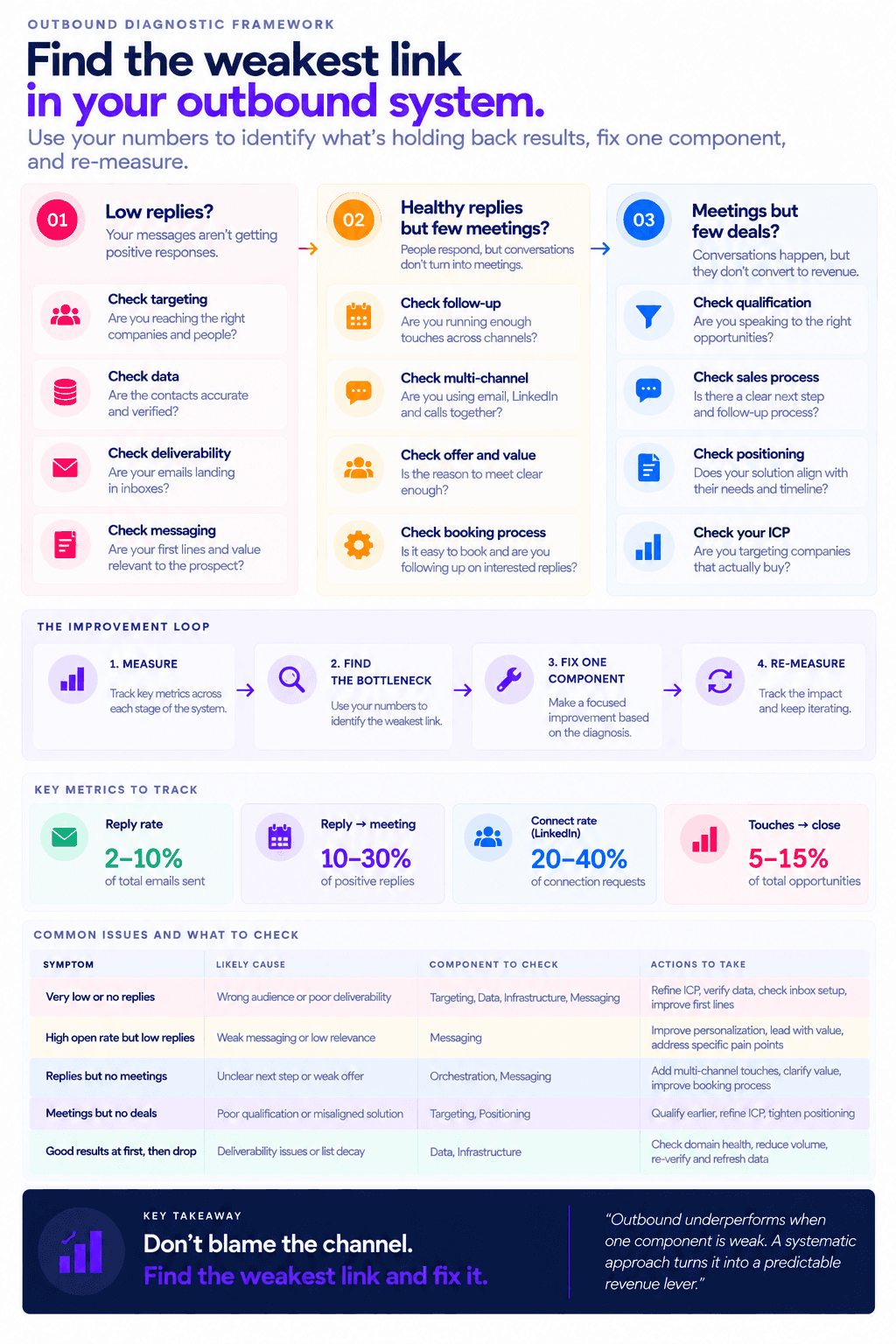
The final component is measurement, because a system you cannot see is a system you cannot improve. The metrics that matter track how efficiently outreach becomes revenue, particularly reply rate, reply-to-meeting conversion, connect rate by attempt, and touches-to-close. Watching these tells you which component is the bottleneck, so you fix the weakest link rather than guessing.
Improvement is then a matter of testing one variable at a time, whether that is the targeting, the offer, or the messaging, and keeping what works. This is also where automation compounds the system, since running the sourcing, enrichment, and sequencing as an AI-driven engine lets a small team operate at a scale that manual work cannot reach. Built and measured this way, outbound becomes one channel inside a broader set of B2B lead generation strategies that produces pipeline predictably.
Where outbound systems break down
Knowing the failure points is as useful as knowing the components, because a system rarely fails everywhere at once. The most common break is deliverability, since a large majority of cold emails still draw no reply and much of that is messages never reaching the inbox rather than weak copy. The second is targeting, where a technically sound system points at the wrong accounts and produces activity without pipeline. The third is persistence, since most reps stop after one or two touches while the majority of deals require several more.
The benchmarks give you a way to spot which link is weak. Average cold email reply rates sit around 3.43%, with top performers reaching the higher single digits, meeting-booked rates run roughly 1 to 4% and reach 4 to 7% for the best teams, and reply-to-meeting conversion sits around 15 to 30%. If your reply rate is healthy but few replies become meetings, the problem is in your booking and follow-up rather than your targeting, and if replies themselves are scarce, the issue is upstream in data, deliverability, or the list. Reading the numbers this way turns a vague sense that outbound is not working into a specific component to fix, and it is why the teams that read the benchmarks and adjust are the ones that pull ahead.
What is a B2B outbound lead generation system?
It is a connected set of components that produces pipeline reliably rather than a one-off campaign. The components are targeting, meaning a precise ideal customer profile sharpened by buying signals; data, meaning accurate, verified, enriched contacts; infrastructure, meaning the deliverability setup that gets messages into inboxes; messaging, meaning relevant, personalized copy built around the prospect; orchestration, meaning coordinated channels and touches over time; and measurement, meaning the metrics that show where the system leaks. Each component feeds the next, so the system is only as strong as its weakest link.
How long does it take to build an outbound system?
The core can be assembled in a few weeks, but it improves continuously. Setting up domains and warming them takes a couple of weeks before volume can safely scale, building and verifying the first target list is quick, and the messaging and cadence come together in parallel. The measurement and testing loop then runs indefinitely, since targeting, offers, and copy improve with iteration. The practical approach is to build each component well enough to launch, then improve the weakest one based on what the metrics reveal.
Do you need AI to run an outbound system?
You can run one manually, and AI mainly changes the scale and consistency you can reach. The components are the same either way, but automating the sourcing, enrichment, personalization, and sequencing lets a small team reach far more of the right accounts without a proportional increase in headcount. The judgment about targeting, positioning, and which prospects to prioritize stays human, while the repetitive research and admin become automated, which is what makes the system scalable rather than labor-bound.
Bringing it together
A B2B outbound lead generation system is an architecture, not a campaign. Define precisely who you target and sharpen it with signals, build data that is accurate and verified, get the deliverability infrastructure right so messages land, write copy built around the prospect, orchestrate it across channels and touches, and measure the whole thing so you can fix the weakest component. Each piece compounds the next, which is why the teams that treat outbound as a connected system generate pipeline predictably while those running disconnected activities keep blaming the channel.
If you want help building an outbound system that produces pipeline reliably, book a call with the Novoslo team and we will show you exactly how it works.