Article
Sep 30, 2026
How Many Touches Should a B2B Outbound Sequence Have?
How many touches a B2B outbound sequence needs: the data points to 8 on average, why fewer gives up too early, and how to space them across channels.

The short answer is more than most teams send and fewer than the aggressive templates suggest. The reliable benchmark is that booking a meeting takes around eight touches on average, and the majority of outbound deals require at least five, yet a large share of reps stop after one or two. The gap between what works and what most teams actually do is where a lot of pipeline is quietly lost.
Touch count is worth deciding deliberately rather than defaulting to whatever a tool ships with, because both undershooting and overshooting cost you. This guide covers how many touches a B2B outbound sequence should have, why the number lands where it does, how to space those touches over time, and how the count changes when you run more than one channel.
The data points to a range, not a single number
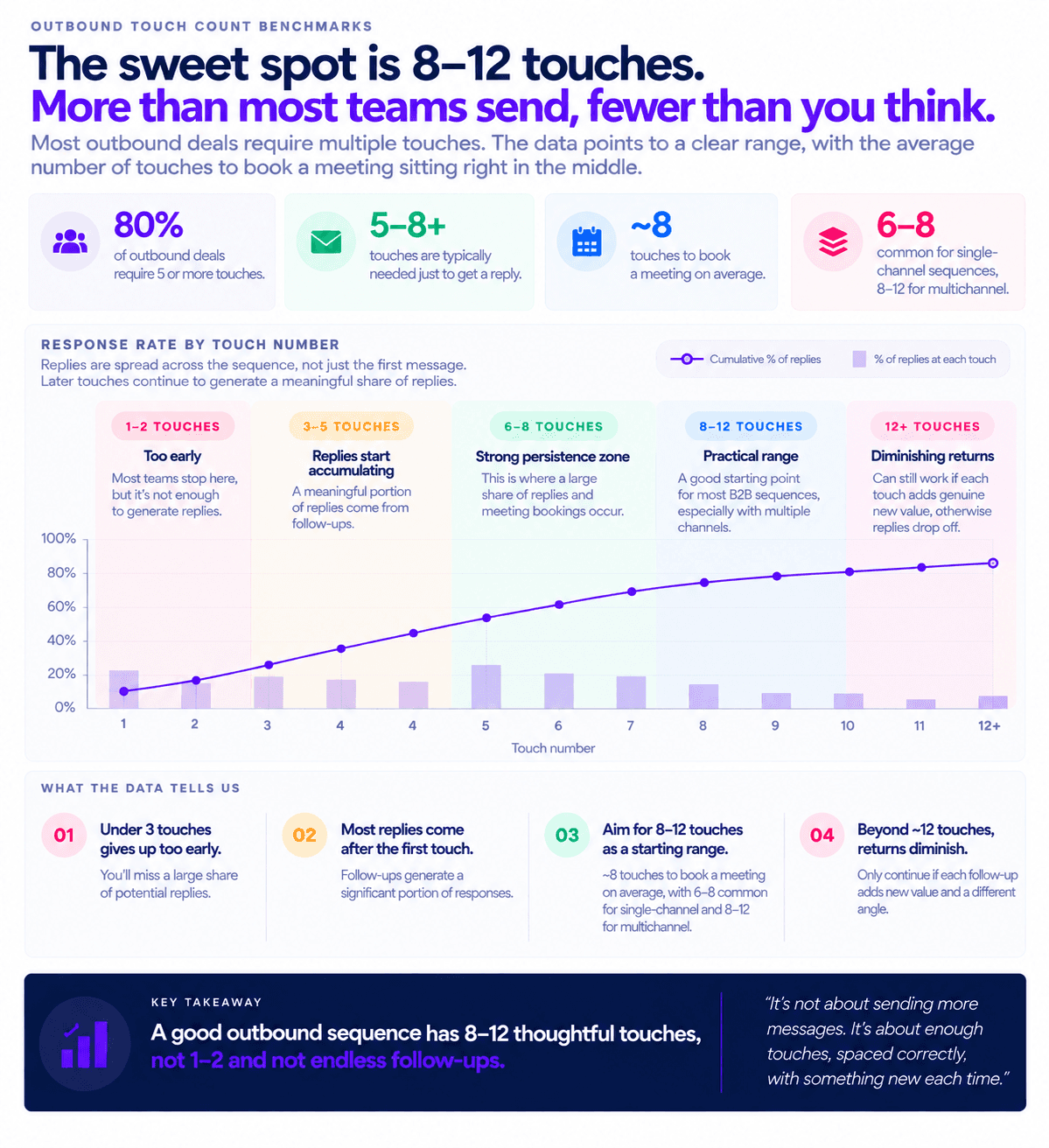
The consistent finding across benchmark sources is that outbound requires persistence. Roughly 80% of outbound deals require five or more touches, and it commonly takes five to eight or more touches just to get a response, before any nurture toward a meeting. That is why a one-and-done approach fails so reliably: it gives up before the point at which most replies actually arrive.
Translating that into a sequence length, the practical range most high-performing teams settle on is six to twelve touches, with structured six-to-eight-touch cadences being a common single-channel default and eight to twelve touchpoints typical once you add channels. The average of eight touches to book a meeting sits comfortably inside that range, which is why aiming for roughly eight to ten is a sound starting point for most B2B sequences.
Why fewer gives up too early, and more stops helping
The reason the number is not lower is that replies are spread across the sequence rather than concentrated in the first message. While the opening touch produces the largest single share of replies, a substantial portion come from follow-ups, so stopping early discards the replies you have not yet earned. A sequence with too few touches abandons prospects who would have responded on the fourth or fifth contact, which is the most common way teams underperform without realizing it.
The reason the number is not higher is that returns diminish once the sequence runs long. Analysis of email cadences found that beyond about seven touchpoints, returns fall sharply unless each follow-up adds genuine new value, and that under three touches gives up too early. The condition attached to that ceiling matters more than the ceiling itself, because a long sequence of repeated asks annoys prospects while a long sequence of genuinely useful touches keeps working. The determining factor is whether each touch earns its place, which is the subject of a good follow-up strategy.
Every touch needs a new reason to exist
The quality of each touch matters more than the raw count, and this is the point most teams miss. Each follow-up should introduce a new angle rather than repeat the same request, whether that is a relevant case study, a newly observed signal, or a different stakeholder's perspective. A message that simply says you are following up adds nothing and trains the prospect to ignore you, while one that offers something new gives them a fresh reason to engage.
This is why the approach that works leads with value rather than repeating a meeting request, the same principle behind outreach that leads with something useful instead of asking for time. Getting the opening touch right carries extra weight since it draws the largest share of replies, which is why a genuinely personalized first line is worth the effort, and structuring the whole sequence around distinct value at each step is what the frameworks high-performing teams use are built to do. A sequence of eight thoughtful touches beats a sequence of twelve repetitive ones every time.
How to space the touches over time
Touch count and timing are two decisions, and the spacing is as important as the number. The practical sweet spot is a sequence of eight to twelve touchpoints spread across roughly seventeen to twenty-one days, front-loaded so the early touches establish presence quickly and the later ones follow up with fresh value. In practice the first week runs at higher frequency, with four to five touches building recognition, and the following days shift to more spaced follow-ups.
Cadence should also flex with engagement. Tighten the spacing when a prospect is showing interest and lengthen it as a deal cools, and for slow, long-cycle prospects a lighter check-in roughly every 21 to 30 days is linked to higher conversion than continued rapid contact. Reading engagement and adjusting the cadence to match it is what separates a sequence that feels responsive from one that feels like an automated barrage, and moving quickly the moment a prospect engages, as covered in speed to lead, is part of the same discipline.
The number changes when you add channels
The touch count is not only an email question, because spreading touches across channels changes both the total and its effectiveness. A single-channel email sequence commonly runs six to eight touches, while a coordinated sequence adding LinkedIn and phone typically runs eight to twelve, since the additional channels create more natural opportunities to reach out without saturating any one of them. Splitting touches this way also performs better, since coordinated multichannel sequences produce far more replies than the same number of touches on one channel, which is the core idea in what a multichannel outbound strategy is.
The distribution matters as much as the total. A workable pattern spreads the touches so email carries the volume, LinkedIn adds a couple of warm touches, and one or two phone attempts close the loop later in the sequence, which is the choreography covered in building a multichannel cadence that books meetings. Deciding which channel does what is its own question, addressed in cold email versus LinkedIn versus cold calling, and the whole sequence sits inside a broader outbound system. Targeting the right accounts with buying signals is what makes the persistence pay off rather than annoy, and remembering why so many cold campaigns fail keeps the focus on quality over raw volume.
Adjust the count to deal size and intent
A single fixed number is a starting point, and the right count shifts with the value of the deal and the temperature of the prospect. Higher-value accounts justify more touches and a longer runway, since the payoff of a booked meeting is larger and enterprise buying cycles involve more stakeholders to reach, so a sequence aimed at a major account can reasonably run longer than one aimed at a smaller, faster deal. Lower-value or high-volume segments do better with a tighter, more efficient sequence, since the economics do not support a long, hand-crafted runway per prospect.
Intent should move the number too. A prospect showing a strong buying signal warrants a tighter, more immediate cadence because the window is open now, while a cold account with no signal is better served by a lighter sequence that does not over-invest before there is evidence of interest. Segmenting your list so each group gets a sequence sized to its value and intent, rather than one length for everyone, is the practical version of this, and it connects to running micro-segmented outbound campaigns where the touch count is matched to the segment. The goal is to spend your persistence where it returns the most, not to apply the same eight touches indiscriminately.
How many touches does it take to book a B2B meeting?
Around eight on average, which is why sequences of roughly eight to ten touches perform well. The majority of outbound deals require at least five touches, and it commonly takes five to eight just to get a response before any nurture toward a meeting. Because replies are spread across the sequence rather than concentrated in the first message, stopping after one or two touches abandons most of the pipeline you could have won. Aiming for eight to twelve touches, with each one adding new value, matches what the benchmark data consistently shows.
Is it possible to send too many outbound touches?
Yes, once the touches stop adding value. Returns diminish sharply beyond about seven touches unless each follow-up introduces a genuinely new angle, so a long sequence of repeated asks annoys prospects and damages your reputation. The ceiling is really about quality rather than a hard number, since a longer sequence of useful, varied touches keeps working while a shorter sequence of repetitive ones does not. The practical guide is to keep extending only as long as each additional touch has a real reason to exist.
How far apart should outbound touches be?
Spread eight to twelve touches across roughly seventeen to twenty-one days, front-loading the first week with higher-frequency touches to establish presence, then spacing the follow-ups further apart. Adjust the cadence to engagement, tightening it when a prospect shows interest and lengthening it as a deal cools, and for slow, long-cycle prospects a lighter check-in every three to four weeks tends to convert better than continued rapid contact. The spacing should feel responsive to the prospect rather than like a fixed automated schedule.

Bringing it together
A B2B outbound sequence should have around eight to twelve touches, since booking a meeting takes roughly eight on average and most deals require at least five, while returns fall off beyond about seven unless each touch adds new value. Fewer touches give up before most replies arrive, and more only help when every message earns its place. Space the touches across two to three weeks, front-load the early ones, flex the cadence with engagement, and split the touches across channels to reach more of the buying committee. The number matters, and the value inside each touch matters more.
If you want help building sequences that persist the right way and book meetings, book a call with the Novoslo team and we will show you exactly how it works.