Article
Jun 1, 2026
How Founders Are Using AI to Scale Cold Outreach
Founders are using AI to compress cold outreach from days to minutes. Signals, enrichment, personalized copy, and campaign deployment in one workflow.
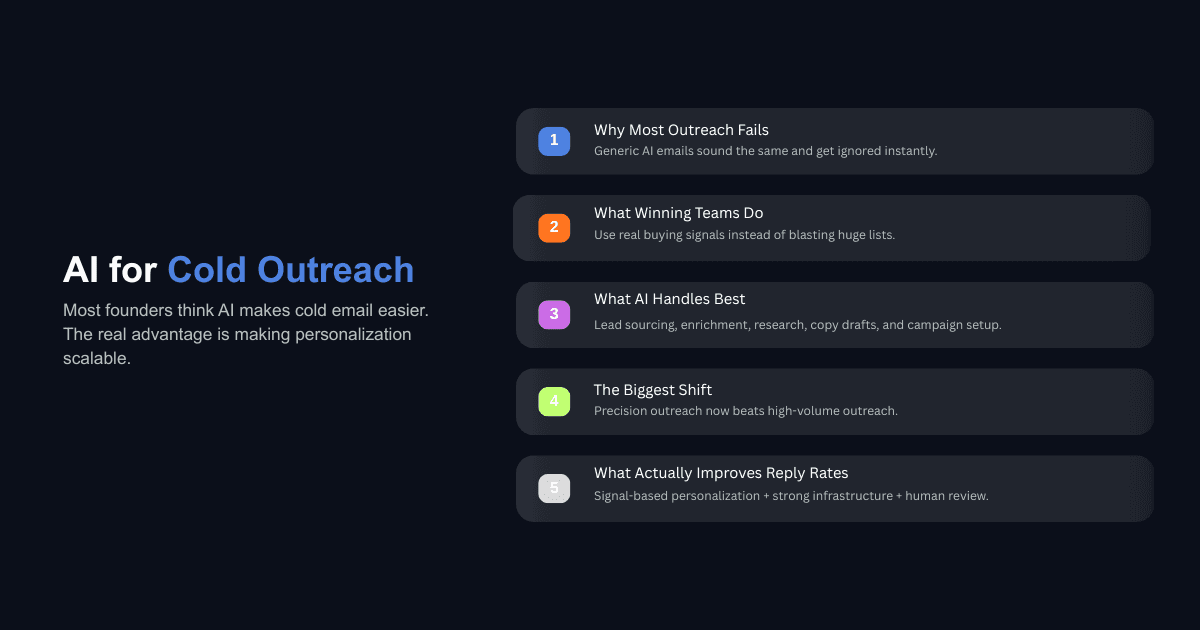
Cold email reply rates have dropped to 3.43% on average in 2026, down from 5% in 2025 and 8.5% in 2019. Inboxes are noisier, spam filters are more aggressive, and most AI-generated outreach reads like it came from the same prompt template everyone else is using. The channel looks broken from the outside.
But the top 10% of outbound campaigns are still clearing 10% reply rates or higher. Some founders running tight segments with intent signals are seeing 15% to 25% in specific verticals. The gap between those numbers and the average is not about sending more emails. It is about how the campaign gets built, what data feeds the copy, and whether the message earns attention or just occupies space.
This post covers the actual systems founders are using to run cold outreach with AI in 2026, from lead sourcing and signal research through copy generation and campaign deployment, and how the entire workflow now fits inside a single workspace.
Why Cold Outreach Still Works (When Most Campaigns Don't)
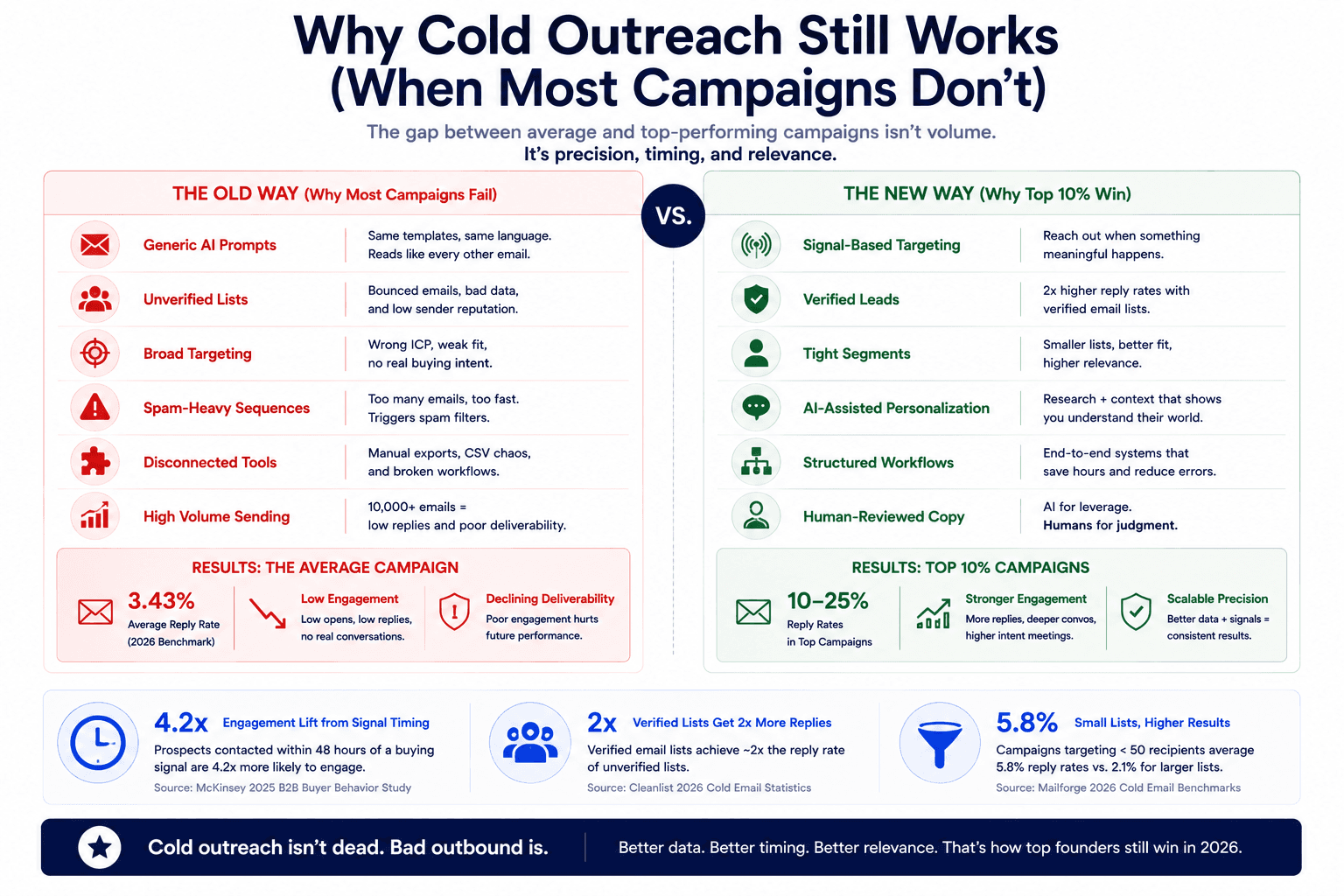
The average B2B cold email reply rate sits between 3% and 5% depending on the dataset. That number is discouraging until you look at what separates the bottom from the top.
The bottom tier sends high volume from poorly warmed domains to unverified lists with copy that sounds like every other AI email in the inbox. The top tier sends fewer emails to tighter segments, uses real signals to time their outreach, and writes copy that references specific things happening at the prospect's company. Verified email lists achieve roughly 2x the reply rate of unverified lists, and campaigns targeting fewer than 50 recipients average 5.8% reply rates compared to 2.1% for larger lists.
The volume approach worked when inboxes were less crowded. In 2026, email service providers increasingly weight engagement quality over simple open signals. They look at reply depth, time spent reading, and whether the recipient actually interacts with the message. Sending 10,000 generic emails does not just produce low reply rates; it actively damages your sender reputation, which makes every future campaign harder to land.
This is why most cold email campaigns are dying in 2026. The teams still winning have shifted from volume to precision, and AI is the infrastructure layer that makes precision possible at scale.
What Signal Based Outbound Actually Looks Like
The single biggest shift in cold outreach over the past year is the move from static list targeting to signal based outbound. Instead of pulling a list of companies that match a firmographic profile and blasting them all at once, founders are monitoring for real buying events and reaching out when something specific happens at a target account.
Those events include things like new executive hires, open job postings that indicate a pain point, recent funding rounds, technology stack changes, product launches, and website visits to competitor pages. McKinsey's 2025 B2B Buyer Behavior Study found that prospects contacted within 48 hours of a buying signal are 4.2x more likely to engage than prospects contacted without any signal context.
That single finding explains the direction outbound has moved. A cold email that says "noticed your team just posted three SDR roles, which usually means pipeline targets are growing faster than your current team can cover" lands differently than "I saw your profile and thought our product would be relevant." The first one demonstrates research and timing. The second one demonstrates a mail merge.
For founders without a dedicated sales ops team, the challenge has always been that signal monitoring is time consuming. Checking LinkedIn for leadership changes, scanning job boards for hiring patterns, reviewing tech stack databases for new tool adoptions, and cross-referencing all of that against your ICP criteria is easily a full day of manual work per campaign. That is exactly where AI workflows have changed the math.
How Founders Are Using AI to Build Lead Lists Without an SDR Team
The traditional cold email tech stack required separate tools for list building, enrichment, email verification, and data formatting, often with a spreadsheet layer holding everything together. Founders running this manually would spend hours moving CSV files between platforms, deduplicating contacts, and troubleshooting API connections. By the time the list was ready, half the day was gone and no emails had been sent.
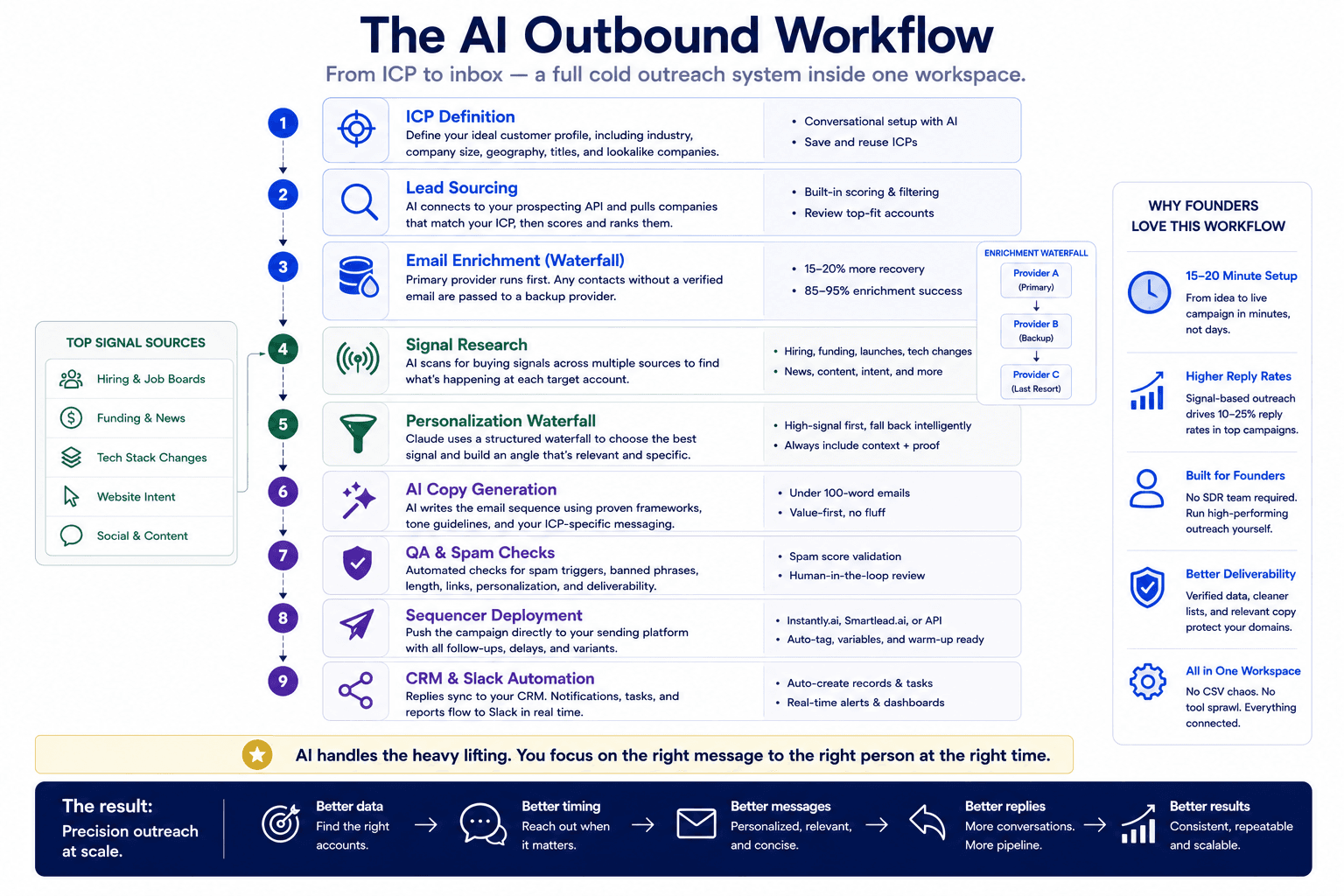
What has changed is that AI coding tools like Claude Code can now build a cold email system from a single workspace. The workflow starts by defining your ICP criteria through a conversation with the AI, specifying the industry, headcount range, geography, job titles, and any lookalike companies you want to use as reference points. The AI connects to your prospecting API, pulls matching companies, and scores them against your criteria before you review a single record.
From there, the AI pulls contacts at each target company, prioritizing the titles and seniority levels you specified. For the email addresses, a waterfall enrichment approach runs the primary data provider first, then sends any contacts that came back without a verified email through a backup provider. Teams running this waterfall consistently report recovery rates between 85% and 95%, which means the manual work of chasing down missing emails across multiple platforms is handled automatically.
The entire process of defining an ICP, pulling companies, finding contacts, and verifying emails that used to take a full afternoon across four or five tools now takes 15 to 20 minutes in a single workspace. For a detailed walkthrough of how this enrichment waterfall works, the guide on how to enrich your lead list using Claude Code covers every step.
What makes this particularly useful for founders is that the workspace remembers context. The same project that scored your leads last week already knows your ICP, your best-performing subject lines, and which API to call for enrichment. You are not re-entering setup information every time you launch a new campaign.
Can AI Write Cold Emails That Actually Sound Human?
This is where most AI outreach falls apart. Asking an AI to "write me a cold email to this person" produces the same generic, overly polished output that recipients have learned to delete on sight. The problem is not the AI's writing ability. The problem is that it has no context about the prospect, no data about what makes the timing relevant, and no framework for what good cold email copy looks like in your specific market.
Lavender's 2025 analysis of 100 million cold emails found that emails written with AI assistance but edited by a human outperformed both fully AI-generated and fully human-written emails. The model that actually works is AI generating the first draft from real data, and a human reviewing it before it goes out.
The founders getting results from AI copy are using a pattern-based approach. Instead of asking the AI to write from scratch, they provide bucket templates that correspond to different signal types. If the AI finds a hiring signal, it uses one copy framework. If it finds a client roster signal, it uses another. If it finds a tech stack match, there is a third template. Each framework follows a proven structure, but the AI adapts the specifics based on what it found during the enrichment and research phase.
This concept of a personalization waterfall is where the operational advantage shows up. The AI runs through a priority list of signal types for each prospect: first check for hiring activity, then look for notable clients, then scan for technology changes, then pull from the founder's bio, and if none of those produce a strong angle, use a fallback that references something specific from the company's website. The output is an email where the first line demonstrates actual research, the body connects a real observation to a relevant offer, and the call to action is low friction.
For teams building these systems, encoding copy standards into a reusable Claude Skill for cold email personalization means every campaign follows the same quality rules without requiring manual prompt engineering each time. The Skill contains tone preferences, banned phrases, spam word filters, formatting standards, and QA checks that run automatically before any copy gets exported.
One enterprise client we worked with reported that after implementing structured AI copy workflows, their team was consistently producing outreach that got responses and generated repeat campaign requests. The quality gap between AI-assisted copy and their previous manual process closed faster than expected, because the AI was drawing on actual enrichment data rather than guessing at personalization.
The copy QA step is critical and is the part most teams skip. Before any email goes out, the AI checks for spam trigger words, removes m-dashes (which are a known tell for AI-generated text), validates that all merge variables follow the correct format for the sequencer, and confirms the email stays under 100 words. Teams that audit and rewrite weak cold email copy as part of their workflow consistently outperform those who send the first draft without review.
What Does a Full AI Cold Email Campaign Look Like End to End?
To make this concrete, here is what the workflow looks like when everything runs through a single AI workspace.
The founder starts by defining the ICP through a conversation with the AI. They specify the industry (for example, PR agencies), the headcount range (20 to 50 employees), the geography (US only), and optionally point the AI at a lookalike company's website for reference. The AI searches the prospecting API and returns a list of matching companies, typically surfacing 300 to 500 targets depending on how narrow the criteria are.
Next, the AI pulls contacts from those companies, finding one to two people per company with the right titles and seniority. It runs the email waterfall, verifies the addresses, and flags any companies where no valid contacts were found.
Then the personalization waterfall runs. For each contact, the AI scrapes the company website, checks for hiring activity, reviews their client list, scans their tech stack, and reads the founder's LinkedIn bio. Based on what it finds, it selects the strongest signal and generates a personalized first line and email body using the copy framework that matches that signal type.
The AI also generates subject lines, follow-up emails for a multi-step sequence (typically three emails spaced across 10 days), and applies the spam check and formatting QA. The entire output gets exported in the format your sequencer expects, whether that is Instantly, SmartLead, or another platform.
The campaign that used to require Clay, six other tools, a copywriter, and six hours of manual assembly now takes under an hour with two tools. For teams running this at volume, the guide on how to automate cold email sequences with Claude Code covers the sequencer integration and deployment steps.
What happens after the call books matters too. Founders are now automating the post-booking pipeline with AI-built workflows: the calendar webhook fires, the contact gets created in the CRM, the deal moves to "discovery call booked," pre-call tasks get generated, and the team gets notified through Slack. One client who implemented this kind of AI-driven sales infrastructure saw their sales efficiency double because reps stopped spending half their time on data entry and started spending it on actual conversations.
The Reverse Lead Magnet Approach That's Replacing PDFs
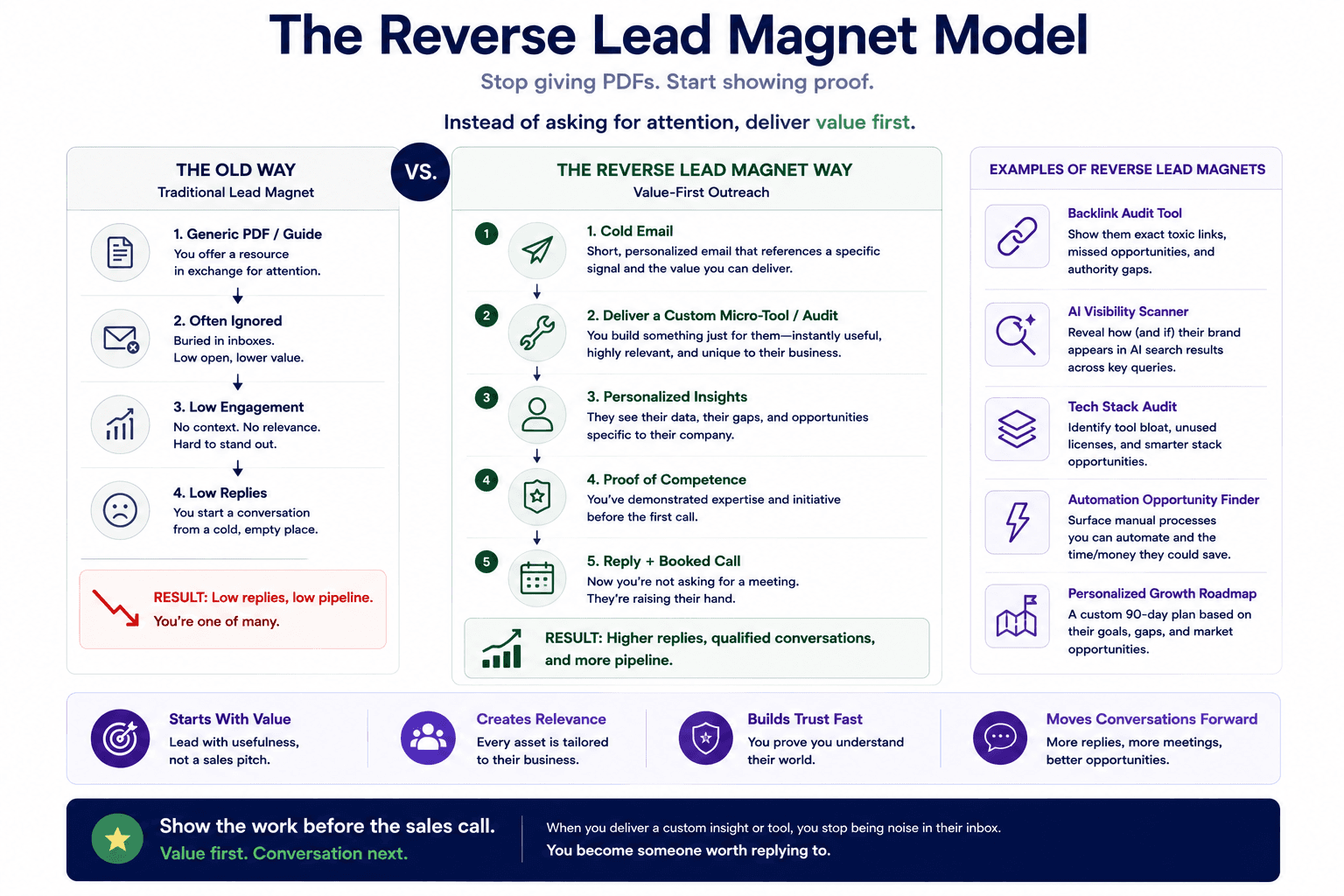
A newer approach gaining traction among founders is the concept of a reverse lead magnet. Traditional lead magnets, the "reply PDF and I'll send you my guide" approach, have stopped converting because everyone knows the PDF was built once and distributed to thousands of people. There is no perceived effort, no personalization, and the recipient knows they are entering a sales funnel.
The reverse lead magnet flips this by offering to build something custom for the prospect. Instead of giving them a PDF to implement, you give them a working tool that solves an actual problem. Founders are using AI coding tools to build micro SaaS applications, small purpose-built web apps that scan a prospect's website, analyze their backlink profile, audit their tech stack, or generate custom automation workflows specific to the tools the prospect already uses.
The cold email reads something like "Would it be okay if I spent some time analyzing your backlink profile and built you a set of recommendations for improving your AI search visibility? I can send it over if useful." When the prospect replies yes, they receive a link to a branded app with their results pre-filled. The app is the proof of competence, the portfolio, and the booking mechanism all in one.
Teams running this approach report averaging around 4% reply rates even in niches that were previously considered impossible for cold email, like selling cold email services to other agencies. The key operational detail is that the app gets built once per vertical. A founder selling SEO services builds one backlink audit tool and uses it across every prospect in that segment.
This approach works because it combines several psychological triggers. The prospect feels like someone invested time in helping them specifically. They see proof of what the sender can do before any sales conversation happens. And the app itself contains a call to action and retargeting pixels, so even prospects who do not book immediately enter a follow-up pipeline.
For founders exploring this strategy, the cold email frameworks that high-performing teams use provides additional context on how to structure the messaging sequence around these kinds of value-first offers.
Where Most Founders Get This Wrong
The tools and workflows described in this post are powerful, but they do not compensate for skipping the fundamentals. Here are the mistakes that consistently kill campaigns regardless of how good the AI layer is.
The first and most common mistake is sending from domains that have not been properly warmed up. DNS authentication (SPF, DKIM, DMARC) and a four to six week warmup period before any AI-generated outreach gets sent are non-negotiable. Teams that skip this step see their emails land in spam at three to four times the normal rate. The best cold email infrastructure setup for B2B companies covers the full technical checklist.
The second mistake is running AI copy without human review. AI generates volume, but human judgment catches the edges where personalization sounds forced, where a signal was misinterpreted, or where the tone drifts into obvious AI patterns. The model that works is AI for the 80% of research and drafting work, human review for the 20% that determines whether the email earns a reply.
The third mistake is not verifying leads with a second tool before sending. The difference between top and bottom tier campaigns often comes down to bounce rates. Top performers keep theirs under 1.5%. Bottom performers are above 12%. Running a verification pass through a dedicated tool before uploading to your sequencer is a small step that has an outsized impact on deliverability.
The fourth mistake is treating AI as a replacement for offer strategy. The best personalization in the world will not save a weak offer. Before building any outreach system, founders need clarity on what problem they solve, what the prospect walks away with from a conversation, and why now is the right time. AI compresses execution time, but the strategic work of understanding your buyer still requires a human who has been close to the outcomes. Teams that pair strong positioning with AI SDR workflows see compounding returns. Teams that automate a bad offer just find out faster that it does not work.
The Operational Shift
Cold outreach in 2026 rewards precision over volume. The founders seeing results are not the ones sending the most emails. They are the ones who have compressed the research, enrichment, copy, and deployment pipeline into a system that runs in under an hour and produces output that looks like it was written by someone who actually spent time understanding the prospect's business.
AI did not make cold email easier in the way most people expected. It did not turn a prompt into a pipeline. What it did was make the high-effort, high-quality approach operationally viable for teams that do not have dedicated SDRs, data ops, or copywriters. The founder who previously had to choose between sending generic volume or spending all day writing ten personalized emails can now do both: precision at scale.
The teams that write personalized first lines using Claude, build reusable copy skills, and connect their enrichment and sequencer APIs into a single workspace are operating at a fundamentally different speed than teams still stitching together five disconnected tools with spreadsheet glue.
If you are building outbound systems for your company and want to explore how AI infrastructure can compress your campaign timelines, book a call with the Novoslo team. We work with founders and operations leaders to build AI workflows that replace manual prospecting work and produce outreach that actually gets responses.