Article
Apr 20, 2026
Why Sales Teams Are Using Claude Code to Personalize Cold Outreach
Sales teams use Claude Code to personalize cold outreach at scale, replacing manual research with AI workflows that actually improve reply rates.
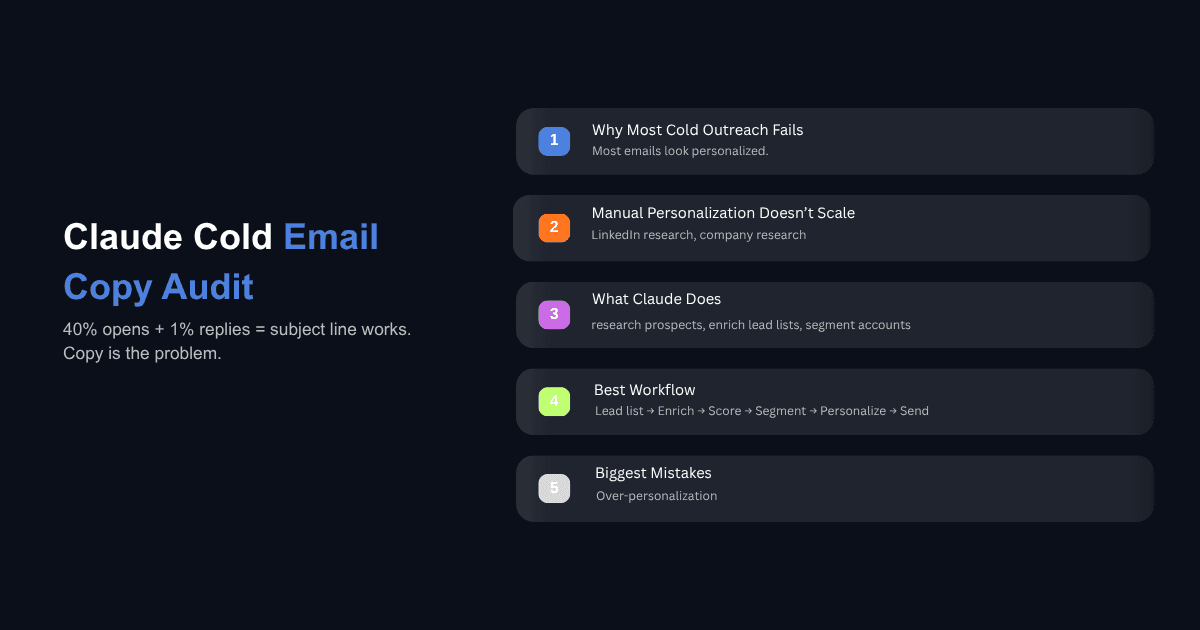
The average cold email reply rate in 2026 sits at 3.43%. Top performers consistently clear 10%. That gap is not explained by better subject lines or smarter send times. It comes down to whether the email feels like it was written for the person reading it or assembled from a template with their name dropped in.
Most sales teams already know personalization matters. 73% of decision makers say it directly affects whether they engage with cold outreach. The issue has never been awareness. The issue is that genuine personalization takes 15 to 30 minutes per prospect when done manually, and no team can sustain that across hundreds of contacts per week.
Claude Code is changing that math. Sales teams are using it to research prospects, write context-aware emails, score leads, and manage outreach workflows in a single session. This post covers how they're doing it, what the results look like, and where the common mistakes show up.
The Personalization Problem That Volume Cannot Fix
Why mail merge tokens stopped working
Every inbox is full of emails that open with "I noticed that [Company] recently [trigger event]" and then pivot into the exact same pitch regardless of the trigger. The format looks personal. The substance is not. Recipients recognize this pattern almost immediately, and the result is that cold emails with surface level personalization now perform about the same as fully generic ones.
Campaigns sent to fewer than 50 recipients average a 5.8% response rate, compared to 2.1% for larger lists. The data is clear: smaller segments with relevant messaging outperform large blasts with token swaps. But running 20 small campaigns instead of one big one multiplies the research and writing load by 20x. That's the bottleneck.
The actual cost of manual research per prospect
A good cold email requires understanding what the company does, what the prospect's role involves, what challenges are likely top of mind based on their industry and recent activity, and how your product connects to any of that. A rep doing this properly spends 15 to 30 minutes per prospect across LinkedIn, company websites, news, and CRM data. At that rate, a team of five SDRs can produce maybe 40 to 50 genuinely personalized emails per day. That is not enough pipeline to sustain most sales targets.
The teams that figured this out early started treating it as an operations problem rather than a messaging problem. They needed a way to do the research and writing at the quality of their best rep, without the time cost that comes with doing it manually.
What Claude Code Does Differently for Sales Teams
How the 200K context window changes prospect research
Most AI tools used for cold email work within small context windows, which means you feed in a prospect's name and company, and the model generates something that sounds plausible but lacks depth. Claude Code operates differently. Its 200K token context window lets you load a prospect's LinkedIn activity, recent company news, job postings, CRM history, and your product documentation all at once, then generate outreach that references specific details from across those sources.
The practical difference is significant. Instead of asking Claude to "write a cold email to a VP of Sales at a fintech company," you're giving it the actual content the prospect posted last week, the job listing their company just opened, and the specific product feature that connects to their situation. The output reads like your best rep spent 30 minutes on research because the model actually processed that volume of information.
If you're evaluating which AI writes the best cold outreach emails, context handling is the differentiator that matters most for this use case.
Connecting to CRMs and outreach tools through MCP
Claude Code connects to external tools through MCP (Model Context Protocol), which is Anthropic's standard for letting AI interact with CRMs, email platforms, data enrichment services, and other software your team already uses. Through MCP, Claude Code can pull prospect data from HubSpot or Salesforce, enrich contact records with additional research, log activity back to your CRM, and draft emails that go directly into your outreach queue.
This means the workflow stays in one place. You don't copy data out of your CRM, paste it into a prompt, generate an email, then paste it back into your sending tool. The integration handles that loop, which removes a surprising amount of friction from the daily process. One solo operator documented reducing 20+ hours of weekly sales admin to minutes of review per batch using Claude Code connected to Apollo, a CRM, and a Gmail MCP server, at roughly EUR 100 in total tooling costs.
How Sales Teams Are Setting Up Claude Code for Cold Outreach
Building a prospect research workflow
The setup starts with defining what information Claude Code should gather for each prospect. Most teams build a research prompt that instructs Claude to look at the prospect's role, company size, recent funding or hiring activity, content they've published or engaged with, and competitive landscape. This prompt acts as a standardized research brief that runs against every lead.
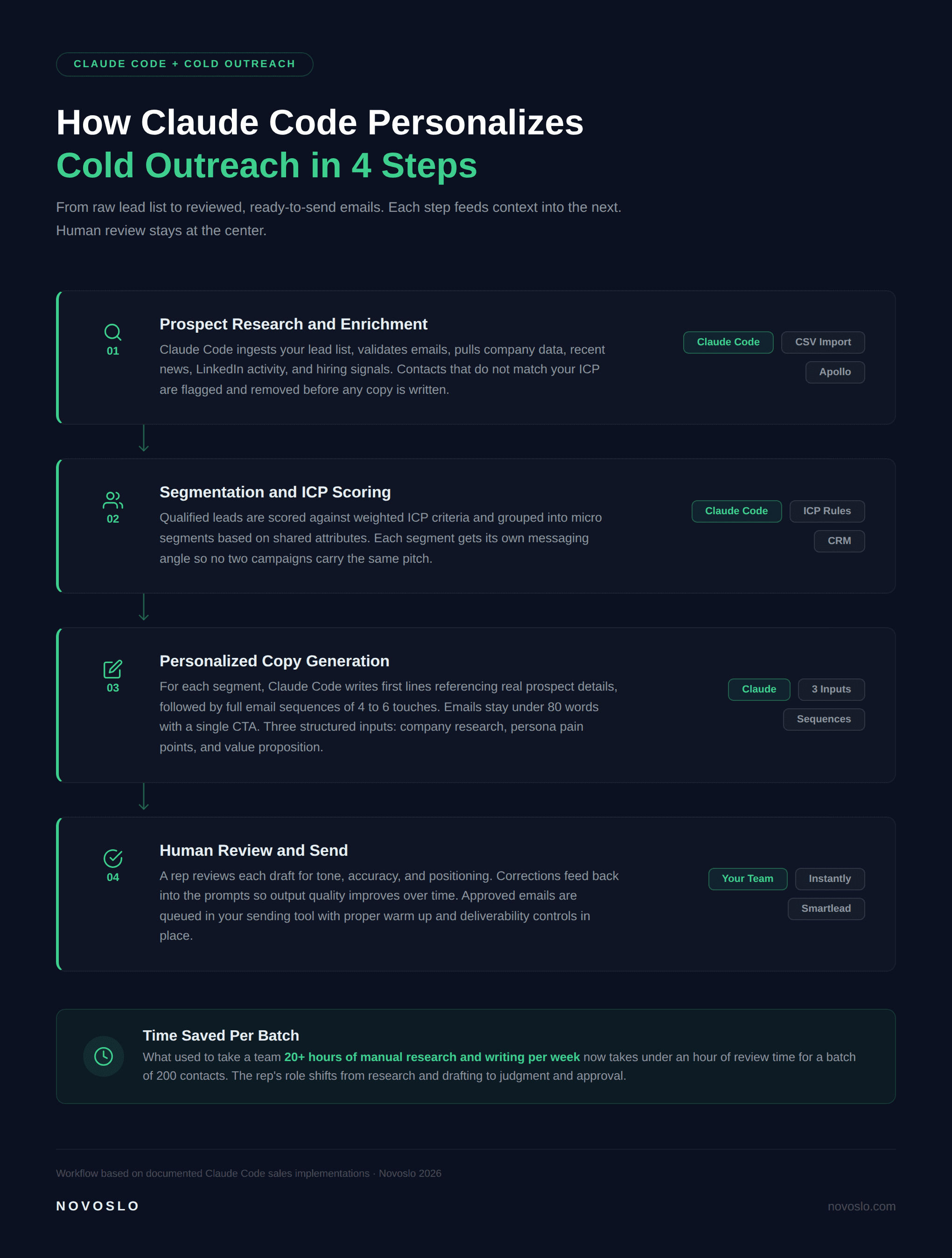
Teams that get the best results enrich their lead lists using Claude Code before writing any outreach. Enrichment means validating email addresses, adding ICP fit scores, pulling recent company signals, and flagging contacts that don't match your target profile. This step filters out low quality leads before you spend any time writing to them, which keeps reply rates higher and protects your sending reputation.
Writing personalized first lines and full sequences
The first line of a cold email carries the most weight. 58% of all replies come from the first email in a sequence, which means your opener needs to earn attention immediately. Claude Code handles this by referencing specific details from the research phase, such as a prospect's recent LinkedIn post, a new product launch at their company, or a hiring pattern that suggests they're scaling a particular function.
The key to writing personalized first lines at scale is giving Claude Code structured context rather than vague instructions. Instead of "write something personalized," you provide the prospect's recent activity, their likely pain points based on role and industry, and the specific angle your product addresses. Claude Code then generates first lines that reference real details, followed by a full sequence that maintains relevance through the follow ups.
For teams running sequences of 4 to 7 emails, Claude Code can generate the entire chain with each message building on the previous one and adding new angles based on different aspects of the prospect's situation.
Scoring and segmenting leads before sending
Before any emails go out, Claude Code can score your lead list against your ICP criteria and segment contacts into micro campaigns based on shared characteristics. A segment might be "VP of Sales at Series B SaaS companies with 50 to 200 employees who recently posted about hiring SDRs." That segment gets its own messaging angle, its own first lines, and its own sequence.
This approach mirrors how high performing cold email teams now operate more like paid media teams, running many targeted campaigns in parallel rather than one broad blast. The difference is that Claude Code makes campaign creation nearly free in terms of time. What used to take half a day to build, segment, enrich, and personalize can now happen in minutes.
You can also build a complete cold email system using Claude Code that handles lead scoring, enrichment, copy generation, and campaign setup from a single workspace.
What Does a Claude Code Cold Outreach Workflow Look Like in Practice?
From lead list to sent email in one session
A typical session starts with a CSV of leads exported from your prospecting tool. Claude Code ingests the list, runs enrichment against each contact, scores them for ICP fit, removes contacts that don't pass a minimum threshold, then segments the remaining contacts into groups based on shared attributes. For each segment, it generates a tailored email sequence with personalized first lines that reference real details about each prospect.
The entire process from raw lead list to draft emails ready for review can take under an hour for a batch of 200 contacts. A rep's job at that point is reviewing drafts, making judgment calls on tone or approach, and approving sends. The research and writing work that used to consume most of the day is handled before the rep opens their inbox.
One enterprise sales team we worked with doubled their sales efficiency after implementing AI for lead engagement and outreach timing. The improvement came not from sending more emails, but from sending fewer, better targeted messages at moments when prospects were more likely to be receptive.
Where human review fits in the process
Claude Code is a first draft tool, not a send button. The output is good and often surprisingly accurate, but it occasionally misreads a segment's pain point, uses an awkward phrase, or generates a call to action that feels too aggressive for the relationship stage. The review step is where your team's sales judgment and market knowledge add the most value.
The practical recommendation is to review the first 50 to 100 generated emails closely, noting patterns in what needs adjustment. Feed those corrections back into your prompts and templates so Claude Code learns your preferences. Over time, the review becomes lighter because the output aligns more closely with your voice and positioning.
Teams that skip this step usually see mediocre results and blame the tool. The ones that invest in the review loop see the gap between AI output and human quality shrink within a few weeks.
Do Signal-Based Campaigns Actually Outperform Generic Outbound?
Reply rate benchmarks for targeted vs. untargeted campaigns
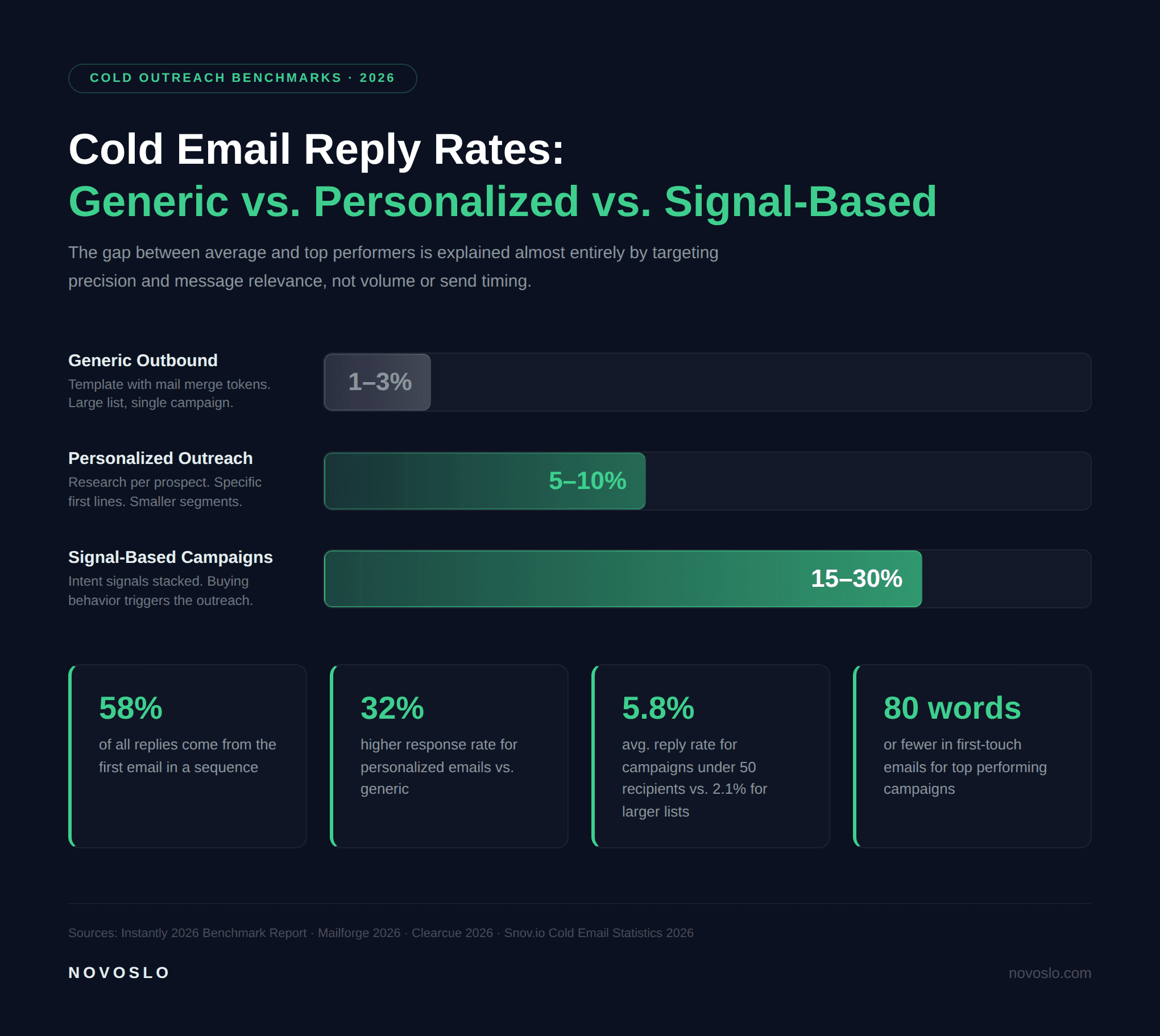
The data supports what most experienced sales leaders already suspect: relevance drives replies more than any other factor. Personalized emails see a 32% higher response rate than generic ones, and campaigns using intent signals such as job postings, funding rounds, competitor engagement, or content activity report reply rates between 15% and 30% when multiple signals are stacked on the same prospect.
Compare that to the 3.4% average reply rate across all cold email, and the math is straightforward. A team sending 500 generic emails to get 17 replies could send 100 signal-informed emails and get 15 to 30 replies. Fewer emails, more responses, lower risk of deliverability problems, and better conversations with prospects who are already thinking about the problem you solve.
Why smaller, more specific campaigns beat large blasts
Campaigns targeting 50 or fewer recipients average a 5.8% response rate compared to 2.1% for larger lists. The reason is that smaller lists tend to be better targeted, and the messaging is more specific to the group's shared context.
Claude Code makes small campaigns economically viable because campaign creation is no longer the bottleneck. You can run 20 campaigns of 25 contacts each instead of one campaign of 500, and each smaller campaign can have its own angle, first lines, and sequence tailored to that specific segment. The infrastructure matters here too. More campaigns mean more sending domains and inboxes to manage, and warm up timelines, SPF, DKIM, and DMARC records still need proper configuration regardless of how smart your copy is.
Common Mistakes When Using Claude Code for Outreach
Over-personalization and when it becomes counterproductive
There is a point where referencing too many details about a prospect stops feeling personal and starts feeling invasive. Mentioning that you saw their LinkedIn post and noticed their company just raised a round is relevant context. Adding that you also noticed they changed their profile picture last Tuesday and their CFO commented on a competitor's article crosses a line.
One or two specific, relevant details per email is enough. The goal is to demonstrate that you understand their situation, not that you've built a dossier on them. Claude Code will include as many details as you give it, so the constraint needs to come from your prompt design and your review process.
If your current copy isn't performing, it's worth taking a step back to audit and rewrite weak cold email copy before adding more personalization on top of a broken foundation.
Skipping deliverability fundamentals
No amount of personalization matters if your emails land in spam. Proper email infrastructure can improve response rates by up to 30%, and the basics haven't changed even though the writing tools have. You still need authenticated domains with SPF, DKIM, and DMARC configured correctly. You still need to warm up new inboxes before sending cold outreach. You still need to keep daily send volume between 25 and 30 per inbox.
Teams adopting Claude Code sometimes get excited about the volume they can now produce and push sending limits beyond what their infrastructure supports. The copy gets better, but deliverability drops, and the net result is the same or worse than before. Build the infrastructure first, then let Claude Code fill it with better content.
What This Means for Your Sales Team
The shift in cold outreach is moving from volume to precision, and that shift is accelerating because the tools now exist to make precision scalable. Claude Code removes the bottleneck that kept most teams stuck on generic outreach: the time it takes to research, segment, and personalize at a level that actually changes reply rates.
The teams getting the best results are the ones treating Claude Code as a research and drafting partner, not a replacement for sales judgment. They still review output, still make strategic decisions about positioning and timing, and still own the relationship once a prospect replies. What they've stopped doing is spending hours on manual research and copy that an AI can handle in minutes.
If your team is still running high volume, low relevance outbound and wondering why reply rates keep declining, the answer is probably not a better subject line. It's a better process. And that process is now accessible to teams of any size.
Novoslo helps B2B companies implement AI into their sales and operations workflows. If you're exploring how to bring Claude Code into your outreach process, talk to us about building a system that fits your team.